
 Worksheets
Carbohydrates Introduction
Total questions: 18
Worksheet time: 9mins
Based on the summary: Carbohydrates are a major energy source, provide 4 kilocalories per gram, typically supply a substantial portion of dietary energy, and glucose is a primary fuel for the body. Which statement most accurately reflects this role of carbohydrates?
Carbohydrates mainly function as structural lipids and provide 9 kilocalories per gram.
Carbohydrates are a key energy source, yielding about 4 kilocalories per gram, with glucose serving as a central fuel.
Carbohydrates are primarily used for vitamin storage and contribute negligible dietary energy.
Carbohydrates supply the least energy in the diet compared to proteins and fats, and fructose is the body’s exclusive fuel.
Which statement best defines saccharides within the context of carbohydrate composition and general formula?
Saccharides are nitrogen-rich molecules that primarily form proteins and follow the general formula (CHN)2.
Saccharides are lipid-derived units composed mainly of long hydrocarbon chains with no fixed formula.
Saccharides are carbohydrate units composed of carbon, hydrogen, and oxygen, commonly represented by a general formula such as (CH2O)n.
Saccharides are phosphate-containing molecules that serve exclusively as coenzymes and lack carbon atoms.
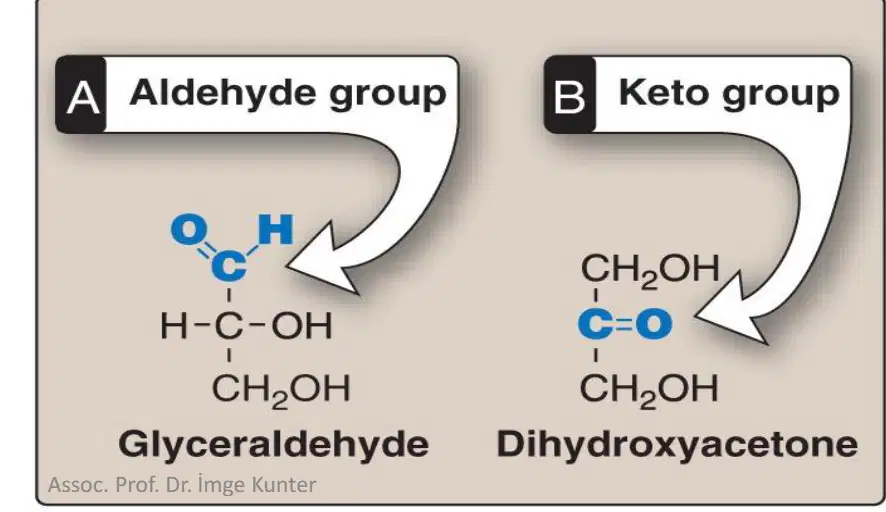
Refer to the diagram showing monosaccharides with aldehyde and keto groups. In photosynthesis, the glucose formed is classified as an aldose. Which functional group in the open-chain form of glucose confirms this classification?
A keto (carbonyl) group located at an internal carbon
An aldehyde (carbonyl) group at the terminal carbon
A carboxyl group at the terminal carbon
An amine group attached to the first carbon
Recall: Which carbohydrate is correctly paired with its generic name based on the number of carbons? Choose the best match.
Glyceraldehyde — hexose
Erythrose — tetrose
Ribose — triose
Glucose — heptose
Which statement best distinguishes monosaccharides, disaccharides, and polysaccharides in the context of carbohydrate types and storage?
Monosaccharides are single sugar units; disaccharides are two linked sugar units; polysaccharides are long chains of many sugar units, some serving as energy storage.
Monosaccharides and disaccharides both contain three sugar units, while polysaccharides contain exactly ten units used only for structural roles.
Monosaccharides are non-carbohydrates; disaccharides are fats; polysaccharides are proteins that store excess carbohydrate as fat.
Monosaccharides and polysaccharides are identical, but disaccharides differ by having an -OH replaced with an -H.
Which statement best distinguishes an aldose from a ketose in monosaccharides?
An aldose contains an aldehyde carbonyl at the end of the chain, whereas a ketose contains a ketone carbonyl within the chain.
An aldose contains only hydroxyl groups, whereas a ketose lacks hydroxyl groups.
An aldose must be a hexose, whereas a ketose must be a triose.
An aldose has no carbonyl group, whereas a ketose has two carbonyl groups.
Which statement best explains why many monosaccharides are readily soluble in water?
They possess multiple hydroxyl groups capable of forming hydrogen bonds with water molecules.
They are exclusively nonpolar, so they disperse in water by hydrophobic interactions.
Their aldehyde or ketone groups always ionize in water, increasing charge-based solubility.
They have long hydrocarbon chains that increase van der Waals attractions with water.
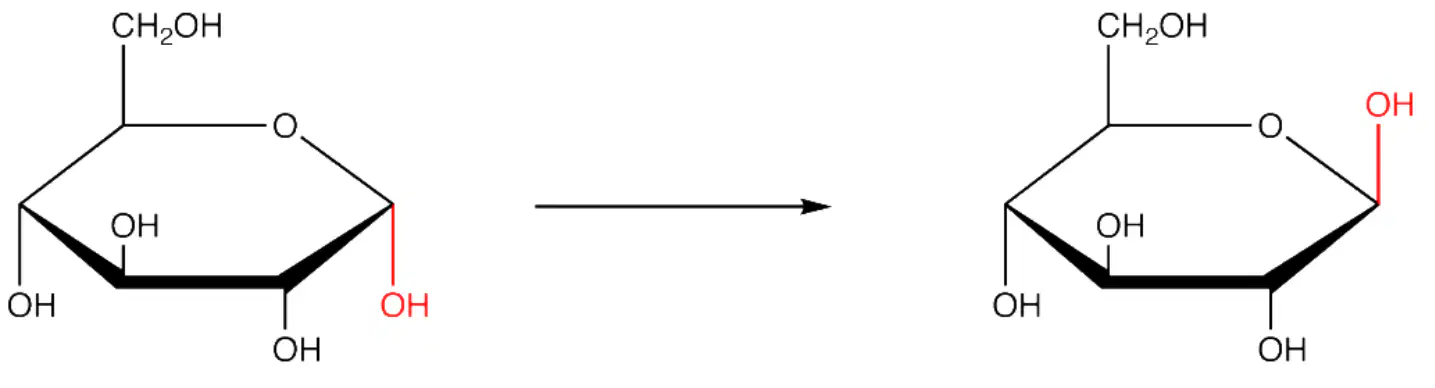
In cyclic monosaccharides, which statement correctly distinguishes the α- and β-forms based on the orientation of the anomeric hydroxyl group (-OH) in the ring?
α-form has the -OH pointing up; β-form has the -OH pointing down
β-form has the -OH pointing up; α-form has the -OH pointing down
Both α- and β-forms have the -OH pointing up
Both α- and β-forms have the -OH pointing down
Polysaccharides are polymers of 10 or more monosaccharide units. Which classification correctly pairs example polymers with the type of monomer variety they contain?
Cellulose and starch are heteropolymers; proteins are homopolymers
Cellulose and starch are homopolymers; proteins and nucleic acids are heteropolymers
Proteins and nucleic acids are homopolymers; cellulose is a heteropolymer
All listed biopolymers are homopolymers because their repeating units are identical
Which statement correctly distinguishes an aldose from a ketose based on the carbonyl group present?
An aldose contains a ketone group; a ketose contains an aldehyde group
An aldose contains an aldehyde group; a ketose contains a ketone group
Both aldoses and ketoses contain aldehyde groups only
Both aldoses and ketoses contain ketone groups only
A monosaccharide classified as a hexose ketose would most appropriately be described as which of the following?
A six‑carbon sugar with an aldehyde carbonyl
A three‑carbon sugar with a ketone carbonyl
A six‑carbon sugar with a ketone carbonyl
A five‑carbon sugar with an aldehyde carbonyl
A sugar with an aldehyde functional group at carbon 1 and a total of four carbons is best described as which type of monosaccharide?
Aldohexose
Aldopentose
Aldotetrose
Ketotetrose
Which description correctly identifies a ketose of six carbons used in many carbohydrate structures?
A ketopentose (5 carbons, ketone)
A ketohexose (6 carbons, ketone)
An aldohexose (6 carbons, aldehyde)
An aldoketose (aldehyde and ketone on the same carbon)
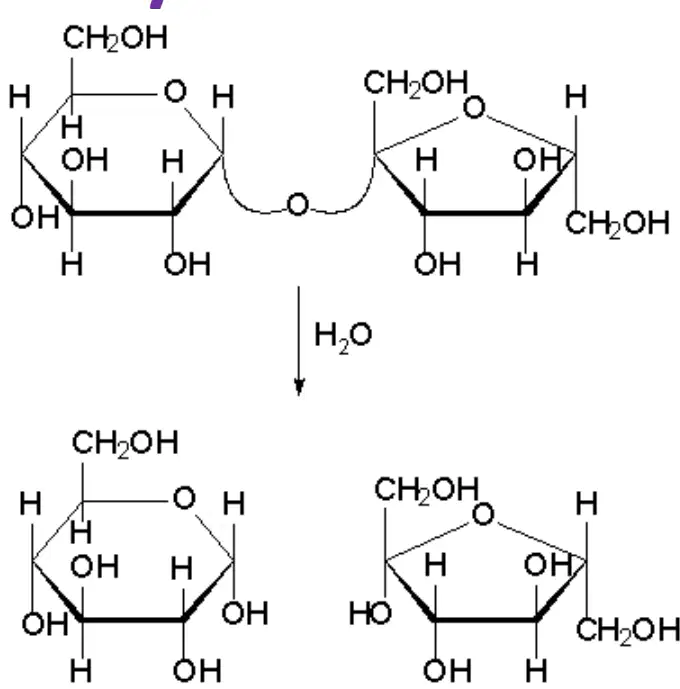
Hydrolysis of a disaccharide adds water to break the glycosidic bond, yielding two monosaccharides. If each product is an aldohexose, which starting disaccharide pairing is most consistent with this outcome?
Two ketopentoses linked by a glycosidic bond
One aldohexose linked to one ketotetrose
Two aldohexoses linked by a glycosidic bond
One aldotetrose linked to one aldohexose
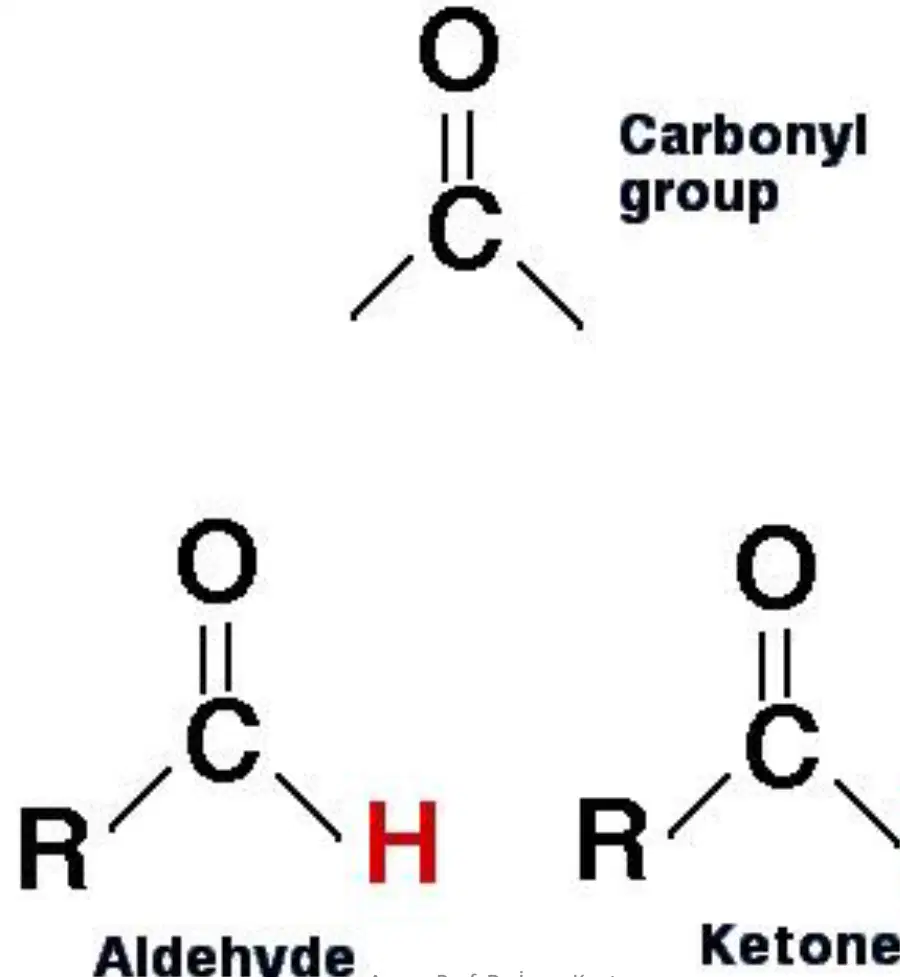
A chiral carbon is central to stereochemistry in sugars. Which definition aligns with the concept of a chiral center in hexose derivatives?
A carbonyl carbon double-bonded to oxygen in aldehydes and ketones.
A carbon attached to four different substituents, leading to non-superimposable mirror images.
A carbon bonded to two identical R groups as shown for ketones.
A carbon that participates only in α-1,4 glycosidic bonds within amylose.
In cyclic monosaccharides, what term is used for the carbon that becomes a new stereocenter upon ring formation and distinguishes the alpha and beta forms?
Anomeric carbon
Chiral side carbon
Glycosidic carbon
Terminal carbon
Glucose can cyclize to a six-membered ring (pyranose) and fructose to a five-membered ring (furanose). Which pairing correctly matches the sugar with the typical ring size formed during cyclization?
Glucose → pyranose; Fructose → furanose
Glucose → furanose; Fructose → pyranose
Both Glucose and Fructose → pyranose
Both Glucose and Fructose → furanose
Which statement best explains why monosaccharides are classified as reducing sugars?
Their carbonyl carbon can be oxidized to a carboxyl group, reducing metal ions in tests like Fehling’s and Benedict’s.
They contain only acetal groups that cannot interconvert with open-chain forms, making them strong oxidants.
They form nonreactive glycosidic bonds that prevent electron transfer to Cu2+ in Fehling’s solution.
They are unable to act as hemiacetals and therefore donate protons readily in aqueous solution.

