
 Worksheets
Pre-Alg Unit 2 Test Review for November 6th
Total questions: 65
Worksheet time: 5hrs 25mins
A(3,3) B(6,6) C(9,3)
An enlargement or a reduction
Turns around the graph


Which is true about the scale factor when a figure is enlarged?
The scale factor is zero.
The scale factor is 1.
The scale factor is larger than 1.
The scale factor is smaller than 1.

What is the scale factor?
k = 2
k = 1/2
k = 4
k = 1/4

Figure S, the small arrow, was dilated with the origin as the center of dilation to create Figure T, the large arrow. Which rule best represents the dilation that was applied to Figure S to create Figure T?


Quadrilateral ABCD was dilated with the origin as the center of dilation to create quadrilateral A'B'C'D'. Which rule best describes the dilation that was applied to quadrilateral ABCD to create quadrilateral A'B'C'D'?
A. (x, y) --> (2x, 2y)
B. (x, y) --> (x + 2, y - 2)
C. (x, y) --> (0.5x, 0.5y)
D. (x, y) --> (x - 0.5, y - 1)

Rectangle ABCD and A'B'C'D' are shown on the coordinate plane. Which algebraic representation shows how the coordinates of rectangle A'B'C'D' were found?


What is the rule for this transformation?
(x, y) --> (2x, 2y)
(x, y) --> (1/2x, 1/2y)
(x, y) --> (-2x, -2y)
Not here


Which is true about the scale factor when a figure is enlarged?
The scale factor is zero.
The scale factor is 1.
The scale factor is larger than 1.
The scale factor is smaller than 1.
What is the scale factor?
k = 2
k = 1/2
k = 4
k = 1/4
Figure S, the small arrow, was dilated with the origin as the center of dilation to create Figure T, the large arrow. Which rule best represents the dilation that was applied to Figure S to create Figure T?
Quadrilateral ABCD was dilated with the origin as the center of dilation to create quadrilateral A'B'C'D'. Which rule best describes the dilation that was applied to quadrilateral ABCD to create quadrilateral A'B'C'D'?
A. (x, y) --> (2x, 2y)
B. (x, y) --> (x + 2, y - 2)
C. (x, y) --> (0.5x, 0.5y)
D. (x, y) --> (x - 0.5, y - 1)
Rectangle ABCD and A'B'C'D' are shown on the coordinate plane. Which algebraic representation shows how the coordinates of rectangle A'B'C'D' were found?
What is the rule for this transformation?
(x, y) --> (2x, 2y)
(x, y) --> (1/2x, 1/2y)
(x, y) --> (-2x, -2y)
Not here

What is the scale factor going from the smaller to the larger triangle?
1/3
1
3
6

If these two images are similar, what is X?
10
12
15
What is a scaled copy?
A scaled copy is a copy of a figure where the new figure is ALWAYS larger than the original.
A scaled copy is a copy of a figure where the new figure is ALWAYS smaller than the original.
A scaled copy is a copy of a figure where every length in the original figure is multiplied by the same number.

Choose all the corresponding parts. (Select all that apply)
Segment AC and Segment DF
Angle B and Angle F
Segment BC and Segment DE
Angle A and Angle D
Segment AB and Segment DE

What angle corresponds with Angle A?
Angle B
Angle C
Angle P
Angle Q
Angle R

What is the scale factor to go from the original triangle to Copy 1?
+ 4
× 21
÷ 2
× 2

CB has a length of 2. It's corresponding side (UT) has a length of 6. What is the scale factor to go from the smaller polygon to the larger polygon?
3
31
4
6

What scale factor was used to produce the image?
2/3
3/2
1/2
1
If two triangles are similar it means the the corresponding angles are?
Congruent
Proportional
Parallel
Opposite

The two triangles are similar. Solve for x.
x=3
x=2
x=98
x=4.5

ΔBAC ∼ ΔEDF
45°
35°
22°
113°
If a 12-meter-tall airplane hanger casts a 18-meter shadow at the same time a parked jet casts a 6-meter shadow, how tall is the jet?
36 meters
9 meters
4 meters
A figure is dilated by a scale factor of 4. Which of the following statements about the figure must be true?
The perimeter and area are both multiplied by 4.
The perimeter is multiplied by 4 and the area is multiplied by 16.
The perimeter and area are both divided by 4.
The perimeter is multiplied by 16 and the area is multiplied by 4.

If the scale factor is 5, how times larger will the area of the big square be compared to the smaller square?
5
20
25

The perimeter of the larger square is 2 times larger than the smaller square.
True
False

The area of the larger square is __________ times larger than the area of the smaller square.
1/2
1
2
4

What is one way to determine how much the area would increase using a scale factor of 3?
take the scale factor and square it to get 3x3=9
add all of the sides together then multiply by 3
multiply the area of the smaller rectangle by 3

How much did the angles increase in the scale copy?
They are twice as large
They are 4 times as large
Angles do not change in scale copies

To perform a dilation you need
scale factor
center of dilation
a point to dilate
degree of rotation
A scale factor bigger than one makes a figure
shrink
enlarge

Which scale factor is an example of a reduction?
k = 1/2
k = 1
k = 3/2
k = 2.5
Which scale factor is an example of an enlargement?
k = 1/2
k = 1
k = 3/2
k = 0.75

Dilations always increase the length of line segments.
Dilations take perpendicular lines to perpendicular lines.
Dilations of an angle are congruent to the original angle.
Dilations increase the measure of angles.
Dilations of a triangle are similar to the original triangle.
Which pair of triangles must be similar?
Triangles 1 and 2 each have a 35 degree angle.
Triangle 3 has a 50 degree angle and a 25 degree angle. Triangle 4 has a 50 degree angle and a 105 degree angle.
Triangle 5 has a 30 degree angle and a 90 degree angle. Triangle 6 has a 30 degree angle and a 70 degree angle.
Triangles 7 and 8 are both isosceles. They each have a 40 degree angle.

Hint: Remember OD x SF = DD (find the scale factor)
8
12.5
2.68
0.67

Which one of the following could be a coordinate for point C?
(2, -2)
(-4, -6)
(6, 2)
(0, 0)
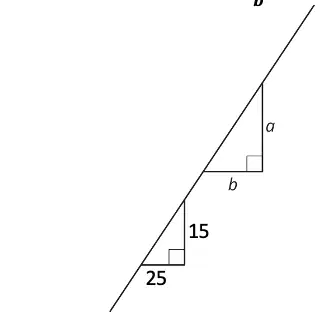
The 2 triangles are similar. Find the value of a/b. Record your final answer as a fraction or improper fraction.
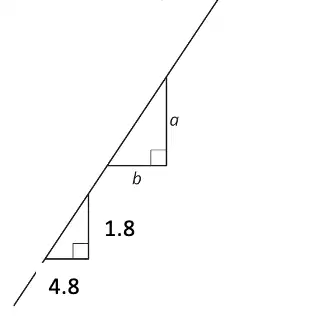
The 2 triangles are similar. Find the value of a/b. Record your final answer as a fraction or improper fraction.
3/8
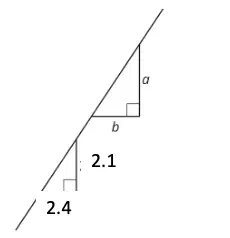
The 2 triangles are similar. Find the value of a/b. Record your final answer as a fraction or improper fraction.
4/5
7/8
8/9
6/7
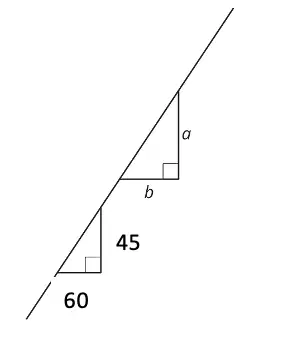
The 2 triangles are similar. Find the value of a/b. Record your final answer as a fraction or improper fraction.

