
 Worksheets
Practice Questions for Grade 9 Science's first Chemistry Test
Total questions: 164
Worksheet time: 3hrs 13mins
Which statement best explains why WHMIS legislation was implemented in Canada?
To reduce ill-health caused by hazardous materials in workplaces through federal, provincial, and territorial action
To standardize lab equipment across schools
To increase household product sales through clearer labels
To eliminate the need for Material Safety Data Sheets (MSDS)
Under WHMIS, which requirement applies to suppliers of hazardous materials?
Provide verbal instructions only when requested
Label hazardous materials properly and include a Material Safety Data Sheet (MSDS) with each shipment
Allow workers to handle materials without training
Ship materials in unmarked containers to reduce confusion
According to WHMIS, what is an employee’s primary responsibility regarding hazardous materials?
To design new hazard symbols
To write government legislation
To perform inspections of other workplaces
To learn about hazardous products and the safe use and handling of these materials
Which pair lists products not covered under WHMIS legislation?
Compressed gases and oxidizing materials
Cosmetics and consumer products subject to the Hazardous Household Products Act
Corrosive materials and dangerously reactive materials
Flammable and combustible materials and biohazardous infectious material
Which action aligns with general laboratory safety procedures?
Taste unknown materials to identify them
Return unused chemicals to their original containers immediately
Wear protective clothing and closed shoes during activities; tie back long hair
Pour liquids while holding containers close to the face to prevent spills
Which statement correctly describes qualitative versus quantitative properties of matter?
Qualitative properties are measured with numbers such as mass and density; quantitative properties use descriptive words like red or brittle
Qualitative properties use descriptive words (e.g., soft, shiny, transparent); quantitative properties are expressed with numbers from measurements (e.g., 100°C, 28 g, 1 g/cm³)
Both qualitative and quantitative properties are based on visual observations only
Quantitative properties rely on opinions, while qualitative properties rely on instruments
Which statement best defines a physical property of matter?
A characteristic observed using senses without changing chemical makeup
A behavior describing how substances form new substances during reactions
A trait that depends only on the amount of sample present
A measurement that always requires a chemical test to observe
Which is an example of a qualitative physical property?
Mass
Color
Density
Concentration
What is a chemical property?
A property describing how a substance can change when interacting to form new substances
A property measured without altering chemical composition
A property such as mass or volume that depends on sample size
A reversible change in state like freezing or condensation
Which statement correctly distinguishes intensive from extensive properties?
Intensive properties depend on quantity of matter; extensive properties do not
Intensive properties do not depend on quantity of matter; extensive properties do
Both intensive and extensive properties depend on sample size
Neither intensive nor extensive properties depend on sample size
Which of the following is an intensive property?
Volume
Mass
Density
Size
Which description matches ductility?
Ability to dissolve a solute
Ability to be bent into sheets
Ability to draw an object into a wire
Measure of mass per unit volume
Which of the following is an example of a physical change?
Rusting iron
Burning wood
Cutting paper
Tarnishing silver
Recall: Which statement best defines corrosion as presented in the lesson?
Corrosion is a rapid burning of metals in air.
Corrosion is a slow chemical change that occurs when a metal reacts with oxygen in the air to form a metal oxide.
Corrosion is the physical wearing down of metals due to friction.
Corrosion is the mixing of two metals to create an alloy.
Recall: What causes iron to rust, and what substance forms as a result according to the lesson?
Exposure to heat forms black iron sulfide.
Contact with nitrogen gas forms gray iron nitride.
Reaction with oxygen and other dissolved substances in water forms reddish-brown iron oxide.
Absorption of carbon dioxide forms white iron carbonate.
Skill/Concept: Why do some people choose aluminum ATV/utility trailers over wood or galvanized steel ones based on the lesson?
Aluminum trailers are lighter but corrode quickly in water.
Aluminum forms a strong oxide layer that is unaffected by water, protecting the metal from further corrosion.
Galvanized steel reacts with oxygen to create a protective plastic coating.
Wood naturally produces an oil that prevents oxidation of nearby metals.
Strategic Thinking: A car owner lives in a snowy area where roads are salted in winter. Based on the lesson’s guidance, which combined actions would best reduce rusting on the vehicle?
Wash the vehicle regularly in winter and keep it under cover when not in use.
Avoid washing to keep the paint dry and park outside for ventilation.
Never apply wax and wipe only the windows.
Use water on all metal surfaces and skip undercoating.
Which statement best defines pyrotechnicians in the context of fireworks?
Technicians who inspect metal structures for rust using physical tests
Specialists who create fireworks displays using chemistry and carefully controlled explosions
Engineers who design launch platforms for rockets without using chemical reactions
Artists who choreograph light shows by programming electronic LEDs
Fireworks are typically designed with three explosive stages inside the casing. Which sequence matches their intended timing and purpose?
First a loud bang and flash, then lift into the air, finally color bursts
First ignition of salts, then oxidizer removal, finally fuse burnout
First color bursts, then lift into the air, finally storage stabilization
First lift the shell into the air, then one or more color bursts, finally a loud bang and flash after the color burst
Why must the choice of oxidizer in a firework be made carefully by the technician?
An incorrect oxidizer will make the fuel too expensive to obtain
The oxidizer might react with metallic salts during storage and cause a dangerous explosion
Oxidizers are only effective at very high altitudes, reducing ground performance
Using any oxidizer prevents the fuses from igniting at the right time
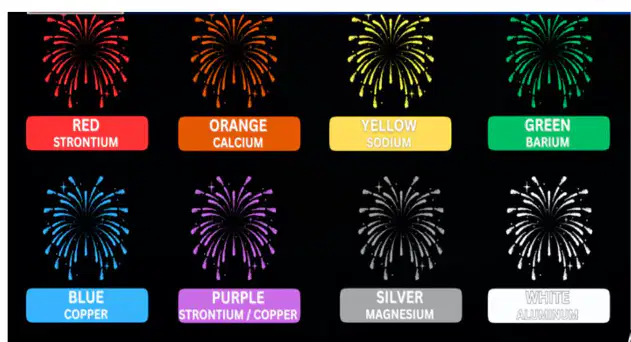
Match each metallic salt to the typical firework color it produces, based on the diagram of labeled firework bursts.
Strontium — green; Barium — red; Copper — silver
Calcium — orange; Sodium — yellow; Magnesium — silver
Copper — purple; Strontium/Copper — blue; Aluminum — green
Barium — blue; Sodium — orange; Strontium — yellow
What does the Particle Theory say about forces between particles?
No forces exist between particles.
Only repulsive forces exist between particles.
There are forces of attraction between particles; stronger forces keep particles closer.
Forces act only on particles in solids, not in liquids or gases.
Which change increases both kinetic energy and particle speed in a substance?
Decreasing the temperature of the substance
Keeping the temperature constant
Increasing the temperature of the substance
Removing forces of attraction between particles
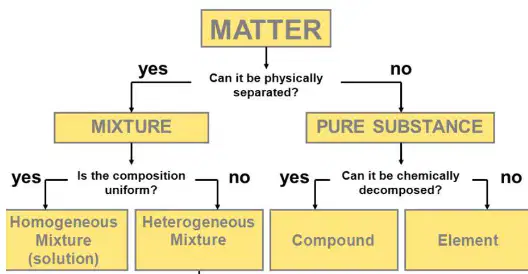
In the flowchart, a sample that cannot be physically separated is classified as which main category?
Mixture
Pure substance
Solution
Heterogeneous material
Which statement describes a pure substance?
Contains only one type of particle and cannot be separated into other substances by physical means.
Contains two or more types of particles and can be separated by physical means.
Has varying composition throughout and looks like many substances.
Is formed only by mixing elements without chemical bonding.
Which choice correctly explains why compounds can be broken down into elements?
They are formed by physical mixing and can be filtered.
Atoms of different elements are chemically joined; chemical means can break these bonds.
Compounds are single atoms that can split spontaneously.
Compounds have non-uniform composition, allowing mechanical separation.
Which example best represents a homogeneous mixture (solution)?
Pile of salt and pepper
Sugar dissolved in water
Mixture of nuts and bolts
Granola cereal
Which reasoning best supports classifying salt dissolved in water as a homogeneous mixture?
Its composition is uniform throughout and components are not distinguishable.
It contains only sodium atoms.
Its components are visible and unevenly distributed.
It can be chemically decomposed into sodium and chlorine easily.
Which classification task requires using evidence rather than just recall: decide if milk from a farmer’s tank is homogeneous or heterogeneous. What supports the correct choice?
It looks like a single pure substance because it is white.
Its varying composition with visible components supports heterogeneous classification.
Its ability to be chemically decomposed supports compound classification.
Its lack of particles supports element classification.
In classifying matter, which two main categories are used?
Elements and compounds
Solids and gases
Pure substances and mixtures
Solutions and mechanical mixtures
Changes in size , shape , form , or state of matter in which the identity of the matter stays the same are examples of
physical properties.
physical changes.
Characteristics of matter that you can observe or measure without changing the identity of matter are
physical properties.
physical changes.
Melting, breaking, freezing, boiling, and dissolving sugar in water, etc. are examples of
physical properties.
physical changes.

Copper can conduct electricity. This is an example of a
physical property
physical change

Aluminum foil has a high luster which means it is very shiny. This is an example of a
physical property
physical change
What is a physical change?
A change in which the composition and quantity of each substance does not change
The formation of a new substance from one or more substances that undergoes a reaction
A chemical reaction
A change in color or smell
What is the main difference between the particles in solids, liquids, and gases?
Particles in solids are tightly packed, while particles in liquids and gases are more spread out
Particles in liquids are tightly packed, while particles in solids and gases are more spread out
Particles in gases are tightly packed, while particles in solids and liquids are more spread out
Particles in solids, liquids, and gases are all tightly packed
What is the definition of matter?
Everything that has mass and takes up space
Energy
Space
Matter is the sound produced by musical instruments
What are the three states of matter?
Solid, liquid, gas
Wood, water, air
Melting, freezing, evaporation
Physical, chemical, changes
What is the scientific term for the change of state from solid to liquid?
Melting
Freezing
Evaporation
Sublimation
What is a chemical change?
A change in which the composition and quantity of each substance does not change
The formation of a new substance from one or more substances that undergoes a reaction
A change in state between solid, liquid, and gas
A change in size or shape
How can you determine if a chemical change has occured?
By the production or absorption of heat
A precipitate (solid) is formed from two liquids
A new smell
All of the above
Which of the following is NOT a physical property?
Solubility
Ductility
Flammability
Viscosity

Is toasting bread a physical or chemical change?
Physical
Chemical

What is a physical change?
A change that does not affect the chemical properties of a substance
A change that affects the chemical properties of a substance

What is a physical property of these strawberries?
Red
Rotten
Flammable

What is a chemical property of paper?
Flammable
White
Light

What is a chemical change?
A change that alters the physical and chemical properties of a substance
A change of state (melting, freezing, etc.)

Is an ice cream cone melting a physical or chemical change?
Physical
Chemical

Is crumpling a piece of paper a physical or chemical change?
Physical
Chemical

Reacts with acid: Chemical or Physical Property
Sour taste: Chemical or Physical Property
Melting point: Chemical or Physical Property
A student heats a beaker of water with a hot plate and over time, the water begins to bubble, the volume decreases and vapor is visible. This is an example of a ____________ change.
Chemical
Nuclear
Physical
Musical
When lithium metal is dropped into a container of water, the lithium sparks and fizzes and the water begins to bubble violently. The conclusion that can be drawn from that is:
A new substance is created because this is a chemical change.
No new substances are created because there is a chemical change.
No new substances are created because this is a physical change.
A new substance is created because this is a physical change.
When two liquids are mixed and a solid is formed, the new solid is called a ________________.
Levitate
Precipitate
Palpitate
Bad date

This is a __________ change.
Physical
Metaphysical
Chemical
Logical

Is this an example of a physical or chemical change?
Physical
Chemical
flammability of a substance
physical change
physical property
chemical change
chemical property
inflating a tire
physical change
physical property
chemical change
chemical property
freezing point
physical change
physical property
chemical change
chemical property
drawing copper into a wire
physical change
physical property
chemical change
chemical property
corrosion of a bicycle frame
physical change
physical property
chemical change
chemical property
fragrance of a flower
physical change
physical property
chemical change
chemical property
boiling water
physical change
physical property
chemical change
chemical property
a characteristic that can be observed without changing the substance
physical change
physical property
chemical change
chemical property
boiling an egg
physical change
physical property
chemical change
chemical property
milk going sour
physical change
physical property
chemical change
chemical property
sugar dissolving in water
physical change
physical property
chemical change
chemical property
Properties that can only be observed or measured by changing the CHEMICAL IDENTITY of a substance.
chemical property
physical property
chemical change
physical change
Properties that can be observed directly or measured WITHOUT changing the chemical identity of the substance.
chemical properties
physical properties
chemical changes
physical changes
Mass, volume, shape, size, color, luster, and hardness are all examples of
chemical properties
physical properties
chemical changes
physical changes
Toxicity, flammability, combustibility, and radioactivity are examples of
chemical properties
physical properties
chemical changes
physical changes
Reactivity is a
chemical property
physical property
Viscosity is a
chemical property
physical property
Solubility is a
physical property
chemical property
Density is a
physical property
chemical property
Cutting, coloring, crushing, melting, boiling and molding (shaping something) are example of
chemical changes
physical changes
Burning, rusting, cooking, and decomposing are examples of
physical changes
chemical changes
Rusting is a _____________ process.
Mechanical
Chemical
Physical
Rusting is a special term, given to the corrosion metal is... .
Au
Pt
Fe
Ag
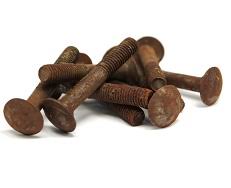
What two things cause Iron to Rust ?
Air and Oxygen
Oxygen and Water
Water and Carbon dioxide
Carbon dioxide and Air
Which of the following items will rust?
A plastic bottle
A gold ring
An iron bridge
A cardboard box
Do all metals rust?
Yes
No
Fill in the blanks;
Iron + __________ + __________ = Iron oxide
oil + water
water + carbon dixoide
oxygen + oil
water + oxygen
Why is rusting a problem?
It looks ugly, no one likes orange
It makes iron really bendy
It makes iron lose its strength
Which of the following is the best way to prevent an engine from rusting?
Galvanising
Electroplating
Oiling
Painting
What are the three ways to protect against corrosion?
Painting , Sacrificial Metal, Scrubbing
Liming, Sacrificial metals, Galvanizing
Liming, Sacrificial metals, Scrubbing
Painting , Sacrificial Metal, Galvanizing
What is the proper turn for the break down of metals?
Corrosion
Rusting
Breakdown
Degradation
What does WHMIS stand for?
Workplace Hazardous Materials Information System
Workplace Hazard Materials Information System
White House Materials Information System
WHMIS
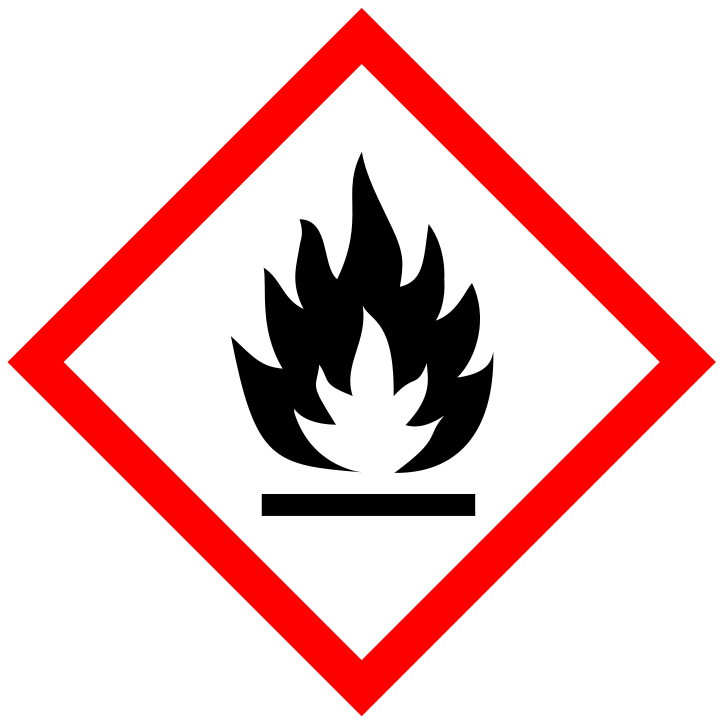
What does this symbol mean?
Flammable
Explosives
Oxidising Agent
Corrosive
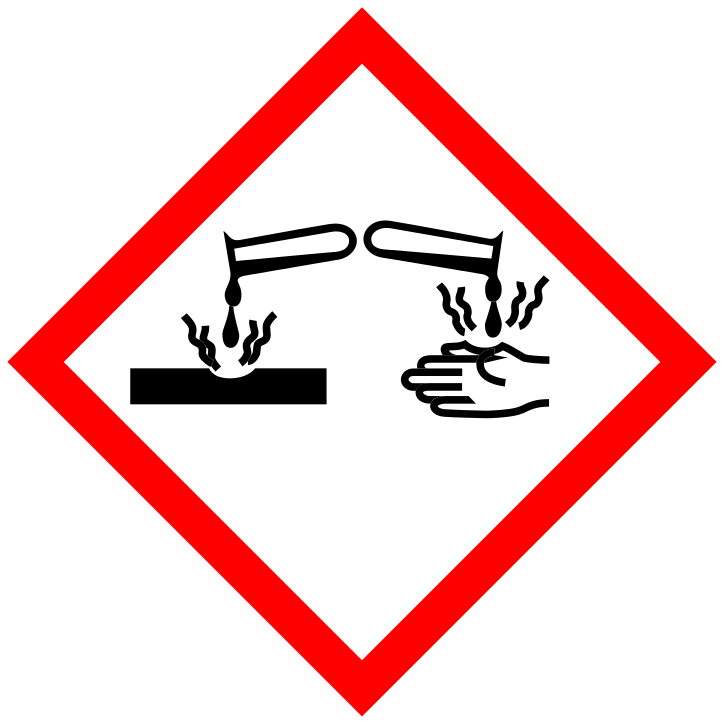
What does this Symbol means?
Corrosive
Irritant
Poison
Carcinogenic

What does this symbol mean?
Flammable
Oxidising Substance
Gases Under Pressure
Explosive

What does this symbol means?
Corrosive
Bottle under Pressure
Gases Under Pressure
Exploding Bottle

What does this symbol mean?
Corrosive
Biohazardous
Oxidizing
Environmental
If you do not understand what to do in the lab activity, you should
skip it and go on to the next part.
ask the instructor before continuing
try different things until something works
clean up all of the equipment


When should safety goggles be worn?
at all times in the lab
only when you want to
when liquids could splash into your eyes OR when using glassware
Long hair in the laboratory must be
A. cut short.
B. held away from the experiment with one hand.
C. always neatly groomed.
D. tied back with a hair elastic
Workplace Hazardous Materials Information System (WHMIS) provides information through
labels
Material Safety Data Sheets (MSDS)
education and training
all of the above
Which of the following IS true?
food and beverages are not allowed in the lab
excess noise and carelessness will result in excellent result and prevent accidents
it is better to work alone in the lab
only serious accidents need to be reported to your teacher
Before leaving the science lab, you should
clean your work area and equipment.
return all equipment to the proper storage area.
wash your hands with soap and water.
All of the above.
Laboratory clothing from a safety point of view should follow these guidelines EXCEPT for
loose jewelry must be removed when in the science lab
where infectious materials are present, lab coats and gloves are essential
open toed shoes, such as sandals, can be worn
long hair is to be tied back
What should you do first when working in a lab for the first time?
Identify the location of the safety equipment
Read the lab manual
Start your experiment immediately
Ask for help from a colleague
What is the purpose of a fire blanket?
To cover lab equipment
To extinguish large fires
To protect from chemical spills
To extinguish small flames and help someone whose clothing is on fire
What is the function of a chemical fume hood?
To provide extra lighting
To protect from toxic vapors
To store chemicals safely
To extinguish fires


What does WHMIS stand for?
Workforce Housing Materials Information System
Work Height Managing Information Symbols
Wokrplace Hazardous Material Information System
Workplace Material System
What does HHPS stand for?
Household Housing Product Sytem
Hazardous Household Product Symbols
High Height Product System
Hazardous Household Product System

What does this HHPS picture mean?
Corrosive
Explosive
Inflammable
Poison

What does this HHPS picture mean?
Corrosive
Explosive
Flammable
Poison
Which symbol should be on a product that could cause burns to skin and clothing?


Which symbols should be on a product that is poisonous and could cause death?
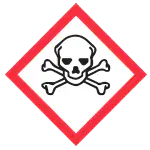
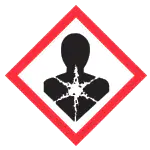
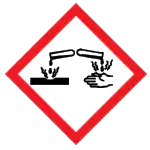

In HHPS, what do the three shapes mean?
Aware, Caution, Danger
Danger, Aware, Warning
Caution, Warning, Violent
Caution, Warning, Danger

What does this HHPS picture mean?
Corrosive
Explosive
Flammable
Poison

What does this HHPS picture mean?
Corrosive
Explosive
Flammable
Poison

What does this WHMIS stand for?
Compressed Gas
Flammable and Combustible Material
Oxidizing Material
Poisonous and Infectious Materials: Immediate and Serious Effects

What does this WHMIS picture mean?
Poisonous and Infectious Material: Other toxic effects
Poisonous and Infectious Material: Biohazardous Infectious
Corrosive Material
Dangerously Reactive

What does this WHMIS picture mean?
Poisonous and Infectious Material: Other toxic effects
Poisonous and Infectious Material: Biohazardous Infectious
Corrosive Material
Dangerously Reactive

Fireworks look blue thanks to...
Calcium (Ca) salts
Sodium salts
Barium (Ba) salts
Copper (Cu) salts
The component of a firework that makes the combustion brighter by bringing oxygen is...
The fuel
The oxidizer
Metals
The component of a firework that makes different colors is...
The fuel
The oxidizer
The metals
Black powder is made of...
Sugar, oxygen and iron
Charcoal, sulfur and potassium nitrate
Charcoal, iron and potassium nitrate
Sulfur, charcoal and sugar

Are made from a combination of 2 or more different elements...
Molecules
Compounds




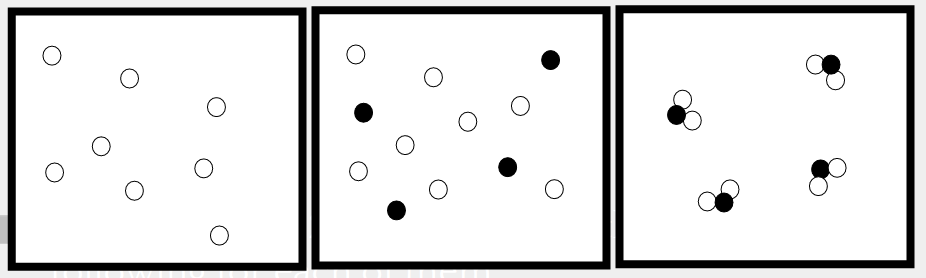
True or False: elements AND compounds are pure substances.
True
False
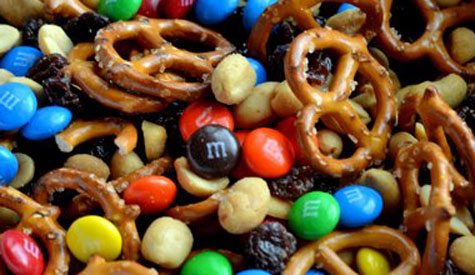
In which mixture can you see all of the parts?
homogeneous
heterogeneous
In which mixture can you not see all of the parts?
homogeneous
heterogeneous
Solutions are ___________ mixtures.
Solid
Homogenous
Heterogeneous
Gas
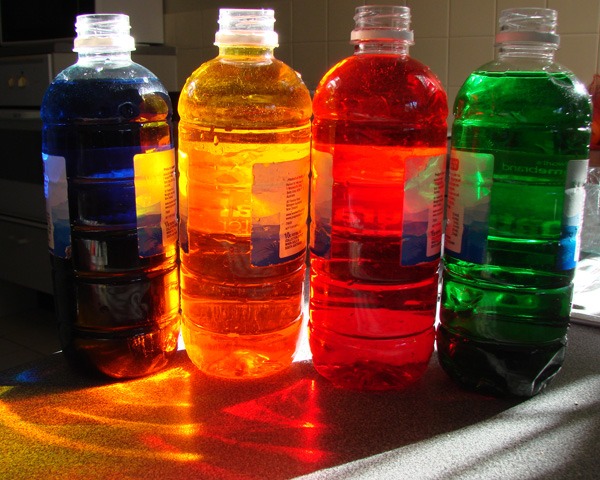
Substances in a mixture can be separated by physical methods.
TRUE
FALSE
A mixture that is uniform in composition; components are evenly distributed and not easily distinguished
homogeneous
heterogeneous
Capable of being dissolved
malleable
soluble
flexible
realiable
A mixture that is not uniform in composition; components are not evenly distributed throughout the mixture
homogeneous
heterogeneous
Material composed of two or more elements or compounds that are physically mixed together but not chemically combined
element
compound
mixture
A substance that cannot be broken down into simpler substances
element
compound
mixture
A pure substance made of only one kind of atom.
element
mixture
compound
A substance made up of atoms of two or more different elements joined by chemical bonds.
element
mixture
compound
___ and ___ are considered to be pure substances.
mixtures and elements
compounds and mixtures
mixtures only
elements and compounds

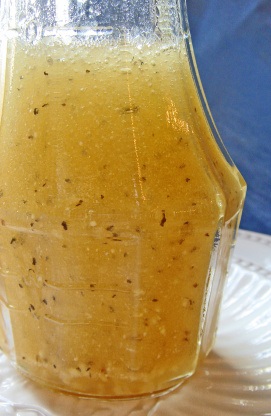
What type of mixture is this?
heterogeneous
homogeneous
A (a) is a material made from atoms of two or more combined elements.
If all the atoms in a sample of matter are alike, that kind of matter is a(n) (a)


This diagram represents...
An element
A molecule
A compound
A mixture of elements and compounds

