
 Worksheets
Chapter 3-Essential Components of Intelligent Agents
Total questions: 89
Worksheet time: 45mins
What is the primary purpose of knowledge representation in intelligent agents?
To store and organize information for decision-making
To increase the speed of hardware processing
To reduce the size of the agent
To improve network connectivity
How does generative AI enhance intelligent agents?
By giving agents more powerful abilities to understand their surroundings and interact meaningfully
By reducing the need for reasoning processes
By eliminating the need for learning mechanisms
By making agents dependent on human input
Why is decision-making and planning important in agentic systems?
It guides agents in choosing the right actions to take
It increases the physical strength of agents
It allows agents to communicate wirelessly
It helps agents store more data
Suppose you are designing an intelligent agent for a complex environment. Which component would be most critical for enabling the agent to learn from its experiences and adapt over time?
Learning mechanisms for adaptive agents
Reasoning in intelligent agents
Technical requirements
Code file management
Which of the following best describes the purpose of knowledge representation in intelligent agents?
To encode an agent’s understanding of its environment for reasoning and decision-making
To increase the speed of data transmission between agents
To reduce the amount of memory used by an agent
To prevent agents from interacting with their environment
How can knowledge representation be formally defined?
As the method of structuring and organizing data for effective utilization by an agent
As the process of encrypting data for security purposes
As the way to store data in a database
As the method of deleting unnecessary information
Which of the following is a key feature of semantic networks?
They use graph-based structures composed of nodes and labeled edges
They rely solely on numerical data
They are limited to representing only physical objects
They cannot represent relationships between concepts
In a semantic network, which relationship type is used to indicate that a "Dog" is a type of "Animal"?
is-a
can-be
has-part
belongs-to
Which statement best explains the flexibility of semantic networks compared to strict logic or rigid database schemas?
Semantic networks allow any concept to be associated with any other concept through an appropriate semantic relation
Semantic networks only allow predefined relationships between concepts
Semantic networks require all data to be numeric
Semantic networks cannot represent nuanced domains
Why are semantic networks considered intuitive for representing knowledge in intelligent agents?
They naturally capture rich, diverse relationships and interconnections in a graphical form
They only use text-based lists for relationships
They restrict the number of relationships between concepts
They do not allow for graphical representation
Which relationship type is used to connect a disease to its symptoms in a semantic network?
causes
is-diagnosed-by
interacts-with
can-be
What is the main advantage of semantic networks in knowledge representation for intelligent agents?
They only store raw data
They allow for generalization and inheritance of properties
They are limited to representing single concepts
They do not support reasoning
Which logical method is mentioned as integrating well with semantic networks for deductive reasoning?
Boolean logic
Fuzzy logic
First-order logic
Modal logic
How can an agent infer new facts using a semantic network?
By ignoring relationship paths
By traversing the graph and chaining sequences of relations
By deleting nodes
By only considering isolated nodes
Suppose a semantic network specifies that "dogs are a subclass of animals" and "animals breathe air." What can an agent infer about dogs?
Dogs do not breathe air
Dogs breathe air
Dogs are not animals
Dogs can fly
Why are semantic networks considered a powerful formalism for knowledge representation in real-world domains?
They only represent isolated facts
They support interconnected concepts and relation composition
They do not allow inheritance
They are limited to numerical data
What is the term used for the data structures that store knowledge about objects, situations, or events in the frame knowledge representation paradigm?
Frames
Tables
Graphs
Lists
How does the hierarchical organization of frames help in knowledge storage?
By allowing inheritance and avoiding redundant attribute definitions
By increasing the number of attributes in each frame
By making frames more complex to understand
By storing all information in a single frame
A key advantage of frames in representing knowledge is that (a) .
Suppose you are designing a frame for "Electric Car" as a sub-frame of "Car Frame." Which attributes would you inherit, and what new attributes might you add?
Inherit: Make, Model, Year, Color, Fuel type, Fuel efficiency; Add: Battery capacity, Charging time
Inherit: Wheels, Passengers; Add: Engine size, Tire pressure
Inherit: Type, Passengers; Add: Sunroof, Trunk size
Inherit: Fuel efficiency, Color; Add: Number of doors, Seat material
If a "Car Frame" contains a method for calculating fuel efficiency, how could this procedural knowledge be useful for intelligent agents?
It allows agents to dynamically compute fuel efficiency for different car instances
It helps agents ignore fuel efficiency data
It restricts agents to only use factual knowledge
It prevents agents from updating car attributes
Which of the following is NOT a real-world application area where frame representations are widely used?
Natural language processing
Expert systems
Object-oriented programming
Weather forecasting
In object-oriented programming, what do classes in OOP languages essentially represent according to frame representations?
Frame-like structures encapsulating attributes and methods
Only data storage units
Simple algorithms
Unstructured code blocks
What is the main advantage of the frame knowledge representation formalism for intelligent agents?
It is the fastest method for data processing
It offers an efficient, structured, and human-compatible way to capture rich conceptual information
It requires no prior knowledge
It is only suitable for robotics
Which logical language is used to encode facts, rules, and axioms about a domain in logic-based representations?
Propositional logic
First-order logic
Specialized modal/temporal logics
All of the above
What does the universal quantifier ∀x mean in logic-based representations?
For some x
For all x
For no x
For one x
Translate the statement "All humans are mortal" into first-order logic.
∀x (Human(x) → Mortal(x))
∃x (Human(x) ∧ Mortal(x))
Human(x) ↔ Mortal(x)
∀x (Mortal(x) → Human(x))
The logical disjunction symbol "∨" represents (a) .
Match each logical connective with its correct symbol in propositional logic.
∧
and
∨
or
→
implies
¬
not
Given the statement "Eventually, the system will stabilize," which type of logic is most appropriate for modeling this?
Propositional logic
First-order logic
Temporal logic
Modal logic
Explain how frame representations in computer vision help object detection systems.
By using frame hierarchies to identify and describe visual entities based on attributes such as shape, color, texture, and so on
By ignoring all visual attributes
By only focusing on text data
By using random guessing
Which operator in temporal logic means "eventually"?
◇
□
∧
→
Match each characteristic with the type of knowledge representation it best describes.
Their formal rigor and strong theoretical properties
Logic-based representations
Their ability to store large amounts of data
Database systems
Their intuitive graphical interfaces
Graphical knowledge representation tools
Their compatibility with all programming languages
Language-agnostic representations
Which application uses rule-based expert system engines as theorem provers over a logical knowledge base?
Expert systems
Database systems
Semantic web
Automated reasoning
Match the following mathematical foundations with their use in relational databases.
Relational algebra/calculus
Used as the primary mathematical foundation for relational databases
Boolean logic
Foundation for true/false value operations in computing
Predicate logic
Basis for expressing queries and constraints in logic-based systems
Fuzzy logic
Used for reasoning with uncertainty in databases
How do intelligent agents benefit from employing the language of logic?
They can build robust knowledge bases and make informed decisions
They can process images faster
They can communicate in natural language
They can access the internet directly
Why are automated reasoning systems valuable in safety-critical domains?
They provide formal verification, consistency, and completeness guarantees
They are easy to program
They require less computational power
They are visually appealing
Match each application with the representation backbone it uses.
Semantic web
OWL and description logics are the backbone of which application?
Database systems
Relational models are the backbone of which application?
Expert systems
Rule-based knowledge representation is the backbone of which application?
Automated reasoning
Inference engines are the backbone of which application?
How can laws, policies, and regulations be represented for formal analysis?
As logical rules
As images
As spreadsheets
As flowcharts
Which reasoning capability allows intelligent agents to explain observations and draw logical conclusions?
Deductive reasoning
Random guessing
Visual recognition
Data mining
Which of the following best describes deductive reasoning?
Starting with specific observations and forming general conclusions
Using analogies to solve problems
Starting with general premises and deriving specific, logically inescapable conclusions
Making predictions based on incomplete information
In the classic example of deductive reasoning, what is the conclusion derived from the premises "All men are mortal" and "Socrates is a man"?
Socrates is immortal
All men are philosophers
Socrates is mortal
Socrates is a scientist
Deductive reasoning is most commonly applied in the domain of (a) .
Which statement about deductive reasoning is correct?
It follows a bottom-up approach
It relies on analogical thinking
It provides irrefutable conclusions if the premises are correct
It is used only in creative writing
How does deductive reasoning differ from other reasoning paradigms in intelligent agents?
It combines data-driven and learned components
It starts with general rules and applies them to derive specific conclusions
It uses neural sequence-to-sequence models exclusively
It ignores logical knowledge bases
Which reasoning technique is used in formal verification to prove correctness properties of hardware or software systems?
Inductive reasoning
Abductive reasoning
Deductive reasoning
Analogical reasoning
In network routing, which reasoning method is applied to determine optimal paths by applying rules and constraints about network topology and bandwidth?
Deductive reasoning
Inductive reasoning
Abductive reasoning
Heuristic reasoning
Which of the following best describes the process of abduction in a medical diagnosis system?
Comparing deduced findings to actual patient data
Using rules about disease models to deduce findings
Inferring possible disease hypotheses from symptoms
Applying network routing protocols
What is the main purpose of comparing deduced findings to actual patient data in a medical diagnosis system?
To generate new hypotheses
To confirm or reject hypotheses
To apply network constraints
To enforce consistency in reasoning
Why is deductive reasoning considered indispensable for intelligent agents?
It allows agents to make generalizations from specific observations
It enables agents to logically expand their knowledge and enforce consistency
It guarantees the truth of all conclusions
It is the only reasoning method used in medical diagnosis
Which statement best describes inductive reasoning?
It uses a top-down approach to apply general rules to specific cases
It involves making generalizations from specific observations
It guarantees the truth of its conclusions
It is used exclusively in software verification
Given the repeated observation "The Sun has risen every day for the past million days," what would an inductive reasoning agent likely conclude?
The sun will definitely rise tomorrow
The sun will likely rise again tomorrow
The sun will never rise again
The sun's rising is logically guaranteed
What is a key difference between inductive and deductive reasoning?
Inductive reasoning is logically guaranteed to be true, while deductive reasoning is not
Deductive reasoning makes generalizations from specific observations, while inductive reasoning applies general rules
Inductive conclusions suggest a likely possibility, while deductive conclusions are logically guaranteed
Both reasoning methods use a bottom-up approach
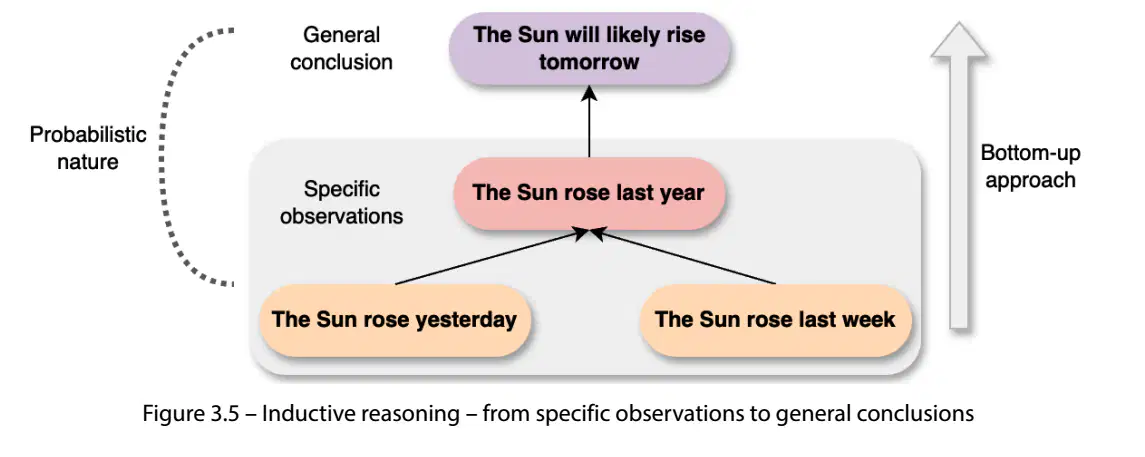
Which approach does inductive reasoning follow according to the diagram?
Top-down approach
Bottom-up approach
Lateral approach
Circular approach
Which of the following domains relies heavily on inductive reasoning to generalize from experimental observations and data?
Scientific method
Legal reasoning
Historical analysis
Artistic interpretation
What is the primary role of inductive reasoning in machine learning?
Inferring general models from training data to make predictions on new instances
Validating hypotheses using deductive logic
Generating random outputs from input data
Memorizing all possible data points
(a) is described as "inference to the best explanation".
In the context of pattern recognition, what is the main function of inductive reasoning?
Classifying inputs based on detected statistical regularities
Generating random patterns from data
Memorizing all input data
Ignoring statistical information
Why is purely inductive reasoning considered limited in intelligent agent architectures?
Conclusions can be incorrect if observed instances are not representative of the entire space
It always guarantees truth
It does not require any data
It is only used for simple tasks
How does abductive reasoning differ from deductive reasoning?
Abduction begins with observed effects and hypothesizes causes, while deduction starts with general rules and arrives at specific conclusions
Abduction always guarantees specific conclusions, while deduction does not
Deduction works backward from effects, while abduction works forward from rules
Both abduction and deduction ignore observed data
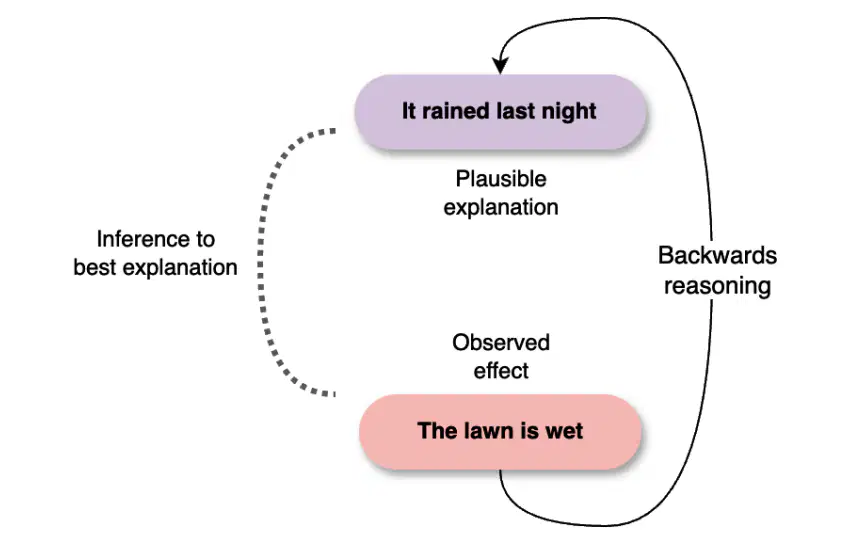
Suppose an intelligent agent observes that the lawn is wet. Using abductive reasoning, what is a plausible explanation?
It rained last night
The lawn is always wet
The lawn is made of plastic
The sun was shining
Why is inductive reasoning indispensable for intelligent agents operating in noisy, uncertain environments?
It allows extraction of knowledge and recognition of patterns from incomplete data
It guarantees absolute truth in all situations
It ignores uncertainty and noise in data
It only works with fully available information
Which of the following best describes abductive reasoning?
Reasoning that infers the most plausible explanation for an observed effect
Reasoning that only uses existing knowledge and data to reach conclusions
Reasoning that always guarantees a single correct explanation
Reasoning that ignores observed effects and focuses on predictions
Which domain commonly uses abductive reasoning to investigate the most probable causes of observed symptoms?
Medical diagnosis
Weather forecasting
Financial accounting
Sports analysis
In fault detection within manufacturing, what is the primary use of abductive reasoning?
To isolate the most likely faults or failures that led to observed anomalies
To predict future production rates
To optimize supply chain logistics
To design new manufacturing equipment
Why is abductive reasoning often used in tandem with deductive reasoning?
To validate the consistency and plausibility of explanatory hypotheses
To ensure only one possible explanation is considered
To avoid reasoning backward from goals
To ignore novel possible explanations
Which of the following is NOT a key advantage of abductive reasoning?
It facilitates thinking outside the box and exploring novel explanations
It guarantees a single correct explanation for every observation
It generates new plausible premises beyond existing knowledge
It is useful in diagnostic domains and root cause analysis
How is abductive reasoning applied in scientific discovery?
By inferring explanatory hypotheses for currently unexplained observations or phenomena
By only using established theories to explain phenomena
By ignoring new observations and focusing on old data
By predicting future trends without evidence
In AI planning, what role does abductive reasoning play?
Agents must abduce sequences of viable actions by reasoning backward from desired goals
Agents only follow pre-programmed instructions
Agents ignore observed effects and focus on random actions
Agents use abductive reasoning to predict weather patterns
Which of the following statements about abductive reasoning is TRUE?
Abductive reasoning does not guarantee correct explanations; multiple hypotheses may be consistent with observations
Abductive reasoning always produces a single, correct answer
Abductive reasoning ignores observed effects
Abductive reasoning is only used in mathematics
Which of the following is a challenge in implementing abductive reasoning in agentic systems?
Lack of computational complexity
Difficulty in maintaining proper knowledge representation
Abundance of complete data
Simple evaluation of hypotheses
What is the main goal of supervised learning?
To discover inherent patterns in unlabeled data
To train an agent to predict outputs for new unseen inputs
To reduce the dimensionality of data
To extract topics from collections of documents
Which application is commonly associated with supervised learning?
Customer segmentation
Topic modeling
Image classification
Dimensionality reduction
Match each type of data or feedback with the corresponding learning approach.
Labeled data with target outputs
Supervised learning
Unlabeled data without associated target outputs
Unsupervised learning
Data with predefined categories
Classification tasks
Data with explicit feedback
Reinforcement learning
Which of the following is NOT an application of unsupervised learning?
Spam detection
Customer segmentation
Anomaly detection
Topic modeling
Explain how integrating abductive reasoning with other reasoning modes can impact agentic systems.
It always simplifies the reasoning process
It can lead to conflicts and scalability issues as the domain grows
It eliminates uncertainty in data
It guarantees objective evaluation of hypotheses
Why is explainability important when handling dynamic environments in intelligent agents?
It reduces the need for knowledge representation
It adds complexity but helps users understand agent decisions
It makes the agent ignore incomplete data
It prevents agents from adapting to new data
Describe one benefit of applying abductive reasoning in intelligent agents.
It limits the agent’s ability to operate in uncertain environments
It increases creativity in postulating tentative explanations
It prevents agents from drawing insights
It reduces the need for robust knowledge representation
Which of the following best describes reinforcement learning?
Learning by transferring knowledge from one domain to another
Learning by trial and error using feedback from the environment
Learning by memorizing large datasets
Learning by supervised labeling of data
Which domain is NOT mentioned as an application area for reinforcement learning?
Game playing
Robotics
Natural language processing
Traffic signal control
Transfer learning is primarily used to:
Maximize efficiency in supply chains
Transfer knowledge learned in one setting to another related setting
Control timing policies for traffic signals
Learn optimal behaviors through rewards and punishments
Which of the following is an example of transfer learning?
Using pre-trained models as initialization for new vision tasks
Learning to master chess through trial and error
Finding policies to maximize efficiency in supply chains
Learning control policies for robot navigation
Why are learning mechanisms important for intelligent agents?
They allow agents to memorize data faster
They equip agents to expand knowledge, refine behaviors, and improve problem-solving capabilities
They help agents ignore feedback from the environment
They prevent agents from adapting to new challenges
In agentic systems, what is the primary purpose of decision-making and planning?
To memorize all possible scenarios
To achieve goals effectively in complex environments
To avoid evaluating outcomes
To ignore constraints and preferences
How does transfer learning accelerate training speed and sample efficiency for new tasks?
By ignoring previously learned patterns
By leveraging previously learned patterns and representations
By starting from scratch for every new task
By using only supervised learning methods
A key hallmark of intelligence in adaptive agents is (a) .
Suppose you are designing an intelligent agent for traffic signal control. How might reinforcement learning be used to improve traffic flow?
By randomly changing signal timings without feedback
By learning optimal timing policies through trial and error and feedback from observed traffic outcomes
By copying signal timings from another city without adaptation
By using only pre-defined static schedules
An agent must choose between several possible actions in a complex environment. What steps should the agent take to make an effective decision?
Select actions randomly without analysis
Analyze scenarios, evaluate outcomes, and select the most desirable action based on preferences and constraints
Ignore possible outcomes and constraints
Always choose the action with the least effort required
Which of the following best describes the purpose of a utility function in decision-making for intelligent agents?
To map outcomes to utility values, enabling agents to compare and choose actions that maximize expected utility.
To randomly assign values to different outcomes without considering agent preferences.
To ensure all outcomes have the same utility value.
To ignore agent goals, rewards, and penalties in decision-making.

