Wayground logo

Free Printable Worksheets

Font size

S
M
L
XL
Worksheets

The Great Depression and Its Impact

Total questions: 9

Worksheet time: 6mins

Name
Class
Date
1.

The name of the economic downfall of America during 1929 is called?

(a)  
2.
Who was president at the time of the Stock Market Crash of 1929?
a)
Abraham Lincoln
b)
Franklin D. Roosevelt
c)
Theodore Roosevelt
d)
Herbert Hoover
3.
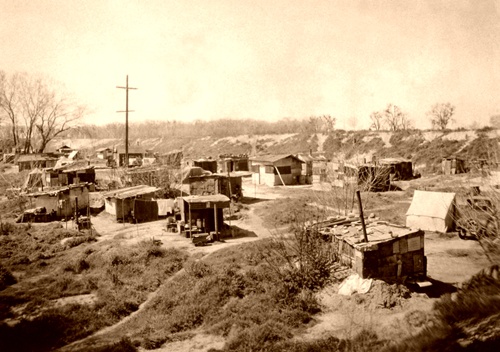
What were the villages full of shacks located in cities filled with unemployed Americans called?
a)
Hoovervilles
b)
Okies
c)
Bonus Army Bases
d)
Rooseveltowns
4.
What natural disaster of the 1930s added insult to injury?
a)
Flooding along the Mississippi River
b)
The Dust Bowl
c)
Tornadoes called the Helen Hunt Twisters
d)
Hurricanes along the Gulf Coast
5.
What effect did the Dust Bowl storms have on the Great Depression?
a)
Many farmers were forced to leave the Great Plains.
b)
Unemployment decreased gradually.
c)
Many homes long the Mississippi River were flooded.
d)
Hoover was re-elected as president.
6.
The Bonus Army incident in 1932 best illustrates the idea that
a)
F.D.R.'
s relief programs were unsuccessful.
b)
many felt that Herbert Hoover was not handling the Depression well.
c)
protests by veterans during the Depression were effective.
d)
the U.S. Army had increased in size and power during the Depression.
7.

Which president created the New Deal programs?

a)

George W. Bush

b)

Franklin Roosevelt

c)

Richard Nixon

d)

John F Kennedy

8.

The cause for the great depression was all of the following, fill in the missing portion. Overproduction, (a)   , Unstable Banking and Restrictive International Trade

(Look at your Review 4.1 and 4.2 Slide 7)

9.

Which two of the following allowed FDR to "win" the people of America after President Hoover?

a)

The belief that Americans are strong-willed that they can fix the economy without the governments help.

b)

The start of contstruction projects like the Hoover Dam.

c)

Denying the retired veterans their pension because, "they have not done enough".

d)

The start of government programs that helped Americans recover from the Great Depression.