
 Worksheets
Topic 1 and 2 Questions Extra Credit
Total questions: 100
Worksheet time: 50mins
Name
Class
Date
1.
What was the main reason that the Romans wished to build good roads?
a)
to transport food more quickly
b)
to make trading more efficient
c)
so soldiers could travel more quickly
d)
so all roads would lead to Rome
2.
What are some of the core beliefs that most Christians share? Choose the TWO correct answers.
a)
Jesus was God in human form.
b)
There are three Gods.
c)
The fate of all souls has been predetermined by God.
d)
God the Father created the universe.
3.
How can you tell that Cicero was considered a great orator?
a)
He persuaded the army to make him emperor.
b)
Politicians disliked his approach to the arts.
c)
Later orators used his speeches as models.
d)
The Romance languages still survive today.
4.
Read the quotation.
“And Jesus went about all the cities and villages, teaching in their synagogues and preaching the gospel of the kingdom, and healing every disease and every infirmity.”
This quotation is most likely an excerpt from the
a)
epistles.
b)
parables.
c)
Gospels.
d)
Book of Revelation.
5.
Jesus was a member of
a)
the Roman army.
b)
the Pharisees.
c)
the Christian people.
d)
the Jewish people.
6.
Which are factors that contributed to the decline of the Roman empire? Choose the TWO correct answers.
a)
depopulation from epidemics
b)
the prohibition of slavery
c)
the death of Marcus Aurelius
d)
frequent civil wars
7.
Why was most Roman trade conducted by sea, rather than by land?
a)
Sea trade was safer, faster, and cheaper.
b)
Land routes were faster, but more expensive.
c)
Sea trade was dangerous, but very fast.
d)
Land routes were impossible in most cases.
8.
Read the quotation.
“Anyone who has two shirts should share with the one who has none, and anyone who has food should do the same.”
―Luke 3:11
This quotation reflects Jesus’s teachings about
a)
showing compassion for the poor.
b)
forgiving those who have sinned.
c)
resisting temptation.
d)
the nature of the soul and salvation.
9.
Which of the following rituals or practices do many Christians follow? Choose the TWO correct answers.
a)
Holy Communion
b)
Passover
c)
resting on Sundays
d)
keeping kosher
10.
In what way did early Roman sculpture differ from ancient Greek sculpture?
a)
Greek sculpture was more modern.
b)
Roman sculpture was more realistic.
c)
Greek sculpture was more colorful.
d)
Roman sculpture was more political.
11.
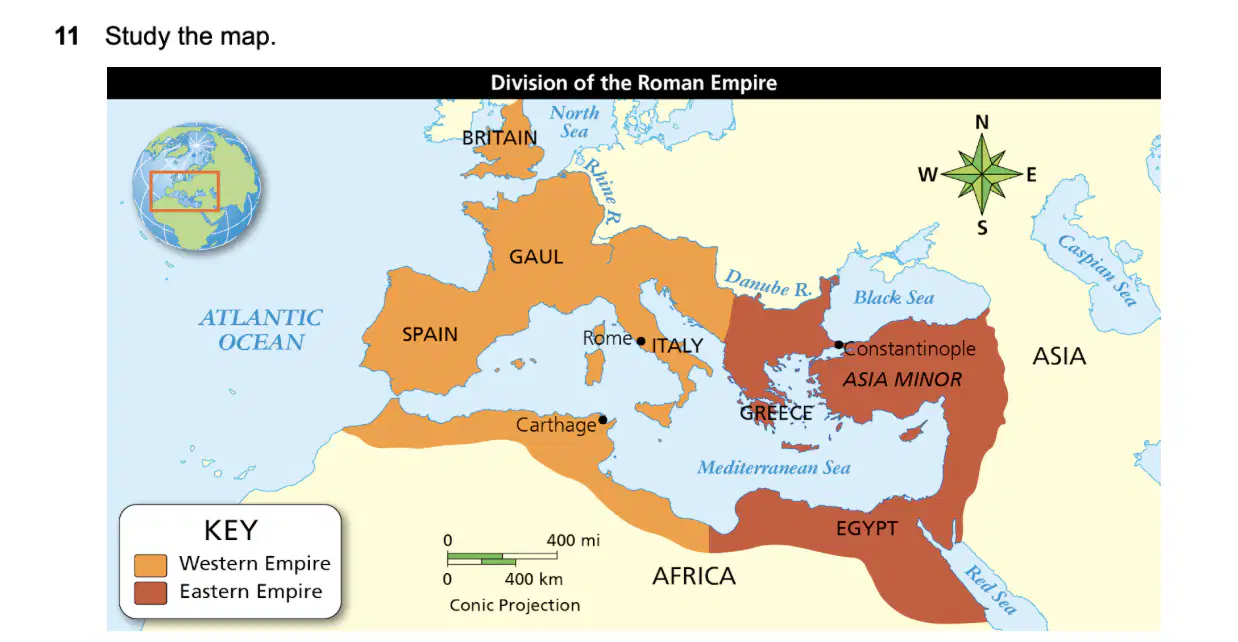
Study the Map
What advantages did location bring to the Eastern empire? Choose the TWO correct answers.
a)
distance from barbarian tribes in western and northern Europe
b)
direct access to the Atlantic Ocean and North Sea
c)
control of trade on the Rhine River
d)
easy access to the Mediterranean, Black, and Red seas
12.
What did the disciples of Jesus do after his death?
a)
They spread Christianity throughout the Roman world.
b)
They argued for Jesus’ innocence with Roman authorities.
c)
They convinced the Jews to stop persecuting Romans.
d)
They hid from the Romans and kept Jesus’ teachings a secret.
13.
Which statement describes the Great Schism?
a)
A Muslims and Jews fought for control.
b)
B Christians and Muslims fought for control.
c)
C Protestants and Catholics disagreed over beliefs.
d)
D Christians disagreed with each other over beliefs.
14.
Which reason explains why the issue of leadership divided the Christian churches?
a)
A The Byzantines rejected the legacy of Rome.
b)
B The pope did not accept the eastern church as Christian.
c)
C The Byzantine emperor wanted to choose the pope.
d)
D Leaders on both sides felt threatened by each other’s claims.
15.
Which of the following statements correctly describes Justinian’s impact on the Byzantine empire?
a)
Under Justinian, the Byzantine empire began a centuries-long expansion.
b)
Under Justinian, the Byzantine empire reached its largest size ever.
c)
Under Justinian, the Byzantine empire shrank to half its original size.
d)
Under Justinian, the Byzantine empire fell to the Ottoman Turks.
16.
Which of the following was a major factor in the decline of the Byzantine empire?
a)
conversion of the Slavs
b)
iconoclasm
c)
arrival of invaders
d)
recapture of Rome
17.
Which of the following statements correctly describe the differences between the Roman Catholic Church and the Eastern Orthodox Church?
a)
The Roman Catholic Church was headed by the pope and rituals were in Greek; the Eastern Orthodox Church was headed by the Byzantine emperor and rituals were in Latin.
b)
The Roman Catholic Church was headed by the Byzantine emperor and rituals were in Greek; the Eastern Orthodox Church was headed by the pope and rituals were in Latin.
c)
The Roman Catholic Church was headed by the Byzantine emperor and rituals were in Latin; the Eastern Orthodox Church was headed by the pope and rituals were in Greek.
d)
The Roman Catholic Church was headed by the pope and rituals were in Latin; the Eastern Orthodox Church was headed by the Byzantine emperor and rituals were in Greek.
18.
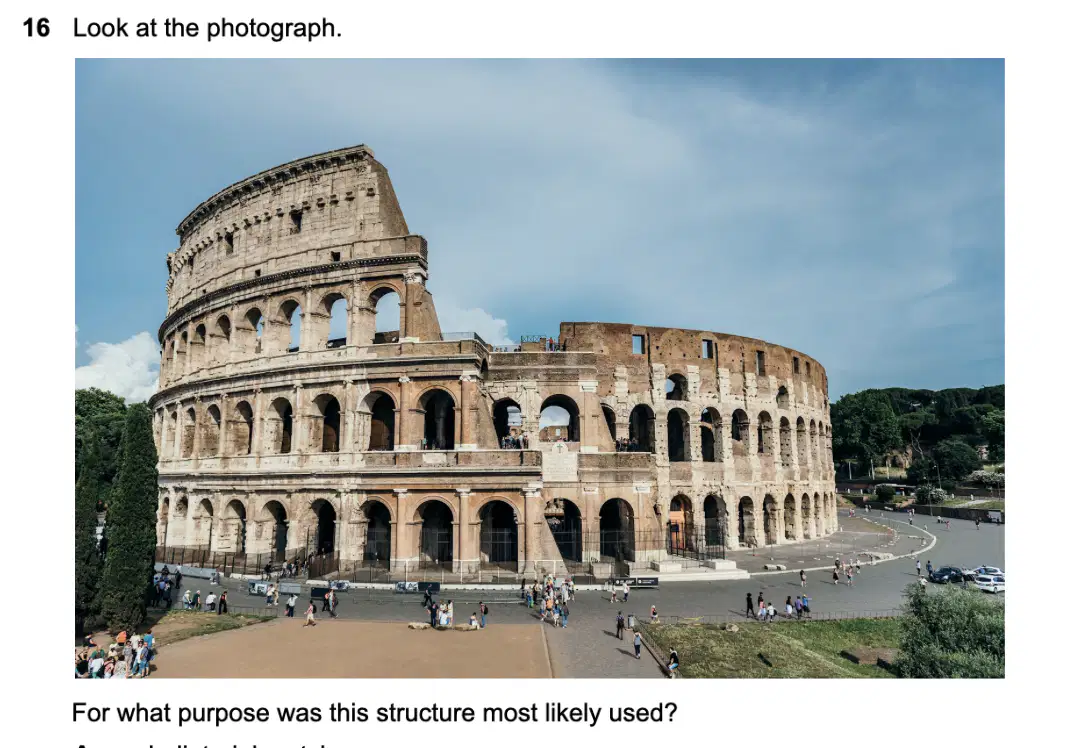
For what purpose was this structure most likely used?
a)
gladiatorial matches
b)
transporting water
c)
political debates
d)
religious worship
19.
Why did the use of icons anger iconoclasts?
a)
They believed using icons was like worshiping objects.
b)
They believed using icons led to the Great Schism.
c)
They believed that only bishops should use icons.
d)
They believed using icons taught people about God.
20.
How did the Byzantine empire differ from the Roman empire? Choose the TWO correct answers.
a)
Its most common religion was Christianity.
b)
Its people did not consider themselves Romans.
c)
It was located in Western Europe.
d)
Its people spoke Greek, not Latin.
21.
How many years passed between the end of the Pax Romana and the division of the empire?
a)
less than 100 years
b)
more than 200 years
c)
more than 100 years
d)
about 5 years
22.
Which Byzantine emperor built Hagia Sophia?
a)
Justinian
b)
Constantine
c)
Maximian
d)
Diocletian
23.
A map showing Europe’s topography would include
a)
major cities.
b)
national boundaries.
c)
mountain ranges.
d)
trade routes.
24.
Most of Europe’s early cities developed near
a)
major rivers.
b)
seacoasts.
c)
mountains.
d)
peninsulas.
25.
Which Germanic tribe defeated the last Roman army in Western Europe?
a)
the Jutes
b)
the Saxons
c)
the Huns
d)
the Franks
26.
What was one step that Charlemagne took to help unite his kingdom?
a)
He chose a single strong heir to inherit his throne.
b)
He drove Muslim forces out of Europe.
c)
He created and supported schools.
d)
He declared himself head of the Catholic Church.
27.
Charlemagne worked with the Catholic Church to
a)
defeat the Eastern Orthodox Church.
b)
spread Christianity to northern Europe.
c)
convert the Franks to Christianity.
d)
reunite the eastern and western Roman empires.
28.
Why do historians refer to the period between 500 CE and 1500 CE as the Middle Ages?
a)
It represented a transitional era between ancient and modern times
b)
It marked the exact center of European civilization
c)
It was exactly in the middle of historical periods
d)
The term was invented by Renaissance scholars
29.
How did Europe's geographical location influence its development during the Middle Ages?
a)
Primarily mountainous and inhospitable
b)
Isolated and disconnected from other regions
c)
Surrounded by multiple bodies of water, enabling trade and migration
d)
Completely landlocked and difficult to access
30.
What unique geographical feature made migration across Europe easier during this period?
a)
The North European Plain
b)
The Mediterranean coastline
c)
The Alpine mountain ranges
d)
The Pyrenees mountain pass
31.
How did Charlemagne contribute to the development of medieval European civilization?
a)
He prevented any form of cultural exchange
b)
He destroyed all existing cultural traditions
c)
He completely isolated European kingdoms
d)
He spread Christianity and encouraged education
32.
What was the significance of the Battle of Tours in 732?
a)
It ended Muslim military expansion into Western Europe
b)
It marked the beginning of the Crusades
c)
It established Roman imperial power
d)
It created the first European parliament
33.
How did the fall of the Roman Empire impact European civilization?
a)
It sparked immediate industrial revolution
b)
It created a unified European government
c)
It caused immediate technological advancement
d)
It led to a period of social, political, and economic decline
34.
What role did rivers play in early European civilization?
a)
They were sources of constant flooding
b)
They were barriers to human settlement
c)
They were completely unused
d)
They provided natural boundaries and facilitated trade
35.
Why was the Pope's crowning of Charlemagne significant?
a)
It created a new military alliance
b)
It established the Church's power to name emperors
c)
It dissolved the Byzantine Empire
d)
It ended all religious conflicts
36.
What characterized the political structure of European kingdoms after Rome's fall?
a)
Strong central monarchies
b)
Complete anarchy
c)
Unified imperial governance
d)
Decentralized power with local leaders
37.
How did Charlemagne view education in his kingdom?
a)
As a tool to unite and improve governance
b)
As a threat to his power
c)
As unnecessary and unimportant
d)
As exclusively religious instruction
38.
What climate characteristic distinguishes Western Europe?
a)
Extreme temperature variations
b)
Consistently dry and cold
c)
Complete lack of precipitation
d)
Moist westerly winds bringing year-round rainfall
39.
What happened to trade networks after the fall of Rome?
a)
They became globally interconnected
b)
They expanded dramatically
c)
They slowed to a trickle
d)
They remained exactly the same
40.
Which geographical feature separates Europe from Asia?
a)
The Ural Mountains
b)
The Pyrenees
c)
The Alps
d)
The North European Plain
41.
What was unique about the Muslim state in Iberia during this period?
a)
It established a strong centralized state
b)
It remained politically fragmented
c)
It was completely isolated
d)
It rejected all cultural exchanges
42.
How did Charlemagne interact with the Catholic Church?
a)
He completely rejected its influence
b)
He prohibited religious practices
c)
He worked closely to spread Christianity
d)
He established a competing religious organization
43.
What geographical characteristic makes Europe a 'peninsula of peninsulas'?
a)
Its isolated mountain ranges
b)
Its uniform terrain
c)
Its lack of coastal regions
d)
Its numerous surrounding water bodies
44.
What happened to Charlemagne's empire after his death?
a)
It remained completely unified
b)
It disappeared entirely
c)
It was immediately conquered
d)
It was split into three parts by his sons
45.
Which Germanic tribes were mentioned as migrating to the British Isles?
a)
Angles, Saxons, and Jutes
b)
Huns and Avars
c)
Slavs and Umayyads
d)
Franks and Lombards
46.
What was the primary method of governance in post-Roman European kingdoms?
a)
Strict military hierarchies
b)
Local leaders and landholders wielding power
c)
Centralized imperial control
d)
Direct democratic processes
47.
How did Charlemagne's approach to governance differ from previous rulers?
a)
He sent officials to ensure fair local rule
b)
He eliminated noble positions
c)
He completely abandoned local governance
d)
He centralized all power in himself
48.
People joined monasteries and convents in order to
a)
spread Christianity throughout Europe.
b)
devote their lives to prayer and study.
c)
control administration of the sacraments.
d)
shut themselves off from the local community.
49.
The Benedictine Rule mainly affected the lives of
a)
missionaries.
b)
bishops.
c)
monks.
d)
the poor and sick.
50.
A missionary named Patrick played a major role in spreading Christianity to
a)
Poland.
b)
Britain.
c)
Russia.
d)
Ireland.
51.
According to medieval Catholic teachings, which of the following would be considered a violation of God’s law?
a)
controlling an army
b)
harming others
c)
believing in hell
d)
performing sacraments
52.
In medieval Europe, the Catholic calendar was used to mark
a)
religious holy days.
b)
farming seasons.
c)
the secular history of Europe.
d)
daily life in the monasteries.
53.
How did missionaries typically approach converting pagans during the early Middle Ages?
a)
Generally through peaceful persuasion and building relationships
b)
By using military force exclusively
c)
By destroying pagan religious sites immediately
d)
Only through royal decree and mandate
54.
What was the primary significance of the Benedictine Rule in medieval monasteries?
a)
It required monks to live in complete isolation
b)
It established a structured life balancing prayer, work, and study
c)
It permitted individual ownership of property
d)
It banned all forms of work
55.
How did monasteries contribute to medieval European society beyond religious practices?
a)
They offered healthcare, education, and preserved ancient learning
b)
They only focused on religious manuscripts
c)
They provided no social services
d)
They were purely agricultural communities
56.
What role did the concept of Christendom play in medieval European identity?
a)
It was irrelevant to social structures
b)
It only applied to nobility
c)
It divided European peoples
d)
It created a sense of common purpose and shared cultural identity
57.
Why was Saint Patrick significant in the spread of Christianity?
a)
He gradually gained trust and founded hundreds of churches
b)
He was rejected by all Irish people
c)
He forcibly converted all Irish tribes
d)
He conquered Ireland militarily
58.
How did the Catholic Church exert power in medieval society?
a)
Through direct democratic processes
b)
Through military conquest alone
c)
By controlling sacrament administration and land ownership
d)
By completely ignoring secular rulers
59.
What distinguished a missionary in the early Middle Ages?
a)
Someone who traveled to collect taxes
b)
A royal diplomat
c)
A professional soldier
d)
A person attempting to convert others to a particular religion
60.
How did Christianity spread in Central and Eastern Europe during the 700s and 800s?
a)
Through violent conquest
b)
By completely avoiding local populations
c)
Exclusively by royal decree
d)
Monks worked to convert Slavic peoples
61.
What was a key characteristic of daily life in medieval monasteries?
a)
Constant military training
b)
No structured activities
c)
Complete leisure and relaxation
d)
A rigid schedule divided into periods of worship, work, and study
62.
What did medieval Catholics believe about salvation?
a)
Only nobles could be saved
b)
Salvation required good deeds, belief in Jesus, and participating in sacraments
c)
Salvation was impossible
d)
Salvation was automatic
63.
Many of the early Viking raids were directed against
a)
castles guarded by knights.
b)
wealthy monasteries.
c)
self-sufficient manors.
d)
fiefs controlled by vassals.
64.
In addition to being coastal raiders, many Vikings also became
a)
explorers.
b)
serfs.
c)
missionaries.
d)
knights.
65.
Under the feudal system, what did lords grant to their vassals?
a)
freedom
b)
money
c)
loyalty
d)
fiefs
66.
What was the main goal of the code of chivalry?
a)
to train sons of nobles how to fight
b)
to regulate life on the manor
c)
to teach knights how to behave honorably
d)
to increase the power of monarchs
67.
Which group made up the majority of the medieval European population?
a)
lords
b)
knights
c)
vassals
d)
peasants
68.
How did improvements in agricultural technology impact medieval European society?
a)
Caused economic decline
b)
Eliminated farming entirely
c)
Reduced population growth
d)
Increased food production and population
69.
What key innovation allowed farmers to cultivate more land in northern Europe?
a)
Stone implements
b)
Wooden plows
c)
Iron-bladed plows
d)
Hand tools
70.
What was the primary advantage of the three-field crop rotation system?
a)
Increased annual planted land
b)
Reduced labor requirements
c)
Guaranteed perfect harvests
d)
Eliminated need for fertilizer
71.
How did the medieval economy benefit from surplus crops?
a)
They enabled trade between regions
b)
They caused economic instability
c)
They were discarded
d)
They were exclusively used for local consumption
72.
What transformation occurred in European towns between 1000 and 1300?
a)
Towns grew and became trade centers
b)
Towns declined
c)
Towns remained unchanged
d)
Towns became exclusively agricultural
73.
What was the primary purpose of medieval guilds?
a)
Religious worship
b)
Military defense
c)
Agricultural expansion
d)
Protecting economic interests of workers
74.
What technological improvement helped horses become more effective draft animals?
a)
New harness design
b)
Selective breeding
c)
Better feeding
d)
Faster breeding
75.
Why did peasants begin leaving manors for towns?
a)
Religious persecution
b)
Promise of freedom and prosperity
c)
Better farming opportunities
d)
Mandatory government relocation
76.
What advantage did horses have over oxen as draft animals?
a)
Cheaper maintenance
b)
Larger size
c)
Faster and more efficient
d)
Better temperament
77.
What region became famous for producing fine woolen cloth?
a)
Flanders
b)
Spain
c)
Italy
d)
England
78.
What agricultural practice allowed soil to recover its fertility?
a)
Intensive farming
b)
Constant planting
c)
Leaving fields fallow
d)
Chemical fertilization
79.
What characterized medieval town fairs?
a)
Exclusively serious business transactions
b)
Only local merchants
c)
Diverse activities including entertainment
d)
No trading allowed
80.
Why was the Middle Ages sometimes called the 'Age of Faith'?
a)
Because people only worked in churches
b)
Because wars were always about religion
c)
Because religion dominated social, cultural, and daily life
d)
Because monks were the only educated people
81.
How did guilds control product quality?
a)
Through government regulation
b)
By testing and training members
c)
Through random inspections
d)
By ignoring standards
82.
What was unique about the mendicant orders?
a)
They owned large amounts of land
b)
They only lived in cities
c)
They survived by begging for food
d)
They were extremely wealthy
83.
How did Francis of Assisi view nature?
a)
As something to be conquered
b)
As a source of economic value
c)
As unimportant to spiritual life
d)
As a reflection of God
84.
What architectural innovation characterized Gothic cathedrals?
a)
Smaller windows
b)
Large windows allowing more light
c)
Massive thick walls
d)
Underground construction
85.
What role did the Church play in developing chivalry?
a)
Tried to shape knights toward Christian values
b)
Encouraged violent behavior
c)
Ignored knights entirely
d)
Completely rejected chivalric codes
86.
How did medieval universities communicate across different regions?
a)
They used translators
b)
They did not communicate
c)
Latin was the universal language of learning
d)
They spoke local languages
87.
What was Thomas Aquinas's key philosophical contribution?
a)
Rejecting all classical philosophy
b)
Eliminating scientific thinking
c)
Arguing that faith and reason both come from God
d)
Promoting only religious education
88.
How did Clare of Assisi's order differ from traditional religious communities?
a)
They rejected Francis's teachings
b)
They were extremely wealthy
c)
They took a vow of poverty
d)
They lived in luxury
89.
What significant change occurred in religious drama during the Middle Ages?
a)
Plays were only performed in churches
b)
The Church began allowing Bible-based plays
c)
Drama was completely banned
d)
Only secular plays were permitted
90.
How did monasteries evolve by the 1200s?
a)
They became centers of agricultural production
b)
They stopped providing any community services
c)
They were abandoned
d)
They became completely isolated
91.
What symbolism did medieval people often see in natural objects?
a)
Spiritual meanings
b)
No particular symbolism
c)
Economic value
d)
Scientific potential
92.
How did religious practices reflect in medieval town life?
a)
People avoided religious activities
b)
Frequent religious processions and incense
c)
Only nobles participated in religious events
d)
No religious influence was visible
93.
What was the primary purpose of early Christian monks and nuns?
a)
Military service
b)
Personal salvation through prayer
c)
Political influence
d)
Agricultural production
94.
How did the preservation of ancient texts occur during the Middle Ages?
a)
Preserved in monastery libraries
b)
Only religious texts survived
c)
No texts were preserved
d)
All texts were destroyed
95.
What characterized the medieval understanding of natural law according to Aquinas?
a)
Laws were irrelevant
b)
Laws were consistent across societies
c)
Laws changed frequently
d)
Laws were human-made
96.
How did art depict religious figures during the High Middle Ages?
a)
Always distant and unapproachable
b)
More human and suffering
c)
Identical to earlier periods
d)
Completely abstract
97.
What metaphor did medieval Europeans use to describe life's unpredictability?
a)
Tree of life
b)
River of time
c)
Wheel of fortune
d)
Circle of destiny
98.
What subjects were considered 'liberal arts' in medieval universities?
a)
Theology only
b)
Grammar and logic
c)
Military strategy
d)
Modern sciences
99.
How did religious orders like the Franciscans view poverty?
a)
As a temporary state
b)
As unimportant
c)
As a spiritual virtue
d)
As a curse
100.
What technological advancement enabled Gothic cathedral construction?
a)
Metal reinforcements
b)
Advanced crane technology
c)
Wooden scaffolding
d)
New building techniques
100 %

