
 Worksheets
Factors of Production Review
Total questions: 25
Worksheet time: 13mins
Name
Class
Date
1.
Which of the following is NOT one of the four factors of production?
a)
Natural Resources
b)
Labor
c)
Capital
d)
Technology
e)
Entrepreneurship
2.
What is labor?
a)
a person who seeks to earn profits by finding new ways to organize factors of production
b)
the human effort that can be applied to the production of goods and services
c)
something that can be used in the production of other goods and services
d)
resources of nature that can be used for the production of goods and services
3.
What is capital?
a)
a person who seeks to earn profits by finding new ways to organize factors of production
b)
the human effort that can be applied to the production of goods and services
c)
something that can be used in the production of other goods and services
d)
resources of nature that can be used for the production of goods and services
4.
What are natural resources?
a)
a person who seeks to earn profits by finding new ways to organize factors of production
b)
the human effort that can be applied to the production of goods and services
c)
something that can be used in the production of other goods and services
d)
resources of nature that can be used for the production of goods and services
5.
What is entrepreneurship?
a)
a person who seeks to earn profits by finding new ways to organize factors of production
b)
the human effort that can be applied to the production of goods and services
c)
something that can be used in the production of other goods and services
d)
resources of nature that can be used for the production of goods and services
6.
What is "human equivalent labor"?
a)
is the skill a worker has as a result of education, training, or experience
b)
labor that an untrained, uneducated person might bring to a production process
c)
purely physical labor
d)
"white collar" labor
7.
What is "human capital"?
a)
is the skill a worker has as a result of education, training, or experience
b)
labor that an untrained, uneducated person might bring to a production process
c)
purely physical labor
d)
"white collar" labor
8.
Which of the following is an example of labor?
a)
workers at a factory
b)
industrial robots
c)
land for a factory
d)
the owner or CEO or financial risk taker
9.
Which of the following is an example of entrepreneurship?
a)
workers at a factory
b)
industrial robots
c)
land for a factory
d)
the owner or CEO or financial risk taker
10.
Which of the following is an example of natural resources?
a)
workers at a factory
b)
industrial robots
c)
land for a factory
d)
the owner or CEO or financial risk taker
11.
Which of the following is an example of capital?
a)
workers at a factory
b)
industrial robots
c)
land for a factory
d)
the owner or CEO or financial risk taker
12.
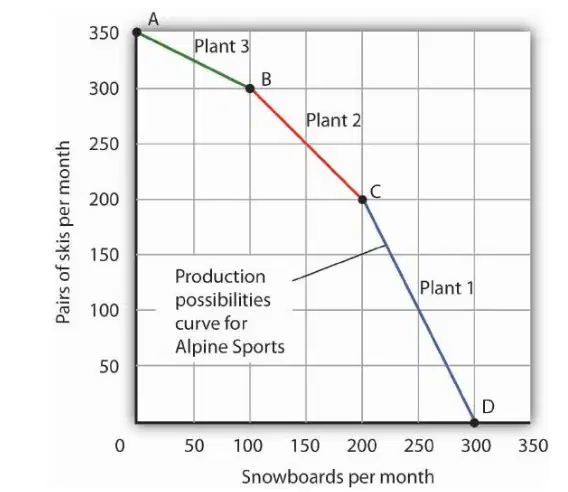
According to the production possibilities curve below, if you produce 300 pairs of skis per month, how many snowboards per month could you produce?
a)
0 snowboards per month
b)
100 snowboards per month
c)
200 snowboards per month
d)
300 snowboards per month
13.
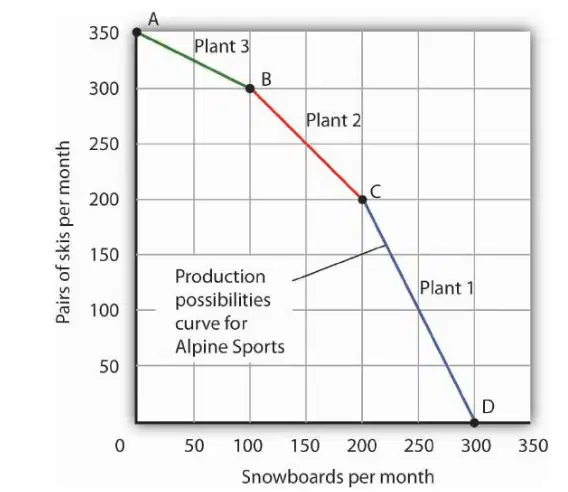
According to the production possibilities curve below, if you produce 200 snowboards per month, how many pairs of skis per month could you produce?
a)
350 pairs of skis per month
b)
300 pairs of skis per month
c)
200 pairs of skis per month
d)
0 pairs of skis per month
14.
What is an "asset"?
a)
a business strategy where products are deliberately designed to have a limited lifespan to encourage consumers to buy replacements sooner than necessary
b)
interest accumulated from a principal sum and previously accumulated interest.
c)
anything of value owned by a person or organization
d)
a graph that shows all combinations of two goods or categories of goods an economy can produce
15.
What is an "compound interest"?
a)
a business strategy where products are deliberately designed to have a limited lifespan to encourage consumers to buy replacements sooner than necessary
b)
interest accumulated from a principal sum and previously accumulated interest.
c)
anything of value owned by a person or organization
d)
a graph that shows all combinations of two goods or categories of goods an economy can produce
16.
What is a production possibilities curve?
a)
a business strategy where products are deliberately designed to have a limited lifespan to encourage consumers to buy replacements sooner than necessary
b)
interest accumulated from a principal sum and previously accumulated interest.
c)
anything of value owned by a person or organization
d)
a graph that shows all combinations of two goods or categories of goods an economy can produce
17.
What is an "planned obsolescence "?
a)
a business strategy where products are deliberately designed to have a limited lifespan to encourage consumers to buy replacements sooner than necessary
b)
interest accumulated from a principal sum and previously accumulated interest.
c)
anything of value owned by a person or organization
d)
a graph that shows all combinations of two goods or categories of goods an economy can produce
18.
The "Food Revolution" that led to products such as Heinz ketchup, Kellogg Cereal, and Coca Cola happened because
a)
competition from Pepsi
b)
World War II
c)
Cities were growing and there was little access to fresh food
d)
the Civil War
19.
Match the entrepreneur to the product they are most associated with:
H.J. Heinz
a)
ketchup
b)
Grape Nuts cereal
c)
the Milky Way candy bar
d)
Coca Cola
20.
Match the entrepreneur to the product they are most associated with:
John Pemberton
a)
ketchup
b)
Grape Nuts cereal
c)
the Milky Way candy bar
d)
Coca Cola
21.
Match the entrepreneur to the product they are most associated with:
Frank Mars
a)
ketchup
b)
Grape Nuts cereal
c)
the Milky Way candy bar
d)
Coca Cola
22.
Match the entrepreneur to the product they are most associated with:
C.W. Post
a)
ketchup
b)
Grape Nuts cereal
c)
the Milky Way candy bar
d)
Coca Cola
23.
Where does Milton Hershey build his milk chocolate production facility?
a)
In Philadelphia to be near a vast source of labor
b)
In New York to take advantage of the capital available there
c)
In a small town in Pennsylvania to be near local dairy farms who would supply milk
d)
In New Orleans to be near the busiest port in the country
24.
With what business is Clarence Birdseye associated?
a)
automobile industry
b)
frozen foods
c)
breakfast cereal
d)
fast food
25.
What business strategy does Marjorie Post begin to use when she inherits her father's cereal empire?
a)
she sells her stake in the Post company and buys Kellogg
b)
she begins to acquire existing food companies
c)
she takes over from her brother
d)
she engages in what is referred to as horizontal integration
100 %

