wayground logo

Free Printable Worksheets

Font size

S
M
L
XL
Worksheets

Axial Skeleton Lab Practical practice

Total questions: 110

Worksheet time: 4hrs 46mins

Name
Class
Date
1.
What type of vertebrae is this?
a)
cervical
b)
lumbar
c)
thoracic
2.
What type of vertebrae is this?
a)
cervical
b)
lumbar
c)
thoracic
3.
What is this vertebrae called?
a)
thoracic
b)
axis
c)
altas
d)
lumbar
4.
This vertebrae is the only one without this part. What is it?
a)
body
b)
spiny process
c)
transverse process
d)
vertebral foramen
5.
Label A
a)
body
b)
spiny process
c)
transverse process
d)
vertebral foramen
6.
Label B
a)
body
b)
spinous process
c)
transverse process
d)
vertebral foramen
7.
Label c
a)
body
b)
spinous process
c)
transverse process
d)
vertebral foramen
8.
What type of vertebrae is this?
a)
cervical
b)
lumbar
c)
thoracic
9.
How many vertebrae does the body have of these?
a)
7
b)
1
c)
2
d)
3
e)
4
10.
How many vertebrae does the body have of these?
a)
5
b)
1
c)
2
d)
3
e)
4
11.
How many vertebrae does the body have of these?
a)
12
b)
1
c)
2
d)
3
e)
4
12.
What is this vertebra called?
a)
lumbar
b)
throacic
c)
cervical
d)
atlas
e)
axis
13.
Label B
a)
sacrum
b)
lumbar
c)
throacic
d)
cervical
e)
atlas
14.
Label C
a)
coccyx
b)
lumbar
c)
throacic
d)
cervical
e)
atlas
15.
Label the bone below
a)
hyoid
b)
lumbar
c)
throacic
d)
cervical
e)
atlas
16.
Which bone structure holds this bone in place?
a)
styloid process
b)
lumbar
c)
throacic
d)
cervical
e)
atlas
17.
What is the projection called?
a)
spinus process
b)
transverse process
c)
body
d)
dens
e)
foramen process
18.
What is this bone called?
a)
rib
b)
humerus
c)
tibia
d)
fibula
19.
How many pairs does the body have of this bone?
a)
7
b)
12
c)
5
d)
3
20.
Label A
a)
nasal
b)
mandible
c)
maxilla
d)
frontal
e)
occipital
21.
Label A
a)
sagittal suture
b)
mandible
c)
maxilla
d)
frontal
e)
occipital
22.
Label B
a)
mastoid process
b)
mandible
c)
maxilla
d)
frontal
e)
occipital
23.
Label C
a)
zygomatic arch
b)
mandible
c)
maxilla
d)
frontal
e)
occipital
24.
Label C
a)
maxilla
b)
mandible
c)
frontal
d)
occipital
e)
temporal
25.
What is the bone labeled A?
a)
parietal
b)
mandible
c)
maxilla
d)
frontal
e)
occipital
26.
Label B
a)
temporal
b)
mandible
c)
maxilla
d)
frontal
e)
occipital
27.
Label D
a)
frontal
b)
mandible
c)
maxilla
d)
occipital
e)
temporal
28.
Identify the bone below.
a)
mandible
b)
maxilla
c)
frontal
d)
occipital
e)
temporal
29.
What are the small holes found on this bone called?
a)
mental foramen
b)
mandible
c)
maxilla
d)
frontal
e)
spinus foramen
30.
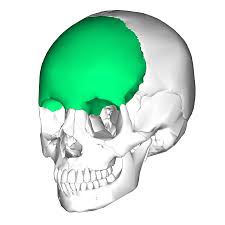
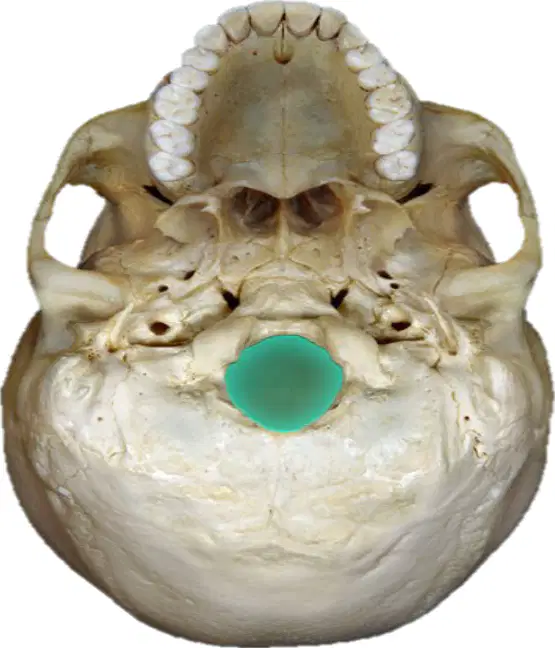
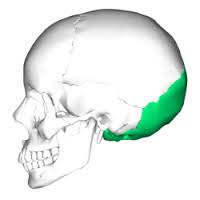
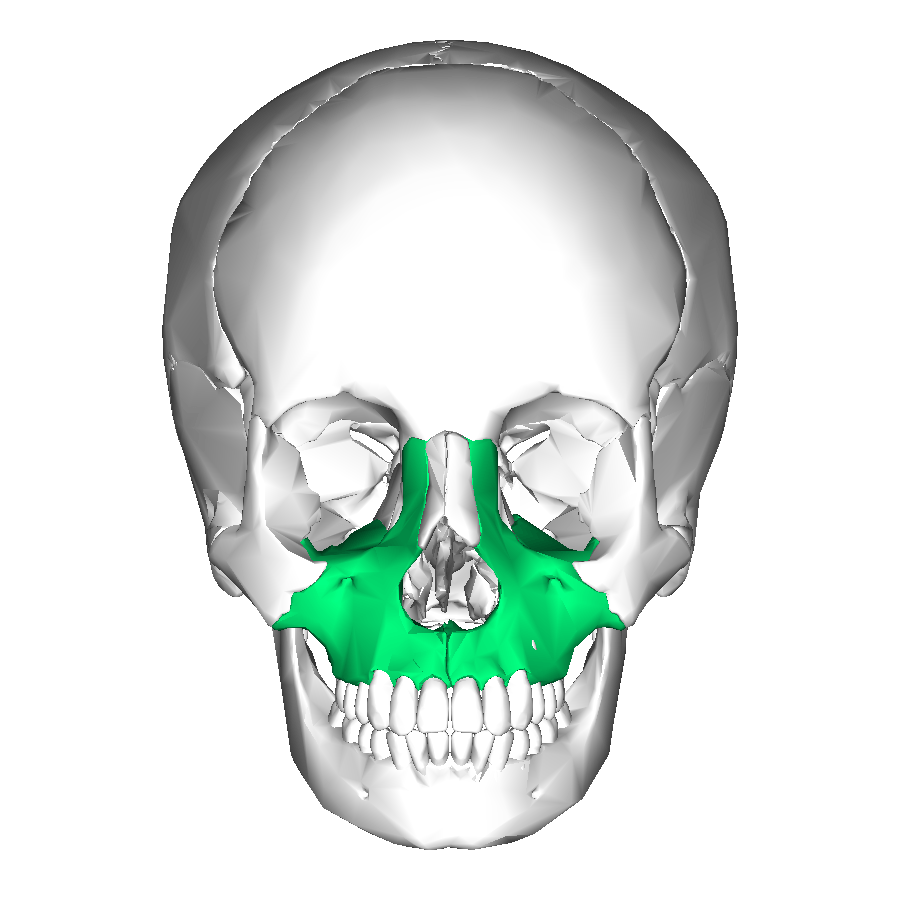
Label the bone colored green below.
a)
occipital
b)
mandible
c)
maxilla
d)
frontal
e)
temporal
31.
Label A
a)
Manubrium
b)
Body
c)
Xiphoid Process
d)
Coastal Cartilage
32.
Label B
a)
Manubrium
b)
Body
c)
Xiphoid Process
d)
Coastal Cartilage
33.
Label C
a)
Manubrium
b)
Body
c)
Xiphoid Process
d)
Coastal Cartilage
34.
Label D
a)
Manubrium
b)
Body
c)
Xiphoid Process
d)
Coastal Cartilage
35.
What is this?
a)
Frontal
b)
Mandible
c)
Occipital
d)
Parietal
36.
What is this?
a)
Nasal
b)
Lacrimal
c)
Ethmoid
d)
Vomer
37.
What is this?
a)
Parietal
b)
Occipital
c)
Frontal
d)
Temporal
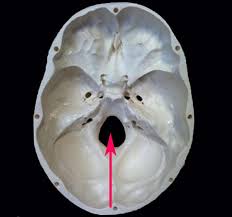
38.
What is this?
a)
Foramen Magnum
b)
Jugular Foramen
c)
Carotid Canal
d)
External Acoustic Meatus
39.
What is this?
a)
Mandible
b)
Maxillae
c)
Zygomatic
d)
Lacrimal
40.
Ribs that attach directly to the sternum?
a)
True ribs
b)
False Ribs
c)
Floating Ribs
41.
C1, articulates with the head
a)
Axis
b)
Atlas
42.
Manubrium, Body, and Xiphoid Process are all parts of the 
a)
Sternum
b)
Vertebral column
c)
Temporal bone
d)
Pelvis
43.
Label 2
a)
Mandibular condyle
b)
Gladiolus
c)
Angle
d)
Ramus
44.
Label 2
a)
Transverse foramen
b)
Vertebral foramen
c)
Transverse process
d)
Spinous process
45.
Label 7
a)
Transverse foramen
b)
Vertebral foramen
c)
Transverse process
d)
Spinous process
46.

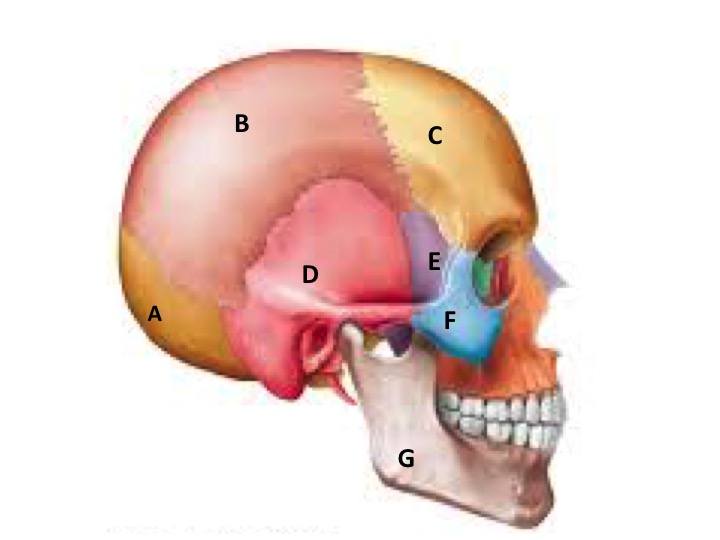
Which bone is labeled E

a)

temporal

b)

sphenoid

c)

frontal

d)

zygomatic

47.

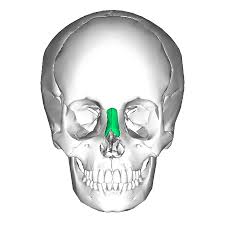
Which bone is bone 1

a)

zygomatic

b)

nasal

c)

vomer

d)

inferior nasal conche

48.

What bone is highlighted in red?

a)

cranium

b)

mandible

c)

scapula

d)

clavicle

49.

Identify bone 1 (green)

a)

Parietal

b)

Temporal

c)

Occipital

d)

Mandibular

50.
C2, acts as pivot point for C1
a)
Atlas
b)
Axis
51.
Label 1
a)
Occipital Condyle
b)
Foramen Magnum
c)
Transverse foramen
d)
Palatine bones
52.
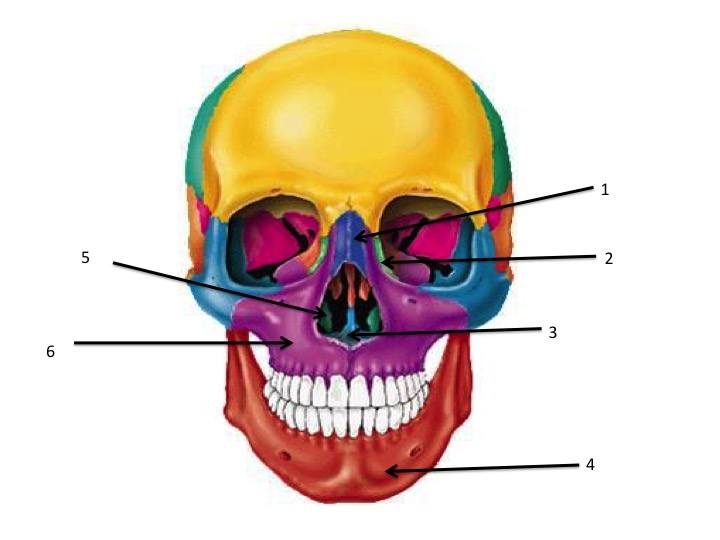
Label 3
a)
Lacrimal
b)
Ethmoid
c)
Vomer
d)
Zygomatic
53.
Label 2
a)
Lambdoidal suture
b)
Coronal suture
c)
Temporal bone
d)
Parietal Bone
54.
Label 4
a)
Mandibular condyle
b)
Gladiolus
c)
Angle
d)
Ramus
55.
Label 6
a)
Manubrium
b)
Gladiolus
c)
Xyphoid Process
d)
Vertebral Ribs
56.
Label 1
a)
Lacrimal
b)
Ethmoid
c)
Vomer
d)
Zygomatic
57.
Label 2
a)
Lacrimal
b)
Ethmoid
c)
Vomer
d)
Zygomatic
58.
Label 7
a)
Lambdoidal suture
b)
Coronal suture
c)
Temporal bone
d)
Parietal Bone
59.
Label 2
a)
Lambdoidal suture
b)
Coronal suture
c)
Temporal bone
d)
Parietal Bone
60.
Label 8
a)
Lambdoidal suture
b)
Coronal suture
c)
Temporal bone
d)
Parietal Bone
61.
Label 2
a)
Transverse foramen
b)
Vertebral foramen
c)
Transverse process
d)
Spinous process
62.
Label 7
a)
Transverse foramen
b)
Vertebral foramen
c)
Transverse process
d)
Spinous process
63.

First cervical vertebra is called the

La primera vértebra cervical se llama

a)

Axis

b)

Body

c)

spinous process

d)

Atlas

64.

The hollow space that contains the spinal cord and membranes (meninges).
El espacio hueco que contiene la médula espinal y las membranas (meninges).

a)

Vertebral foramen

b)

Spinous process

c)

Transverse process

d)

Intervertebral disc

65.

The thin regions (blue) between articulating vertebrae from C2 to L5 that provide cushioning between the vertebrae are called
Las regiones delgadas (azul) entre las vértebras articuladas de C2 a L5 que proporcionan amortiguación entre las vértebras se denominan
a)

the spinous processes

b)

the transverse processes

c)

the intervertebral disks

d)

the vertebral foramen

66.

Which best describes characteristics of the cervical vertebrae

Cuál describe mejor las características de las vértebras cervicales

a)

thickest vertebrae, 7, allows for the least movement

b)

thinnest vertebrae, 5, allows for the most movement

c)

thinnest vertebrae, 7, allows for the most movement

d)

thickest vertebrae, 7, allows for the most movement

67.

The second cervical vertebra is called the

La segunda vértebra cervical se llama

a)

Axis

b)

Body

c)

transverse process

d)

Atlas

68.

There are __________ lumbar vertebrae.

Hay __________ vértebras lumbares.

a)

12

b)

5

c)

7

d)

6

69.

How many thoracic vertebrae are in the spinal column?

¿Cuántas vértebras torácicas hay en la columna vertebral?

a)

15

b)

5

c)

12

d)

7

70.

The increase in vertebrae size from the neck to the lower back is due to

El aumento del tamaño de las vértebras desde el cuello hasta la espalda baja se debe a

a)

supporting more weight in the lower back than in the neck

soportando más peso en la espalda baja que en el cuello

b)

supporting less weight in the lower back than in the neck

soportando menos peso en la espalda baja que en el cuello

c)

not evolution

no evolución

d)

vertebrae are all the same size

las vértebras son todas del mismo tamaño

71.

The vertebrae that articulate (join) with the ribs to form the rib cage are called the

Las vértebras que se articulan (unen) con las costillas para formar la caja torácica se denominan

a)

thoracic vertebrae.

b)

cervical vertebrae.

c)

lumbar vertebrae.

d)

sacral vertebrae.

72.

Match typical vertebra

73.

What is #7?

a)

Pedicle

b)

spinous process

74.

What is #2?

a)

Superior Articular Facet

b)

Vertebral Foramen

75.

What is #5?

a)

Body

b)

Spinous Process

76.

What is #1?

a)

Spinous Process

b)

Vertebral Arch

77.
Question Image

Match the following

a)

spinous process

1.

1. ?

b)

vertebral arch

2.

2. ?

c)

vertebral foreman

3.

3. ?

d)

lamina

4.

4. ?

e)

transverse process

5.

5. ?

78.
Question Image

Match the following

a)

1. ?

1.

spinous process

b)

2. ?

2.

vertebral arch

c)

3. ?

3.

vertebral foreman

d)

4. ?

4.

lamina

e)

5. ?

5.

transverse process

79.
Second cervical vertebra.
a)
Axis
b)
Body
c)
Vertebra prominens
d)
Atlas
80.
Thin columns of bones that point out to the left and right sides (lateral) of the body used for muscle attachment 
a)
spinous process
b)
intervertebral disc
c)
transverse process
d)
vertebral foramen 
81.

What kind of vertebra is this?

a)

thoracic

b)

cervical

c)

lumbar

d)

sacral

82.

What kind of vertebrae is this?

a)

thoracic

b)

cervical

c)

lumbar

d)

sacral

83.

What kind of vertebra is this?

a)

thoracic

b)

lumbar

c)

cervical

d)

sacral

84.

superior protrusion of axis, called the odontoid process

a)

xiphoid process

b)

dens

c)

spinous process

d)

cubs

85.

Identify parts of a typical vertebra

86.

Identify vertebrae

87.

What is the highlighted structure in the image called?

a)

Foramen Magnum

b)

Sella Turcica

c)

Mastoid Process

d)

Zygomatic Arch

88.

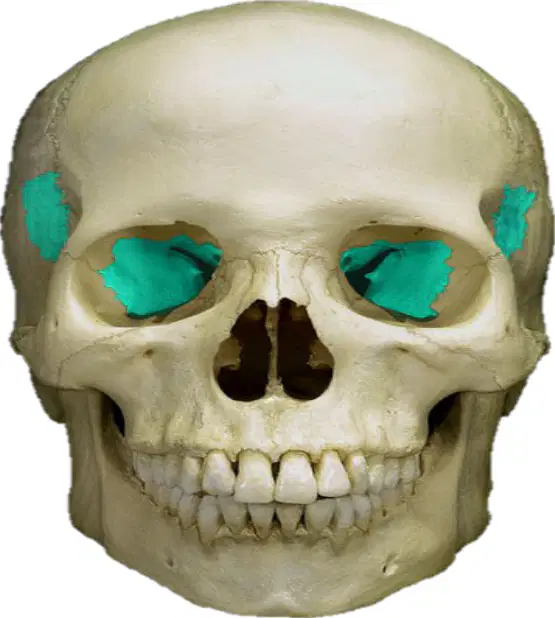
Which bone is highlighted in green in the provided images of the skull?

a)

Frontal bone

b)

Parietal bone

c)

Sphenoid bone

d)

Temporal bone

89.

What is #1?

a)

Spinous Process

b)

Vertebral Arch

90.

What is #8?

a)

Vertebral Arch

b)

Body

91.

What is #5?

a)

Body

b)

Spinous Process

92.

What is #6?

a)

Lamina

b)

Traverse Process

93.

What #3?

a)

traverse process

b)

Vertebral Foramen

94.

What is #4?

a)

Vertebral Foramen

b)

vertebral arch

95.

What is the vertebral body?

a)

Red Portion

b)

Blue Portion

96.

What is the vertebral arch?

a)

Red Portion

b)

Blue Portion

97.
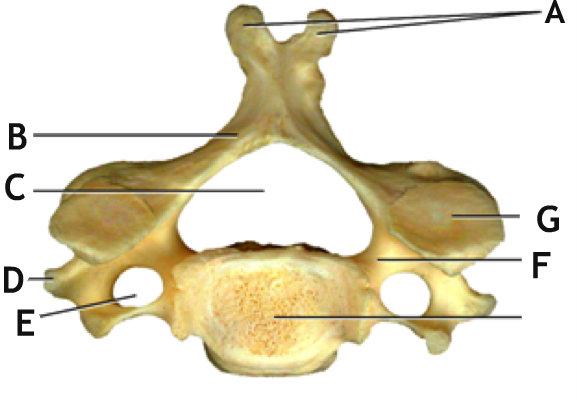
Which letter represents the pedicle?
a)
B
b)
C
c)
F
d)
A
98.

What structure is not apart of the vertebral arch?

a)

Pedicle

b)

Transverse Process

c)

Lamina

d)

Intervertebral Disc

e)

Spinous Process

99.

What is number 1? Bony projection posteriorly.

a)

Transverse Process

b)

Spinous Process

c)

Body

d)

Pedicle

100.

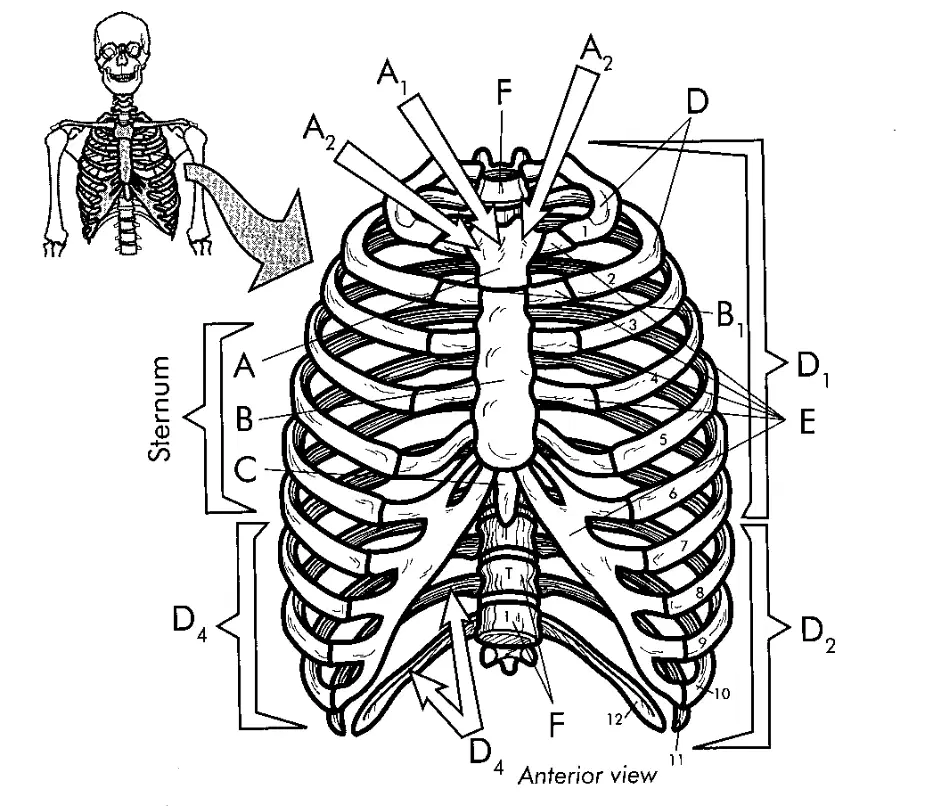
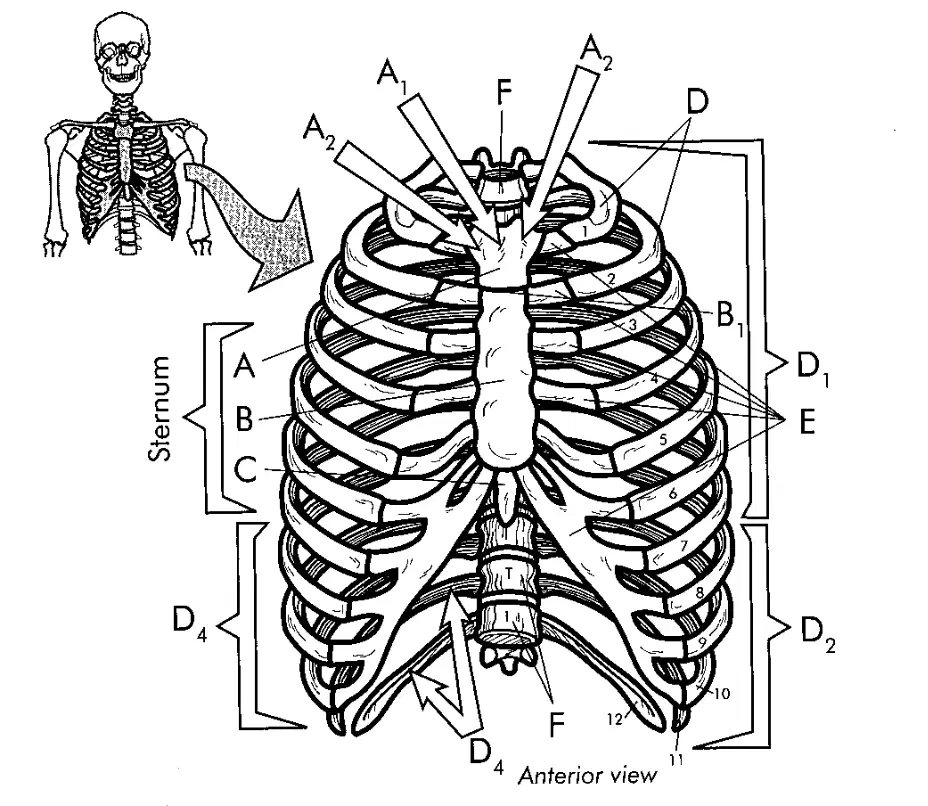
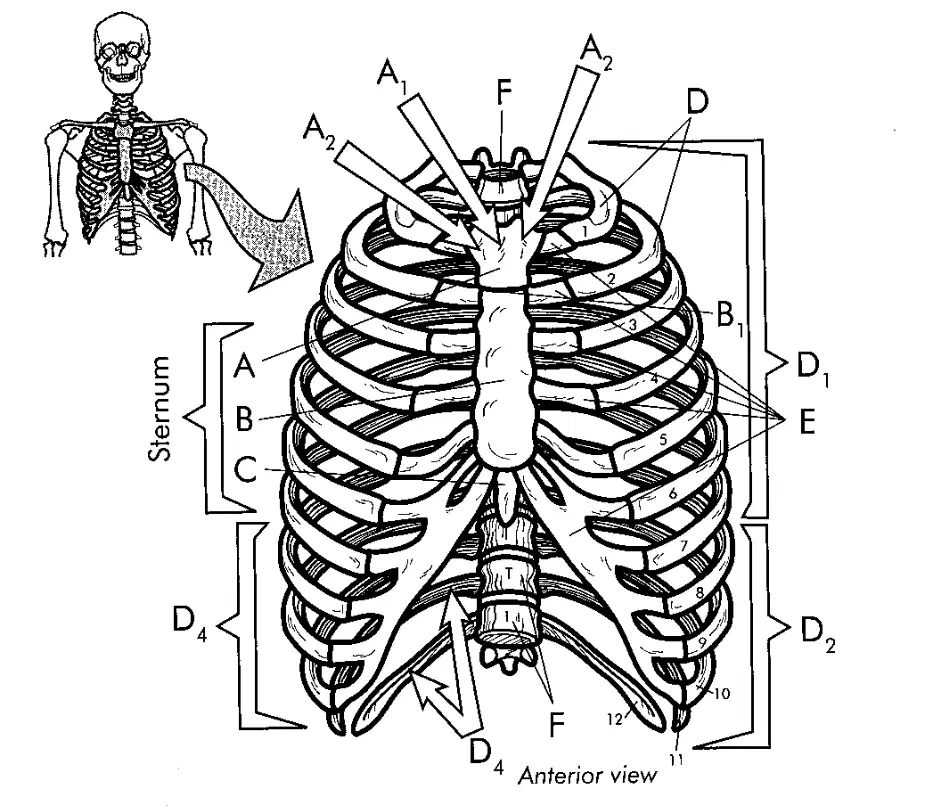
A

a)

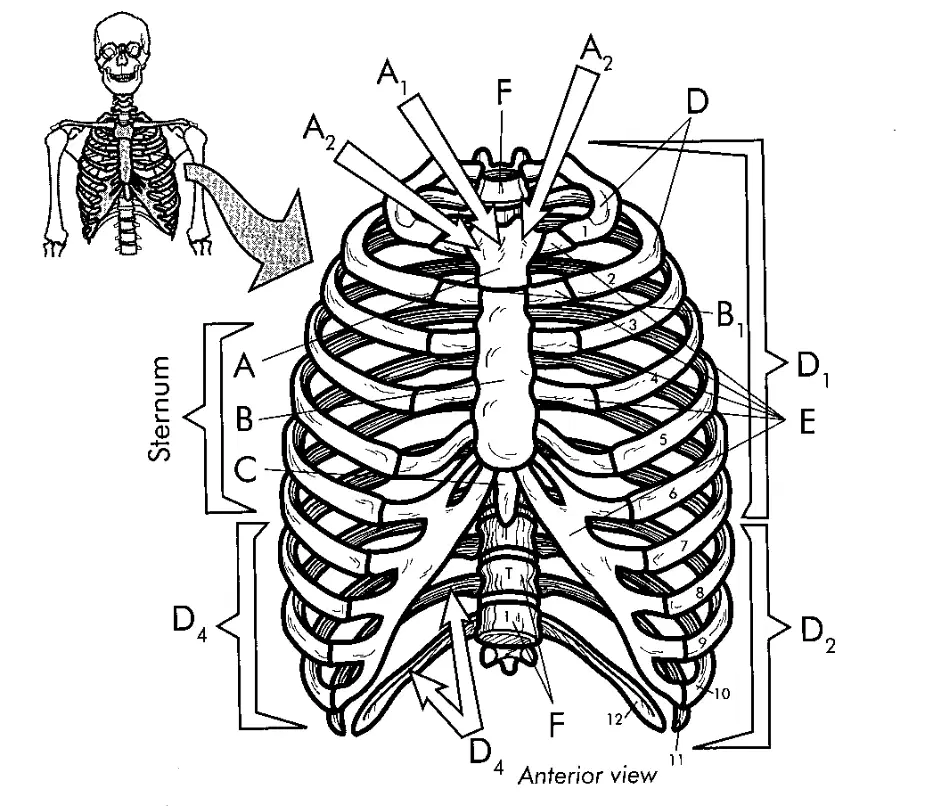
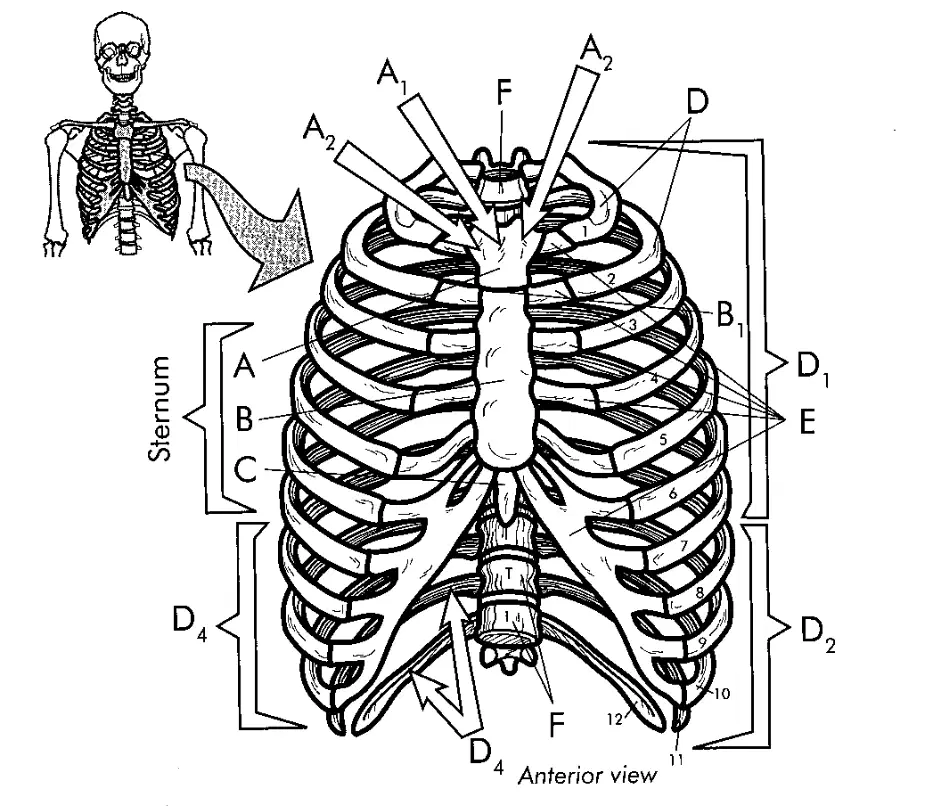
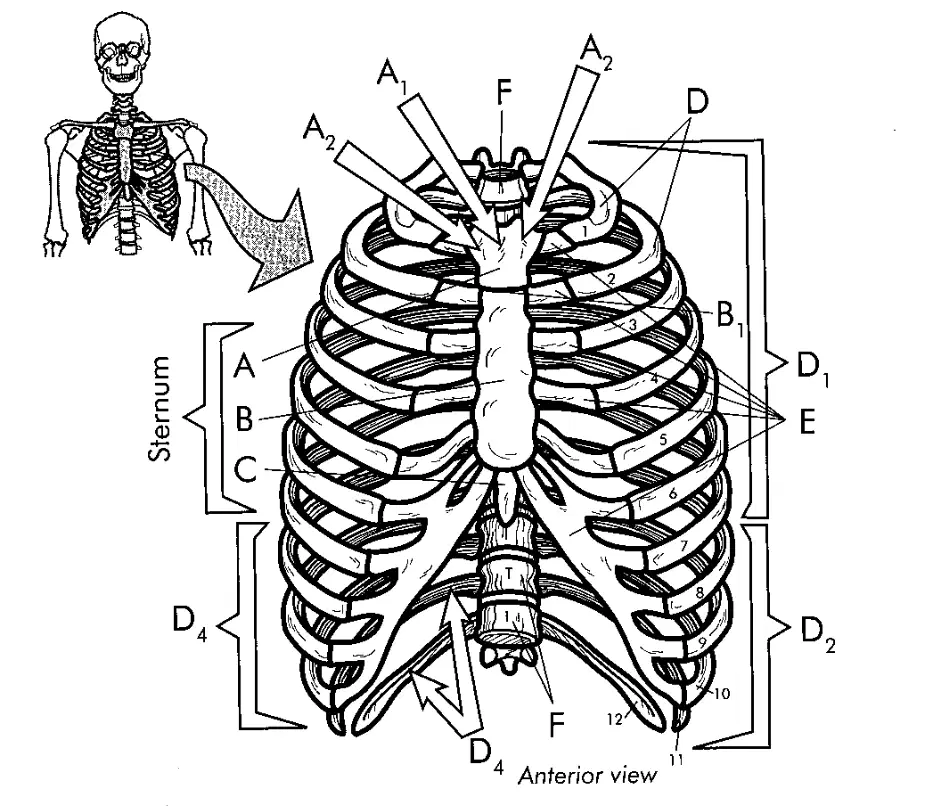
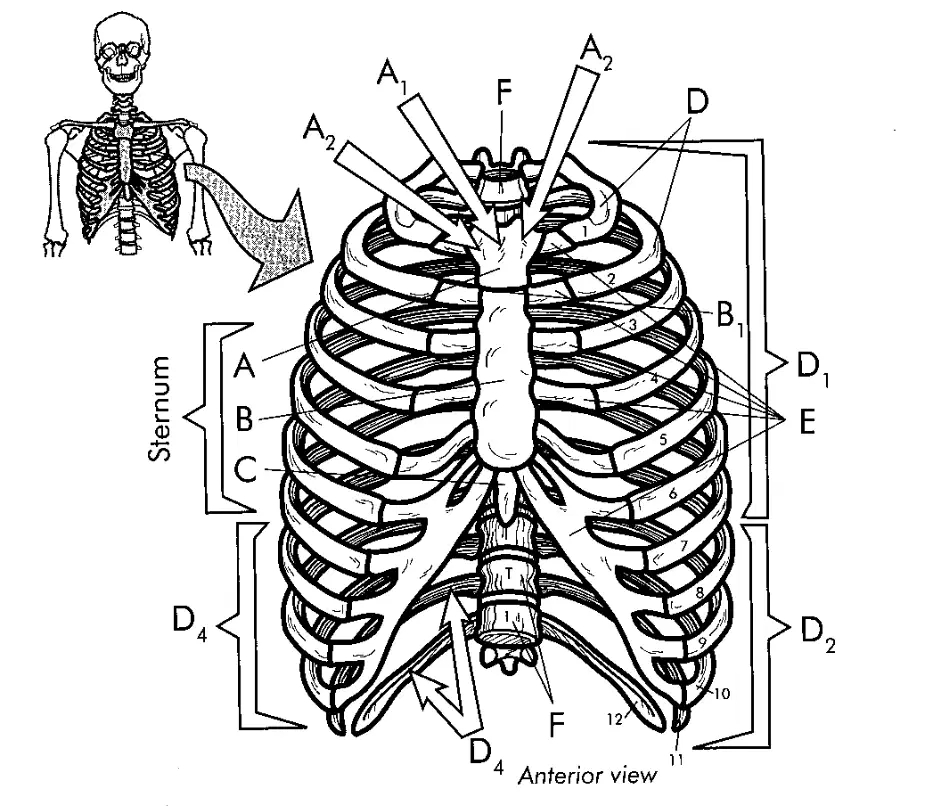
manubrium

b)

sternal angle

c)

xiphoid process

d)

body

101.

B

a)

sternal angle

b)

xiphoid process

c)

manubrium

d)

body

102.

C

a)

manubrium

b)

jugular notch

c)

xiphoid process

d)

sternal angle

103.

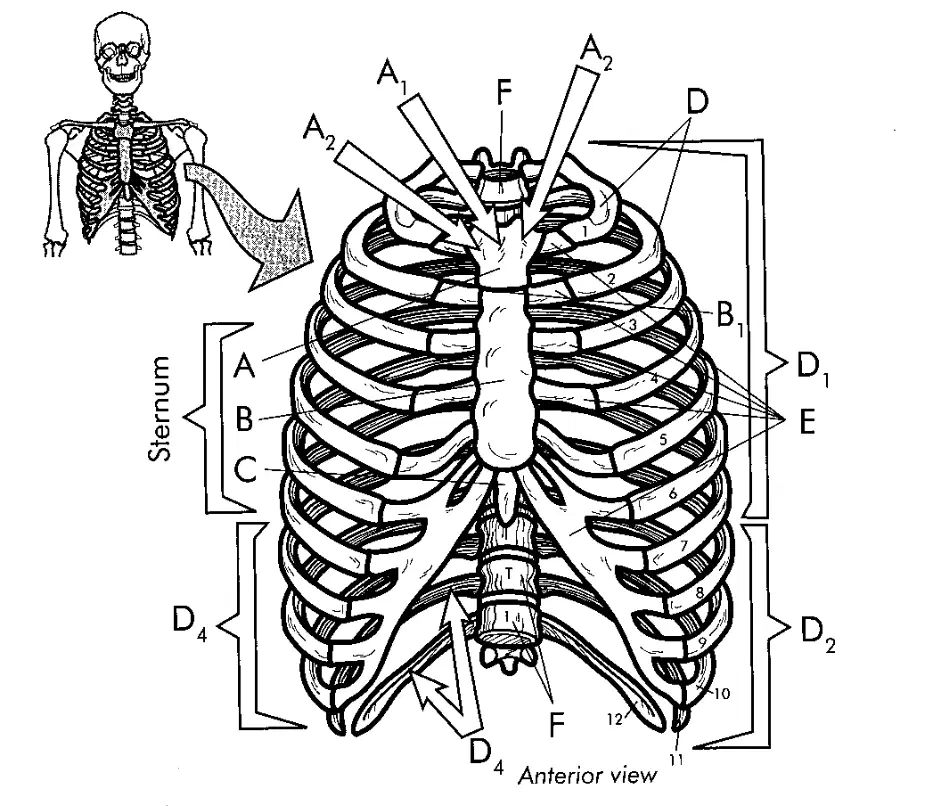
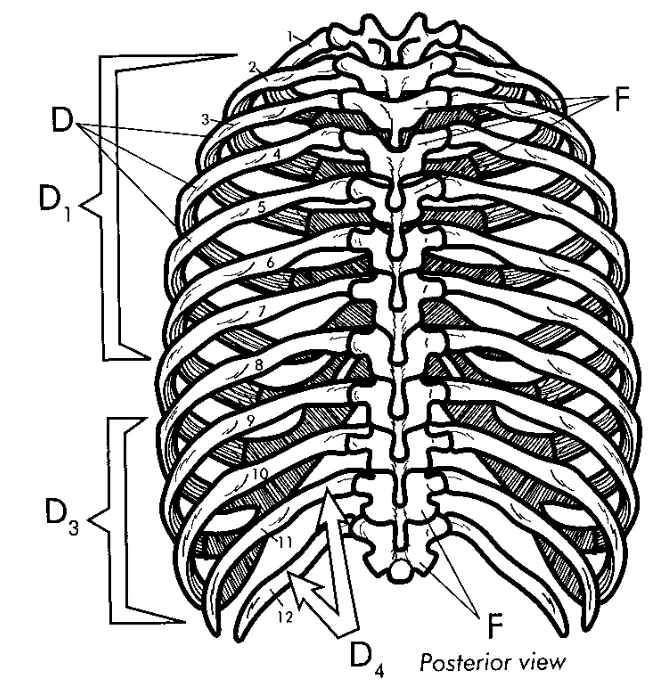
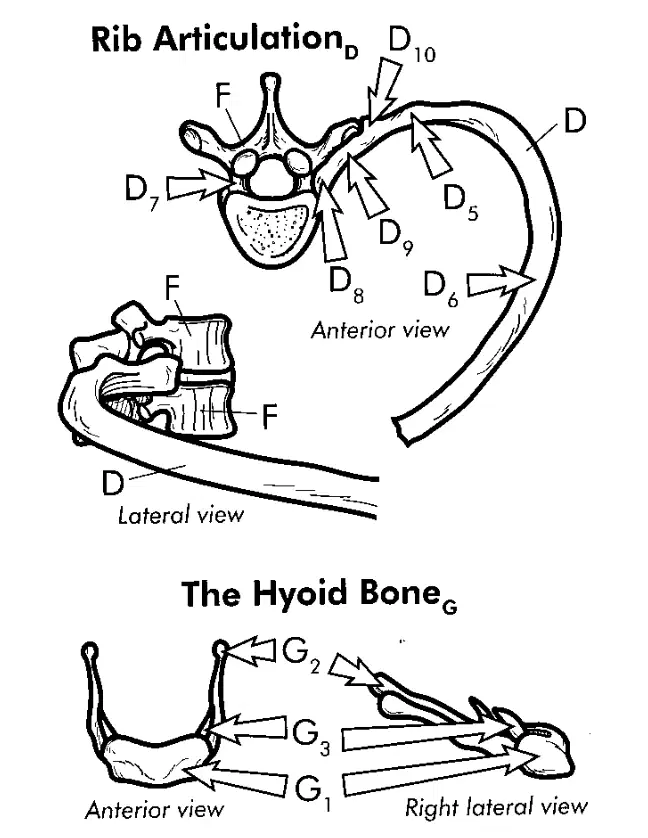
D

a)

tubercle

b)

body

c)

floating ribs

d)

rib

104.

D1

a)

true ribs

b)

false ribs

c)

vertebrochondral ribs

d)

capitulum

105.

D2

a)

costal cartilages

b)

false ribs

c)

true ribs

d)

vertebrochondral ribs

106.

D4

a)

floating ribs

b)

true ribs

c)

false ribs

d)

vertebrochondral ribs

107.

E

a)

vertebrochondral ribs

b)

xiphoid process

c)

floating ribs

d)

costal cartilages

108.

F

a)

vertebrae

b)

hyoid bone

c)

true ribs

d)

false ribs

109.

G1

a)

tubercle

b)

lesser horns

c)

greater horns

d)

hyoid bone body

110.
a)

sternum

b)

sacrum

c)

hyoid

d)

lumbar