
Font size
 Worksheets
Inequalities and Their Interpretations
Total questions: 212
Worksheet time: 6hrs 5mins

¿Qué muestra la recta numérica?
x = 3
x > 3
x < 3
x > 6

¿Qué desigualdad se muestra en el gráfico adjunto?
x < -1
x ≤ -1
x > -1
x ≥ -1

¿Qué desigualdad representa el gráfico de la recta numérica?
x ≤ 4
x ≥ -4
x < -4
x < 4

¿Qué desigualdad representa la gráfica de la recta numérica?
x ≥ 3
x > 3
x < -3
x ≤ -3
¿Qué desigualdad representa la gráfica de la recta numérica?
x ≥ 3
x > 3
x < -3
x ≤ -3

¿Qué desigualdad representa la gráfica de la recta numérica?
x > 5
x < −5
x ≥ 5
x ≥ −5

¿Qué desigualdad representa el gráfico de la recta numérica?
x < 4
x > -4
x < -4
x < 4

Relaciona el gráfico con su desigualdad.
a > 11
a < 11
a ≥ 11
a ≤ 11

¿Qué gráfico corresponde a la desigualdad
x ≥ 2.5?
A
B
C
D

¿Qué gráfico corresponde a la desigualdad
r ≥ -6?
A
B
C
D
x > 5
x es menor que 5
x es mayor que 5
x es menor o igual que 5
x es mayor o igual que 5
¿Cómo puedes escribir de otra forma más común:
7 > x
x > 7
x < 7
7 < x
¿Cómo puedes escribir de otra forma más común:
11≤ b
b ≤ 11
b >11
b ≥ 11
5+x≤6
24 ≤ h + 15
**Pista - ¡No olvides reescribir tu respuesta para que la variable esté primero (tendrás que invertir el signo de la desigualdad)!
h ≥ -9
h ≥ 9
h ≤ 39
-5 + w > -2
w > -7
w > 3
w < -7
w < 3
w - 12 ≥ - 23
w ≥ -11
w ≥ - 35
w ≥ 1
w ≥ -9
u + 14 ≤ 9
u ≤ -5
u ≤ 23
u ≤ 5
u ≥ -5
-10 ≥ -3 + a/4
a ≤ -28
a ≥ -28
a ≤ 28
a ≥ 28
-5 + d/4 > -7
d > -8
d < -8
d > 8
d < 8
-41 ≤ 4 - 5z
z ≤ 9
z ≥ 9
z ≤ -9
z ≥ -9
30 < -4f + 6
f < -6
f > -6
f < 6
f > 6
2 - 3r ≤ 32
r ≥ -10
r ≤ -10
r ≥ 10
r ≤ 10
-4 + p/3 ≥ 7
p ≥ 33
p ≥ 28
p ≥ 40
p ≥ 21
-6s + 4 < -50
s > 9
s < 9
s > 7
s < 7
-12 < -2y + 4
y < 8
y > 8
y < 4
y > 4
6v + 5 ≥ 71
v ≥ 11
v ≥ 13
v ≥ 9
v ≥ 7
5 ≥ -4 + x/2
x ≤ 18
x ≥ 18
x ≤ 14
x ≥ 10
4y < 12
y < 3
y < 48
12p ≥ 120
p ≤ 1440
p ≥1440
p ≤10
p ≥10
10n < 90
n < 900
n < 9

x<4
x≤1
x≤4
x≥1
Resuelve
-5m < 10
m < -2
m > -2
m < -50
m > -50
Resuelve
(n/3) > -20
n > 60
n < -17
n > -60
n < -23
x + 9 > 17
x > -8
x > 8
x > 26
x > -26
Resuelve.
−8x+7<15
x>1
x<1
x>−1
x<−1
Resuelve.
3n+3≥30
n≤9
n≥9
n≤11
n≥11
Resuelve.
17≤−2m−3
−10≥m
−10≤m
−7≥m
−7≤m
Resuelve para t.
6t + 4 ≤ -2
t ≤ -1
t ≤ 1
t = 1
1 = t

5(2 - 4g) - 3g ≤ 5g - 186
g ≥ 7
g ≤ 7
g ≥ -7
g ≤ -7
-73 < 5r - 9 + 3r
r > -8
r < -8
r > 8
r < 8
3y + 4y ≤ 119
y ≤ 17
y ≥ 17
y ≤ 7
y ≥ 7
-5k - 4 + 3k ≥ 30
k ≤ -17
k ≥ -17
k ≤ 17
k ≥ 17
23 ≥ -6a - 5 + 2a
a ≥ -7
a ≤ -7
a ≥ 7
a ≤ 7
8f - 176 ≤ 6(4 - 2f)
f ≤ 10
f ≥ 10
f ≤ -10
f ≥ -10
6b - 180 > 4(5 - 3b) - 2b
b > 10
b < 10
b > -10
b < -10
2(3 - 5q) < 6q - 58
q > 4
q < 4
q > -4
q < -4
-154 > 5x + 2x
x < -22
x > -22
x < 22
x > 22
11d - 246 ≥ 3(5 - 4d) - 6d
d ≥ 13
d ≥ 11
d ≥ 15
d ≥ 9

What is the slope of this line?
¿Cuál es la pendiente de esta línea?
21
35
610
−53

What is the slope of this line?
¿Cuál es la pendiente de esta línea?
-5
5
310
−310

What is the slope of this line?
¿Cuál es la pendiente de esta línea?
104
−103
103
52

What is the slope of this line?
¿Cuál es la pendiente de esta línea?
−310
310
103
−103

What is the slope of this line?
¿Cuál es la pendiente de esta línea?
5
10
-10
-5

What is the slope of this line?
¿Cuál es la pendiente de esta línea?
710
−107
107
−710

What is the slope of this line?
¿Cuál es la pendiente de esta línea?
10
5
-5
-10

¿Qué tipo de pendiente?
negativa
positiva
pendiente cero

¿Qué tipo de pendiente?
negativa
empinada
indefinida
pendiente cero
empanada

¿Qué tipo de pendiente?
pendiente indefinida
pendiente positiva
pendiente negativa
pendiente cero
What is the slope of this equation?
y=38x−5
-5
38
What is the y-intercept of this equation?
y=38x−5
38
-5
What is the slope of this line: y = 6x + 4
y
4
6
1/6
What is the y-intercept of the line: y = -2x + 6
y
unknown
-2
6
What is the slope of the line: y = -3/4x +2
-3/4
-2
4
-2
What is the slope of this line: y = -4x - 9
9
4
-4
-9
What is the y-intercept of this line: y = 2/3x - 4
2/3x
3
4
-4
y = -4x - 8
The slope is 4.
True
False
y = 1/2x - 3
The y-intercept is -3.
True
False
What is the y-intercept of this line: y = 5 - 7x
5
7
1/5
-7
What is the y-intercept of this line: y = 5 - 7x
5
7
1/5
-7
What is the y-intercept of this line: y = 5x
5
0
-5
Not enough information
What is the slope of this line: y = 10
10
Undefined
0
-10
Dibuja cada línea en la gráfica.
Draw the line on the graph for this equation: y=3x+2
Dibuja cada línea en la gráfica.
Draw the line on the graph for this equation: y=23x+3
Dibuja cada línea en la gráfica.
Draw the line on the graph for this equation: y=−6x−3
Dibuja cada línea en la gráfica.
Draw the line on the graph for this equation: y=37x+5
Dibuja cada línea en la gráfica.
Draw the line on the graph for this equation: y=−52x−2
Dibuja cada línea en la gráfica.
Draw the line on the graph for this equation: y=21x−1
Dibuja cada línea en la gráfica.
Draw the line on the graph for this equation: y=31x−4
Dibuja cada línea en la gráfica.
Draw the line on the graph for this equation: y=21x+4

Which equation best represents the relationship between x and y in the graph?
y = 3x + 3
y = 3x - 1
y = 1/3x + 3
y = 1/3x - 1

Which equation best represents the relationship between x and y on the graph?
y = -3x + 1/3
y = 1/3x + 3
y = 3x - 9
Which of the graphs represent y = 2x - 4?


Which equation best represents the relationship between x and y on the graph?
y = x + 3
y = x -3
y = -x + 3
y = -x - 3

What is the correct equation of the graph?
y=-3x+9
y=9x+3
y=3x+9
Choose the correct graph :
y=4x+6


Choose the correct graph :
y=6x-4

Using the following graphing, write a linear equation. (Type without spaces)
(a)

Write the equation for the line.
y= -1x+3
y= 4x+3
y=(1/4)x+3
y= -4x+3

Write the equation of the line.
y=(3/5)x-1
y=(-3/5)x-1
y=(5/3)x+1
y=(3/5)x+1

Write the equation of the line.
y = -2/3x + 4
y = 2/3x + 4
y = 3/2x + 4
y = -3/2x + 4
Determine the slope and y-intercept. y = 3/2x + 3
slope: 5 y-intercept: (0,3)
slope: 3/2 y-intercept: (0,3)
slope: 4 y-intercept: (0,3/2)
slope: 1/5 y-intercept: (0,5)
Encuentra la pendiente:
( - 4, 3 ) y ( - 6, - 7)
0
indefinida
-5
5
Encuentra la pendiente de la recta que pasa por cada par de puntos.
(-32, 5) y (4, -5).
14−5
0
18−5
Indefinida
Encuentra la pendiente de la recta que pasa por cada par de puntos.
(2, 3) y (-3,-5)
3 4
5 8
5 −8
3 −4
Encuentra la pendiente de la recta que pasa por cada par de puntos.
(-22, 9) y (5, -9).
Indefinida
0
-2
3 −2
Encuentra la pendiente de la recta que pasa por cada par de puntos.
(5,-6) y (12, -6).
7 12
127
0
Indefinida
Encuentra la pendiente de la recta que pasa por cada par de puntos.
(8, 4) y (2, 6).
3 −1
3 1
1
-1
Encuentra la pendiente de la línea que pasa por:
(-4, 7) y (-6, -4)
2/11
13/2
3/10
11/2
Encuentra la pendiente de la línea que pasa por:
(5, -10) y (5, -4)
indefinida
0
- 14/10
10/14
Encuentra la pendiente de la recta que pasa por:
(-3, -4) y (7, 6)
0
Indefinida
-1
1
Encuentra la pendiente de la recta que pasa por:
(6,7) y (4,2)
2/5
-5/2
5/2
-1/2
Encuentra la pendiente de la recta que pasa por:
(2, 4) y (6, 12)
1/2
-1/2
2
-2
Encuentra la pendiente de la recta que pasa por:
(10, 1) y (5, 2)
1/5
-1/5
5
-5
Encuentra la pendiente de la recta que pasa por:
(-2, 8) y (0, 8)
0
-2
2
1/2
Encuentra la pendiente de la recta que pasa por:
(-12, -5) y (0, -8)
1/4
-1/4
4
-4
Encuentra la pendiente dadas estos puntos:
(1,2) y (3,4)
1
2
-1
-2
Encuentra la pendiente dadas estos puntos:
(2,-4) y (3,1)
5
-3
3
-5

Encuentra la pendiente de la recta que pasa por los puntos (7, 12) y (9, 9).
m=−23
m= 34
m=−65
m=32

Encuentra la pendiente entre los puntos (6, 1) y (8, 10)
m=29
m=63
m=37
m=72

Encuentra la pendiente de la recta que pasa por los puntos (7, 9) y (9, 2).
m=−27
m=53
m=−35
m=92

Encuentra la pendiente de la recta que pasa por los puntos (1, 4) y (8, 10).
m=76
m=98
m=14
m=52

Encuentra la pendiente de los puntos (10, 9) y (2, 2)
m=87
m=51
m=26
m=45

Encuentra la pendiente de la recta que pasa por los puntos (10, 3) y (6, 10)
m=−47
m=−52
m=34
m=85

Encuentra la pendiente de la recta que pasa por los puntos (1, 4) y (10, 9).
m=95
m=54
m=38
m=18

Encuentra la pendiente de la recta que pasa por los puntos (1, 1) y (6, 10)
m=59
m=61
m=210
m=114

Encuentra la pendiente de los puntos (7, 5) y (4, 4)
m=31
m=84
m=29
m=49

Encuentra la pendiente de la recta que pasa por los puntos (10, 9) y (1, 1)
m=98
m=15
m=56
m=73

Encuentra la pendiente de los puntos (7, 6) y (10, 4)
m=−32
m=43
m=−15
m=76

Encuentra la pendiente de los puntos (1, 4) y (9, 5)
m=81
m=27
m=73
m=15

Encuentra la pendiente de la recta que pasa por los puntos (4, 2) y (7, 9)
m=37
m=51
m=85
m=210

Encuentra la pendiente de la recta que pasa por los puntos (6, 2) y (8, 5)
m=23
m=51
m=311
m=28

Encuentra la pendiente de la recta que pasa por los puntos (1, 6) y (10, 4)
m=−92
m=73
m=−110
m=136

Encuentra la pendiente de la recta que pasa por los puntos (6, 1) y (9, 9).
m=38
m=51
m=1211
m=19

Encuentra la pendiente de la recta que pasa por los puntos (8, 2) y (1, 4).
m=−72
m=61
m=−17
m=98

Encuentra la pendiente
m=−21
m=43
m=−15
m=78

Encuentra la pendiente de la recta que pasa por los puntos (10, 4) y (4, 11)
m=−67
m=−73
m=38
m=79

Encuentra la pendiente
m=−58
m=−65
m=27
m=31
Encuentra la pendiente de la recta que pasa por:
(-4, 7) y (-6, -4)
2/11
13/2
3/10
11/2
Encuentra la pendiente de la recta que pasa por:
(-3, -4) y (7, 6)
0
Indefinida
-1
1
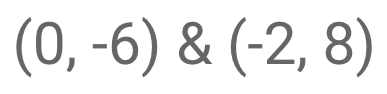
Determina la pendiente.
m=1/7
m=-1/7
m=-7
m=7
Encuentra la pendiente de la recta que pasa por:
(-4, 7) y (-6, -4)
2/11
13/2
3/10
11/2
Encuentra la pendiente de la recta que pasa por:
(10, 1) y (5, 2)
1/5
-1/5
5
-5
Encuentra la pendiente de la recta que pasa por:
(-2, 8) y (0, 8)
0
-2
2
1/2
Encuentra la pendiente de la recta que pasa por:
(-12, -5) y (0, -8)
1/4
-1/4
4
-4
Encuentra la pendiente dadas estos puntos:
(4,-4) y (2,0)
-2
2
1/2
-1/2
Encuentra la pendiente de una recta que pasa por los siguientes puntos:
(5,1) y (8,3)
m = 32
m = −32
m = −23
m = 23
Encuentra la pendiente de la recta que pasa por los puntos (6, 1) y (8, 10)
m=29
m=63
m=37
m=72


Which of the following equations match the given graph?
4x - 3y ≤ -9
3x + 4y ≥ 12
3x + 4y > 12
4x - 3y < -9


Which of the following inequalities matches the given graph?
5x - 2y ≥ -2
2x - 5y ≤ -10
2x - 5y ≥ -10
2x + 5y ≥ 10
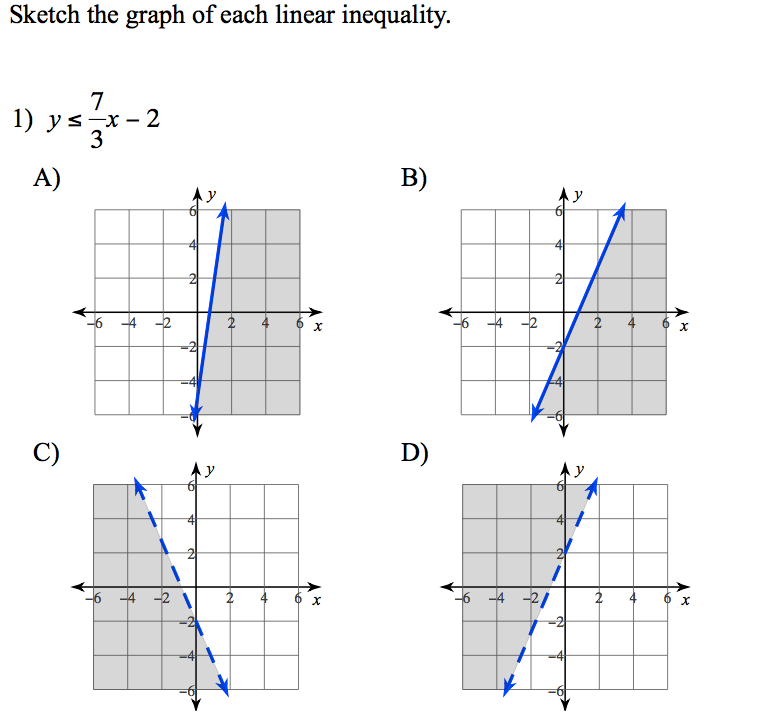
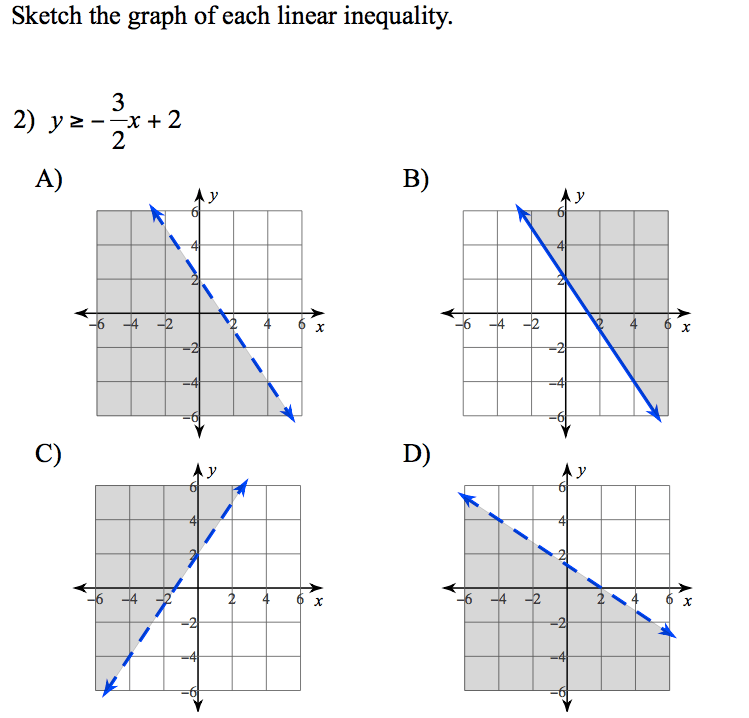
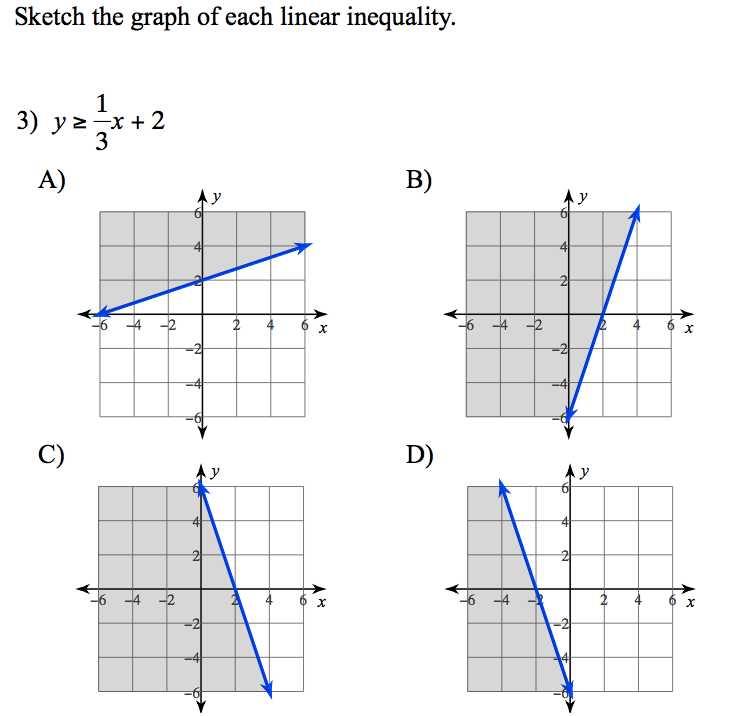
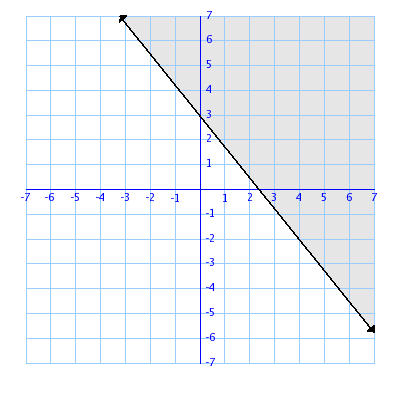

Which graph best represents the following inequality?


Determine whether point A is a solution to the linear inequality that is shown.
Yes
No
Sometimes
Determine whether point (-2,-3) is a solution to the linear inequality that is shown.
Yes
No
Sometimes

Is the point (3, 1) a solution for the following inequality? Choose the best answer that has the best explanation.
Yes because it is located in the shaded region.
No because it is located on the line and the line is dotted.
Yes because it is located on the line.
No because it is in the shaded region.

When graphing an inequality, which symbols tell you to use a dashed line?
<, >
≤, ≥
When graphing an inequality, which symbols tell you to use a solid line?
<, >
≤, ≥

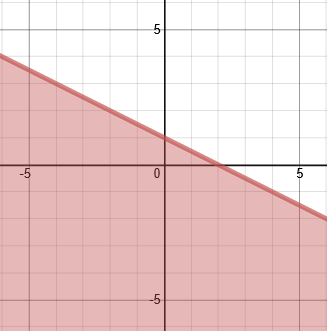
Determine whether point A is a solution to the linear inequality that is shown.
Yes
No
Sometimes
When graphing an inequality with the following symbol:
< or ≤
you should shade...
above the line
below the line
When graphing an inequality with the following symbol:
< or >
you should use a...
solid line
dashed line
When graphing an inequality with the following symbol:
> or ≥
you should shade...
above the line
below the line
When graphing an inequality with the following symbol: ≤or≥
you should use a...
solid line
dashed line
Which of the following is "NOT" a solution for the inequality?
y ≤ 5x - 1
(0, -3)
(5, 24)
(-2, -15)
(1, 7)
Which of the following is true of the given graph?
y ≥ -2x + 1
The graph is a dotted line, shaded above.
The graph is a solid line, shaded above.
The graph is a dotted line, shaded below.
The graph is a solid line, shaded below.
When graphing y<53x−4 , you will draw which of the following.
A dotted line
A solid line
Shade up
Shade down
How can I tell if an inequality will have a dashed line?
It has an equal sign.
The symbol is greater than or less than.
The symbol has "or equal to."
You just guess.
Is the point (1, 2) a solution for the following inequality? Choose the best answer that has the best explanation.
Yes because it is located in the shaded region.
No because it is located on the line and the line is dotted.
Yes because it is located on the line.
No because it is in the shaded region.
Which of the following is the graph of the inequality y<31x+4


Which of the following graphs best represents this inequality y≤56x+2


Which of the following graphs best represents this inequality y>59x+5


Which of the following graphs best represents this inequality y<41x−4


Which of the following graphs best represents this inequality y≥58x−5


Which of the following graphs best represents this inequality y>41x+2


Which of the following graphs best represents this inequality y≤5x


Which of the following graphs best represents this inequality y≤−47x−5


Which of the following graphs best represents this inequality y≤21x−1


Which of the following graphs best represents this inequality y<5x−4


Which of the following graphs best represents this inequality y<−41x−2


Which of the following graphs best represents this inequality y≥−x−1


Which of the following graphs best represents this inequality y≥54x+5


Which of the following graphs best represents this inequality y>5x−2


Which of the following graphs best represents this inequality y≥45x+2


Which of the following graphs best represents this inequality y>−9x−4


Which of the following graphs best represents this inequality y≤−2x−5


Which of the following graphs best represents this inequality x>0


Which of the following graphs best represents this inequality y≤2

Which of the following graphs best represents this inequality y≤−x−4


