
 Worksheets
Unit 3 and 4 Review
Total questions: 50
Worksheet time: 35mins
Which of the following are characteristics of a monopoly?
One seller
High barriers to entry
Control over price
All of the above
What type of monopoly is it when 1 company can produce items cheaper than 2 comp. firms?
Legal Monopoly
Natural Monopoly
Technical Monopoly
Geographic Monopoly
Monopolies are
Price Takers
Price Makers
Perfect competition is best described as a market with
few firms producing essentially the same product
many firms producing essentially the same product
many firms producing very different products
few firms producing very different products
A factor that makes it difficult for firms to enter a market is called...
a barrier to entry
an obstacle to entry
a block to entry
an impediment to entry
Perfect competition pushes firms to
maximum sales
take over other firms
maximum possible output
efficiency
What is the behavior of firms in perfect competition with regards to price?
They have control over the market price
They constantly undercut each other
They charge higher than the market price
They are passive price takers
Perfectly competitive firms will maximize profit where
MR > MC
MR < MC
MR = MC
TR = P x Q
If P < ATC, a firm should
shut down in the short run
stay open in the short run
stay open in the short run if P > AVC
shut down in the short run if P > AVC
Which of the following is not a characteristic for perfect competition?
No barriers to entry and exit
Large firms
Perfect Information
Homogenous product
Which of the following is an example of a perfectly competitive firm?
Farmer's market stand
Fast food restaurant
Cell phone service provider
Local internet service provider
Differentiation is _________________.
having identical products.
copying another business.
small differences that make your product unique.
having control of the market value.
Which of the following best describes an oligopoly?
many monopolistically competitive firms
a few firms sharing monopoly power
a former monopoly that has been broken up by the government
a government-granted franchise or monopoly
Oligopoly is a market structure characterized by:
independence in decision making
regulated natural monopolies
substantial diseconomies of scale
a large number of small firms
strategic behavior between rival firms
Oligopoly is a market structure that is characterized by a _____ number of ______ firms that produce _____ products.
large; relatively small, independent; identical
small; independent; identical or differentiated
large; relatively small, independent; differentiated
small; independent; differentiated
small; interdependent; identical or differentiated
In which of the following market structures is it sometimes assumed that rival firms will match price decreases but not match price increases?
Perfect competition
Oligopoly
Natural Monopoly
Monopolistic Competition
Monopoly
Which statement describes the law of demand?
As prices rise, quantity demanded decreases
As prices rise, demand decreases.
As prices fall, quantity demanded decreases.
As prices fall, demand decreases.
Which is an example of the Law of Demand at work?
The price of the pizza goes up when the price of cheese goes up.
Demand for pizza goes down when tacos become more popular
The price of pizza falls when the demand for pizza falls
Demand for pizza rises when the price of pizza falls
The amount of a good or service that producers are willing and able to sell at all possible prices during a given period of time.
Supply
Demand
Factor of Production
Production
The market equilibrium price is the price at which
surpluses depress the number of goods supplied
shortages and surpluses will have no effect on the market
the government will not intervene in the market
the quantity demanded is the same as the quantity supplied

When there is a shortage the price will usually?
rise
fall
remain the same
equilibrium
Which of the following best describes an oligopoly?
many monopolistically competitive firms
a few firms sharing monopoly power
a former monopoly that has been broken up by the government
a government-granted franchise or monopoly
Collusion most frequently occurs in industries that are
oligopolistic
monopolistically competitive
monopolistic
perfectly competitive
One difference between oligopolies and monopolistically competitive markets is that
there is no deadweight loss in monopolistically competitive markets, but there is in oligopolies
the products sold in monopolistically competitive markets are identical
oligopolies have fewer barriers to entry
firms maximize profits in monopolistically competitive markets but not in oligopolies
there are fewer firms in oligopolistic markets than in monopolistically competitive ones
In which of the following market structures is it sometimes assumed that rival firms will match price decreases but not match price increases?
Perfect competition
Oligopoly
Natural Monopoly
Monopolistic Competition
Monopoly
The cartel model of oligopoly predicts that
all firms in the industry act in unison to set monopoly price
each producer acts independently of others
firms follow the low-price firm in the industry
differences in cost of production discourage individual firms from cheating
the markup on marginal cost should be the same for all firms
Collusion, price leadership, and price wars are usually observed in which of the following market structures?
Perfect Competition
Monopolistic Competition
Oligopoly
Monopoly
Natural Monopoly
Oligopoly is a market structure characterized by:
independence in decision making
regulated natural monopolies
substantial diseconomies of scale
a large number of small firms
strategic behavior between rival firms
Oligopoly is a market structure that is characterized by a _____ number of ______ firms that produce _____ products.
large; relatively small, independent; identical
small; independent; identical or differentiated
large; relatively small, independent; differentiated
small; independent; differentiated
small; interdependent; identical or differentiated
What is a defining characteristic of an Oligopoly?
Mutual Interdependence
Great Usage of Non- Price Competition
Many Firms Competing For Business
Only one provider.
John Nash is famous for the _________ _________________, which is used in Game Theory.
(a)
When there is a best outcome regardless of the other players actions in Game Theory, we have a (a)
Strategy.

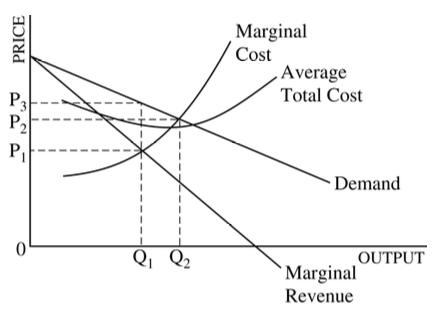
What will be the total revenue for this monopolist?
12.50
82.5
105.00
187.50
What will be the total profit for this monopolist?
12.50
82.5
105.00
187.50

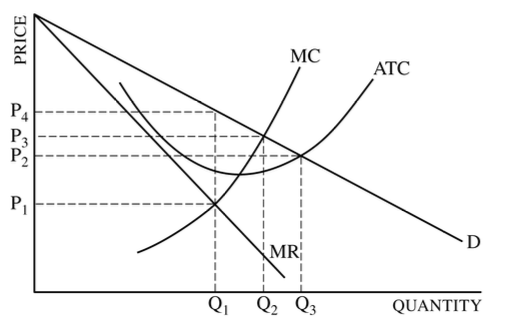
Based on this graph, this firm will:
make positive short-run profits
incur losses in the short-run
shut-down in the short run

In the long-run, price will equal
(a)
Firms are incurring short-run losses in a perfectly competitive firm. What will happen in the long-run?
New firms will enter and price will increase
New firms will enter and price will decrease
Firms will exit and price will increase
Firms will exit and price will decrease
Which of the following markets is closest to perfectly competitive?
airlines
wheat
cell phones
textbooks
Which of the following is NOT an assumption of perfect competition
perfect information
free entry and exit
different goods
lots of buyers/sellers
Which of the following would be an example of a fixed cost?
A monthly electricity payment that is sometimes higher or lower
A monthly electric bill of $26
The wages you pay a varying # of employees
A monthly rent payment of $500 that is locked in for a year
When a firm is producing 0 output; total cost =
0
Marginal Cost
Total Fixed Cost
Total Variable Cost
Where is the optimal output found for a perfectly competitive firm?
MC < MR
MR = MC
MR > MC
Price > ATC

