
Font size
 Worksheets
Unit 3 Review
Total questions: 25
Worksheet time: 13mins
During the 8th-century dispute over icons, which of the following supported the use of icons?
the Pope
the patriarch
the Byzantine emperor
the bishops of the East
Justinian set up a panel of experts to
negotiate with the Bulgar raiders.
create a Byzantine University.
plan the construction of a complex bridge.
compile laws to regulate a complex society.
Orthodox Christianity became the state religion of which of the following?
Byzantine Empire
Western Roman Empire
Seljuk Empire
Mongol Empire
The bargain made between a lord and a vassal was that the
vassal would build a city on the lord's lands.
lord would defend the vassal in battle.
lord would grant the vassal land in exchange for military service.
vassal would build a monastery in exchange for food.
Why did learning decline during the last years of Roman Empire?
Invaders burned most of the empire's collections of manuscripts.
Invaders could neither read nor write and did not understand Latin.
Everything written in Greek was destroyed by the invaders.
How were feudalism and manorialism related?
Feudalism was a social/political order, and manorialism was the economic arrangement that supported it.
Feudalism applied only to lords, while manorialism involved serfs.
The laws of feudalism were set by the king, and the laws of the manor were set by the Church.
Feudalism involved only war, while manorialism involved farming.
As the western half of the Roman Empire slid into decline in the late 5th century, the eastern half
fell to Muslim invaders from Arabia
carried on the Roman tradition of polytheism
continued many elements of Roman culture and developed into a new empire
reclaimed the west under a new Roman state
Who brought Christianity to the Franks (a Germanic kingdom in Gaul)?
Franks never accepted Christianity
Charlemagne
Charles Martel
Clovis
During the Post-Classical period, the western half of Christianity was
Eastern Orthodox
Methodist
Cyrillic
Roman Catholic
Religious Leadership
Rome:________________ :: Constantinople:______________
Pope, bishop
Pope, Emperor
bishop, Pope
Emperor, Pope
The term feudalism is best defined as a
holy war between Christians and Muslims
process in which goods are traded for other goods
division of political power between three separate branches
system in which land is exchanged for military service and loyalty
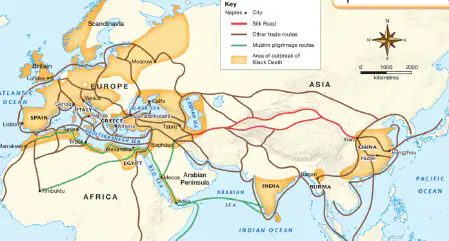
Which of the following is true about the spread of the Black Death in Europe?
its movement inland was slower than its movement on water
its spread was connected to trade
medieval armies’ use of biological warfare increased the rate of infection
most victims were forced out of cities to wander roads, leading to the disease’s spread
Which statement best describes one of the reasons for the end of medieval Europe?
European states moved from a cash economy to an economy based on control of landed property.
As trade between Europe and Asia decreased, the size of towns along these trade routes declined.
The Black Death reduced the population in Europe by almost one third, giving peasants and laborers greater economic power.
The Crusades interrupted trade between Asia and Europe.
The Crusades began in 1095 when the Pope called upon Christians to recapture the “Holy Land” (Jerusalem) from Muslim control. What was an unexpected result of the Crusades?
It ended a long period of trade between Europe and the Middle East.
The Pope was unseated from his position of authority over the Catholic Church.
Contact with the cultures of the Middle East brought about a decline in European art,
music, and literature.
Europeans learned of new products and ideas through their contact with Islamic culture.
Constantinople’s location on the Bosporus Strait was one reason that the Byzantine Empire was able to
conquer the Russian city of Moscow
spread Judaism throughout western Europe
control key trade routes between Europe and Asia
unite the Greek Orthodox Church and the Roman Catholic Church
One of the major works of architecture completed during the reign of Justinian was a huge cathedral called
Hagia Sophia
Colosseum
the Ka’aba
Canterbury Cathedral
Which of the following was not a way that Byzantium influenced Russia and most Slavic peoples?
architecture
language
religion
racial identity
Source: Justinian’s Code
The precepts of the law are these: to live honestly, to injure no one, and to give every man his due. The study of law consists of two branches, law public and law private. The former relates to the welfare of the Roman State; the latter to the advantage of the individual citizen.
What fundamental elements of law in the Western world can be seen above?
the law is meant to injure people
the law is meant for wealthy citizens
the law is divided into two branches
the law is dictated by religion
True or False: Did the location of Constantinople contribute to the growth and prosperity in the city/region?
True
False
Which of the following was NOT an achievement under the rule of Emperor Justinian?
Building the Hagia Sophia
Creation of the Justinian Code
Recapturing Western Rome
Changing the name of the city from Byzantium to Constantinople
The people of the Byzantine Empire viewed themselves as:
Greek
Roman
Muslims
Byzantiums
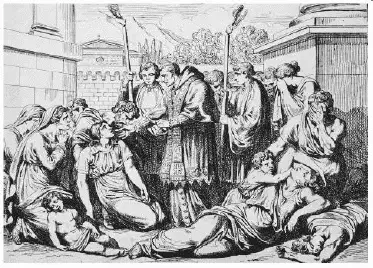
Which of the following statements best describes the relationship between the Bubonic Plague and medieval Catholic Church?
The Plague cured the greed and general corruption of the Church
Bishops and priests fled to Constantinople to avoid the Plague
The inability of bishops and priests to cure inflicted citizens weakened the power of the Church
The Plague was spread by Christian missionaries
All of the following were effects of the Crusades except for
decreased power of the Pope and church
brought the middle east under Christian control
left a legacy of bitterness and hatred for Muslims toward Christians
weakened feudal nobility and increased power of the kings
Which institution served as the main unifying force of medieval Western Europe?
legislature
monarchy
military
church

