
Font size
 Worksheets
Acute Coronary Syndromes Ch 30
Total questions: 91
Worksheet time: 46mins
According to the contents, which class of drugs is specifically mentioned for secondary prevention after ACS?
Drugs for Secondary Prevention After ACS
Antiviral Drugs
Beta Blockers Only
Diuretics
Based on the table of contents, what is the primary focus of Chapter 30?
Acute Coronary Syndromes
Chronic Kidney Disease
Diabetes Mellitus
Hypertension
If a student wanted to learn about the differences between UA, NSTEMI, and STEMI, which section should they refer to?
Diagnosis
Background
Key Counseling Points
Other Considerations
Which of the following is a type of antiplatelet drug mentioned in the contents?
P2Y12 Inhibitors
ACE Inhibitors
Statins
Calcium Channel Blockers
Suppose a patient is being treated for ACS and the physician is considering a glycoprotein IIb/IIIa receptor antagonist. Which section of the chapter would provide more information about this drug class?
Antiplatelet Drugs
Fibrinolytics
Diagnosis
Key Counseling Points
A student is preparing a presentation on the key counseling points for patients after ACS. Which page should they refer to according to the contents?
Page 505
Page 497
Page 498
Page 500
Which of the following best describes the main cause of acute coronary syndrome (ACS)?
Plaque buildup (atherosclerosis) in the coronary arteries
Viral infection of the heart muscle
High levels of potassium in the blood
Congenital heart defects
Which symptom is most commonly associated with acute coronary syndrome (ACS)?
Chest pain lasting more than 10 minutes
Sudden loss of vision
Persistent cough
Severe abdominal cramps
Which of the following is NOT a modifiable risk factor for ACS?
Age
Smoking
Lack of exercise
Excessive alcohol
What should a patient do if chest pain is not improved or worsens five minutes after the first dose of sublingual nitroglycerin?
Call 911
Take another medication
Wait for 30 minutes
Drink a glass of water
Which diagnostic test should be performed and evaluated within ten minutes at the site of first medical contact for suspected ACS?
12-lead ECG
Chest X-ray
Echocardiogram
MRI scan
Which cardiac biomarkers are considered the most sensitive and specific for diagnosing ACS?
Cardiac troponins I and T (TnI and TnT)
Creatine kinase myocardial isoenzyme (CK-MB)
Myoglobin
C-reactive protein
A 60-year-old male with a history of hypertension and smoking presents with chest pain radiating to his jaw. Which risk factors for ACS does he have?
Age, hypertension, smoking
Female gender, diabetes, lack of exercise
Young age, no family history, healthy lifestyle
Only excessive alcohol use
Why is it important to obtain cardiac biomarker levels at presentation and again 3–6 hours after symptom onset in patients with ACS symptoms?
To detect changes in cardiac enzyme levels that confirm diagnosis
To monitor blood sugar levels
To check for kidney function
To assess lung capacity
Which of the following best explains why ACS is considered a medical emergency?
It can lead to sudden, reduced blood flow (ischemia) and cardiac muscle cell death
It always causes a fever
It is easily treated with over-the-counter medication
It only affects young adults
A patient with suspected STEMI should be transported to which facility if possible?
A hospital with percutaneous coronary intervention (PCI) capability
A local pharmacy
A general practitioner’s office
A rehabilitation center
Which of the following is a distinguishing feature of STEMI compared to UA and NSTEMI?
ST segment elevation
Partial blockage
Negative cardiac enzymes
None or transient ischemic ECG changes
What is the primary goal of treatment for acute coronary syndromes?
Immediate relief of ischemia and prevention of MI expansion and death
Lowering blood pressure only
Increasing cholesterol levels
Reducing fever
Which drug class works by inhibiting platelet aggregation to prevent clot formation/growth?
Antiplatelets
Anticoagulants
Antianginals
Beta-blockers
A patient with STEMI should have blocked arteries opened as quickly as possible with which of the following treatments?
PCI or fibrinolysis
Antibiotics
NSAIDs
Immediate-release nifedipine
If PCI cannot be performed within 120 minutes of first medical contact, what therapy is recommended for STEMI patients?
Fibrinolytic therapy
Antibiotics
Beta-blockers only
Immediate-release nifedipine
Which of the following medications should be avoided in the acute setting of ACS due to increased risk of mortality?
NSAIDs (except aspirin)
Aspirin
Oxygen
Nitrates
Which of the following is NOT a mechanism of action for antianginal drugs?
Decrease myocardial oxygen demand
Increase blood flow to relieve ischemia
Inhibit clotting factors
Prevent platelet aggregation
What is the role of a stent in PCI?
To keep the artery open after widening it
To dissolve blood clots
To measure blood pressure
To deliver medication directly to the heart muscle
Which of the following is a reason immediate-release nifedipine should not be used in the acute setting of ACS?
It increases the risk of mortality
It lowers cholesterol too quickly
It causes excessive sedation
It increases platelet aggregation
Which drug provides pain relief and helps anxiety in patients with acute coronary syndrome (ACS)?
Morphine sulfate
Aspirin
Oxygen
Beta-Blockers
What is the primary clinical benefit of nitrates in the management of ACS?
Dilate coronary arteries and improve collateral blood flow
Reduce heart rate and contractility
Inhibit clotting factors
Block angiotensin II production
Which of the following drugs should be administered if arterial oxygen saturation is less than 90% or if respiratory distress is present?
Oxygen
Aspirin
Beta-Blockers
ACE Inhibitors
Which antiplatelet drugs are mentioned as P2Y12 inhibitors for ACS management?
Clopidogrel, prasugrel, and ticagrelor
Aspirin, enoxaparin, and bivalirudin
Morphine, oxygen, and nitrates
Eptifibatide, tirofiban, and dalteparin
According to the guidelines, when should an oral, low-dose beta-blocker be started in ACS patients (if not contraindicated)?
Within the first 24 hours
After 48 hours
Only after discharge
Only if pain persists
Which of the following is a contraindication for the use of ACE inhibitors in ACS patients?
ACE inhibitor intolerance
Low blood pressure
History of aspirin allergy
Oxygen saturation above 95%
Which anticoagulant is preferred for STEMI patients according to the document?
Bivalirudin
Aspirin
Morphine sulfate
Clopidogrel
Which of the following is a long-term benefit of beta-blockers in ACS patients?
Improved long-term survival
Increased oxygen saturation
Reduced anxiety
Enhanced platelet inhibition
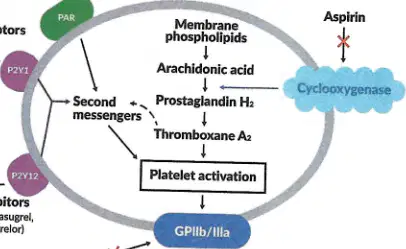
Which enzyme does aspirin irreversibly inhibit to decrease the production of thromboxane A2?
COX-1 and COX-2
ADP receptors
PAR-1 receptor
GPIIb/IIIa receptor
What is the primary action of P2Y12 inhibitors on platelets?
Bind to the platelet adenosine diphosphate (ADP) P2Y12 receptors
Inhibit cyclooxygenase
Block the PAR-1 receptor
Increase thromboxane A2 production
Which receptor do GPIIb/IIIa antagonists block to prevent platelet aggregation?
GPIIb/IIIa receptor
ADP receptor
PAR-1 receptor
Cyclooxygenase receptor
What is the role of dual antiplatelet therapy (DAPT) in acute coronary syndrome (ACS)?
It combines aspirin with a P2Y12 inhibitor to prevent platelet aggregation.
It uses only aspirin to prevent clot formation.
It combines aspirin with a GPIIb/IIIa antagonist for long-term therapy.
It uses only P2Y12 inhibitors for maintenance therapy.
Clopidogrel is classified as which type of drug?
Prodrug
Active metabolite
Cyclooxygenase inhibitor
Thrombin receptor antagonist
Which enzyme is primarily responsible for converting clopidogrel to its active metabolite?
CYP2C19
COX-1
GPIIb/IIIa
PAR-1
What is a major contraindication for clopidogrel therapy?
Serious bleeding (e.g., GI, intracranial hemorrhage)
Hypertension
Diabetes mellitus
Hyperlipidemia
Which medication should NOT be used with clopidogrel due to drug interactions?
Omeprazole
Aspirin
Atorvastatin
Metoprolol
What is the recommended maintenance dose of clopidogrel for most patients?
75 mg PO daily
300 mg PO daily
600 mg PO daily
150 mg PO daily
Which of the following drugs is only indicated for ACS managed with PCI and should be dispensed in its original container to protect from moisture?
Prasugrel (Effient)
Ticagrelor (Brilinta)
Cangrelor (Kengreal)
Clopidogrel
What is the recommended maintenance dose (MD) of Ticagrelor (Brilinta) after the initial loading dose for the first year following PCI?
10 mg PO daily
90 mg PO BID
60 mg PO BID
5 mg PO daily
Which of the following is a boxed warning for both Prasugrel and Ticagrelor?
Risk of severe hepatic impairment
Significant, sometimes fatal, bleeding
Dyspnea (>10%)
Bradyarrhythmias
A 78-year-old patient with a history of diabetes is being considered for Prasugrel therapy after PCI. Based on the safety information, what is the most appropriate action?
Start Prasugrel immediately
Avoid Prasugrel due to high bleeding risk
Use a higher dose of Prasugrel
Switch to Cangrelor
Which drug is administered as an IV bolus prior to PCI and continued as an infusion for the duration of the procedure?
Prasugrel (Effient)
Ticagrelor (Brilinta)
Cangrelor (Kengreal)
Clopidogrel
Why should Ticagrelor not be given with maintenance doses of aspirin greater than 100 mg daily?
It increases the risk of bradyarrhythmias
It reduces the effectiveness of Ticagrelor
It causes severe hepatic impairment
It increases the risk of uric acid elevation
A patient is scheduled for elective surgery and is currently taking Prasugrel. How many days before the surgery should Prasugrel be stopped?
2 days
3 days
5 days
7 days
Which of the following is a contraindication for all three drugs listed (Prasugrel, Ticagrelor, Cangrelor)?
Severe hepatic impairment
Active serious bleeding
History of TIA
Dyspnea
After discontinuation of Cangrelor, how long does it take for its effects to be gone?
30 minutes
1 hour
6 hours
24 hours
Which side effect is more likely to occur with Ticagrelor compared to Prasugrel?
TTP
Dyspnea (>10%)
Severe hepatic impairment
Bradyarrhythmias
Which of the following drugs should be avoided in combination with clopidogrel due to the risk of decreased antiplatelet effect?
CYP2C19 inhibitors esomeprazole and omeprazole
NSAIDs and warfarin
Simvastatin and lovastatin
Digoxin
What is the main risk when P2Y12 inhibitors are used with NSAIDs, warfarin, SSRIs, or SNRIs?
Increased bleeding risk
Decreased drug absorption
Increased blood pressure
Decreased heart rate
Which statement best describes the mechanism of action of glycoprotein IIb/IIIa receptor antagonists like eptifibatide and tirofiban?
They reversibly block the GPIIb/IIIa receptor to prevent platelet aggregation.
They inhibit CYP3A4 enzymes to reduce drug interactions.
They increase platelet production in the bone marrow.
They act as anticoagulants by inhibiting thrombin.
A patient on ticagrelor should avoid which of the following due to the risk of increased drug levels?
Strong CYP3A4 inhibitors or inducers
NSAIDs
Digoxin
Eptifibatide
Which of the following is a contraindication for the use of eptifibatide?
Thrombocytopenia (platelets < 100,000 cells/mm³)
Mild hypertension
History of seasonal allergies
Controlled diabetes
A patient is being considered for eptifibatide therapy. Which monitoring parameter is most important to assess during treatment?
Hemoglobin, hematocrit, platelets, signs/symptoms of bleeding, and renal function
Blood glucose and potassium levels
Liver function tests only
Serum calcium and magnesium
If a patient with a history of hemorrhagic stroke within the past 30 days is prescribed eptifibatide, what is the most appropriate action?
Do not administer eptifibatide due to contraindication.
Reduce the dose of eptifibatide.
Monitor the patient more frequently.
Substitute with a higher dose of tirofiban.
Why should clopidogrel and repaglinide not be used together?
Clopidogrel increases the effects of repaglinide, which can cause hypoglycemia.
Repaglinide increases the risk of bleeding with clopidogrel.
Both drugs are metabolized by CYP3A4, leading to toxicity.
They both cause hypertension.
A patient with ACS is on a P2Y12 inhibitor and develops significant bleeding. What is the best course of action regarding the P2Y12 inhibitor?
Manage the bleeding without discontinuing the P2Y12 inhibitor if possible.
Immediately stop the P2Y12 inhibitor permanently.
Switch to a CYP3A4 inhibitor.
Double the dose of the P2Y12 inhibitor.
A patient is receiving tirofiban and has a creatinine clearance (CrCl) of 50 mL/min. How should the maintenance dose be adjusted?
Reduce the maintenance dose to 0.075 mcg/kg/min.
Increase the maintenance dose to 0.3 mcg/kg/min.
No adjustment is needed.
Double the loading dose.
Which of the following is a primary indication for the use of Vorapaxar?
To reduce thrombotic cardiovascular events in patients with a history of MI or PAD
To treat acute heart failure
To manage hypertension
To control arrhythmias
What is the recommended daily oral dose of Vorapaxar (Zontivity)?
2.08 mg (one tablet)
10 mg (two tablets)
5 mg (one tablet)
0.5 mg (half tablet)
Which of the following is a major safety concern (boxed warning) for Vorapaxar?
Bleeding risk, including ICH and fatal bleeding
Severe hypertension
Renal failure
Hyperkalemia
Vorapaxar should NOT be used in patients with which of the following conditions?
History of stroke, TIA, ICH, or active serious bleeding
Mild hypertension
Controlled diabetes
Mild anemia
Vorapaxar is a substrate of which enzyme, making it important to avoid strong inhibitors or inducers?
CYP3A4
CYP2D6
CYP1A2
CYP2C9
Which of the following best describes the mechanism of action of fibrinolytic drugs?
They convert plasminogen to plasmin, leading to clot breakdown
They inhibit platelet aggregation
They block beta-adrenergic receptors
They increase cardiac contractility
Fibrinolytics are used only for which type of myocardial infarction?
STEMI
NSTEMI
Unstable angina
Silent MI
What is the recommended time window for administering fibrinolytic therapy to improve survival in STEMI?
Within 30 minutes of hospital arrival
Within 2 hours of symptom onset
Within 6 hours of hospital discharge
Within 48 hours of diagnosis
Which of the following is a contraindication for the use of Alteplase (Activase)?
Active internal bleeding or bleeding diathesis
Mild hyperlipidemia
Controlled asthma
Mild dehydration
A patient weighing 75 kg is to receive Tenecteplase (TNKase) for STEMI. What is the correct single IV bolus dose?
40 mg
30 mg
35 mg
50 mg
Which of the following is a common side effect of fibrinolytic therapy?
Bleeding (including ICH)
Hyperglycemia
Bradycardia
Hypokalemia
Why is it important to monitor hemoglobin (Hgb), hematocrit (Hct), and signs/symptoms of bleeding in patients receiving fibrinolytics?
To detect and manage potential bleeding complications
To assess liver function
To monitor for arrhythmias
To evaluate renal function
Explain why fibrinolytic therapy is only recommended for STEMI and not for other types of myocardial infarction.
Because evidence shows improved survival only in STEMI patients
Because it is less expensive for STEMI
Because it is easier to administer in STEMI
Because it is not effective in any type of MI
A patient with a recent history of intracranial hemorrhage is being considered for Alteplase therapy. What should be the clinical decision and why?
Alteplase should be avoided due to high risk of bleeding
Alteplase should be given at a lower dose
Alteplase is safe in this patient
Alteplase should be replaced with aspirin
Describe the difference in dosing of Alteplase when used for ischemic stroke compared to STEMI.
The dosing regimen differs and should be referenced in the stroke chapter
The dosing is always the same
The dose is doubled for stroke
The dose is halved for stroke
Which medication is typically recommended indefinitely (usually 81 mg per day) for secondary prevention after an acute coronary syndrome (ACS), unless contraindicated?
Aspirin
Beta-blocker
Statin
Nitroglycerin
For how long should a P2Y12 inhibitor be used in medical management after ACS, in combination with aspirin 81 mg?
At least 12 months
At least 3 months
At least 6 months
At least 24 months
Which of the following is a contraindication for aldosterone antagonist therapy in patients after ACS?
Renal impairment (SCr > 2.5 mg/dL in males)
Hypertension
Diabetes
Heart failure with reduced ejection fraction
Why should COX-2 selective NSAIDs be avoided in patients with high cardiovascular risk after ACS?
They increase cardiovascular risk
They are ineffective for pain relief
They cause hypoglycemia
They interact with statins
A patient with ACS and atrial fibrillation (AF) who has undergone PCI with a stent may require which of the following therapies?
Triple antithrombotic therapy
Only aspirin
Only a beta-blocker
Only a statin
If a patient is at high risk of bleeding after PCI, what adjustment may be considered regarding dual antiplatelet therapy (DAPT)?
Transition to ticagrelor monotherapy or de-escalate DAPT after 1 month
Continue DAPT indefinitely
Stop all antiplatelet therapy immediately
Increase the dose of aspirin
Which lifestyle counseling advice is recommended for patients after ACS?
Encourage physical exercise and a healthy diet
Avoid all medications
Increase alcohol intake
Avoid managing chronic conditions
Explain why proton pump inhibitors are recommended for patients with a history of GI bleeding who are taking triple antithrombotic therapy after ACS.
To reduce the risk of gastrointestinal bleeding
To increase the absorption of antithrombotic drugs
To lower blood pressure
To prevent heart failure
Which medications are mentioned for patient counseling in the Stable Angina chapter?
Aspirin, nitrates, and clopidogrel
Beta-blockers, statins, and insulin
Warfarin, digoxin, and amlodipine
Metformin, lisinopril, and furosemide
According to the 2017 ESC Guidelines, which condition is managed in patients presenting with ST-segment elevation?
Acute Myocardial Infarction
Stable Angina
Heart Failure
Atrial Fibrillation
Which guideline provides a focused update on the duration of dual antiplatelet therapy in patients with coronary artery disease?
2016 ACC/AHA Guideline
2017 ESC Guidelines
2014 AHA/ACC Guideline
2013 ACCF/AHA Guideline
If a patient presents with Non-ST-Elevation Acute Coronary Syndromes, which guideline should be referenced for management?
2014 AHA/ACC Guideline
2017 ESC Guidelines
2016 ACC/AHA Guideline
2013 ACCF/AHA Guideline
A physician is planning the management of ST-Elevation Myocardial Infarction. Which guideline should they consult?
2013 ACCF/AHA Guideline
2017 ESC Guidelines
2016 ACC/AHA Guideline
2014 AHA/ACC Guideline
Explain why dual antiplatelet therapy duration is important in patients with coronary artery disease, referencing the appropriate guideline.
It reduces the risk of recurrent cardiovascular events, as highlighted in the 2016 ACC/AHA Guideline.
It increases blood pressure, as highlighted in the 2017 ESC Guidelines.
It prevents diabetes, as highlighted in the 2014 AHA/ACC Guideline.
It treats arrhythmias, as highlighted in the 2013 ACCF/AHA Guideline.

