
 Worksheets
Earth Science Worksheet Questions
Total questions: 20
Worksheet time: 10mins
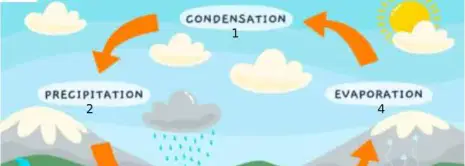
What would happen if the process no. (4) increases? Refer to the water cycle diagram showing condensation (1), precipitation (2), collection (3), and evaporation (4).
The seas levels would be increases and there would be more precipitation.
The seas level would be increase and there would be less precipitation.
The seas levels would be decrease and there would be less precipitation.
The seas levels would be decrease and there would be more precipitation.
The water in the seas and oceans don't quickly oscillate in temperature due to water ...
absorb heat slowly.
release large amount of energy.
has an acidic effect.
is changeful solvent.
Water is liquid at room temperature due to
High boiling point of water.
High melting point of water
Cohesive forces by hydrogen bonds.
Combination of atoms by covalent bonds
Water molecules have an angular geometry due to
The low difference in the electronegativity difference between oxygen & hydrogen.
The high difference in the electronegativity difference between oxygen & hydrogen.
Water is strong polar solvent.
Hydrogen bonds between water molecules.
Why can polar molecules dissolve in water?
It can form hydrogen bond.
It can interact with the charge of water
It is more energetically favorable water-solute interaction
All polar molecules are amphipathic in nature.

The angle (a) in the figure in front of you is ......
104.0 °
104.5 °
105.0 °
105.4 °
Which of the following statement is true?
Electronegativity of hydrogen and oxygen is same.
oxygen &hydrogen do not have significant electronegativity in water.
Hydrogen is more electronegative than Oxygen.
Oxygen is more electronegative than Hydrogen.
Theoretically, a single water molecule can form ….. bonds at a time.
1
2
3
4
When liquid water freezes to form ice, the water molecules become arranged in a specific way to make a crystal with ..........
Pentagonal shape.
Hexagonal shape.
Heptagonal shape.
Octagonal shape.
The highest density of water at …. C°
-4
0
4
100
Why should we conserve water?
More water is available for usage
Water pollution has decreased &
The demand for water has decreased
Water is required for all day to day activities
The process of seeping water into the ground is known a
Infiltration
Filtration
Both Filtration and Infiltration
None of Filtration and Infiltration
The possible correct reasons for the drying up of water in the wells is. I. No one uses wells as there are taps in every house. II. The lakes (ponds) in which rainwater used to collect are no longer there. II. A number of electric motor-driven pumps have come up to draw underground water. IV. The increase in population.
I, II & III
I, II & IV
II, III & IV
I, II, III & IV
The most suitable application of rainwater harvesting is
Irrigation
Water for pets
Used in cooking
use for industrial purposes
Dams have many advantages as
covering crop land.
Increasing fish resources
Displacing wildlife and people.
Disrupting the natural migration of fish
Potable water is
The water that is safe to drink
Water that has been boiled into vapor
freshwater that is not salty
Water that comes through the pipe of a tap
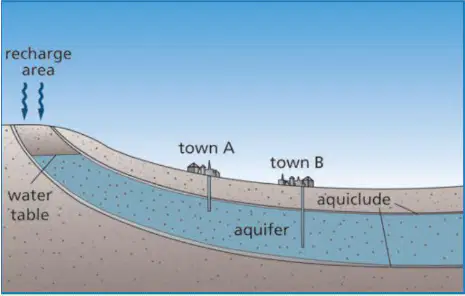
From the opposite figure answer the question: Which well (s) would not be affected, when the volume of water entering the recharge area decreases?
A
B
A & B
No one
The main source of ground water is.
Outgassing from deep within earth's interior.
Surface water where intersects the zone of recharge.
Hydroscopic water where it intersects the zone of recharged
Precipitation that percolates downward as gravitational water
The volume of the water entering the reservoir ( the river ) vary due to .......
The types of sedimentary rocks.
The type of layers that overlying aquifer
The amount of rains falls in recharge area.
The distance between the recharge area and reservoir.
The yield of a well depends on
permeability of soil
actual flow velocity
area of aquifer opening into the wells
permeability and actual flow velocity

