
 Worksheets
Adrenal glands
Total questions: 148
Worksheet time: 2hrs 14mins
Where are the adrenal glands located?
below each kidney
above each kidney
medial to each kidney
lateral to each kidney
Suprarenal glands are small ___ glands that sit on top of each kidney
Endocrine
Exocrine
What are the two distinct parts of the adrenal gland?
Cortex and Fascia
Medulla and Pyramids
Cortex and Medulla
Capsule and Fascia
The inner part of the adrenal gland is called
(a)
The outer part of the adrenal gland is called the (a)
Which adrenal gland is shaped like a pyramid or triangle similar to a Y or V?
Right
Left
Which adrenal gland is semilunar or crescent shaped?
Right
Left
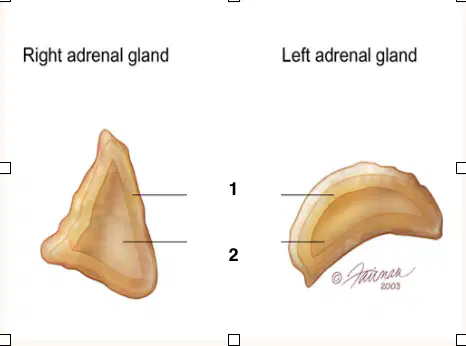
1
(a)
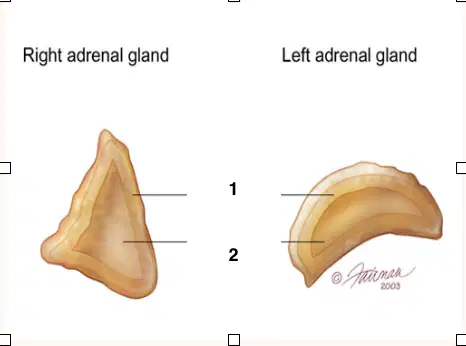
2
(a)
The cortex is derived from (a) cells of the intermediate mesoderm near the urogenital ridge
The medulla is derived from (a) cells (ectoderm origin) that migrate into the developing cortex
Around what week of gestation does the mesodermal cells proliferate to form the fetal adrenal cortex?
4
7
6
5
(a) invade this area to form the medulla, which will later produce catecholamines (epinephrine and norepinephrine).
By the __ to __ week the definitive cortex begins to form the outside of the fetal cortex?
10-11
8-9
9-10
7-8
The adrenal glands are large at birth due to prominent fetal cortex, which regresses after birth
true
false
(a) produces steroid precursors
Zona glomerulosa, zona fasciulata, and the zona reticularis all make up the (a)
Zona glomerulosa is responsible for (a)
Zona fasciculata is responsible for (a)
Zona reticularis is responsible for (a)
The adrenal gland receives a rich blood supply from (a) main suprarenal arteries
Superior suprarenal arteries are derived from the (a)
Middle suprarenal artery is derived from the (a)
Inferior suprarenal artery is derived from the (a)
Blood leaves the adrenal glands from the (a)
The right suprarenal veins drain directly into the (a)
The left suprarenal vein drains into the (a)
The outer part of the adrenal gland. It produces steroid hormones — mainly aldosterone, cortisol, and androgens
(a)
The central part of the gland. It is made up of chromaffin cells, which come from neural crest cells
(a)
Which part of the adrenal glands secrete epinephrine and norepinephrine?
Cortex
Medulla
The outer layers that surround the medulla makes up __ of the gland and is comprised of three layers
90%
80%
50%
70%
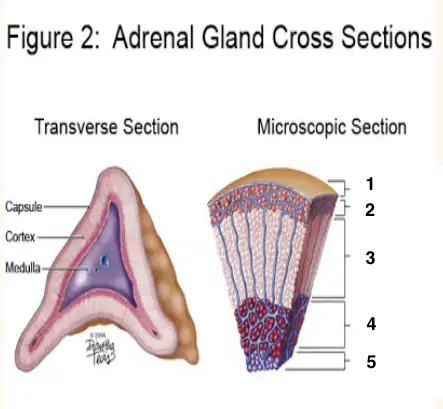
1
(a)
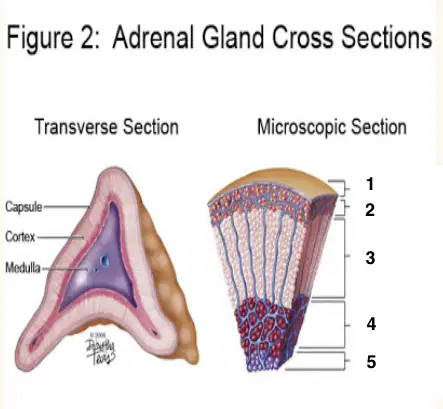
2
(a)
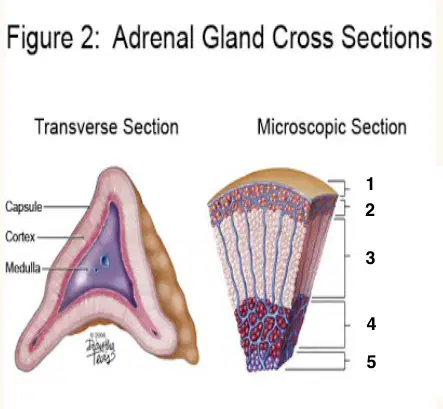
3
(a)
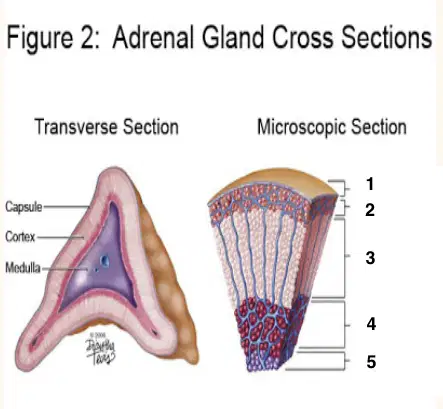
4
(a)
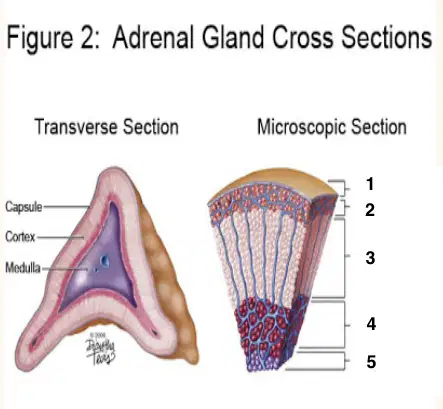
5
(a)
The outermost layer.
Primarily responsible for producing mineralocorticoids, such as aldosterone, which regulate sodium and potassium balance in the body
(a)
The middle layer.
Produces glucocorticoids, such as cortisol, which are involved in metabolism and the body's response to stress
(a)
The innermost layer of the cortex.
Secretes androgens, which are male sex hormones, contributing to the development of secondary sexual characteristics
(a)
The (a) is the central portion of the adrenal gland. It sits inside the outer cortex and is made up of chromaffin cells, which come from neural crest cells during development
These (a) cells act like modified nerve cells — they are part of the sympathetic nervous system (the system that prepares the body for “fight or flight” situations).
The medulla's main job is to secrete epinephrine and nonepinephrine
(a)
The hormones produced by the (a) increases heart rate, raises blood pressure, boosts blood flow to muscles, and increases energy availability
These hormones are released into the blood when the body is under stress or danger
(a)
The adrenal glands sit in the (a) space, just above the kidney and within renal fascia (gerona's fascia)
The adrenal glands are separated from the kidney by a later of (a) fat
The right adrenal gland is (a) related to the liver and IVC
The right adrenal gland (a) rests on the diaphragm
The right adrenal gland (a) is close to the IVC and right crus of diaphragm
The left adrenal gland is (a) related to the stomach (lesser sac) and pancreas
The left adrenal gland (a) rests on the diaphragm
The left adrenal gland is (a) close to the aorta and left crus of diaphragm
Both glands receive a rich blood supply (superior, middle, and inferior suprarenal arteries).
True
False
The right suprarenal vein drains directly into the IVC, while the left suprarenal vein drains into the left renal vein.
True
False
In newborns, the adrenal glands are relatively (a) compared to the kidneys
In neonates, the adrenal glands are ___ the size of the kidney
2/3
1/3
3/4
5/7
In adults, adrenal glands are ___
<3cm
>3cm
<4cm
>4cm
In adults, each adrenal gland is about (a) cm in height
Adrenal glands are ___ long
3-4cm
2-3cm
5-6cm
2-6cm
Adrenal glands are __cm thick
2
3
5
1
Adrenal glands weigh ___ grams
3-6
2-3
4-5
3-4
In adults, On imaging, glands larger than this may indicate enlargement or pathology (e.g., adrenal tumor or hyperplasia
true
false
Small, indistinct, low-gray structures that are hypoechoic relative to adjacent anatomy. In some cases only the highly reflective fat that surrounds them is seen
(a)
Thin, hyperechoic core surrounded by a thick, anechoic zone
(a)
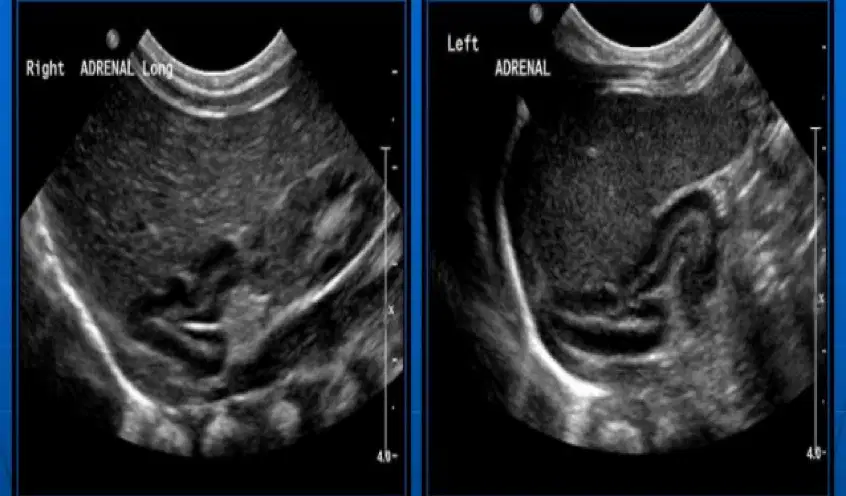
These images show the right and left adrenal glands in a (a)
The adult adrenal glands are ___ the size of the kidney
1/3
4/5
1/13
2/6
Absence of one or both adrenal glands
(a)
One adrenal gland missing
(a)
Both glands are absent (very rare)
(a)
Causes: developmental failure of the adrenal primordium or neural crest migration defect
(a)
depends on whether one or both glands are affected
Unilateral: usually no symptoms (other gland compensates)
Bilateral: life-threatening adrenal insufficiency in newborns
(a)
The cortex makes up the outer part of the gland and secretes (a) hormones
- Controls salt (Na⁺) and water balance by acting on the kidneys
- Helps maintain blood pressure and fluid balance
(a)
- Regulates metabolism, glucose levels, and helps the body handle stress
- Also has anti-inflammatory and immunosuppressive effects
(a)
- Produces small amounts of androgens (sex hormones).
- Contribute to secondary sexual characteristics, especially during puberty.
(a)
Mineralocorticoids = (a)
Glucocorticoids = (a)
Gonadal Hormones / Sex Steroids = (a)
Catecholamines = (a)
The medulla forms the inner part of the adrenal gland.
It acts as a neuroendocrine organ — part of the sympathetic nervous system.
(a)
Epinephrine (adrenaline) and Norepinephrine (noradrenaline) are secreted by (a) cells.
The medulla functions as part of the (a) system, releasing hormones directly into the bloodstream to act on distant organs
This helps coordinate the body’s rapid stress response
(a)
Epinephrine and nonepinephrine = (a)
Excess cortisol secretion
Pituitary overproduction of ACTH
(a)
Adrenal tumor or prolonged steroid use
(a)
Moon face, central obesity
Muscle weakness, thin skin, purple striae
Hypertension, osteoporosis, diabetes
(a)
Enzyme defect (↓ cortisol → ↑ ACTH → ↑ androgens)
(a)
In females this syndrome can cause virilization, ambiguous genitalia
(a)
In males this syndrome can cause precocious puberty
(a)
This syndrome is treated by steroid replacement therapy
(a)
aldosterone from adrenal cortex (zona glomerulosa)
Often due to aldosterone-secreting adenoma
(a)
Sodium & water retention → hypertension
Potassium loss → muscle weakness, fatigue
(a)
The treatment for this disease is remove tumor / aldosterone antagonists
(a)
(Primary Adrenal Insufficiency)
(a)
is a chronic disorder caused by failure of the adrenal cortex to produce sufficient glucocorticoids (cortisol) and mineralocorticoids (aldosterone).
(a)
Blood sugar drops, blood pressure falls, and salt and water are lost.
(a)
ACTH levels rise (because the pituitary tries to stimulate the adrenals), which also increases melanin, causing skin darkening
(a)
In conn's disease, aldosterone is (a)
In Addisons disease, aldosterone is (a)
In cushings disease/syndrome cortisol is (a)
In Addisons disease, cortisol is (a)
In Addisons disease, ACTH is (a)
In cushings syndrome ACTH is (a)
In cushings disease ACTH is (a)
In pheochromocytoma (adrenal medulla tumor) Catecholamines are (a)
in pheochromocytoma and paraganglioma total metanephrines are (a)
Measured in plasma or urine as metabolites of catecholamines
(a)
Final urinary metabolite of catecholamines
(a)
in pheochromocytoma Vanillylmandelic Acid (VMA) is (a)
Decreased hematocrit may suggest (a) , especially in newborns or trauma cases
Ultrasound helps detect bleeding or hematoma in the adrenal region
True
False
Hypertension is used to evaluate for (a) such as Pheochromocytoma or Aldosterone-producing adenoma
Excess catecholamines
(a)
Conn’s disease
(a)
Helps identify secondary causes of hypertension
(a)
Occurs due to excess androgen production
(a)
Ultrasound helps detect adrenal tumors or hyperplasia causing female masculinization or precocious puberty in males
True
False
Is there special prep required for adrenal exams?
Yes
No
If evaluating for mass, metastases, or retroperitoneal anatomy: fast 6–8 hours
True
False
Use the highest frequency and a smaller footprint transducer
(a)
3–5 MHz curvilinear transducer
(a)
7–12 MHz linear or small curvilinear probe
(a)
between liver, upper pole of right kidney, and IVC
(a)
between aorta, spleen, and upper pole of left kidney
(a)
The cortex (outer zone) appears (a) – darker on the screen
The medulla (central part) appears (a) – bright or reflective line in the center
This distinct contrast between cortex and medulla helps in identifying normal adrenal anatomy versus mass or hemorrhage
True
False
Adrenal glands are not routinely visualized due to small size and deep location
true
false
The liver and occasionally the right kidney serve as effective (a) windows
For transverse scans, apply an intercostal approach to locate the IVC, which lies __ and __ to the upper kidney pole
(a)
In (a) % of cases, at least one gland can be visualized after 26–27 weeks of gestation.
Located anterior, medial, and superior to the kidneys
(a)
The cortex and medulla are usually indistinguishable on standard imaging
True
False
The normal adrenal texture appears homogeneous and hypoechoic.
Glands are typically surrounded by highly (a) fat
When using (a) transducers (e.g., for endoscopic or intraoperative imaging), the glands may show Hyperechoic medullary echoes, Hypoechoic cortex, Hyperechoic halo of surrounding fat
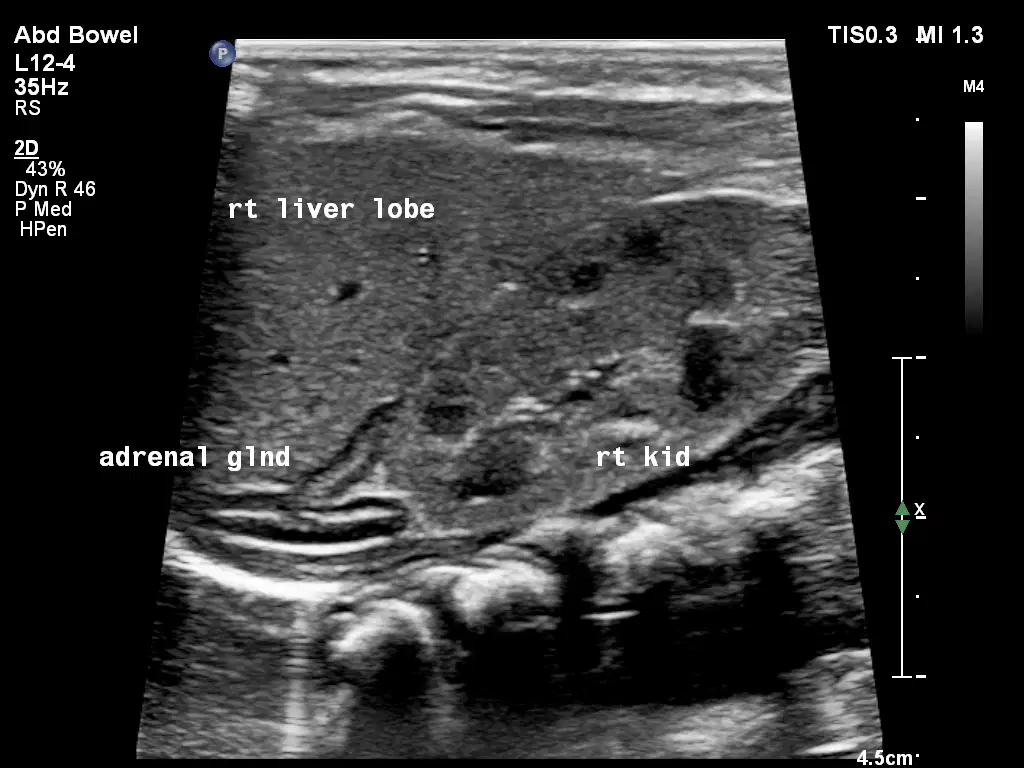
This image shows
(a)
The pancreatic tail and splenic vein mark the (a) superior border
Cirrhosis, fatty liver, and obesity reduce sound penetration
True
False
Take care to distinguish the crus of the diaphragm (a tubular structure medial to the right adrenal) to avoid misidentification.
True
False
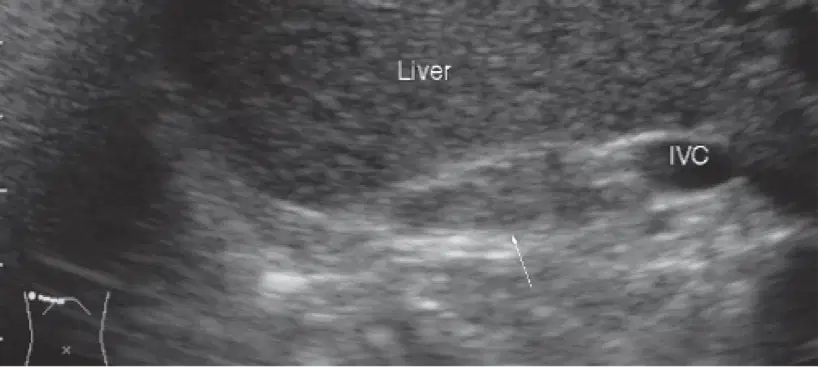
This shows the (a)
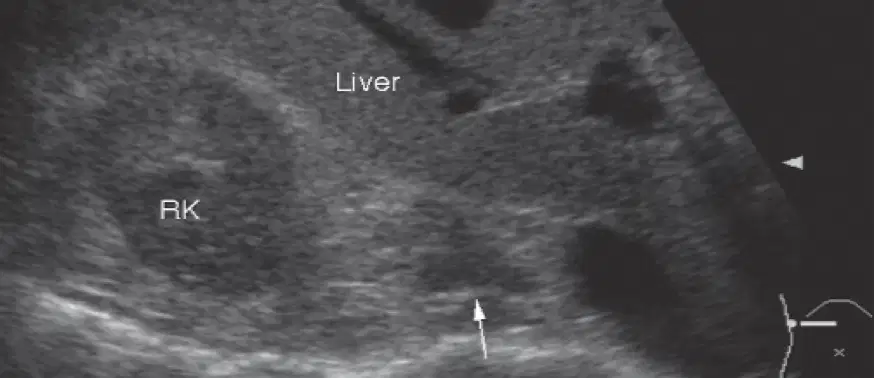
this shows the (a)
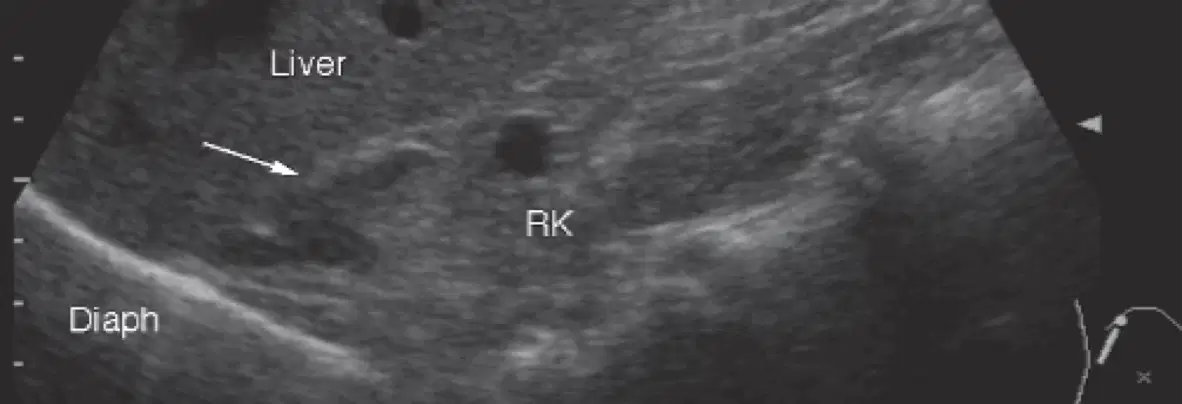
This shows the (a)
This shows the (a)
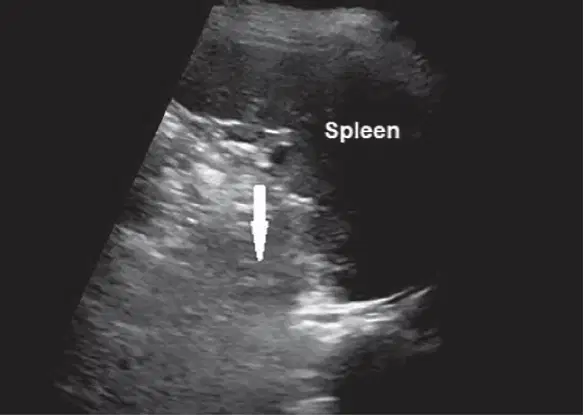
This shows the (a)
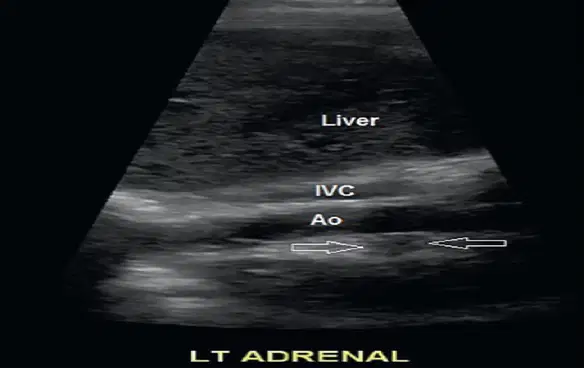
This shows the (a)
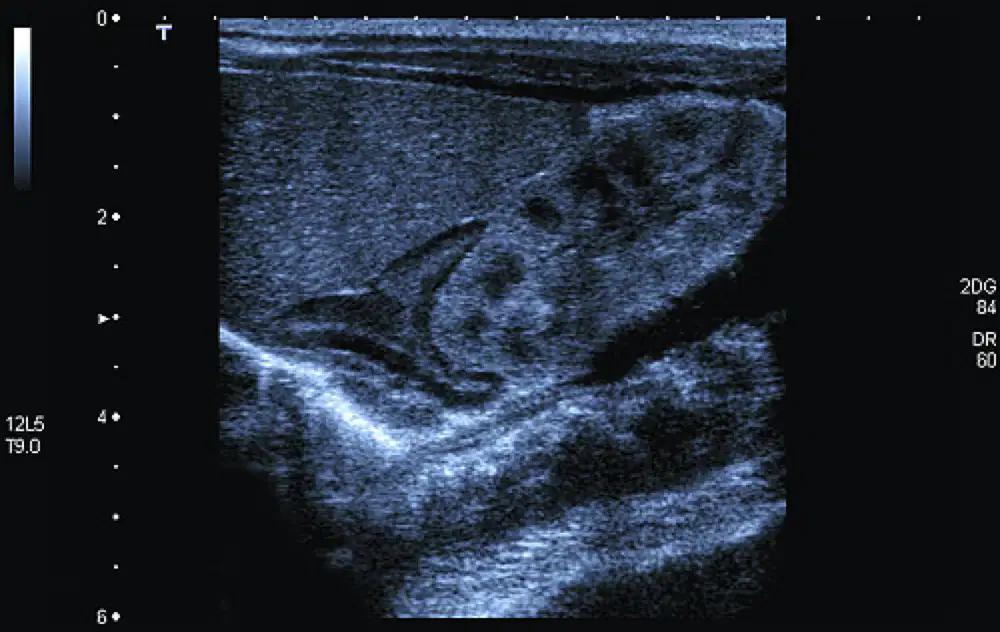
This shows the (a)
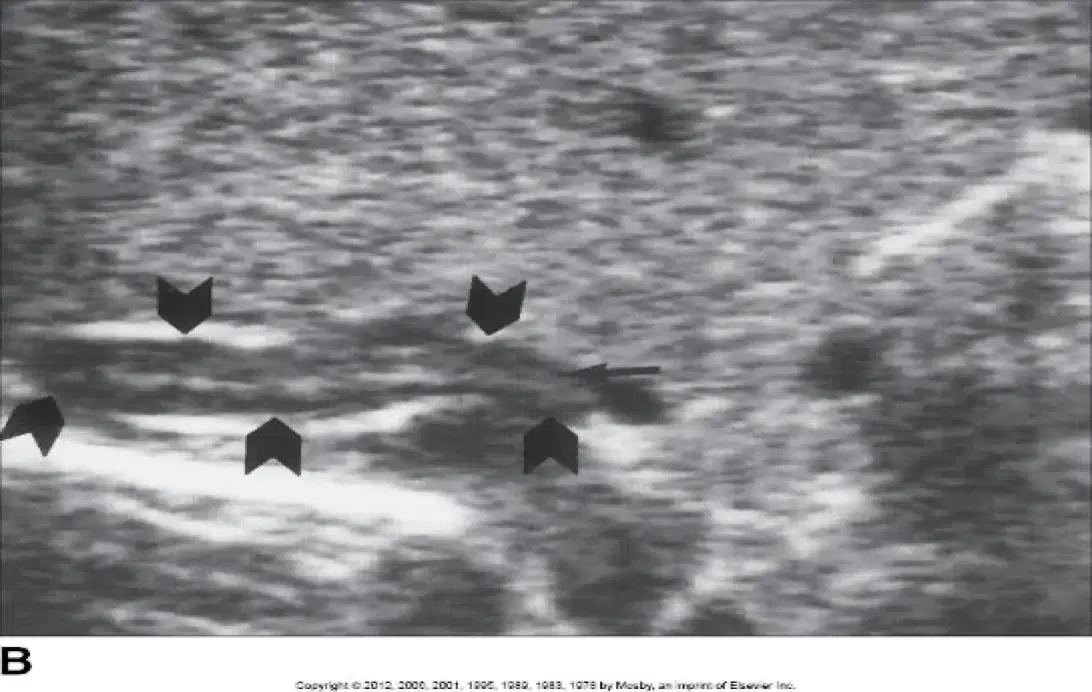
this shows the
(a)

