
 Worksheets
Definitions of Loads and Beams
Total questions: 10
Worksheet time: 10mins
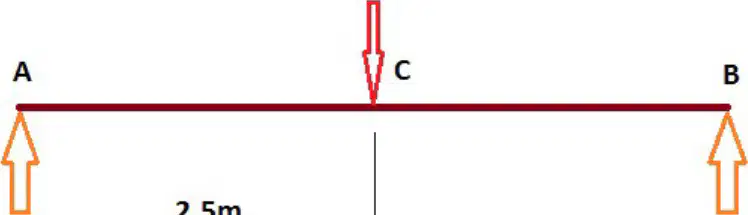
A beam is shown with supports at A and B and a downward point load at C. Based on the definitions provided, which statement best characterizes a point load?
A load spread uniformly along the entire span of a structural element
A concentrated load applied at a single location on a structural member
A load that varies linearly from one end of a beam to the other
A dynamic load that changes with time across the element
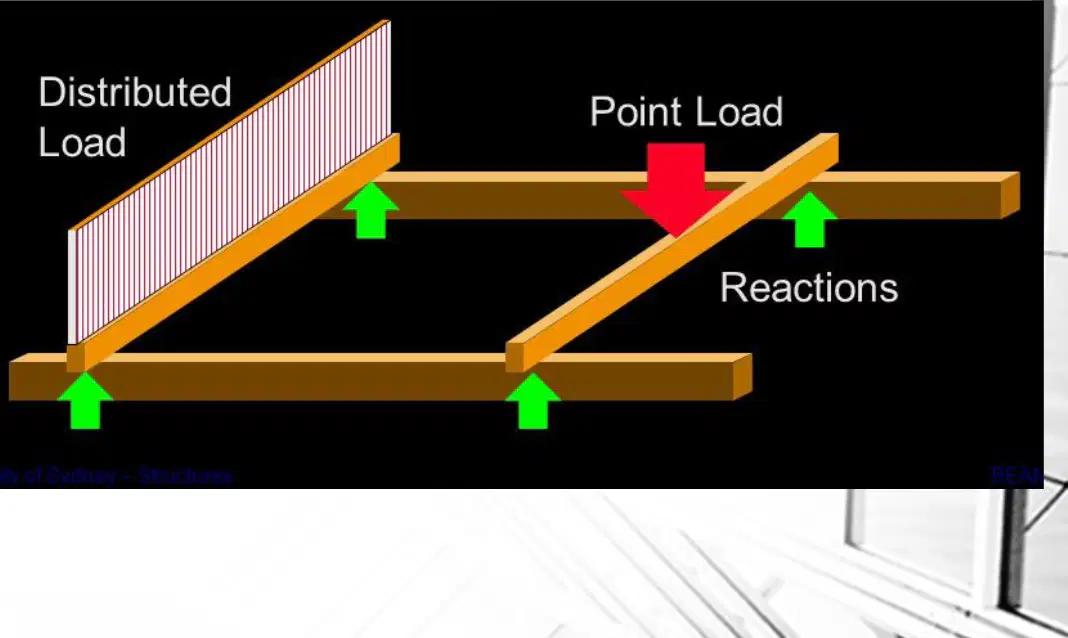
Which scenario most accurately represents a uniformly distributed load (UDL) as defined?
A hammer striking a nail at one spot on a joist
A masonry wall bearing evenly along the length of a beam
A single column transferring load at one contact point
A point force from a stiletto heel on a floorboard
A concentrated load is applied to a rafter by a heavy object of mass m due to gravity. Using the definition and Newton’s 2nd Law, which expression best relates the load magnitude at the point of contact?
Magnitude equals m divided by gravitational acceleration (m/g)
Magnitude equals gravitational acceleration divided by mass (g/m)
Magnitude equals mass times gravitational acceleration (m·a, with a≈g)
Magnitude equals mass minus gravitational acceleration (m−g)
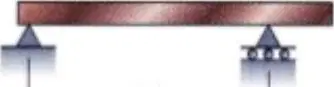
Using the definition provided: A simply supported beam is supported on one end by a pinned joint and on the other end by a rolling joint, allowing movement that helps prevent failure as loads are applied. Which statement best explains why this support arrangement accommodates varying climatic loads such as wind and snow without causing failure?
It fully restrains the beam from all movement, eliminating deflection under any load.
It allows axial and rotational movement at both ends, so the beam never experiences bending.
It provides restraint against vertical reactions while permitting necessary movement, reducing stress from thermal and climatic load effects.
It converts all applied loads directly into torsion, preventing bending stresses.
Refer to the diagram of three statically determinate beams. Which configuration best represents an overhanging beam?
A beam with one fixed end and the other end free, projecting beyond the support line.
A beam supported at both ends with the span entirely between the supports and no projection.
A beam with two supports where a portion of the beam extends beyond one of the supports, creating a projection past the support.
Which definition best captures the purpose and content of a Free Body Diagram (FBD) for a structural member?
A scaled drawing of the entire building showing materials and finishes.
A schematic that removes the member from its environment and represents it with lines and symbols, showing only applied forces and reactions.
A 3D rendering used to visualize dynamic movement and tolerance during construction.
A site plan that locates the beam within the structural grid and lists its physical attributes.
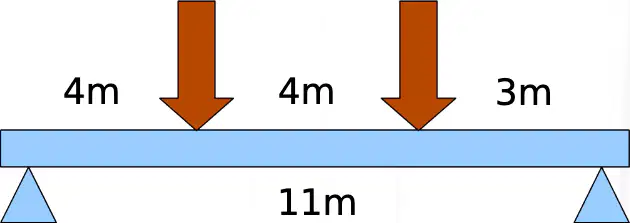
A simply supported 11 m beam has two downward point loads: 50 kN located 4 m from the left reaction (RL) and 100 kN located a further 4 m to the right (i.e., 8 m from RL). Using the procedure “determine clockwise moments about RL,” what is the total clockwise moment about RL due to these loads?
400 kN·m
600 kN·m
1000 kN·m
1200 kN·m
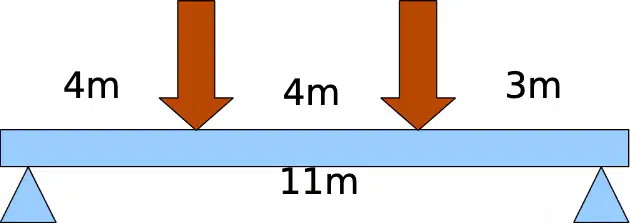
Follow the outlined procedure: determine clockwise moments about RL, determine anticlockwise moments about RL, note that moments sum to zero at equilibrium, then resolve vertical forces. Which step correctly uses equilibrium to compute the right reaction (RR) after finding the total clockwise moment about RL?
Set RR × 11 m equal to the total clockwise moment to solve for RR.
Add RR to RL to equal the larger of the two point loads.
Subtract the 50 kN load from the 100 kN load to obtain RR.
Set RR × 8 m equal to the total anticlockwise moment to solve for RR.
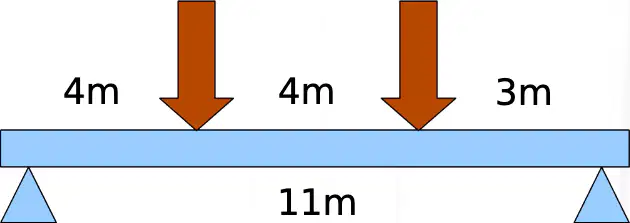
A simply supported beam has two point loads: 50 kN located 4 m from the left support (RL) and 100 kN located 8 m from RL (i.e., 4 m further along). The span between supports is 11 m. Using equilibrium of moments about the right support (RR), the reaction at RR was found to be RR = 90.91 kN. Resolve forces vertically to determine the reaction at the left support RL. Choose the correct value.
RL = 59.09 kN
RL = 90.91 kN
RL = 50.00 kN
RL = 40.00 kN

Using the same 8 m beam with a 10 kN/m UDL, take moments about the left support RL. The clockwise moment due to the UDL equals the anticlockwise moment due to reaction RR. What is RR? Use: total UDL = 10 kN/m × 8 m = 80 kN acting at 4 m from RL; equilibrium of moments: RR × 8 m = 80 kN × 4 m.
RR = 20 kN
RR = 40 kN
RR = 80 kN
RR = 160 kN

