
 Worksheets
Economics Year 10 - Autumn Term Revision
Total questions: 77
Worksheet time: 39mins
Economics is regarded as a science because
Its issues can be easily verified by reference to facts.
It adopts the scientific method in making its analysis.
Its issues are relevant for national development.
Its subject matter studies human behaviour.
The opportunity cost of a worker going to the university is
tuition, fees and books.
boarding and lodging.
the wages given up to attend university.
transportation and entertainment.
Which of the following is central to the definition of Economics?
Resources
Wants
Scarcity
Capital.
The study of economics is important to every society because it
enables individuals to satisfy all their wants.
helps in the utilisation of scarce resources.
helps producers to know what to produce.
restores equilibrium between producers and consumers.
A consumer with 10 naira needs a dress, a pair of shoes, a handbag and jewellery costing 20, 10, 7 and 3 naira respectively. The opportunity cost of buying the pair of shoes is the
dress.
jewellery.
dress, handbag and jewellery.
dress and jewellery.
Scale of preference shows
incomes of consumers in order of size.
utilities enjoyed by consumers.
opportunity cost of goods consumed.
consumers' wants in order of priority.
The study of economics is mainly concerned with how to
Rank individuals want to be given abundant resources.
Make a choice when resources are inadequate.
satisfy every member of all societies.
Produce all the goods needed by everyone.
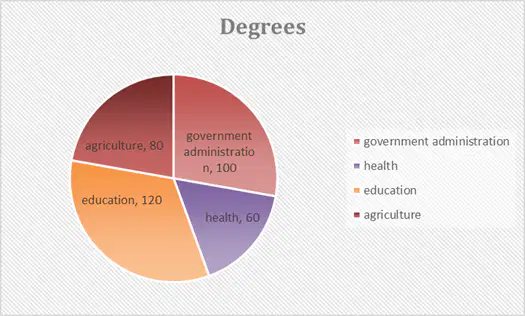
If the budget of the country were $7,200.00. How much is allocated to Education?
$2,400.00.
$2,000.00.
$1,200.00.
$1,000.00.
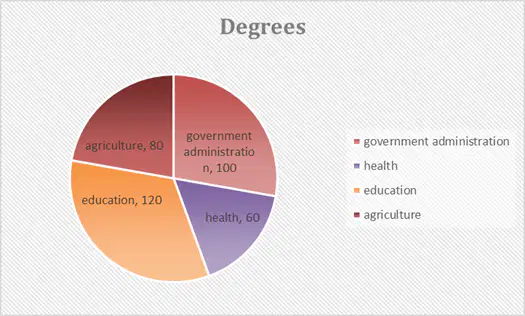
What is the ratio of expenditure on health to Agriculture?
2:3.
3:4.
4:3.
5:4.
In a pie chart, the population of a city is represented by a sector of 45°. If the country has a population of 10 million people, then the city's population is
0.0045 million.
4.5 million.
1.25 million.
16 million.
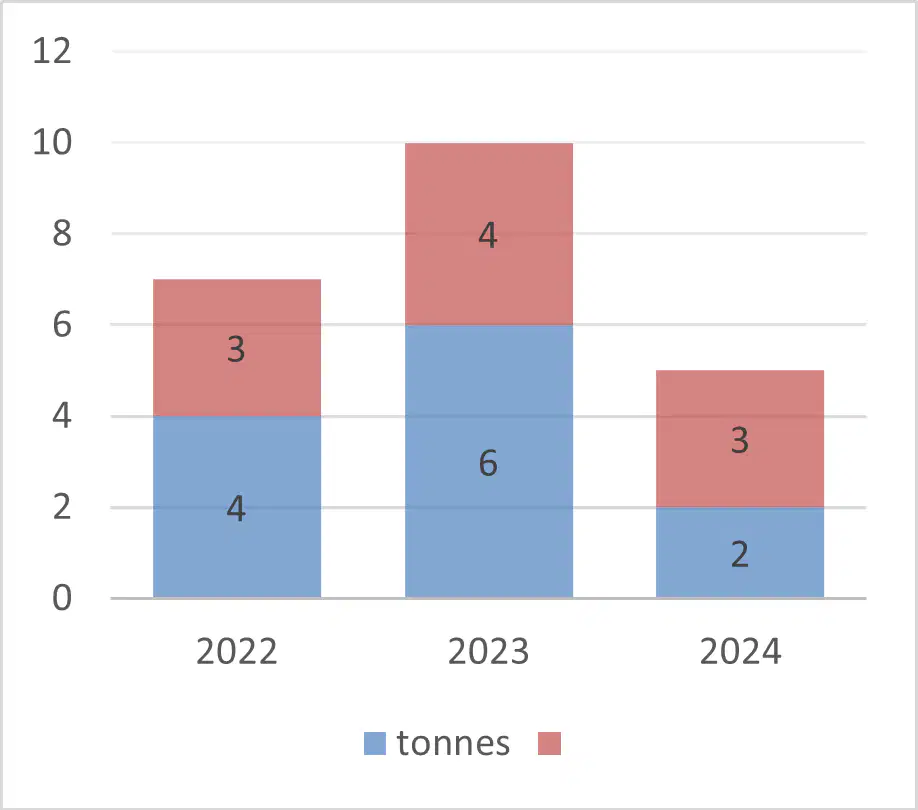
The diagram above depicts a
simple bar chart.
complex bar chart.
component bar chart.
multiple bar chart.
The wages of a group of workers in dollars are stated below: 40, 30, 70, 20, 60, 10, 10, 80, 30 and 10. What is the mean wage?
$35
$36
$37
$38
One way of obtaining the median of a given data is to
Sum the value and divide by the number of items.
Arrange the data in ascending order and subtract each item from the mean.
Arrange the data in descending order and add each item to the least.
Arrange the data in either ascending or descending order and find what item divides the set in two equal parts.
The marks obtained by 9 students in a class test are recorded below: 9, 8, 7, 5, 7, 6, 8, 9 and 7. What is the median mark?
7
7.5
8
8.5
Market supply may increase if there is an increase in the
Price of the product.
prices of factors of production.
tax paid on raw materials.
high price on raw materials.
Effective supply is the total amount of a commodity
from a single producer.
in the warehouses of producers.
offered for sale at a market price.
produced for the market.
The demand curve for goods of ostentation is usual
negatively sloped.
positively sloped.
vertical.
horizontal.
Which of the following factors is not a cause of change in demand? Changes in
taste and fashion
income distribution
price of the commodity
the size of the population
The law of demand states that:
As price falls, quantity demanded increases
As price increases, quantity demanded remains constant.
Demand increases as price increases.
As price falls, quantity demanded also falls
Demand in Economics is synonymous to ________
Needs
Wants of the consumers
all goods demanded in the market.
Wants to be supported with the ability to pay.
Which of the following economist definitions of economics was widely accepted by the public?
Adam Smith
Alfred Marshal
A.I. Pigou
Professor Lionel C. Robins
________ is a situation where a particular goods is forgone in favour of another goods.
Explicit cost
opportunity cost
implicit cost
marginal cost
The supply and demand for goods and services are influenced by the
supermarket
entrepreneur
goods size
price mechanism
The market supply curve slopes upwards from left to right, indicating that
At a lower price, more is supplied
Two commodities can be supplied at the same time
At a lower price, less is supplied
Producers pay high taxes
________ is the price at which demands equal supply.
Demand Function
Equilibrium price
Supply price
Price system
The exploitation of mineral resources constitutes which form of production?
Primary production
Secondary production
Tertiary production
Services production
Warehousing economic activity that falls under A tertiary production.
Primary production.
intermediate production
secondary production.
tertiary production.
Which of the following is a reward to a factor of production?
Interest
Donation
Gift
Subsidy
The transformation of raw materials into finished goods and their distribution to the consumers to satisfy their wants is _______.
specialization
division of labour
production
occupation.
Production is said to be complete when the goods and services get to the
producer
wholesaler
consumer
retailer.
A large firm may experience diseconomies of scale if there is
difficulty in coordinating decisions.
Division of labour in production.
employment of more specialists.
decrease in the cost of production.
In manufacturing, division of labour may be hindered by
excessive demand for the product.
low level of technology
excess supply of Labour.
increase in the export of goods.
The use of mass advertising media will enable a firm to enjoy
managerial economies.
financial economies.
marketing economies.
welfare economies.
A small-scale firm located within an industrial estate will enjoy
government protection and funding
technological economies of scale.
external economies of scale.
financial economies of scale.
Land as a factor of production is made useful through the
application of human effort.
acts of nature.
application of fertiliser
Use of machines.
The distinguishing function of an entrepreneur is
planning.
control.
risk-bearing.
management.
Which of the following items is not classified as working capital?
Equipment
Fuel
Money to pay wages.
Semi-finished goods.
Production involves ________________
Creation of goods and services
Selling of goods and services
distribution of goods
All of the above
The concentration of one's productive efforts on a particular line of production is
distribution
specialization
efficiency
co-ordination
40. Division of labour give rise to _______.
The increase in production of goods and services.
delay in production
the price of goods
unemployment
The concentration of a region in a particular aspect of economic activities is__________.
specialisation by sex
specialisation by product
specialisation by process
territorial specialisation
When the growth of a firm is achieved by its own single effort, it is called
external diseconomies
Internal diseconomies
external economies
internal economies of scale
The technique of production that has to do with the use of more capital, machines and machinery is__.
labour-intensive
knowledge-intensive
capital-intensive
machine-intensive
The problems that people encounter while attempting to satisfy their numerous wants with the limited resources available to them is ____________.
basic economic problem
high development problem
educational problem
basic social problem
The optimum use or combination of factors of production to achieve higher and better output at a reasonable cost is
What to produce
for whom to produce
How to produce
efficiency of resource use.
In a market economy, the problem of what goods to produce is solved primarily by
directives of the government.
the pattern of consumers' spending.
producers of consumer goods.
people producing what they want.
Economic problems arise in all societies because
Resources are mismanaged by leaders.
There is no proper planning.
Resources are not in adequate supply.
The services of economists are not employed.
The fundamental economic problem in every society is
the large number of the unemployed.
inadequate supply of money.
corruption and mismanagement.
limited supply of productive resources.
What is human capital?
Physical assets
Intangible assets
Tangible assets
Financial assets
What is brain drain?
Migration of unskilled labour
Migration of skilled labour
Loss of physical capital
Loss of brain memory
The quantity demanded and supplied of computers is represented by the following functions: Qd = 400 – 5P Qs = 150 + 20P a. Calculate: i. Equilibrium Price
Equilibrium Price = 10
Equilibrium Price = 5
Equilibrium Price = 20
Equilibrium Price = 8
The quantity demanded and supplied of computers is represented by the following functions: Qd = 400 – 5P Qs = 150 + 20P. Calculate: ii. Equilibrium quantity
Equilibrium quantity = 350
Equilibrium quantity = 400
Equilibrium quantity = 250
Equilibrium quantity = 500
The quantity demanded and supplied of computers is represented by the following functions: Qd = 400 – 5P Qs = 150 + 20P. If the price level changes to N12, calculate the Quantity demanded.
340
320
380
400
The quantity demanded and supplied of computers is represented by the following functions: Qd = 400 – 5P Qs = 150 + 20P. If the price level changes to N12, calculate the Quantity supplied.
Quantity supplied = 390
Quantity supplied = 240
Quantity supplied = 150
Quantity supplied = 320
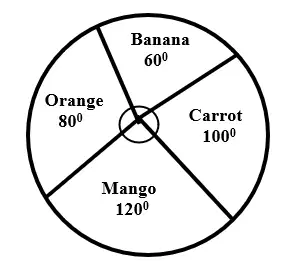
The Total number of fruits consumed by a family in a year was 720, represented by the pie chart below. Calculate: i. The quantity of bananas consumed by the family.
Quantity of bananas = 60/360 × 720 = 120
Quantity of bananas = 90/360 × 720 = 180
Quantity of bananas = 45/360 × 720 = 90
Quantity of bananas = 30/360 × 720 = 60
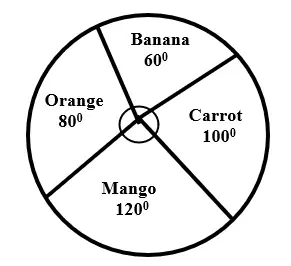
The Total number of fruits consumed by a family in a year was 720, represented by the pie chart below. Calculate: The quantity of carrots consumed by the family.
200
150
300
100
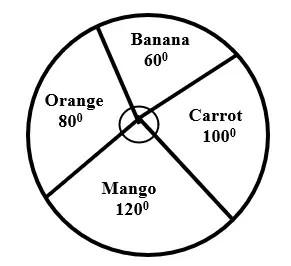
The Total number of fruits consumed by a family in a year was 720, represented by the pie chart below. Calculate: The total amount of bananas and carrots consumed by the family.
320
250
400
180
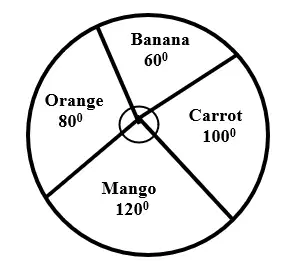
The Total number of fruits consumed by a family in a year was 720, represented by the pie chart below. Calculate: The quantity of mangoes consumed by the family.
240
180
300
120
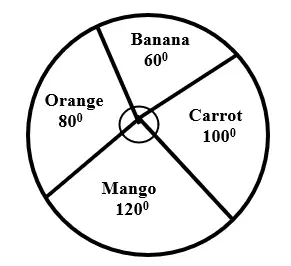
The quantity of oranges consumed by the family, when the total is 720
160
120
200
90
Economics can be defined as:
The study of how people allocate scarce resources to satisfy unlimited wants.
The study of ancient civilizations and their cultures.
The process of creating art and literature.
The science of weather and climate patterns.
Studying economics is important because _______________.
It helps individuals understand how resources are allocated and how decisions impact society.
It teaches people how to become professional accountants.
It only focuses on historical events and their impact.
It is mainly about memorizing mathematical formulas.
Economics is regarded as a social science because:
It studies human behavior and interactions within societies.
It focuses only on natural phenomena.
It deals exclusively with mathematical models.
It ignores the impact of society on economic decisions.
Production is said to be completed in economics when the goods get to the consumer. Do you agree with this idea?
Yes, because production is only complete when goods reach the final consumer.
No, because production ends when goods are manufactured, not delivered.
No, because production is complete after goods are stored in warehouses.
Yes, because production is complete once goods are sold to retailers.
List the factors of production and give their rewards.
Land, Labour, Capital, and Entrepreneurship; rewards are rent, wages, interest, and profit respectively.
Land, Water, Air, and Fire; rewards are salary, bonus, commission, and royalty respectively.
Labour, Management, Technology, and Marketing; rewards are rent, interest, dividend, and fee respectively.
Land, Labour, Capital, and Management; rewards are rent, salary, interest, and commission respectively.
Distinguish the demand schedule from the demand curve.
A demand schedule is a table showing quantities demanded at different prices, while a demand curve is a graph representing this relationship.
A demand schedule is a graph showing supply at different prices, while a demand curve is a table of demand.
A demand schedule and a demand curve both show supply at different prices.
A demand schedule is a list of products, while a demand curve is a list of prices.
The meaning of Demand in Economics is:
The desire backed by ability to pay for a good or service
The total supply of goods in a market
The amount of goods produced by a firm
The cost of producing a good
State the law of demand and give a detailed explanation about the law of demand.
The law of demand states that, other things being equal, as the price of a good increases, the quantity demanded decreases, and as the price decreases, the quantity demanded increases.
The law of demand states that, other things being equal, as the price of a good increases, the quantity demanded increases.
The law of demand states that, other things being equal, as the price of a good decreases, the quantity demanded decreases.
The law of demand states that, other things being equal, price and quantity demanded are not related.
Specialisation is important in the production of goods and services because:
it allows workers to focus on specific tasks, increasing efficiency and output.
it reduces the need for any training or skills.
it makes production slower and less efficient.
it eliminates the need for cooperation among workers.
Which of the following is a type of specialisation?
Occupational specialisation
Seasonal migration
Random allocation
Generalisation
Distinguish between: i. Money cost and opportunity cost.
Money cost refers to the actual monetary expenditure, while opportunity cost refers to the value of the next best alternative forgone.
Money cost is the value of all alternatives forgone, while opportunity cost is the actual monetary expenditure.
Money cost and opportunity cost are both the same and refer to monetary expenditure.
Money cost refers to non-monetary sacrifices, while opportunity cost refers to monetary expenditure.
Distinguish between: ii. Normal good and inferior good.
A normal good is one whose demand increases as income increases, while an inferior good is one whose demand decreases as income increases.
A normal good is one whose demand decreases as income increases, while an inferior good is one whose demand increases as income increases.
A normal good and an inferior good both have demand that increases as income increases.
A normal good and an inferior good both have demand that decreases as income increases.
What is effective demand?
Effective demand refers to the demand for goods and services backed by the ability and willingness to pay.
Effective demand is the total demand for goods and services in an economy, regardless of payment ability.
Effective demand means the desire for goods and services without considering purchasing power.
Effective demand is the supply of goods and services available in the market.
Which of the following is NOT a type of supply?
Joint supply
Composite supply
Market supply
Demand supply
Division of labour refers to:
The separation of work into different tasks, with each worker specializing in one task.
The process of workers changing jobs frequently.
The equal distribution of income among workers.
The use of machines to replace human labour.
Explain: ii. Economics of scale.
Economies of scale refer to the cost advantages that a business obtains due to expansion, resulting in a reduction in average cost per unit.
Economies of scale refer to the increase in costs as production expands, leading to higher average costs per unit.
Economies of scale refer to the process of reducing production entirely to minimize costs.
Economies of scale refer to the advantages gained by producing fewer goods at higher costs.
Human capital refers to:
The skills, knowledge, and experience possessed by individuals.
Physical assets owned by a company.
The total amount of money invested in a business.
Natural resources available in a country.
Two reasons economics is a social science:
1. Subject matter is human behaviour in relation to resources. 2. Uses scientific method—hypotheses, data, testing, models—to explain social phenomena.
1. Focuses only on mathematical equations. 2. Studies only natural resources.
1. Deals exclusively with government policies. 2. Ignores human behaviour.
1. Concerned only with production and consumption of goods. 2. Avoids scientific methods.

