
 Worksheets
Ecosystem Energy and Water Cycle
Total questions: 17
Worksheet time: 36mins

: A process in which elements, chemical compounds, and other forms of matter are passed from one organism to another and from one part of the biosphere to another.
Biogeochemical Cycle
carbon cycle
nitrogen cycle
hydrological cycle
Energy enters an ecosystem in the form of ________ and exits the ecosystem in the form of ____.
heat; sunlight
sunlight; energy
sunlight; heat
photosynthesis; respiration
3-6.
Answer the questions below after watching the video
What is the process called when water from rivers and oceans turns into water vapor and rises into the air?
Condensation
Precipitation
Evaporation
Transpiration
How are clouds formed in the sky?
Water vapor freezes into ice crystals.
Tiny water droplets combine with gases and dust particles.
Raindrops rise back into the sky.
Sunlight reflects off the atmosphere.
What is the term for water falling from clouds to the Earth's surface in forms like rain, hail, or snow?
Evaporation
Condensation
Collection
Precipitation
What is the process called when plants release water vapor into the atmosphere, similar to sweating?
Evaporation
Sublimation
Transpiration
Condensation

Elements and compounds are ________ in biogeochemical cycles
evaporated
recycled
percolated
infiltrated
• Oceans, rivers, and lakes.
• Stored in the bodies of living organisms.
• In the atmosphere as clouds and water vapor.
• Stored underground and groundwater.
Nitrogen
Water
Carbon
Hydrogen
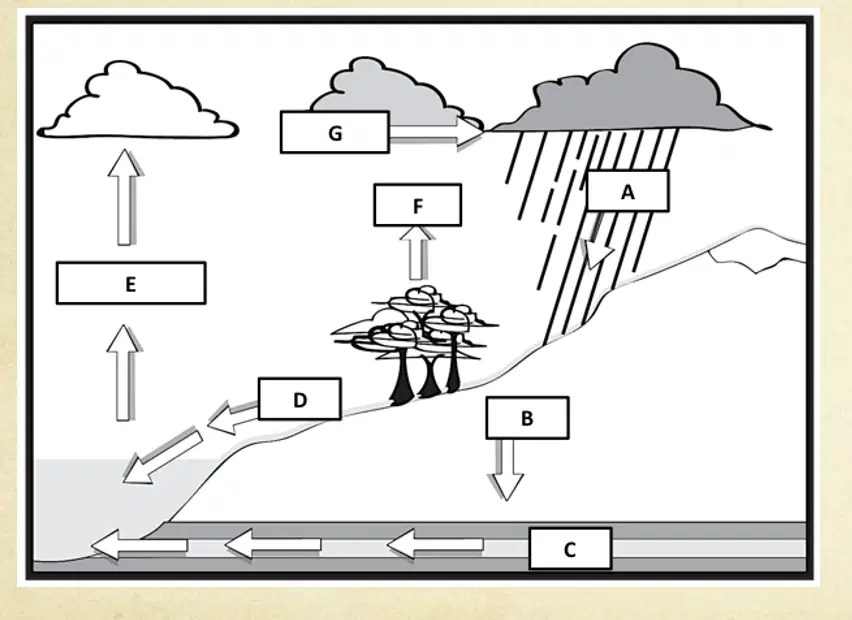
What is "A"?
condensation
evaporation
snow
precipitation
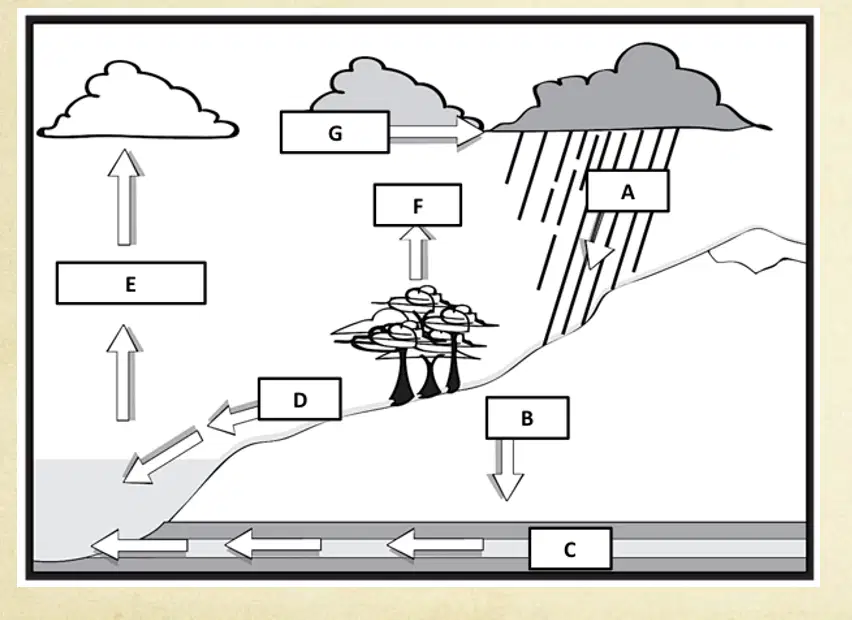
What is "E"?
evaporation
precipitation
runoff
condensation
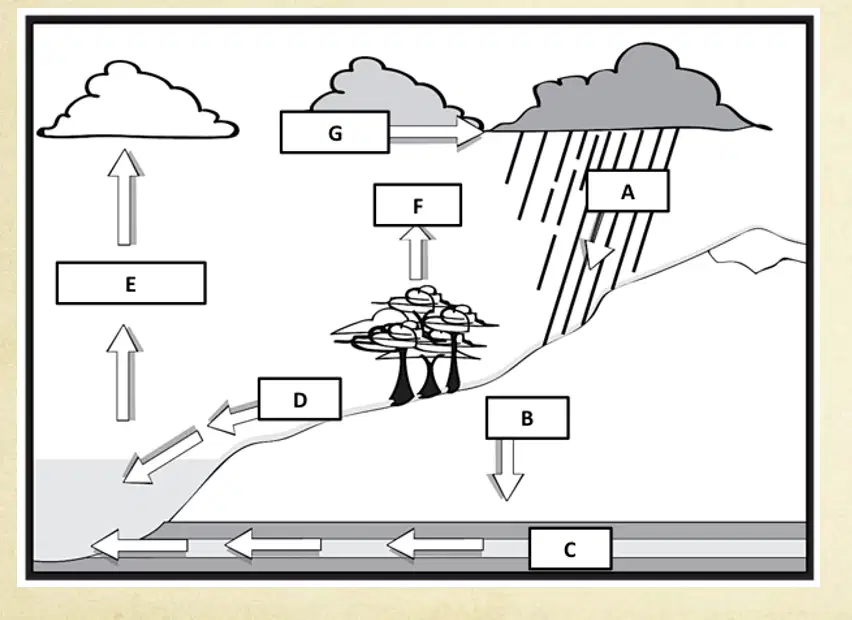
What is "F"?
percolation
precipitation
transpiration
condensation
12-15.
Answer the questions below after watching the video
Which of the following is NOT one of the five major locations where carbon recycles?
Atmosphere
Earth's interior
Stratosphere
Ocean
What are the two main forms of carbon found in the atmosphere?
Carbon monoxide and carbon dioxide
Methane and carbon monoxide
Carbon dioxide and methane
Carbonic acid and methane
How do plants primarily absorb carbon from the atmosphere?
Through their roots as organic carbon
As carbon dioxide for photosynthesis
By consuming other organisms
As methane during respiration
Which human activity contributes to increasing the amount of carbon in the atmosphere?
Photosynthesis
Burning fossil fuels
Ocean uptake
Microbial decomposition
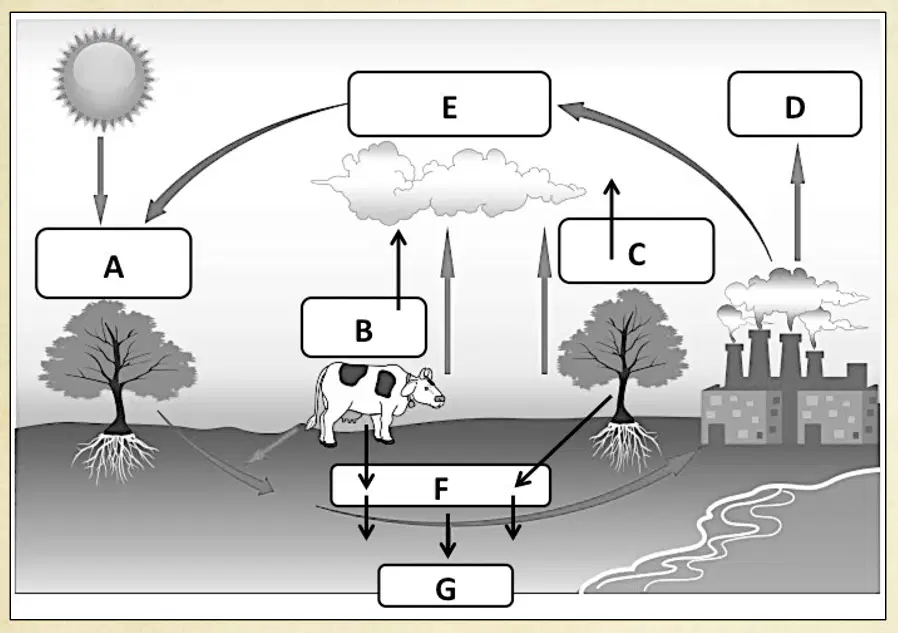
What is "D"?
decompostion
evaporation
Burning of Fossil Fuels
photosynthesis

What is "B"?
respiration
photosynthesis
decomposition
burning of fossil fuels
18-25.
Answer the questions below after watching the video
How do nitrogen reservoirs generally compare to carbon reservoirs in terms of the duration they hold the element?
Nitrogen reservoirs hold nitrogen for millions of years.
Nitrogen reservoirs generally hold nitrogen for a relatively short period of time.
Carbon reservoirs hold carbon for relatively short periods.
Carbon reservoirs are primarily found in the atmosphere.
Despite being the largest reservoir of nitrogen, why is atmospheric nitrogen (N2 gas) not directly available for use by most plants and animals?
It is too abundant, leading to saturation.
It exists in a stable, unreactive form that cannot be easily assimilated.
It is toxic to most living organisms in its gaseous state.
It is primarily found in the upper atmosphere, inaccessible to terrestrial life.
What is the essential role of nitrogen fixation in the nitrogen cycle?
Converting biologically available nitrogen back into atmospheric N2 gas.
Transforming atmospheric N2 gas into forms usable by plants and animals.
Breaking down organic nitrogen compounds into ammonia.
Converting nitrites into nitrates.
Which of the following represents a natural process of nitrogen fixation?
Industrial combustion of fossil fuels to produce nitrates.
The action of lightning converting atmospheric nitrogen into usable forms.
The application of synthetic fertilizers in agriculture.
The process of denitrification by bacteria in soil.
How do plants primarily obtain nitrogen for assimilation?
By directly absorbing atmospheric nitrogen (N2)
By consuming other animals
By taking in nitrates (NO3-) or ammonia (NH3) from the soil
Through the process of denitrification
What is the primary role of decomposers in ammonification?
Converting atmospheric nitrogen into a usable form
Breaking down dead organic matter and waste into ammonia
Converting ammonia into nitrites and nitrates
Releasing nitrogen gas back into the atmosphere
Which chemical transformation occurs during nitrification?
Nitrogen gas (N2) is converted into ammonia (NH3)
Ammonium (NH4+) is converted into nitrite (NO2-) and then nitrate (NO3-)
Nitrate (NO3-) is converted into nitrous oxide (N2O)
Dead biomass is converted into ammonium (NH4+)
How do agricultural practices contribute to global warming through the nitrogen cycle?
By increasing ammonia volatilization, leading to acid rain
By producing nitrous oxide (N2O) through denitrification in agricultural soils
By causing nitrate leaching into water bodies, leading to eutrophication
By reducing the amount of nitrogen available for crops, decreasing food production
the conversion of nitrate to nitrogen gas. This nitrogen gas is released into the atmosphere.
nitrogen cycle
denitrifying bacteria
denitrification
nitrification
removes carbon from the atmosphere in the form of carbon dioxide. The carbon is used to build molecules of glucose, and other organic compounds.
Water
the carbon Cycle
Photosynthesis
Respiration
releases carbon dioxide back into the atmosphere.
Nitrogen Cycle
Carbon cycle
Photosynthesis
Respiration
These are the decomposers. They break down dead, organic matter and convert it to ammonia.
Ammonifying Bacteria
Dung Beetles
Denitrifying Bacteria
Nitrifying Bacteria
the absorption and incorporation of nitrogen into plant and animal compounds.
ammonification
assimilation
denitrification
nitrogen cycle

