
 Worksheets
Adi Tala: Components and Hand Actions
Total questions: 10
Worksheet time: 5mins
Which statement best defines Adi Tala within the South Indian music system?
It is a rare tala used mainly for solo percussion.
It is the most common tala in Carnatic music and is also called Chaturasra Triputa Tala.
It is a tala that uses only silent hand actions without claps.
It is a tala found only in folk dance traditions of North India.
Adi Tala is composed of specific angas. Select the correct combination of angas and their counts.
1 Laghu of 4 counts and 2 Drutas of 2 counts each
2 Laghus of 3 counts each and 1 Druta of 4 counts
1 Laghu of 3 counts and 2 Drutas of 3 counts each
3 Drutas of 2 counts each without any Laghu
Based on the description of angas, how many total units does Adi Talam contain? Show your reasoning: add the counts of all angas.
6 units, because 1 Laghu (4) + 1 Druta (2)
8 units, because 1 Laghu (4) + 2 Drutas (2+2)
10 units, because 2 Laghus (4+4) + 1 Druta (2)
12 units, because 3 Drutas (2+2+2) + 1 Laghu (6)
Which option correctly matches the type of Kriya with its nature?
Sashabdakriya – a soundless action; Nishabdakriya – an action with sound
Sashabdakriya – an action with sound; Nishabdakriya – a soundless action
Both Sashabdakriya and Nishabdakriya – actions with sound
Both Sashabdakriya and Nishabdakriya – soundless actions
Refer to the table and images of hand actions for Adi Tala. During the Laghu, after one clap, what sequence completes the remaining counts?
Two hand waves followed by a clap
Three finger counts starting from the little finger and ending at the middle finger
One finger count followed by two claps
A single continuous hand wave for three counts
In Adi Tala, what term refers to one complete cycle consisting of 8 Aksharakalas formed by executing one Laghu (4 counts) and two Drutas (2 counts each)?
Avartana
Anga
Aksharakala
Laya
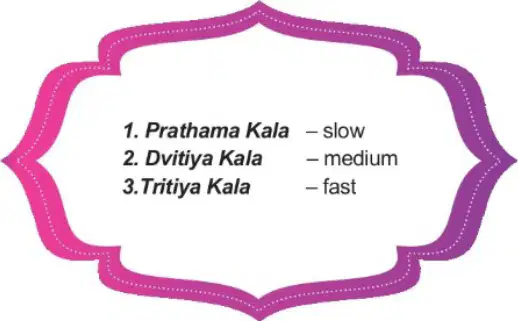
Which statement best describes the three degrees of speeds (Kala) used in the notation form of Adi Tala?
Prathama Kala is medium, Dvitiya Kala is slow, Tritiya Kala is fast
Prathama Kala is slow, Dvitiya Kala is medium, Tritiya Kala is fast
Prathama Kala is fast, Dvitiya Kala is medium, Tritiya Kala is slow
All three Kalas indicate the same speed

Using the speed relationships shown, if Prathama Kala is the base speed, how many times faster is Tritiya Kala compared to Prathama Kala?
Two times faster
Three times faster
Four times faster
Equal speed

Refer to the notation grid of Adi Tala. Which set of syllables correctly corresponds to the 1st speed (Prathama Kala) counts 1–4?
Ta, Ka, Dhimi, Mi
Ta, Ka, Dhi, Mi
TaKa, Dhimi, TaKa, Jhanu
TaKaDhiMi, TaKaJhanu, TaKaDhiMi, TaKaJhanu
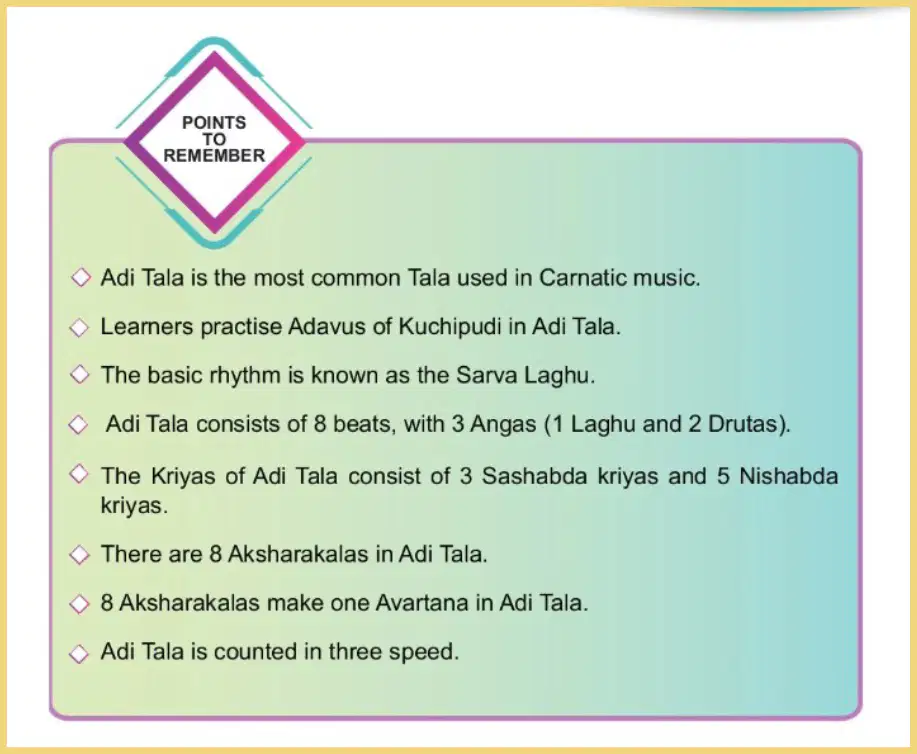
Which statement correctly describes the Angas of Adi Tala based on the summary: it has 8 beats organized as 3 Angas?
1 Laghu and 2 Drutas
3 Laghus
2 Laghus and 1 Druta
1 Laghu and 1 Druta

