
Font size
 Worksheets
The Family & Support
Total questions: 25
Worksheet time: 13mins
According to Catholic teaching, what is a key reason the family is called the "domestic church"?
It is a place where children first learn civic duties
It is where children learn the love of God and receive the first proclamation of faith
It is primarily responsible for economic security
It functions as a legal institution for marriage licenses
Which statement best reflects Pope Benedict XVI’s description of the family in his Angelus (27 December 2009)?
The family is mainly a private unit for economic stability
The family is a communion of love that provides a secure environment for growth
The family is a temporary association formed for convenience
The family is a political institution that shapes national policy
Which of the following is identified as a principal purpose of the family in Catholic teaching?
Educating children in morals and prayer
Providing lifelong relationships of love and faithfulness
Promoting competition among siblings
Serving the needs of the family before others exclusively
Which influence on Catholic teaching about family is highlighted in this section?
The example of the Holy Family of Jesus, Mary, and Joseph
Modern economic theories on household management
Political party platforms
Secular psychological models only
What are Catholics called to do when facing relationship difficulties, according to the text on the purpose of family?
Keep problems hidden to protect reputation
Seek marriage counselling to reconcile relationships for the benefit of children
Immediately pursue legal separation
Avoid discussing issues with the parish community
Which two differences distinguish the Catholic view of family from some Humanist views mentioned?
Catholics derive beliefs from the teachings of God
Families should be formed as a consequence of a marriage between a man and a woman
Families must be large and multigenerational
Parents must be ordained ministers
Which document by Pope John Paul II reaffirmed the Catholic Church’s position on marriage and the family?
Humanae Vitae
Familiaris Consortio
Lumen Gentium
Gaudium et Spes
According to the section on different types of family, what does Part 3 (36–64) of Familiaris Consortio emphasize?
The role of the Christian family, including parents’ duties to serve life and educate children as Catholics
Only the financial management of households
Political participation of families in civic life
Exclusive focus on pre-marriage counselling
What pastoral focus is described in Part 4 (65–84) of Familiaris Consortio?
Guidelines for monastic communities
Pastoral care of the family, including Church support before and after marriage
Rules for religious orders
Economic policies for Catholic nations
Which statement captures Pope Francis’s approach to persons who experience same-sex attraction as cited?
He declared attraction itself sinful and grounds for exclusion
He said, “If a person is gay and seeks God and has goodwill, who am I to judge?”
He mandated excommunication for all same-sex couples
He avoided commenting on the topic
Which family types are explicitly named as preferred by Catholics?
Nuclear
Single parent
Same-sex parents
Extended and blended
How does the Church’s stance address difficulties faced by newer family types, according to Familiaris Consortio 77–85?
It denies that such families face discrimination or emotional difficulties
It recognizes social differences and acceptance but acknowledges real difficulties, and teaches that every family needs support whatever its type
It provides support only to nuclear families
It focuses solely on doctrinal penalties
In parish life, what forms of support are local churches called to provide to families?
Practical support
Spiritual support
Mandatory financial subsidies for all members
Exclusive services only for married couples without children
What is one reason attending Mass is encouraged for families in this text?
It is the only time Catholics may speak to clergy
It offers an opportunity for the family to be together, sometimes the only time they sit together in the week
It fulfills civil legal requirements for marriage
It is primarily for social networking
How do catechesis programmes and parent classes support families, according to the section?
They help parents learn about the sacraments and Catholic teaching
They offer training on bringing up children in the Catholic faith
They replace parental responsibilities entirely
They discourage participation in parish life
Which statement best summarizes the Catholic understanding of the family’s role in educating children?
The state is solely responsible for moral education
The family is the principal place for educating children in morals—learning right from wrong—and introducing prayer and the faith
Education should be outsourced to external tutors
Moral formation happens only after Confirmation
According to the material, what is a core feature of Family Groups within a parish?
They meet annually to plan fundraising campaigns
They encourage monthly low-cost activities that foster friendship and support in love of Jesus
They are exclusive to married couples with children
They focus primarily on theological study courses
Who is welcomed to join parish Family Groups as described?
Only registered families
Any member of the parish, including individuals and couples
Only youth aged 13–18
Only those attending Catholic schools
Select the statements that accurately describe the purpose and nature of parish Family Groups.
They provide inclusive friendship groups that bring families, couples, and individuals together
They require high-cost membership fees to sustain parish budgets
They encourage members to spend time together in support of each other and love of Jesus
They operate as competitive clubs with ranked leadership
Bishop Peter Doyle’s comment highlights an outcome of Family Groups. What benefit does he describe?
They make parishes more family-sensitive, friendly, and welcoming
They reduce the need for clergy training in counselling
They ensure every parish child attends Catholic school
They replace all existing youth ministries
Which range of parish-based groups for children is mentioned?
Mother and toddler groups
Youth clubs and Girl Guide/Scout-affiliated groups
Young adult discussion groups
Catechism classes for first communion only
What is children’s liturgy during Mass intended to do?
Give children a separate worship liturgy while parents attend the main service
Replace the parish’s main service entirely
Provide childcare with no religious content
Train children for choir performances only
Which example of practical assistance by Catholic charities is specifically mentioned?
Providing legal advice on annulments
Offering furniture to a struggling rehomed family or one facing financial hardship
Running compulsory parenting classes
Funding private schooling for all parish children
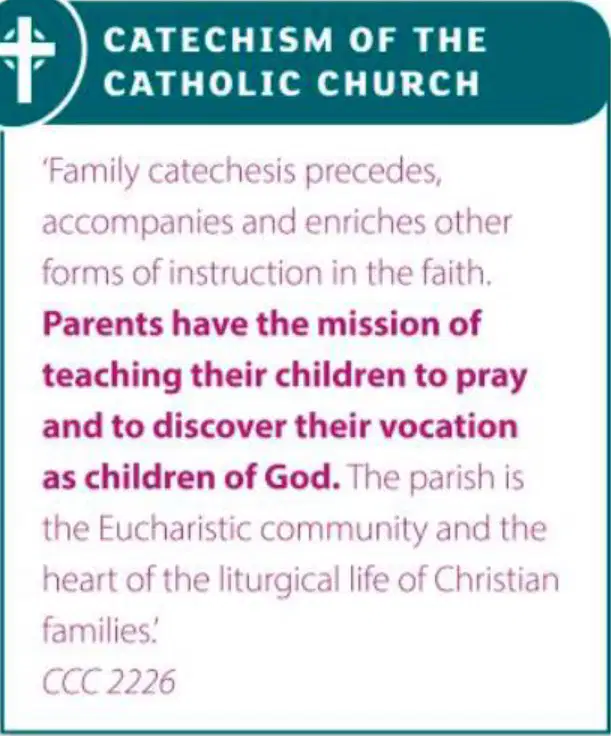
According to CCC 2226, which statement best summarizes the parents’ mission in family catechesis?
Parents ensure their children memorize every catechism answer for exams.
Parents have the mission of teaching their children to pray and to discover their vocation as children of God.
Parents primarily organize parish fundraisers and social events.
Parents delegate all religious instruction to the school and youth group.
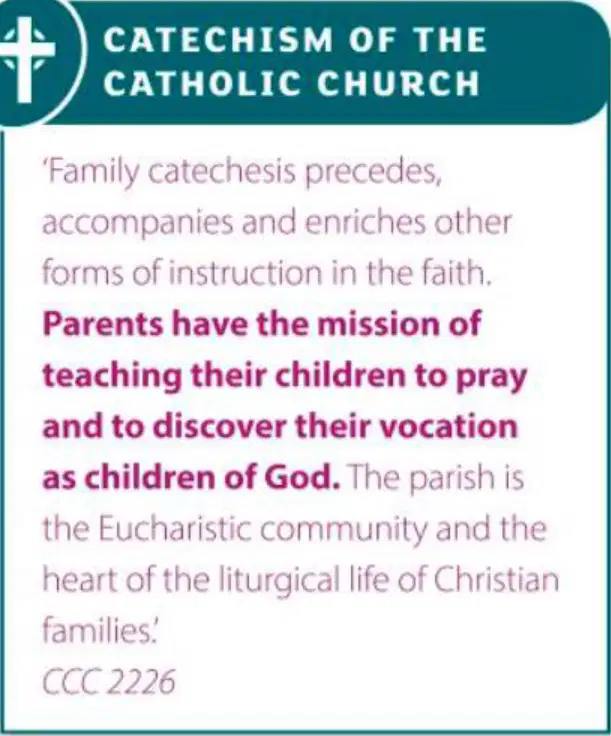
Based on the CCC 2226 excerpt: Family catechesis precedes, accompanies, and enriches other forms of instruction; and the parish is the Eucharistic community and the heart of the liturgical life of Christian families. Which roles are affirmed? Select all that apply.
Family catechesis supports and enhances other faith instruction.
The parish serves as the central Eucharistic and liturgical community for families.
Schools, not families, are the sole source of religious formation.
Parents’ mission is unrelated to helping children pray or discern their vocation.

