
 Worksheets
Monohybrid and Dihybrid Crosses
Total questions: 35
Worksheet time: 51mins
The passing of genetic traits from parent to offspring is known as
heredity
trait
gene
allele
What predicts genetic outcomes?
genetic engineering
punnet square
probability
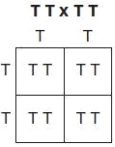
What is ratio of the offspring from the cross shown will be homozygous recessive for the trait of tallness? T = tall t = short
0 in 4
1 in 4
2 in 4
4 in 4

Brown eyes are dominant over blue eyes. What is the probability that the offspring will have brown eyes in this cross?
25%
50%
75%
100%
Identify all the DOMINANT alleles

In mice, black fur (B) is dominant to white fur (b). According to the Punnett square shown, the offspring in box 4 would:
be white.
be heterozygous.
be gray.
be homozygous.
In mice, black fur (B) is dominant to white fur (b). According to the Punnett square shown, how many offspring would be black?
0
1
2
3
4
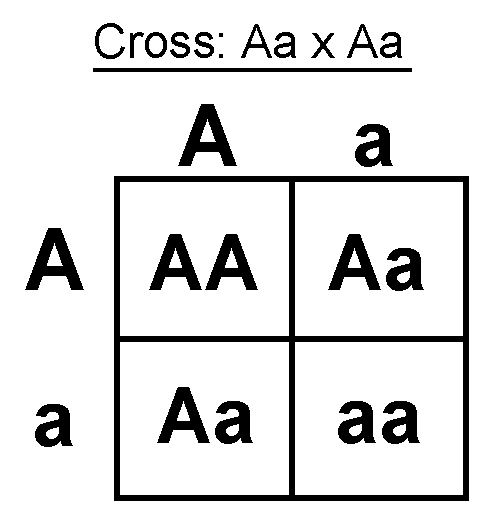
What are the possible phenotype(s) of the offspring? (A-Brown hair; a-blond hair)
50 % Brown Hair and 50% Blond Hair
25 % Brown Hair and 75% Blond Hair
75 % Brown Hair and 25% Blond Hair
0% Brown Hair and 100% Blond Hair
Brown eyes are dominant over blue eyes. What is the probability that the offspring will have brown eyes in this cross?
25%
50%
75%
100%

Long fur (L) is dominant to short fur (l) in rabbits. Which rabbits would have long fur?
LL
Ll
ll

Having a Widow's Peak is dominant (W) over not having one (w). If parent A (WW) and parent B (ww) have a child, what is the likelihood that--
The child will have a widow's peak
100%
The child will not have a widow's peak
0%
The genotype of these children
Ww
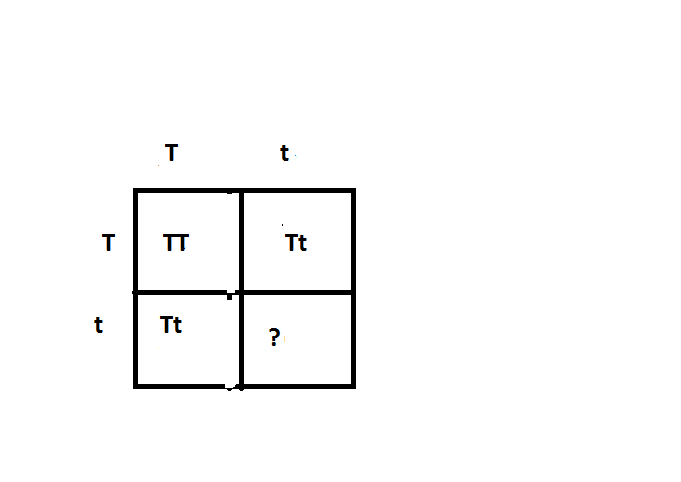
T - tall and t = short. In the Punnett square below, what belongs in the missing square (a)

Match the following genotypes with their descriptions.
Homozygous dominant
Genotype TT
Heterozygous
Genotype Tt
Homozygous recessive
Genotype tt

In a genetic cross between two heterozygous individuals (Bb), what is the probability of producing a homozygous recessive offspring?
50%
25%
0%
75%
Which of the following is an example of a genotype?
Tall
Blue eyes
Short
Tt
In a cross between a homozygous dominant and a homozygous recessive individual, what will be the phenotype of the offspring?
All recessive
All dominant
50% dominant, 50% recessive
75% dominant, 25% recessive
This is a Dihybrid Punnett Square. It has 16 boxes and crosses 2 traits instead of one. Use your knowledge of how to write genotypes and fill in the first row with the correct genotypes.
Select the boxes in the Punnett Square where you would find heterozygous offspring.
A white mouse with red eyes is crossed with a black mouse with brown eyes. The white mouse is recessive for both of its traits. The black mouse is dominant for both of its traits.
This cross would be
BBEE x bbee
BBEe x BbEe
BbEE x BbEe
BBee x BBEE

What goes in box 15
aabb
AABB
aaBB
AAbb


Based off this punnett square, what fraction of the offspring will have wrinkled, yellow seeds?
9/16
3/16
1/16
16/16
What is Mendel's Law of Independent Assortment?
If the recessive allele is passed for one trait, then it is more likely that the recessive allele will be passed for the other trait.
The passing of allele of one trait does not affect the passing of allele of another trait.
If the dominant allele is passed for one trait, then it is more likely that the dominant allele will be passed for the other trait.
If the dominant allele is passed for one trait, then it is more likely that the recessive allele will be passed for the other trait.
Mendel's Law of Segregation means?
Every person has two alleles for each trait, they segregate from each other and the dominant is passed more often.
Every person has two alleles for each trait, Where two traits are being passed, they do not effect each other.
Every person has two alleles for each trait, they segregate from each other and are passed down at random.
Every person has two alleles for each trait, they segregate from each other and the recessive is passed more often.

