
 Worksheets
US History Semester 1 Study Guide
Total questions: 138
Worksheet time: 1hrs 21mins
Which of the following statements best describes the Trail of Tears?
A forced removal of 100,000 Native Americans over 1,200 miles, resulting in 15,000 deaths and overseen by 6,000 troops.
A voluntary migration of Native Americans to new lands, with government support and no casualties.
A military campaign to expand American territory into the Northwest, resulting in the removal of settlers.
A trade route established for the exchange of goods between Native Americans and settlers.
What was one of the main reasons for the surge in westward migration across the United States in the 1800s?
The popularity of the American beaver fur trade, which spurred migration to the Northwest Oregon Territory.
The discovery of gold in California, which led to immediate settlement of the West.
The completion of the transcontinental railroad, making travel easy and fast.
The end of the Civil War, which opened new lands for settlement.
Which treaty set the boundary between the United States and British territory in the Oregon region at the 49th parallel?
The Oregon Treaty of 1846, which compromised with Britain to set the boundary at the 49th parallel.
The Treaty of Guadalupe Hidalgo, which ended the Mexican-American War.
The Adams-Onis Treaty, which gave the United States control over Florida.
The Louisiana Purchase, which doubled the size of the United States.
Which group migrated west because they were persecuted for their beliefs in polygamy and communal ownership of property, eventually settling the Utah Territory by 1850?
Mormons, who were persecuted for their beliefs and settled the Utah Territory by 1850.
Missionaries, who believed it was their Manifest Destiny to spread the word of God.
Merchants, who traveled the Santa Fe Trail to set up trading outposts.
Pioneers, who sought gold and new opportunities in California.
Which of the following best describes the journey on the Oregon Trail?
A 2,000 mile wagon trip from Missouri to Oregon that took about 6 months and required large amounts of supplies such as flour, biscuits, bacon, and coffee.
A 500 mile journey from Texas to California that could be completed in a few weeks with minimal supplies.
A 1,200 mile trek along the Santa Fe Trail, primarily for trading purposes, requiring only light provisions.
A short migration from the East Coast to the Midwest, mostly by train and steamboat.
During the period from 1821 to 1836, what happened in the Mexican territory of Tejas (Texas)?
Many Americans moved to Tejas, and the Mexican government soon lost control of the territory.
Texans fought the Mexican government for sovereignty at the Alamo and won their independence.
Americans in Texas asked the United States government to allow Texas into the union.
Congress refused to discuss the 'Texas Question' to avoid the issue of adding a slave state.
What was the outcome of the Bear Flag Revolt in California?
California became a de-facto territory of the United States after American forces captured Mexican outposts and General Vallejo supported annexation.
California remained under Mexican control until the end of the Civil War.
The revolt failed, and California was not annexed by the United States until 1900.
The Bear Flag Revolt led to immediate statehood for California in 1846.
Which of the following was NOT a reason for westward migration in the United States during the 1800s?
The completion of the transcontinental railroad, which occurred after most westward migration had already taken place.
The Louisiana Purchase, which opened new lands for settlement.
Manifest Destiny, the belief that Americans were destined to expand westward.
Native American Removal, which made land available for settlers.
Which of the following statements best describes the Trail of Tears?
A forced removal of 100,000 Native Americans over 1,200 miles, resulting in 15,000 deaths and overseen by 6,000 troops.
A voluntary migration of Native Americans to new lands, with government support and no casualties.
A military campaign to expand American territory into the Northwest, resulting in the removal of settlers.
A trade route established for the exchange of goods between Native Americans and settlers.
What was one of the main reasons for the surge in westward migration across the United States in the 1800s?
The popularity of the American beaver fur trade, which spurred migration to the Northwest Oregon Territory.
The discovery of gold in California, which led to immediate settlement of the West.
The completion of the transcontinental railroad, making travel easy and fast.
The end of the Civil War, which opened new lands for settlement.
Which treaty set the boundary between the United States and British territory in the Oregon region at the 49th parallel?
The Oregon Treaty of 1846, which compromised with Britain to set the boundary at the 49th parallel.
The Treaty of Guadalupe Hidalgo, which ended the Mexican-American War.
The Adams-Onis Treaty, which gave the United States control over Florida.
The Louisiana Purchase, which doubled the size of the United States.
Which group migrated west because they were persecuted for their beliefs in polygamy and communal ownership of property, eventually settling the Utah Territory by 1850?
Mormons, who were persecuted for their beliefs and settled the Utah Territory by 1850.
Missionaries, who believed it was their Manifest Destiny to spread the word of God.
Merchants, who traveled the Santa Fe Trail to set up trading outposts.
Pioneers, who sought gold and new opportunities in California.
Which of the following best describes the journey on the Oregon Trail?
A 2,000 mile wagon trip from Missouri to Oregon that took about 6 months and required large amounts of supplies such as flour, biscuits, bacon, and coffee.
A 500 mile journey from Texas to California that could be completed in a few weeks with minimal supplies.
A 1,200 mile trek along the Santa Fe Trail, primarily for trading purposes, requiring only light provisions.
A short migration from the East Coast to the Midwest, mostly by train and steamboat.
During the period from 1821 to 1836, what happened in the Mexican territory of Tejas (Texas)?
Many Americans moved to Tejas, and the Mexican government soon lost control of the territory.
Texans fought the Mexican government for sovereignty at the Alamo and won their independence.
Americans in Texas asked the United States government to allow Texas into the union.
Congress refused to discuss the 'Texas Question' to avoid the issue of adding a slave state.
What was the outcome of the Bear Flag Revolt in California?
California became a de-facto territory of the United States after American forces captured Mexican outposts and General Vallejo supported annexation.
California remained under Mexican control until the end of the Civil War.
The revolt failed, and California was not annexed by the United States until 1900.
The Bear Flag Revolt led to immediate statehood for California in 1846.
Which of the following was NOT a reason for westward migration in the United States during the 1800s?
The completion of the transcontinental railroad, which occurred after most westward migration had already taken place.
The Louisiana Purchase, which opened new lands for settlement.
Manifest Destiny, the belief that Americans were destined to expand westward.
Native American Removal, which made land available for settlers.
Why did tensions increase between the US and Mexico before the Mexican-American War?
Because the US and Mexico disagreed on the location of their shared border.
Because the US wanted to buy land from Mexico and Mexico refused.
Because Mexico wanted to invade the US for gold.
Because the US refused to recognize Mexico as a country.
According to President Polk in May 1846, what action did Mexico take that led to war?
Mexico invaded US territory and shed American blood on US soil.
Mexico refused to sell land to the US.
Mexico signed a treaty with another country.
Mexico sent a message to the US government.
What was Abraham Lincoln's criticism of President Polk's justification for the Mexican-American War?
Lincoln argued that Polk's message was confusing and lacked a clear explanation of the war's purpose.
Lincoln believed Polk was right to declare war on Mexico.
Lincoln thought Polk should have sent more troops to Texas.
Lincoln supported Polk's plan to annex California.
Which event marked the official start of the Mexican-American War?
Mexican troops engaged with General Taylor's troops and Congress declared war.
President Polk offered Mexico $30 million for disputed areas.
Santa Anna resigned as Mexican president.
The Treaty of Guadalupe Hidalgo was signed.
What were the main terms of the Treaty of Guadalupe Hidalgo signed on February 2, 1848?
Mexico gave up present-day California, Nevada, Utah, and parts of Arizona, New Mexico, Colorado, and Wyoming; the US agreed to pay $15 million and protect Mexicans living in America.
Mexico agreed to sell Texas to the US for $30 million.
The US recognized the Nueces River as the border.
Mexico annexed California and New Mexico.
What was a major effect of the discovery of gold at Sutter's Fort in 1848?
Tens of thousands of people migrated to California in hopes of striking it rich.
California immediately became a state.
The US and Mexico went to war over gold.
Gold was discovered in Texas as well.
Who were the '49ers' during the California Gold Rush?
People who migrated to California in 1849 to search for gold.
Miners who worked in Nevada.
Settlers who moved to Texas after the war.
US soldiers stationed in California.
How did the California Gold Rush affect the development of towns along the California Trail?
Boomtowns grew overnight to accommodate the sudden influx of migrants.
Towns along the trail were abandoned.
The Gold Rush had no impact on settlement patterns.
Only government officials were allowed to settle along the trail.
Refer to the map of the US in 1849. Which region was most affected by the Gold Rush migration?
California and the areas along the Sacramento River.
The eastern United States.
The southern states near the Rio Grande.
The northern states bordering Canada.
Which river did the United States believe marked the border between the US and Mexico before the Mexican-American War?
Rio Grande River
Nueces River farther north
Mississippi River
Colorado River
What was the immediate result after President Polk sent General Zachary Taylor and his troops to Texas?
Mexican troops engaged with Taylor's troops and Congress declared the start of the Mexican-American War.
Mexico accepted the $30 million offer for Texas, California, and New Mexico.
The US withdrew its troops from Texas to avoid conflict.
Santa Anna resigned as president of Mexico.
According to Abraham Lincoln's statement in the House of Representatives on January 12, 1848, what was his main criticism of President Polk regarding the Mexican-American War?
Polk did not provide a clear or convincing reason for the war.
Polk refused to negotiate with Mexico.
Polk wanted to annex all of Mexico.
Polk was too quick to accept peace terms.
What was one major outcome of the Treaty of Guadalupe Hidalgo, signed on February 2, 1848?
The US gained present-day California, Nevada, Utah, and parts of several other states from Mexico.
Mexico gained control of Texas and New Mexico.
The US paid $30 million for the disputed territories.
The US withdrew all troops from the Rio Grande.
What was a significant effect of the discovery of gold at Sutter's Fort in 1848?
Tens of thousands of people migrated to California in hopes of striking it rich, becoming known as '49ers.
The US immediately annexed California without debate.
Gold was discovered in Texas, leading to a new migration wave.
The Mexican-American War restarted due to disputes over gold.
Which statement best captures the definition of Manifest Destiny as presented in the material?
The belief that the United States should remain within the original thirteen colonies
The idea that America was destined to expand its empire of liberty from the Atlantic coast to the Pacific Coast
A plan to expand only through peaceful negotiations with European powers
A movement to limit immigration to western territories
Who coined the term "Manifest Destiny"?
James K. Polk
Andrew Jackson
John L. O'Sullivan
Henry Clay
According to the quotation in the material, Manifest Destiny aimed to overspread the continent for what purpose?
To secure military bases against European empires
For the free development of America's yearly multiplying millions
To end slavery in all U.S. territories
To convert Native Americans to Christianity
Which of the following was a land purchase that advanced Manifest Destiny?
Treaty of Guadalupe Hidalgo (1848)
Gadsden Purchase (1854)
War for Texas Independence (1835–1836)
Indian Removal Act (1830)
Which event officially ended the U.S.–Mexican War according to the material?
Annexation of Texas (1845)
Treaty of Fort Laramie (1851)
Treaty of Guadalupe Hidalgo (1848)
California statehood (1850)
Which item belongs under "Removal of Native Americans" in the chart?
Oregon Territory acquisition
Trail of Tears (1838)
Alaska Purchase (1867)
War with Mexico (1846–1848)
Which sequence shows a method of expansion primarily through war and annexation?
Louisiana Purchase → Alaska Purchase → Gadsden Purchase
War for Texas Independence → Annexation of Texas → War with Mexico
Indian Removal Act → Treaty of Fort Laramie → Trail of Tears
California statehood → Oregon Territory → Alaska Purchase
Which of the following was the earliest event listed among land purchases and annexations?
Annexation of Texas
California statehood
Louisiana Purchase
Gadsden Purchase
Which act or treaty is specifically connected to Native American displacement in 1830?
Indian Removal Act
Treaty of Guadalupe Hidalgo
Compromise of 1850
Annexation of Texas
Which option correctly pairs an event with its year as shown in the chart?
Gadsden Purchase — 1867
Alaska Purchase — 1854
California statehood — 1850
Annexation of Texas — 1830
In the Texas narrative, which requirement did Mexicans set for new settlers moving to Texas?
They must pay a gold tax and serve in the Mexican army
They must obey Mexican laws and observe Catholicism
They must free enslaved people immediately
They must become citizens of the United States
What major source of tension grew as the Texas Anglo population increased?
Disputes over fur trading rights
Conflicts about railroad routes
The bringing of slaves into Texas, which Mexico did not accept
Arguments over mining claims
Which leader marched with about 4,000 Mexican soldiers to enforce Mexican laws in Texas, leading to a battle at the Alamo?
Henry Clay
Sam Houston
James K. Polk
General Santa Anna
What was the rallying cry used by Texan Anglos when they fought back under Sam Houston?
Remember the Maine!
Fifty-Four Forty or Fight!
Remember the Alamo!
Give me liberty or give me death!
What political change occurred in 1836 related to Texas, according to the material?
Texas became a U.S. state
Sam Houston became President of the Republic of Texas
Mexico recognized Texas independence through a formal treaty
The U.S. annexed Texas
In what year was Texas annexed by the United States, as stated in the material?
1836
1845
1848
1850
Which 1848 event helped ignite nationwide interest in moving west to California?
California admitted as a free state
James Marshall's discovery of gold at John Sutter's property
Construction of the transcontinental railroad
Gadsden Purchase
Which president confirmed in his State of the Union address that large quantities of gold had been discovered in California?
Andrew Jackson
James K. Polk
Martin Van Buren
Zachary Taylor
What was a direct outcome of the Compromise of 1850 regarding California?
California entered the United States as a free state
California remained an independent republic
Slavery was expanded into all western territories
Mexico retained control over California
Which sequence best represents the timeline from discovery to statehood shown in the material?
Gold discovered (1848) → Gold fever (1849) → California statehood (1850)
Gold fever (1849) → President Polk confirms gold (1848) → California statehood (1850)
California statehood (1850) → Gold discovered (1848) → Gold fever (1849)
President Polk confirms gold (1848) → California statehood (1850) → Gold discovered (1849)
A law making it illegal to teach enslaved people to read and write most directly served which purpose of Slave Codes?
Maintaining social control through ignorance
Protecting property rights of plantation owners
Promoting religious freedom for all residents
Ensuring equal access to legal representation
Which factor most contributed to Nat Turner’s decision to lead a rebellion in 1831?
Promises of land grants from Virginia officials
Religious conviction to strike against oppressors
Legal protection under state militia policies
Support from the Underground Railroad network
What best describes the Underground Railroad during the early 19th century?
A clandestine network aiding escapes to the North and Canada
A public charity distributing manumission papers
A government-funded rail line transporting freedmen
A formal army unit protecting fugitive slaves
Which consequence of the Bleeding Sumner incident most heightened sectional tensions in 1856?
Preston Brooks being hailed as a hero across the South
Southern condemnation of Charles Sumner’s anti-slavery speech
Immediate bipartisan calls to abolish slavery nationwide
Northern praise for Preston Brooks’s defense of honor
How did the Dred Scott v. Sandford ruling undermine efforts to limit slavery’s expansion?
It held Congress lacked power to ban slavery in territories
It mandated gradual emancipation in border states
It affirmed popular sovereignty as constitutional policy
It declared enslaved people U.S. citizens with voting rights
Compare Lincoln’s and Douglas’s positions in the 1858 Illinois debates. Which pairing aligns with their arguments?
Lincoln: popular sovereignty; Douglas: immediate abolition nationwide
Lincoln: slavery is morally wrong; Douglas: federal power should spread slavery
Lincoln: property rights protection; Douglas: expand slavery to territories
Lincoln: restrict slavery’s spread; Douglas: states’ rights limit federal action
Evaluate John Brown’s Harpers Ferry raid outcomes. Which assessment best fits the historical evidence provided?
Limited local support, quick defeat, and Brown’s execution
Broad local slave participation sustained a week-long uprising
Failed raid but immediate congressional ban on slavery
Successful seizure of arms leading to regional emancipation
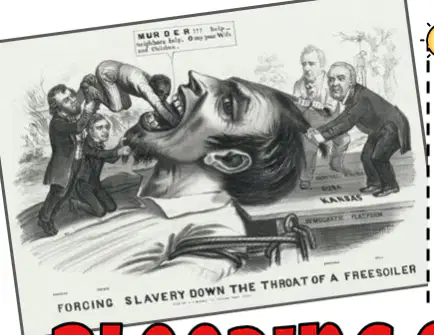
Interpret the Kansas cartoon’s claim about Democratic policy in the 1850s. What is the central argument depicted?
Democrats promoted neutral compromise to reduce conflict
Democrats defended free-soil settlers from slaveowners
Democrats forced slavery upon Kansas free-soilers
Democrats backed abolitionist violence across territories
Which issue most defined the 1860 presidential campaign across parties?
Protecting tariffs for Northern industry
Managing western land speculation
Determining slavery’s expansion into territories
Reforming banking and internal improvements
Which pairing correctly matches a 1860 candidate with the position highlighted in the campaign?
Abraham Lincoln — immediate nationwide abolition of slavery
Stephen Douglas — federal protection of slavery nationwide
John Breckinridge — popular sovereignty in territories
John Bell — avoid taking a stance on slavery’s expansion
Why was Lincoln’s victory considered significant for the Republican Party’s future?
It ended Southern threats of disunion and compromise
It realigned Democrats to embrace abolition immediately
It proved Republicans could win while conceding on slavery
It showed a national majority for stopping slavery’s spread
Which statement best captures South Carolina’s stated reason for secession after Lincoln’s election?
To pressure Republicans into cabinet appointments
To secure immediate emancipation throughout the Union
To build a powerful Southern Confederacy outside the Union
To negotiate a new compromise on territorial governance
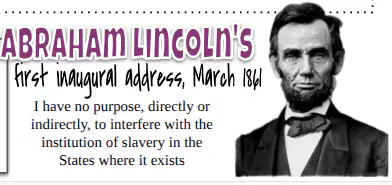
In his First Inaugural Address (March 1861), what position did Lincoln publicly take regarding slavery where it already existed?
He would leave the decision entirely to each territory
He planned to abolish it by executive proclamation
He sought Congress to mandate immediate compensated emancipation
He would not interfere with it where it currently existed
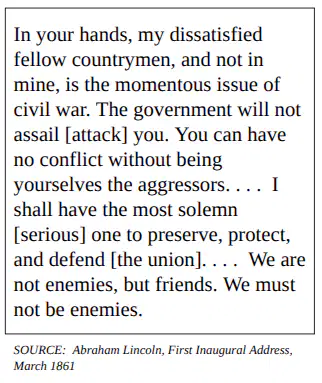
Which statement best captures Lincoln’s central point in the quoted passage from his First Inaugural Address?
He intends to attack seceded states to restore order
He will avoid initiating conflict to preserve the Union
He plans to punish dissenters to deter rebellion
He will immediately abolish slavery across all states
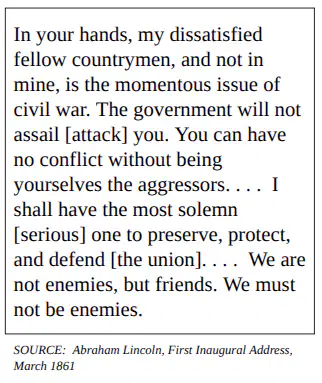
Why might Lincoln avoid naming South Carolina and other seceded states directly in this section of the speech?
To de-escalate tensions and keep the Union together
To comply with strict newspaper censorship rules
To conceal the identities from Northern audiences
To blame Congress for the crisis rather than states
Which type of corroborating source would most effectively test whether Lincoln’s goal was truly to preserve the Union?
Maps showing Civil War battle locations
Personal letters revealing private intentions
Photographs of inauguration crowds
Census data on population in 1860
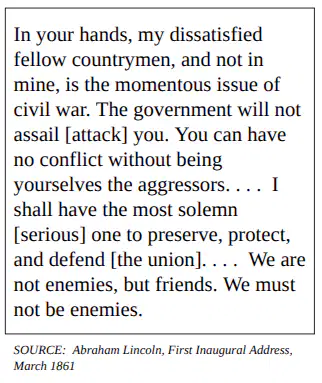
In the passage, Lincoln addresses “dissatisfied fellow countrymen.” What does this audience choice suggest about his strategy?
He intends to exclude Southern listeners from the Union
He frames secessionists as friends to invite reconciliation
He seeks to isolate opponents as foreign enemies
He demands unconditional surrender before negotiation
Which event most directly accelerated Southern states’ decision to secede after the 1860 election?
Lincoln’s call for immediate abolition nationwide
Congress passing the Crittenden Compromise
Douglas’s endorsement of federal slave codes
Lincoln’s election without Southern electoral votes
What was a primary goal of the Underground Railroad’s conductors?
To organize armed resistance against slave catchers
To secretly guide enslaved people to freedom in the North
To negotiate legal emancipation with Southern legislatures
To distribute abolitionist pamphlets in Southern cities
How did the Dred Scott decision influence the national debate over slavery?
It led to immediate emancipation in Northern states
It strengthened the authority of states to ban slavery
It declared that enslaved people could sue in federal court
It invalidated congressional efforts to restrict slavery in territories
What was a key reason many Southerners viewed Lincoln’s election as a threat?
He advocated for states’ rights above federal law
He supported Southern economic interests
He opposed the expansion of slavery into new territories
He promised to abolish slavery in all states immediately
Which action did abolitionists most commonly take to resist the Fugitive Slave Act?
Encouraging secession from the Union
Lobbying for the expansion of slave codes
Establishing safe houses along the Underground Railroad
Organizing violent uprisings in Southern states
How did the Missouri Compromise attempt to address sectional tensions over slavery?
By maintaining a balance between free and slave states
By allowing popular sovereignty in every territory
By banning slavery in all new states
By granting immediate emancipation to all enslaved people
Which of the following best explains why the Fugitive Slave Act was controversial in Northern states?
It granted voting rights to formerly enslaved individuals
It provided financial compensation to slaveholders only in the South
It abolished slavery in all Northern territories
It required citizens to assist in capturing escaped enslaved people
What was a major effect of the publication of Uncle Tom’s Cabin in the 1850s?
It encouraged Southern states to expand slavery into new territories
It resulted in the election of John Brown as president
It led to the immediate repeal of the Missouri Compromise
It increased support for the abolitionist movement in the North
Which statement best describes the impact of the Kansas-Nebraska Act on sectional tensions?
It increased tensions by allowing popular sovereignty to decide on slavery
It unified Northern and Southern states under a single policy
It ended the debate over the expansion of slavery permanently
It reduced conflict by banning slavery in all new territories
Which legislative act repealed the Missouri Compromise and heightened sectional conflict over slavery?
Kansas-Nebraska Act
Compromise of 1850
Wilmot Proviso
Fugitive Slave Act
What was a direct result of the Supreme Court’s ruling in Dred Scott v. Sandford for enslaved people?
They were emancipated in free states
They could not claim freedom through the courts
They gained the right to vote in federal elections
They were declared citizens with legal rights
Which argument did Southern leaders most frequently use to justify secession after the 1860 election?
Expansion of the Underground Railroad
Support for immediate abolition of slavery
Desire for economic integration with the North
Protection of states’ rights and slavery
What was the main effect of the Fugitive Slave Act on Northern states?
It abolished slavery in all Northern states
It allowed enslaved people to vote in local elections
It granted freedom to all enslaved people crossing state lines
It required citizens to assist in capturing escaped enslaved people
Which argument did supporters of popular sovereignty use to justify their stance on slavery in new territories?
Local settlers should decide whether to allow slavery
Congress must ban slavery in all territories
Only the Supreme Court can determine slavery’s legality
Slavery should be immediately abolished nationwide
How did the Compromise of 1850 attempt to resolve disputes between free and slave states?
By admitting California as a free state and enacting a stricter Fugitive Slave Law
By abolishing slavery in all existing states
By granting voting rights to all enslaved people
By requiring all states to adopt slave codes
Which statement best captures Lincoln’s position on slavery at the time of his first inauguration?
He planned to abolish slavery everywhere immediately
He supported expanding slavery into new territories
He would not interfere with slavery where it already existed
He believed Congress lacked any role on slavery
What concern does Lincoln identify among people in the Southern states in March 1861?
Fear that their property and security were endangered
Belief that tariffs would collapse plantation profits
Expectation that Western states would secede first
Suspicion that Europe would invade Southern ports
Lincoln claims the Union is perpetual. Which reasoning aligns with his view?
Perpetuity arises from temporary interstate agreements
Perpetuity depends on a yearly vote by all states
Perpetuity is implied by fundamental law of national governments
Perpetuity exists only during wartime emergencies
According to Lincoln, what is the legal status of a state attempting to leave the Union on its own?
Conditional on presidential proclamation
Lawful if approved by its legislature alone
Lawful if accompanied by a state referendum
Unlawful because no state may secede on its own
Which actions did Lincoln label as insurrectionary or revolutionary?
State regulations on interstate commerce
Peaceful petitions to amend the Constitution
Acts of violence against United States authority
Local elections altering county leadership
Which phrase reflects Lincoln’s closing appeal for national unity?
‘Manifest destiny for all’
‘A house divided cannot stand’
‘Government of the people’
‘Better angels of our nature’
Lincoln states he has no lawful right and no inclination to do which of the following?
Interfere with slavery in existing slave states
Call for immediate compensated emancipation
Enforce federal laws in seceded territories
Collect tariffs in Southern ports
Which best explains Lincoln’s purpose in addressing Southern apprehensions?
To justify military invasion of the South
To reassure that their rights would be protected
To announce new federal taxes on plantations
To encourage border states to join the Confederacy
What does Lincoln suggest about evidence for his stance on slavery before taking office?
It was communicated only to party leaders
It could be found in his published speeches
It was secret and not publicly available
It changed weekly during the campaign
Which statement aligns with Lincoln’s view of the Constitution regarding the Union?
The Constitution creates a perpetual national government
The Constitution forms a temporary compact of states
The Constitution permits secession by majority vote
The Constitution allows each state to nullify laws
Lincoln contrasts ‘enemies’ and ‘friends’ in his conclusion. What does he urge?
Uniting through shared memories and patriotism
Choosing neutrality between Union and Confederacy
Breaking bonds of affection to avoid conflict
Postponing reconciliation until war ends
Which of the following best reflects Lincoln’s use of ‘mystic chords of memory’?
Shared national experiences can inspire reconciliation
Religious conversion is necessary for political unity
Economic growth will dissolve political divisions
Party platforms are more important than principles
Identify the claim Lincoln rejects regarding his intentions as president.
He intends to enforce the Constitution faithfully
He intends to endanger Southern peace and security
He intends to leave slavery untouched in the territories
He intends to protect federal property
Which inference about Lincoln’s audience is most reasonable from the address excerpts?
They believed secession was constitutionally valid
They were unified on tariff reform policy
They wanted immediate emancipation measures
They feared federal interference with slavery
What constitutional principle underlies Lincoln’s refusal to recognize unilateral secession?
Judicial review is the only constitutional remedy
National government derives authority from compact theory
States’ rights supersede national sovereignty
Supremacy of federal law and national union
If a state used violence to seize a federal fort in 1861, how would Lincoln likely classify that act?
Constitutional and peaceful dissent
Insurrectionary against United States authority
Lawful under state militia laws
A domestic dispute beyond federal concern
Which interpretation best explains Lincoln’s statement ‘I am loath to close’?
He hesitated because he hoped to appeal to hearts
He wished to extend his legal arguments further
He planned to announce new cabinet appointments
He feared Congress would reject his speech
Which policy direction is most consistent with Lincoln’s remarks about not interfering with slavery where it existed?
Federal compensation for emancipated enslavers
Maintaining status quo while preventing expansion
Immediate nationwide abolition through proclamation
Territorial popular sovereignty without limits
Lincoln’s claim that ample contrary evidence existed ‘all the while’ implies what about his critics’ accusations?
They lacked public proof for their claims
They reflected Northern support for secession
They were endorsed by Supreme Court rulings
They were based on new confidential documents
Which reasoning strategy does Lincoln use to argue Union perpetuity?
Reliance on military necessity alone
Citation of foreign treaties guaranteeing unity
Prediction of economic collapse if divided
Appeal to implied constitutional design
Who was the Vice President under George Washington?
Thomas Jefferson
John Adams
Alexander Hamilton
Edmund Randolph
What was the original number of members in the Supreme Court according to the Judiciary Act of 1789?
5 members
6 members
7 members
9 members
What role did Alexander Hamilton serve in the first cabinet?
Secretary of War
Secretary of State
Secretary of Treasury
Attorney General
What was the main financial issue America faced at the start of the new nation?
$80 million in debt
Surplus of funds
No national currency
Excessive wealth
What was a key point in Washington's farewell address about political parties?
They are essential for democracy.
They should be avoided to prevent factionalism.
They should be encouraged for diverse opinions.
They are irrelevant to governance.
What was the reaction of farmers to the whiskey tax?
They supported it.
They rebelled against it.
They ignored it.
They benefited from it.
What was the main idea of Hamilton's quote regarding the National Bank?
It was unnecessary.
It was implied by the Constitution.
It was explicitly mentioned in the Constitution.
It was opposed by all states.
What was the main reason France began attacking American ships during John Adams' presidency?
To support American trade with England
To prevent Americans from trading with England
To expand French territory
To negotiate a peace treaty
What was the purpose of the Alien and Sedition Acts according to the Federalists?
To promote free speech
To give the government new powers
To encourage immigration
To reduce taxes
What did the Virginia and Kentucky Resolutions argue about federal laws?
States must always follow federal laws
States can nullify unconstitutional federal laws
Federal laws are supreme over state laws
States should create their own federal laws
What did the Alien and Sedition Acts make harder for immigrants?
To find employment
To vote
To travel
To own property
What was the purpose of the XYZ Affair negotiations?
To declare war on France
To negotiate peace with France
To form an alliance with England
To expand American territory
What was the purpose of sending representatives to France during the XYZ Affair?
To negotiate peace
To declare war
To form an alliance
To expand trade
Why was Thomas Jefferson troubled by John Adams' presidency?
He believed Adams was too lenient with foreign nations.
He thought Adams was not supportive of the military.
He was convinced radicals within Adams' party were against the spirit of 1776.
He felt Adams was too focused on economic policies.
What was Jefferson's stance on the press according to the Philadelphia Aurora?
He wanted to control the press.
He supported the liberty of the press.
He ignored the press entirely.
He believed the press should be state-run.
What did Jefferson want to prevent by running for president?
The expansion of the military.
The destruction of states' rights.
The increase of foreign alliances.
The rise of economic instability.
What did Jefferson believe about the national government under Federalist rule?
It was too weak.
It was oppressive like Great Britain’s.
It was supportive of the arts.
It was focused on education.
What did Jefferson believe about the Federalists' intentions?
They wanted to promote international trade.
They wanted to undermine and demolish the republic.
They wanted to focus on education.
They wanted to increase agricultural production.
What was the Philadelphia Aurora's stance on the rights of conscience?
They should be limited.
They should be protected.
They should be ignored.
They should be controlled by the church.
What did Jefferson believe about the Federalists' impact on the states?
They would strengthen state governments.
They would destroy the states.
They would promote state independence.
They would focus on state education.
Who was elected as the first Vice President of the United States?
Thomas Jefferson
John Adams
Alexander Hamilton
Edmund Randolph
What was the purpose of the Judiciary Act of 1789?
To create a single-tier court system
To establish a three-tier system of federal courts
To eliminate the Supreme Court
To increase the number of state courts
What was one of the main issues America faced that was addressed by Hamilton's Plan?
Lack of a national bank
Excessive military spending
Overpopulation
Trade deficits with Europe
What was the original number of members in the Supreme Court as established by the Judiciary Act of 1789?
3
6
9
12
What was one of the actions included in Hamilton's Plan to address national debt?
Decrease taxes on imported goods
Excise tax on Whiskey
Increase military spending
Reduce tariffs
What was the main focus of the Secretary of State in George Washington's cabinet?
Defense
Economy
Other countries
Justice
What was one of the reasons for creating a national bank according to Hamilton's Plan?
To increase state debts
To unite public authority and faith with private credit
To eliminate all taxes
To reduce the power of the federal government
What was the main economic issue America faced that was highlighted in the document?
Overproduction of goods
$80 million in debt
Lack of trade partners
High employment rates
What was the role of the Supreme Court as established by the Judiciary Act of 1789?
To create laws
To preside over the court system
To decide appeals from District Courts
To manage state courts
What was Hamilton's perspective on the implied powers of the Constitution?
They should be strictly limited.
They are as valid as express powers.
They should be ignored.
They are unnecessary for governance.
What was a consequence of the Whiskey Rebellion?
Farmers gained more political power.
The national capital was moved to the south.
Washington led an army to quell the rebellion.
The rebellion strengthened the Anti-Federalists.
What was the main idea of Hamilton's quote regarding the Constitution?
The Constitution should be interpreted strictly.
Government policies should be flexible.
The Constitution explicitly mentions a bank.
All government policies should be absolutely necessary.
What was the role of the Democratic Republicans in the Whiskey Rebellion?
They supported the rebellion.
They were blamed for the rebellion.
They led the rebellion.
They were neutral in the conflict.
What was Washington's advice regarding foreign policy in his farewell address?
Engage in alliances with all countries.
Avoid entangling alliances with other countries.
Focus on expanding the nation's borders.
Prioritize trade over all other concerns.
What was the significance of the Neutrality Proclamation issued by Washington?
It declared war on France.
It supported the French Revolution.
It kept the United States out of European conflicts.
It allied the United States with Britain.
What was one of the reasons for the Whiskey Rebellion?
Farmers were against the national army.
Farmers opposed taxes on whiskey.
Farmers wanted more representation in Congress.
Farmers supported the National Bank.
What was the outcome of the French Revolution in 1789 for the United States?
The United States declared war on France.
The United States issued a Neutrality Proclamation.
The United States formed an alliance with France.
The United States increased trade with France.
What was the purpose of Jay's Treaty?
To declare war on Britain.
To prevent further impressment of American sailors.
To form an alliance with France.
To increase tariffs on British goods.
What was the main idea of the "PRO" perspective on the National Bank?
It was unnecessary for the economy.
It was supported by the Constitution's implied powers.
It was only beneficial for northern states.
It was a temporary solution.
What was the main idea of Washington's farewell address regarding political parties?
Political parties are essential for democracy.
Political parties can be dangerous and should be avoided.
Political parties should focus on international issues.
Political parties should be limited to two.
What was the primary age range for soldiers in the Continental Army?
16-25
25-35
18-25
20-30
Which two states contributed the majority of soldiers to the Continental Army?
New York and Pennsylvania
Georgia and South Carolina
New Jersey and Maryland
Massachusetts and Virginia
What was the main reason for the high desertion rate in the Continental Army in 1776?
Lack of proper training
Harsh weather conditions
Scarcity of supplies
Low pay in worthless currency
Which battle is considered a turning point that led France to ally with the Americans?
Battle of Bunker Hill
Battle of Yorktown
Battle of Saratoga
Battle of Camden
What was the outcome of the Battle of Bunker Hill?
American victory with high morale
British retreat to Nova Scotia
British victory but boosted American morale
Decisive American victory
What was the significance of the Valley Forge Winter for the Continental Army?
It was a time of plentiful supplies
It was a period of harsh conditions and crucial training
It marked the end of the war
It led to the capture of Philadelphia
Which Native American tribes supported the British during the Revolutionary War?
Oneida and Tuscarora
Shawnee and Delaware
Seneca, Cayuga, Onondaga, Mohawk
Cherokee and Creek
What was the main role of American privateers during the war?
To attack British merchant ships
To transport troops
To engage in direct naval battles with the Royal Navy
To blockade British ports
What was the result of the Battle of Camden?
Stalemate
Worst American defeat
American victory
British victory with heavy losses
What was the strategic importance of the Battle of Yorktown?
It led to the capture of New York City
It was a major British victory
It marked the last major battle of the war
It was the first battle of the war
How did the Treaty of Paris (1783) affect U.S. boundaries?
U.S. boundaries were limited to the east coast
U.S. boundaries extended to the Mississippi River
U.S. boundaries included all of Canada
U.S. boundaries were restricted to the original 13 colonies
What was the impact of the British presence in the Southern Campaign?
It resulted in a stalemate
It turned many Southerners against the British
It strengthened Loyalist support
It led to the capture of New York
Which battle was a major morale boost for the Americans after Washington's crossing of the Delaware?
Battle of Yorktown
Battle of Princeton
Battle of Saratoga
Battle of Trenton
What was the role of local militias during the Revolutionary War?
To negotiate treaties with Native Americans
To engage in naval warfare
To protect settlements and respond to threats
To serve as the main fighting force
What was the main reason for the Continental Army's reliance on foraging?
To avoid detection by the British
Abundance of local resources
Scarcity of supplies
Strategic military advantage

