
 Worksheets
BIOSPHERE
Total questions: 96
Worksheet time: 48mins
Which of the following types of heterotrophs eat other animals?
omnivores
herbivores
carnivores
All of life on earth exists in a region known as ______________
an ecosystem
a biome
the biosphere
ecology
Groups of different species that live together in a defined area make up a(n) _________________
A. population
B. community
C. ecosystem
D. biosphere
The process in which organisms use chemical energy stored IN THE CHEMICAL BONDS OF INORGANIC MOLECULES to make their own food in the absence of light is called _________________
photosynthesis
chemosynthesis
fermentation
cellular respiration
Heterotrophs are also called _______________.
autotrophs
photosynthesizers
producers
consumers
Each step in a food chain or web is called a _________________
energy trap
consumer index
trophic level
ecology group
Autotrophs can also be called _____________________.
A. producers
B. consumers
C. detritivores
D. decomposers
Only about _____ percent of the energy available within one trophic level is transferred to organisms at the next trophic level when they are eaten.
10%
25%
50%
1%
Put the following in order from least to most complex: BIOSPHERE, POPULATION, ECOSYSTEM, COMMUNITY, INDIVIDUAL ORGANISM, BIOME. Write the correct order in the blanks provided.
INDIVIDUAL ORGANISM → POPULATION → COMMUNITY → ECOSYSTEM → BIOME → BIOSPHERE
BIOSPHERE → BIOME → ECOSYSTEM → COMMUNITY → POPULATION → INDIVIDUAL ORGANISM
POPULATION → INDIVIDUAL ORGANISM → COMMUNITY → ECOSYSTEM → BIOME → BIOSPHERE
INDIVIDUAL ORGANISM → COMMUNITY → POPULATION → ECOSYSTEM → BIOME → BIOSPHERE
How is a food chain different from a food web?
A food chain shows a single path of energy flow, while a food web shows multiple interconnected paths of energy flow.
A food chain and a food web are exactly the same.
A food chain shows multiple interconnected paths, while a food web shows a single path.
A food web only includes plants, while a food chain includes animals.
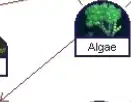
Name a producer in this food web.
Algae (or Sedge)
Fish
Frog
Snake
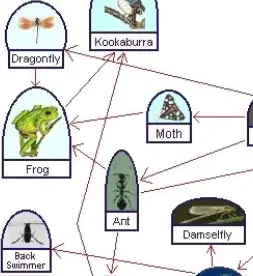
Refer to the food web diagram. Name two heterotrophs.
Frog, Dragonfly (other possible answers: Kookaburra, Lizard, Moth, Ant, etc.)
Grass, Tree
Sunlight, Water
Soil, Air
What do you think will happen to the frog population in this community if all the centipedes were killed off by a disease?
it would increase
it would decrease
it wouldn’t change... frogs don’t eat centipedes
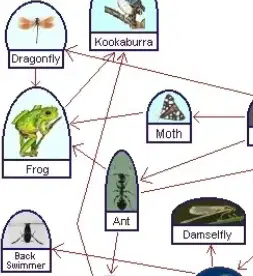
Refer to the food web diagram. What will happen to the frog population if all the centipedes were killed off by a disease?
The frog population will decrease due to less available food.
The frog population will increase due to less competition.
The frog population will remain unchanged.
The frog population will migrate to another area.
During which process do plants use carbon dioxide?
cellular respiration
photosynthesis
denitrification
transpiration
In the nitrogen cycle, bacteria that live in soil and on plant roots in a symbiotic relationship with legumes change nitrogen gas into ammonia in a process called _______________.
nitrogen fixation
denitrification
photosynthesis
respiration
Which biogeochemical cycle does NOT involve a stage where the chemical enters the atmosphere?
carbon cycle
water cycle
phosphorus cycle
nitrogen cycle
Which of the following is NOT recycled in a biogeochemical cycle in the biosphere?
Water
Carbon
Nitrogen
Energy
Carbon cycles through the biosphere in all of the following EXCEPT ______________________
A. photosynthesis
B. transpiration
C. burning fossil fuels
D. decay of dead plants and animals
How is carbon stored in the biosphere?
in the atmosphere as CO₂
underground as fossil fuels and calcium carbonate rock
in the oceans as dissolved CO₂
in soil as ammonia
How is nitrogen returned to the atmosphere in the nitrogen cycle?
burning fossil fuels
transpiration
denitrification by bacteria
erosion of rock
How is the movement of matter through the biosphere different from the flow of energy?
Matter is recycled within and between ecosystems thorough biogeochemical cycles.
Energy is recycled within and between ecosystems thorough biogeochemical cycles.
Matter flows one way through an ecosystem and is used up
Energy flows one way through an ecosystem and is used up.
Which biomolecules found in living things contain carbon?
nucleic acids (DNA & RNA)
lipids
carbohydrates
ATP
proteins
Which biomolecules found in living things contain phosphorus?
nucleic acids (DNA & RNA)
lipids
carbohydrates
ATP
proteins
Name the 3 types of SYMBIOSIS: Relationship in which one organism benefits, but the other is neither helped nor harmed.
Commensalism
Mutualism
Parasitism
Competition
Name the 3 types of SYMBIOSIS: Relationship in which one organism benefits and the other is harmed in some way.
Parasitism
Mutualism
Commensalism
Neutralism
Name the 3 types of SYMBIOSIS: Relationship in which both organisms benefit.
Mutualism
Parasitism
Commensalism
Predation
The __________________________ principle states that NO two species can occupy the same niche in the same habitat at the same time.
competitive exclusion
resource partitioning
mutualism
succession
Use what you learned about limiting nutrients to explain why many lakes in Arkansas turn green in late summer.
Many lakes in Arkansas turn green in late summer because an increase in limiting nutrients like nitrogen and phosphorus causes algae to grow rapidly.
Many lakes in Arkansas turn green in late summer because the water temperature drops significantly, killing fish and turning the water green.
Many lakes in Arkansas turn green in late summer because the lakes are cleaned and chemicals are added to change the color.
Many lakes in Arkansas turn green in late summer because the wind stirs up mud from the bottom, making the water appear green.
Fill in the table below: TRANSPIRATION | EVAPORATION WAY THEY ARE DIFFERENT: __________________________ | __________________________ WAY THEY ARE ALIKE: __________________________ | __________________________
WAY THEY ARE DIFFERENT: Transpiration is the process by which water is lost from plants through their leaves; Evaporation is the process by which water changes from liquid to gas from any surface. WAY THEY ARE ALIKE: Both involve the change of water from liquid to vapor.
WAY THEY ARE DIFFERENT: Transpiration is the process by which water is lost from animals; Evaporation is the process by which water is absorbed by soil. WAY THEY ARE ALIKE: Both involve the movement of water underground.
WAY THEY ARE DIFFERENT: Transpiration is the process by which water is gained by plants; Evaporation is the process by which water is lost from plants only. WAY THEY ARE ALIKE: Both involve the freezing of water.
WAY THEY ARE DIFFERENT: Transpiration is the process by which water is lost from rocks; Evaporation is the process by which water is lost from clouds. WAY THEY ARE ALIKE: Both involve the condensation of water.
Name 4 biogeochemical cycles:
Water cycle, Carbon cycle, Nitrogen cycle, Phosphorus cycle
Water cycle, Oxygen cycle, Sulfur cycle, Iron cycle
Carbon cycle, Nitrogen cycle, Oxygen cycle, Calcium cycle
Phosphorus cycle, Water cycle, Sulfur cycle, Potassium cycle
NAME THE CYCLE DESCRIBED: Cycle in which photosynthesis and cellular respiration participate
Carbon cycle
Nitrogen cycle
Water cycle
Oxygen cycle
NAME THE CYCLE DESCRIBED: __________________ Only cycle which does not pass through the atmosphere
Phosphorus cycle
Carbon cycle
Nitrogen cycle
Water cycle
NAME THE CYCLE DESCRIBED: Cycle that involves transpiration
Water cycle
Carbon cycle
Nitrogen cycle
Oxygen cycle
Cycle which is dependent on bacteria for nitrogen fixation and denitrification
Nitrogen cycle
Carbon cycle
Oxygen cycle
Water cycle
NAME THE CYCLE DESCRIBED: Process by which water enters the atmosphere from the leaves of plants
Transpiration
Photosynthesis
Condensation
Evaporation
NAME THE CYCLE DESCRIBED: Cycle in which volcanic activity and burning fossil fuels plays a role
Carbon cycle
Nitrogen cycle
Water cycle
Phosphorus cycle
NAME THE CYCLE DESCRIBED: __________________ Another name for the water cycle
Hydrologic cycle
Carbon cycle
Nitrogen cycle
Oxygen cycle
NAME THE CYCLE DESCRIBED: Cycle which includes an underground reservoir in the form of fossil fuels
Carbon cycle
Nitrogen cycle
Water cycle
Phosphorus cycle
NAME THE STEP IN A BIOGEOCHEMICAL CYCLE: __________________ Process in which nitrogen gas from the atmosphere is converted into ammonia by bacteria that live in the soil and on the roots of plants called legumes
Nitrogen fixation
Denitrification
Photosynthesis
Transpiration
NAME THE STEP IN A BIOGEOCHEMICAL CYCLE: __________________ Process in which soil bacteria convert nitrogen compounds in soil back into nitrogen gas which is released into the atmosphere
Denitrification
Nitrogen fixation
Ammonification
Nitrification
NAME THE STEP IN A BIOGEOCHEMICAL CYCLE: __________________ Process in which sunlight is used to change atmospheric carbon into biomolecules used for energy by living things
Photosynthesis
Respiration
Decomposition
Transpiration
NAME THE STEP IN A BIOGEOCHEMICAL CYCLE: __________________ Process in which water evaporates from the surface of plant leaves
Transpiration
Condensation
Precipitation
Infiltration
NAME THE STEP IN A BIOGEOCHEMICAL CYCLE: __________________ Process in which nutrients in dead organisms are returned to the soil
Decomposition
Photosynthesis
Transpiration
Condensation
NAME THE STEP IN A BIOGEOCHEMICAL CYCLE: __________________ Process in which the break down of sugars in living things returns carbon to the atmosphere as CO₂
Cellular respiration
Photosynthesis
Transpiration
Nitrogen fixation
________________ Process in which liquid water changes into gas form
Evaporation
Condensation
Precipitation
Sublimation
________________ Process in which water vapor (gas) changes into liquid water
Condensation
Evaporation
Precipitation
Sublimation
Tell 2 human activities by which carbon can enter the atmosphere as CO₂ during the carbon cycle
Burning fossil fuels, deforestation
Planting trees, photosynthesis
Drinking water, eating food
Condensation, precipitation
Name 2 NON-human activities by which carbon can enter the atmosphere or oceans during the carbon cycle.
Respiration, volcanic eruptions
Photosynthesis, fossil fuel burning
Deforestation, cement production
Mining, agriculture
Tell one way carbon leaves the atmosphere during the carbon cycle.
Photosynthesis
Respiration
Combustion
Decomposition
Tell 2 ways water enters the atmosphere in the water cycle
Evaporation, transpiration
Condensation, precipitation
Runoff, infiltration
Collection, absorption
Tell something humans do to return nitrogen to the soil for the nitrogen cycle.
Use fertilizers
Burn fossil fuels
Release oxygen
Plant more trees
Although almost 80% of the atmosphere is made up of nitrogen gas, most living things don’t have the enzymes necessary to use nitrogen directly from the atmosphere. How do we get the nitrogen we need to make proteins and DNA if we can’t get it from breathing?
By consuming plants and animals that have absorbed nitrogen compounds
By absorbing nitrogen directly from the air through our skin
By converting atmospheric nitrogen into usable forms through breathing
By producing nitrogen internally through cellular respiration
WHAT’S THE TYPE OF SYMBIOSIS?
Mutualism
Parasitism
Commensalism
Predation
WHAT'S THE TYPE OF SYMBIOSIS?
Mutualism
Parasitism
Commensalism
Predation
WHAT'S THE TYPE OF SYMBIOSIS?
Parasitism
Mutualism
Commensalism
Amensalism
WHAT’S THE TYPE OF SYMBIOSIS?
Parasitism
Mutualism
Commensalism
Amensalism
WHAT’S THE TYPE OF SYMBIOSIS?
Mutualism
Parasitism
Commensalism
Predation
WHAT’S THE TYPE OF SYMBIOSIS?
Mutualism
Parasitism
Commensalism
Predation
WHAT’S THE TYPE OF SYMBIOSIS?
Mutualism
Parasitism
Commensalism
Predation
WHAT'S THE TYPE OF SYMBIOSIS?
Mutualism
Parasitism
Commensalism
Predation
WHAT'S THE TYPE OF SYMBIOSIS?
Mutualism
Parasitism
Commensalism
Predation
WHAT’S THE TYPE OF SYMBIOSIS?
Mutualism
Parasitism
Commensalism
Competition
WHAT’S THE TYPE OF SYMBIOSIS?
Mutualism
Parasitism
Commensalism
Competition
WHAT'S THE TYPE OF SYMBIOSIS?
Parasitism
Mutualism
Commensalism
Amensalism
WHAT'S THE TYPE OF SYMBIOSIS?
Commensalism
Parasitism
Mutualism
Amensalism
WHAT'S THE TYPE OF SYMBIOSIS?
Parasitism
Mutualism
Commensalism
Amensalism
Identify the type of symbiosis.
Mutualism
Parasitism
Commensalism
Predation
Identify the type of symbiosis shown in the diagram.
Mutualism
Parasitism
Commensalism
Competition
Name the 3 kinds of symbiosis you learned about.
Mutualism, Commensalism, Parasitism
Predation, Competition, Mutualism
Photosynthesis, Respiration, Decomposition
Migration, Hibernation, Adaptation
Name one way CARBON is added to the atmosphere during the carbon cycle.
Photosynthesis
Respiration by animals
Absorption by plants
Formation of fossil fuels
Select TWO of the FOUR ways that organisms interact in an ecosystem.
Competition and predation
Migration and photosynthesis
Respiration and decomposition
Evaporation and condensation
Food chains always have a(n) ____________ on their first trophic level.
Producer
Consumer
Decomposer
Herbivore
Process in which bacteria convert nitrates into nitrogen gas and release it into the atmosphere.
Denitrification
Nitrogen fixation
Ammonification
Nitrification
Which of these is a decomposer?
tree
mushroom
cow
lion
The process in which water from plant leaves evaporates into the atmosphere is ____________.
Transpiration
Photosynthesis
Respiration
Condensation
8. The biogeochemical cycle that does not cycle through the atmosphere is:
Nitrogen cycle
Carbon cycle
Phosphorus cycle
Water cycle
Which of the following is NOT part of the nitrogen cycle?
Denitrification
Nitrogen fixation
Photosynthesis
Addition of fertilizer
Excretion by animals
Humans get the nitrogen they need from the atmosphere.
True
False

Which of these is a herbivore?
tree
mushroom
cow
lion
12. Name a biomolecule found in living things that contains NITROGEN.
Glucose
Cellulose
Protein
Starch
The water cycle is also called the ____________ cycle.
Hydrologic
Carbon
Nitrogen
Oxygen
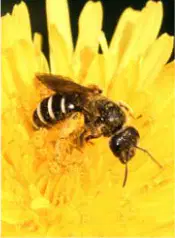
Name this kind of symbiosis in which both organisms help each other.
Mutualism
Parasitism
Commensalism
Predation
Make a food chain out of the following: herbivore, omnivore, producer.
Producer → Herbivore → Omnivore
Omnivore → Producer → Herbivore
Herbivore → Producer → Omnivore
Producer → Omnivore → Herbivore
16. Name the biogeochemical cycle that includes: run off, precipitation, evaporation, transpiration, and condensation.
Carbon cycle
Nitrogen cycle
Water cycle
Phosphorus cycle
Put the following in order of increasing complexity: Biosphere, population, organism, ecosystem, community, biome.
organism → population → community → ecosystem → biome → biosphere
biosphere → biome → ecosystem → community → population → organism
population → organism → community → ecosystem → biosphere → biome
organism → community → population → ecosystem → biosphere → biome
Bacteria in the soil that have a symbiotic relationship with legumes can turn nitrogen gas into ________ in a process called nitrogen fixation.
ammonia
oxygen
carbon dioxide
methane
Type of symbiosis in which one organism benefits but the other is neither helped nor harmed.
Commensalism
Mutualism
Parasitism
Competition
Name THREE of the FOUR biogeochemical cycles you learned about.
Water, Carbon, Nitrogen
Oxygen, Phosphorus, Sulfur
Carbon, Oxygen, Iron
Nitrogen, Sulfur, Calcium
21. Organisms have to compete for several things in an ecosystem. Which of the following is NOT typically one of them?
Food
Water
Shelter
Entertainment
An organism’s ________ describes where it lives, what it eats, what eats it, how it interacts with other organisms, how and when it reproduces, and how it acts.
niche
habitat
species
population
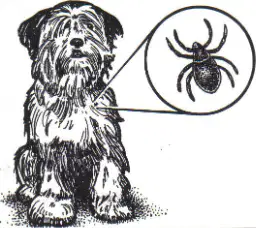
Name this type of symbiosis.
Parasitism
Mutualism
Commensalism
Amensalism
Which organisms are necessary ________ for producing ammonia, nitrates, and nitrites during the nitrogen cycle?
bacteria
fungi
plants
insects
All the non-living things in an ecosystem that affect an organism are called ________ factors.
abiotic
biotic
organic
genetic
Some bacteria that live in hostile places (like volcano vents) can produce their own food WITHOUT LIGHT in a process called ________________.
chemosynthesis
photosynthesis
fermentation
respiration
Organisms that feed on dead plant & animal remains are called _________________
detritivores or decomposers
herbivores
carnivores
omnivores

