
 Worksheets
Unit 6 Progress Test - Electrochemistry
Total questions: 20
Worksheet time: 3600secs
Concentrated aqueous sodium chloride is electrolysed using inert electrodes. What is the main product formed at the positive electrode (anode)
chlorine
hydrogen
oxygen
sodium
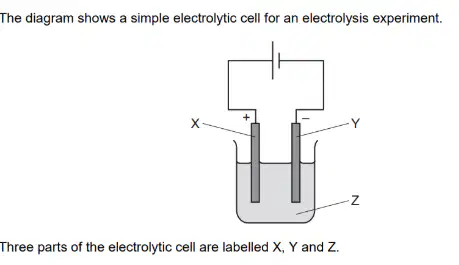
Which option shows the correct labels to replace X, Y, and Z respectively in the diagram?
anode; cathode; aqueous salt
anode; cathode; solid salt
cathode; anode; aqueous salt
cathode; anode; solid salt
Which equation represents the overall reaction that produces electricity in a hydrogen-oxygen fuel cell?
H2 + O2 → H2O2
2H2O → 2H2 + O2
2H2 + O2 → 2H2O
2H2O2 → 2H2O + O2
Which option describes the electrolysis of molten potassium bromide?
product at anode: bromine
product at cathode: hydrogen
product at anode: bromine
product at cathode: potassium
product at anode: hydrogen
product at cathode: bromine
product at anode: potassium
product at cathode: bromine
What is product of a hydrogen-oxygen fuel cell?
hydrogen and oxygen
hydrogen only
carbon dioxide
water
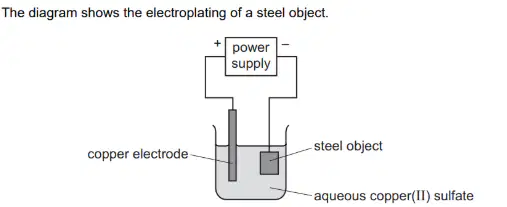
A student makes three statements
1. The steel object turns a reddish-brown color
2. The aqueous copper(II) sulfate change to a paler blue color
3. The copper electrode becomes a thinner
1, 2, and 3
1 and 2 only
1 and 3 only
2 and 3 only
Concentrated aqueous sodium chloride is electrolysed using inert electrodes. Which equation shows the correct ionic half-equation for the reaction at the anode?
Cl- + e- → Cl
2Cl-→ Cl2 + 2e-
H+ → H + e-
2H+ + 2e- → H2
Molten zinc oxide is electrolysed using inert electrodes. Which option identifies the product at each electrode?
anode: zinc
cathode: oxygen
anode: hydrogen
cathode: oxygen
anode: oxygen
cathode: zinc
anode: oxygen
cathode: hydrogen
Dilute aqueous sodium chloride is electrolysed using platinum electrodes. What is the half-equation for the reaction at the cathode?
2H+ + 2e- → H2
Na+ + e- → Na
2Cl- → Cl2 + 2e-
4OH- → 2H2O + O2 + 4e-
Hydrogen-oxygen fuel cells can be used to power vehicles. Which statement about hydrogen-oxygen fuel cells is correct?
The equation for the overall reaction is H2 + O2 → H2O2
The only chemical products are water and carbon dioxide
Chemical energy in the fuel is converted into electrical energy
The hydrogen used in hydrogen-oxygen fuel cells is a fossil fuel
Which particles are responsible for the transfer of charge in the external circuit during the electrolysis of molten lead(II) bromide?
anions
atoms
cations
electrons
Two statements about hydrogen are listed
1. Hydrogen is used as a fuel
2. When hydrogen burns in the air to form water, thermal energy is produced
Which conclusion about these statements is correct?
Both statements are correct, and statement 2 explains statement 1
Both statements are correct, but statement 2 does not explain statement 1
Statement 1 is correct, but statement 2 is not correct
Statement 2 is correct, but statement 1 is not correct
Concentrated aqueous copper(II) chloride is electrolysed using carbon electrodes. What is formed at each electrodes?
negative electrode: chlorine
positive electrode: copper
negative electrode: copper
positive electrode: chlorine
negative electrode: copper
positive electrode: oxygen
negative electrode: oxygen
positive electrode: copper
Which products are formed when dilute sulfuric acid undergoes electrolysis?
anode: oxygen
cathode: hydrogen
anode: hydrogen
cathode: oxygen
anode: sulfur dioxide
cathode: hydrogen
anode: oxygen
cathode: sulfur dioxide
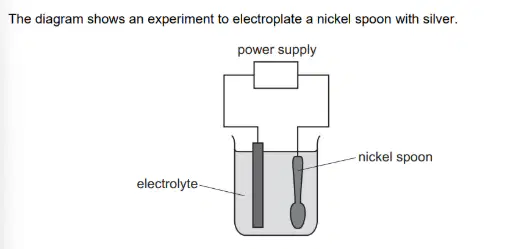
Which row correctly describes the positive electrode, the negative electrode and the electrolyte, repectively ....
nickel spoon; pure nickel; silver nitrate solution
nickel spoon; pure silver; nickel nitrate solution
pure nickel; nickel spoon; silver nitrate solution
pure silver; nickel spoon; silver nitrate solution
Three aqueous solutions, L, M, and N, are electrolysed using inert electrodes.
L is concentrated hydrochloric acid
M is concentrated aqueous sodium chloride
N is dilute aqueous sodium chloride
Which solutions produce a pale
L and M
L only
M and N
N only
Dilute sulfuric acid is electrolysed using inert electrodes. What are the ionic half-equations for the reactions that take place at each electrode?
positive electrode: 2H+ + 2e- → H2
negative electrode: 4OH- → 2H2O + O2 + 4e-
positive electrode: 2H+ + 2e- → H2
negative electrode: 4OH- + 4H+ → 4H2O
positive electrode: 4OH- → 2H2O + O2 + 4e-
negative electrode: 2H+ + 2e- → H2
positive electrode: 4OH- + 4H+ → 4H2O
negative electrode: 2H+ + 2e- → H2
Which statements about hydrogen-oxygen fuel cells are correct?
1. They convert chemical energy into electrical energy
2. Hydrogen is reduced in the fuel cells
3. They do not produce any atmospheric pollutants
1, 2, and 3
1 and 2 only
1 and 3 only
2 and 3 only
Concentrated aqueous sodium chloride and dilute sulfuric acid are each electrolysed separately using inert electrodes. Three statements about the electrolysis of these electrolytes are listed
1. a gas is produced at each electrode for both electrolytes
2. oxygen is produced at the cathode for both electrolytes
3. hydrogen is produced at the cathode for both electrolytes
Which statements are correct?
1 and 3
1 only
2 only
3 only
Hydrogen-oxygen fuel cells can be used to power cars. Which processes produce the fuel of a hydrogen-oygen fuel cell?
1. the crecking of hydrocarbons
2. the electrolysis of dilute sulfuric acid]
3. photosynthesis
4. the electrolysis of molten aluminium oxide
1 and 2
1 and 4
2 and 3
3 and 4

