
NEW
Font size
 Worksheets
Imperialism and WW1 Test Review-AP
Total questions: 30
Worksheet time: 15mins
In his book, Mahan urged Americans to build a large navy and acquire colonies as Britain had. What other strategy did Mahan advocate for the United States to succeed as a naval power?
Building a canal through Central America
Developing an air force
Having a large standing army
Placing military bases in Europe
How did the writings of Alfred Thayer Mahan encourage United States Imperialism?
His published speeches to the US Senate persuaded public opinion to favor acquiring colonies for America to remain an industrial power.
His books demonstrated the importance of obtaining colonies for naval bases, increasing overseas trade, and building a canal in Central America.
His letters as a Secretary of State persuaded President McKinley to Annex Territories from Spain
His articles for popular newspapers condemned Spain on humanitarian grounds for its treatment of the Cuban rebels.
Which of the following statements BEST explains the purpose of the Great White Fleet?
To cut off supplies to the troops in Germany during WWI
To bring an end to the Russo-Japanese War
To demonstrate American’s increased military power to the world
To combat Germany’s practice of unrestricted submarine warfare
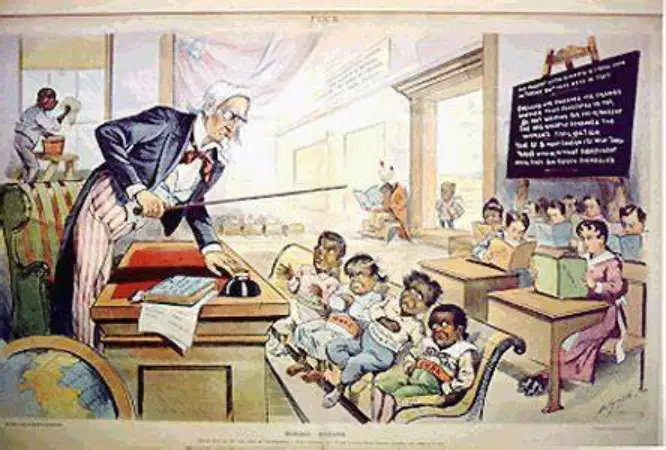
The cartoon below was published in 1898. The text at the bottom of this cartoon reads: “Uncle Sam: Now, children, you’ve got to learn those lessons whether you want to or not! But just take a look at the class ahead of you, and remember that, in a little while, you will be glad to be here as they are!” Based on the cartoon, which statement would the artist most likely agree?
Imperialists intended to rule over colonial people whether they consented or not.
Imperialists generally planned to replace local peoples with American colonists.
Imperialists refused to use local populations as an inexpensive labor force.
Imperialists planned to spend more on development costs than they could ever recover in profits.
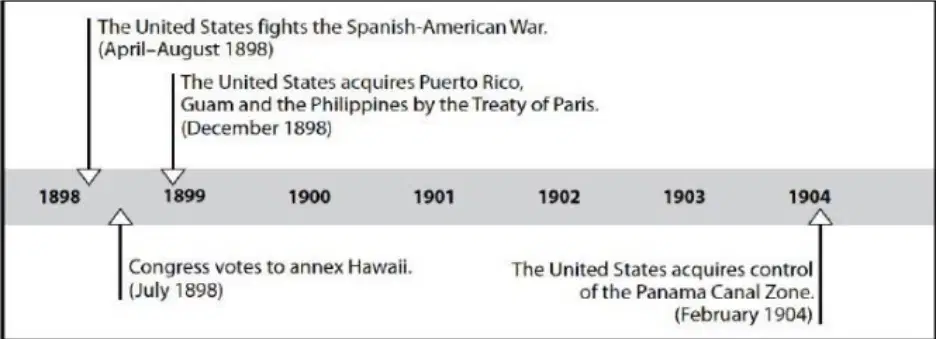
The timeline below shows events in U.S. history between 1898 and 1904. Based on the timeline, which conclusion can be made about American policy in these years?
Americans took new steps because they feared attacks by foreign powers
Colonial peoples welcomed American leadership to develop their economies.
Congressional leaders overcame the reluctance of U.S. Presidents to acquire overseas possessions.
American imperialists triumphed over those opposing the annexation of overseas territories.
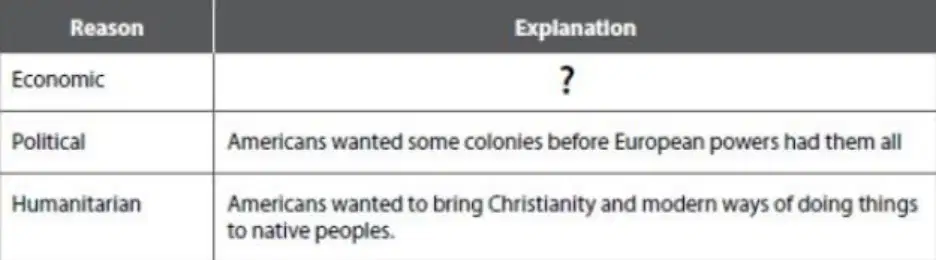
Which sentence completes the table? Reason/Explanation table shown: Economic — ?. Political — Americans wanted some colonies before European powers had them all. Humanitarian — Americans wanted to bring Christianity and modern ways of doing things to native peoples.
Americans wanted overseas markets for their goods
Americans supported free trade
Americans wanted to manufacture goods in overseas factories
Americans wanted to import colonial laborers to the United States
How did U.S. intervention in World War I represent a turning point in American foreign policy?
Americans obtained their first colonies after the war
Americans became deeply entangled in European affairs
American scientists developed nuclear weapons
Congress refused to declare war on Germany
How did the War Industries Board prepare Americans for war during World War I?
by silencing criticism of U.S. policies
by raising money to help pay for the war effort
by conscripting young men into the armed forces
by increasing wartime production
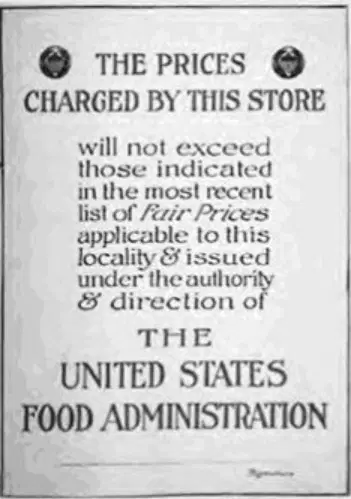
The poster below was issued by a federal agency during World War I. What was the purpose of this document?
to provide guidance to farmers
to maintain food prices during wartime
to ration food on the home front
to prevent abuses by railroad owners
Which constitutional issue was raised by the Espionage Act of 1917 and the Sedition Act of 1918?
the limits of free speech in wartime
freedom of religion in wartime
racial segregation in public schools
whether specific ethnic groups could be interned in wartime
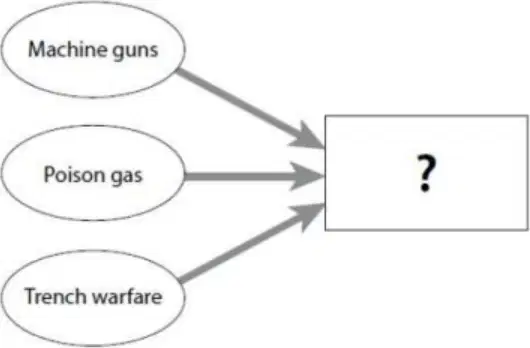
The diagram below shows details about the war in Europe from 1914 to 1918. Which best completes the diagram? Diagram shows three ovals labeled Machine guns, Poison gas, Trench warfare with arrows pointing to a blank box.
Deadlock between the Central and Allied Powers
Superiority of British troops
Rapid advance of German troops
Unrestricted submarine warfare against neutral shipping
Why did the U.S. Senate fail to ratify the Treaty of Versailles in 1919?
Many Senators opposed the severe sanctions that the treaty placed on Germany.
Many Senators felt the League of Nations would interfere with American plans in the Philippines.
Many Senators feared the League of Nations would involve the United States in foreign wars.
Many Senators predicted that membership in the new League of Nations would be too expensive.
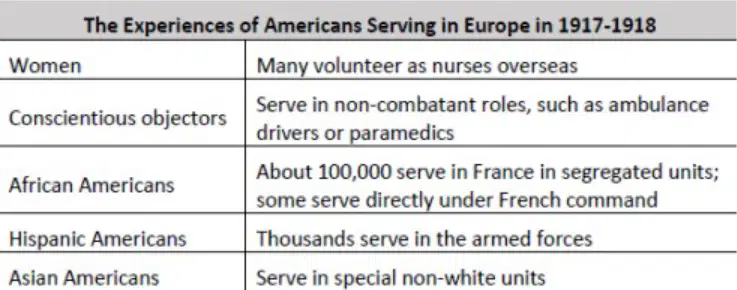
The following chart shows information about World War I. The Experiences of Americans Serving in Europe in 1917–1918: Women—Many volunteer as nurses overseas; Conscientious objectors—Serve in non-combatant roles, such as ambulance drivers or paramedics; African Americans—About 100,000 serve in France in segregated units; some serve directly under French command; Hispanic Americans—Thousands serve in the armed forces; Asian Americans—Serve in special non-white units. Based on the chart, what conclusion can be made about American service overseas during World War I?
All major groups of American society participated in the war effort, but some faced special challenges because of contemporary prejudices.
The American armed services treated all Americans who were willing to serve as equal in status
Women and conscientious objectors were treated similarly to African Americans, Hispanics, and Asian Americans.
The American military failed to help the French because it refused to include members from all groups of American society.
How were American women affected by World War I?
Many enlisted to serve in non-combatant roles overseas.
Many became conscientious objectors opposed to the war.
Many helped their husbands and sons to evade military service.
Many showed their patriotism by selling war bonds, serving as nurses, or working in factories.
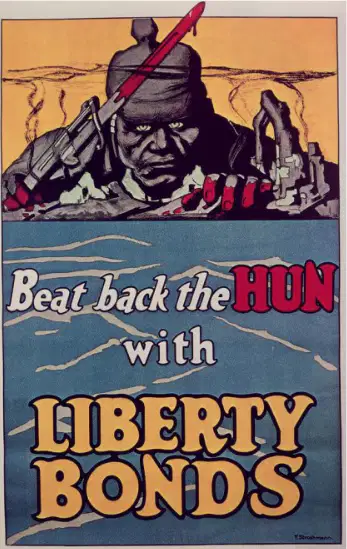
The poster below appeared in the United States during World War I. How did posters like this affect German Americans during World War I?
Increased numbers of school children enrolled in German classes.
Many communities shut down their German cultural programs.
Thousands of German Americans became disloyal to the United States.
Most German Americans were arrested and placed in internment camps.
Why did the U.S. Senate fail to ratify the Treaty of Versailles in 1919?
Many Senators opposed the severe sanctions that the treaty placed on Germany.
Many Senators felt the League of Nations would interfere with American plans in the Philippines.
Many Senators feared the League of Nations would involve the United States in foreign wars.
Many Senators predicted that membership in the new League of Nations would be too expensive.
The information below provides details about the impact on Florida of an important historical event. A submarine base was built in Key West. Five flight schools were established in Florida. 42,000 Floridians served in the armed forces. More than 1,000 Floridians lost their lives in the war. Florida produced cotton for uniforms and fruits and vegetables for troops. Which event had these effects on Florida?
Spanish-American War
World War I
World War II
The Civil War
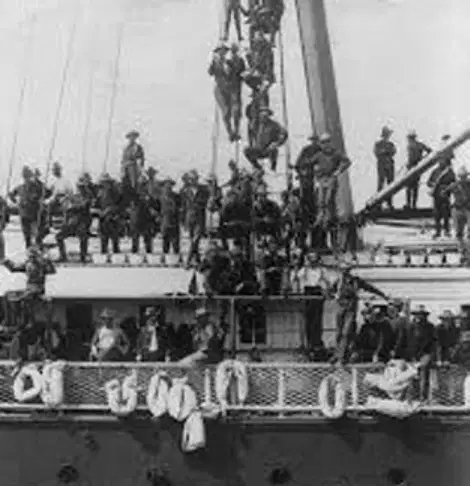
The photograph shows Theodore Roosevelt and the Rough Riders headed to Cuba from Florida in 1898. What is the relationship between the action shown and Florida’s role in the Spanish-American War?
The explosion of the U.S.S. Maine in the Port of Tampa led many Americans to support war with Spain
Florida served as a primary staging area for U.S. troops bound to fight in Cuba
Spanish atrocities against Cubans also occurred toward Cuban exiles in Miami, Florida
Many Floridians did not support the independence of Cuba from Spain in fear of a homeland attack from the Cubans once they gained their independence
What was not a main cause of the war in Europe?
Militarism
Annexation
Alliances
Imperialism
Why did the United States enter World War I?
To expand its colonial empire
To support the Central Powers in achieving global dominance
To remain neutral and avoid involvement in European conflicts
To protect economic interests and respond to unrestricted submarine warfare
Who gave the Fourteen Points speech, and what was its main purpose?
Woodrow Wilson; to propose principles for peace and prevent future conflicts
Franklin D. Roosevelt; to outline plans for post–World War II reconstruction
Theodore Roosevelt; to encourage U.S. neutrality in World War I
Herbert Hoover; to address economic relief efforts during the Great Depression
President Woodrow Wilson argued that the peace plan to end World War I should reflect “peace without victory.” What is the name of his peace plan to support this vision?
The Treaty of Paris
The Treaty of Versailles
The Fourteen Points
The Treaty of Ghent
The Home Front in the United States during the First World War was marked by an increase in all the following except
Mandatory government rationing of food and fuel
Employment opportunities for African Americans and Mexican Americans
Participation of women in factory work, government service, and volunteer work
Suppression of freedom of speech with passage of the Espionage and Sedition Acts
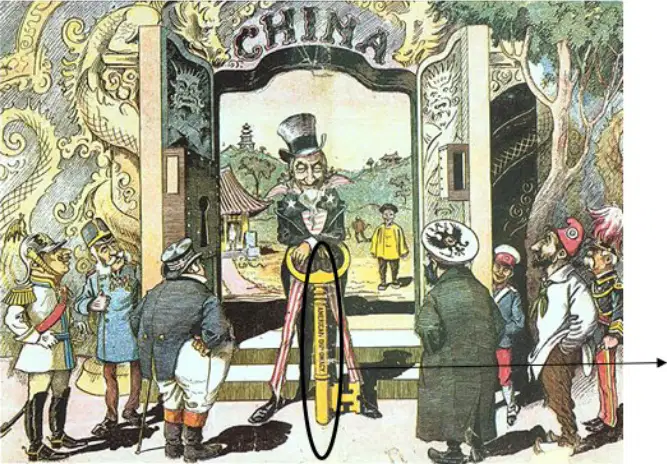
The following cartoon was published in 1900. The key is labeled “American Diplomacy.” What does the cartoon imply about the Open Door Policy?
It favored American interests over other foreign interests in China
It treated all foreign interests in China fairly
It weakened American
It mainly benefited America’s competitors
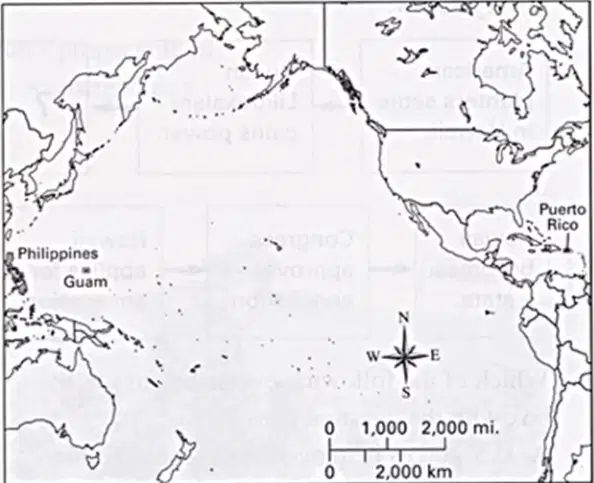
The map below shows territories acquired because of the Spanish American war. What do the islands labeled on the map have in common?
They were battle sites during the Spanish American War
They all gained their independence following the Spanish American War
They all became US territories following the Spanish American War
They were all territories annexed by the US because of the Open Door Policy
Which Federal Agency IS NOT correctly paired with its achievements during WW1? A War Industries Board — ensured that factories produced the materials needed for soldiers overseas B Selective Service Act — created more selective requirements for young men wishing to serve in the military C War Labor Board — required the hiring of women to fill jobs vacated by men fighting in Europe D Committee on Public Information — created propaganda by making pamphlets and newsreels to promote the war effort
War Industries Board — ensured that factories produced the materials needed for soldiers overseas
Selective Service Act — created more selective requirements for young men wishing to serve in the military
War Labor Board — required the hiring of women to fill jobs vacated by men fighting in Europe
Committee on Public Information — created propaganda by making pamphlets and newsreels to promote the war effort
The Teller Amendment stated that the United States—
would annex Cuba after the war
could not permanently control Cuba
would grant statehood to Puerto Rico
demanded reparations from Spain

Read the quotation below from President Wilson’s message to Congress in 1914: “The United States must, . . . during these days that are to try men’s souls, . . . be impartial in thought, as well as action, must put a curb upon our sentiments, as well as upon every transaction that might be construed as a preference of one party to the struggle before another.” What was the president asking the nation to do?
offer loans and sell supplies to our allies
make the world safe for democracy
compete for trade and territory with our enemies
adopt a policy of neutrality
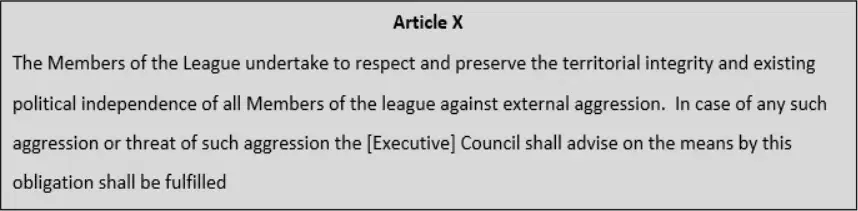
The excerpt below is from the Covenant of the League of Nations, a part of the Treaty of Versailles. Article X: “The Members of the League undertake to respect and preserve the territorial integrity and existing political independence of all Members of the league against external aggression. In case of any such aggression or threat of such aggression the [Executive] Council shall advise on the means by this obligation shall be fulfilled.” Why did many US Senators object to this article?
They had plans to seize new overseas territories for the United States
They were afraid that the League would be controlled by hostile powers
They feared Americans would be required to act against aggression in Europe
They thought it demanded that Americans grant Philippine independence
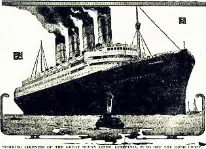
How did this event contribute to the United States’ entry into World War I?
It furthered anti-government protests in the United States
It encouraged anti-immigration campaigns in the United States
It became necessary for President Wilson to propose a plan for peace
It became difficult for President Wilson to defend a policy of neutrality.

