
 Worksheets
Introduction to Tropical Architecture and World Climates
Total questions: 117
Worksheet time: 59mins
What is the main focus of tropical architecture?
The study of climate-oriented architecture and its environmental link or influence on tropical surroundings.
The design of buildings for cold climates with minimal environmental impact.
The use of advanced technology in building construction.
The preservation of historical buildings in tropical regions.
Which of the following is NOT a key aspect of climate responsive architecture?
Efficient use of materials and embodied energy.
Minimizing site impact.
Maximizing energy waste.
Thermal comfort.
When designing for hot humid conditions, what is most important for interiors?
Protection from heat and maximum ventilation.
Use of heavy insulation.
Minimizing window size.
Increasing the number of interior walls.
Which mnemonic helps remember the major world climate zones?
ACECA: Arctic Circle, Tropic of Cancer, Equator, Tropic of Capricorn, Antarctica.
CLIMA: Climate, Latitude, Ice, Mountains, Altitude.
WORLD: Weather, Orientation, Region, Latitude, Daylight.
TEMPS: Tropics, Equator, Mountains, Polar, Subtropical.
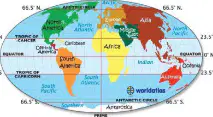
Refer to the world climate map. Which climate zone is characterized by extremely cold winters and summers, with plant life almost non-existent except for some algae?
Polar climate
Temperate climate
Tropical climate
Mediterranean climate
Which climate region contains the greatest diversity of plant and animal life and experiences all months with average temperatures above 18°C (64°F)?
Tropical region
Arid region
Temperate region
Tundra region
Which climate zone is described as having coarse soil, mostly shrubs and short woody trees, deficient precipitation, and potential water loss from evaporation and transpiration?
Arid zone
Temperate zone
Mediterranean zone
Tundra zone
Which climate zone is found in regions such as California, Chile, South Africa, and Australia, and is characterized by mild winters, hot dry summers, and plants that are typically shrubby and less than three feet tall?
Mediterranean climate
Tropical climate
Polar climate
Arid climate
Which climate type in the Philippines is characterized by two pronounced seasons: dry from November to April and wet during the rest of the year?
Type 1
Type 2
Type 3
Type 4
What is the mean annual temperature in the Philippines?
26.6°C
28.3°C
25.5°C
18.3°C
Which city in the Philippines receives the greatest amount of rainfall annually?
Baguio City
General Santos City
Southern Cotabato
Manila
What is the dominant wind direction of summer monsoons (Habagat) in the Philippines?
Westerly
Easterly
Northerly
Southerly
Which of the following is NOT a cause of climate variation in the Philippines?
Latitude
Elevation
Population density
Ocean and wind currents
In tropical rainforest climates, what is the typical pattern of precipitation and temperature throughout the year?
Hot average temperature all year round with high monthly precipitation
Cool average temperature with low precipitation
Hot average temperature with dry winters
Variable temperature with moderate precipitation
Why is the southern Philippines considered desirable for agriculture and industrial development?
It is often spared from being directly hit by typhoons due to their northwesterly movement.
It receives the greatest amount of rainfall in the country.
It has the coolest average temperature.
It is closest to the equator.
Which of the following best describes the climate in tropical regions?
Hot and wet, with heat as the dominant problem
Cool and dry, with frost as the dominant problem
Variable, with frequent snow and ice
Mild, with moderate rainfall and temperature
Which phenomenon causes water and air to curve as they travel across or above the earth’s surface due to the earth’s rotation?
Coriolis Effect
Trade Wind Convergence
Monsoon Circulation
Tropical Cyclone Formation
What is the primary function of the Intertropical Convergent Zone (ITCZ) in global climate?
It marks the point of trade wind convergence and controls tropical climate.
It increases the temperature in polar regions.
It causes the formation of hurricanes in the Atlantic Ocean.
It prevents rainfall in desert regions.
Which climate type is characterized by mean temperatures above 18°C in every month and a driest month occurring at or soon after the winter solstice?
Tropical Monsoon
Tropical Wet & Dry
Temperate
Arid
Refer to the diagram showing the spiral structure of a tropical cyclone, including the eye, spiral bands, and eyewall. What is the correct order of these features from the center outward?
Eye, Eyewall, Spiral Bands
Spiral Bands, Eyewall, Eye
Eyewall, Spiral Bands, Eye
Spiral Bands, Eye, Eyewall
Which of the following is NOT a design objective in tropical climate architecture?
Increase heat gain
Maximize ventilation but protect from typhoon wind
Prevent unnecessary increase in humidity level
Have good drainage system to accommodate precipitation
A typhoon is best described as which of the following?
A violent wind with a circular movement found in the west Pacific Ocean
A slow-moving wind system in temperate regions
A dry wind that occurs during winter months
A gentle breeze that affects coastal areas
Which of the following is a common problem in areas with tropical climate?
High temperature level
Low humidity level
Frequent snowfall
Scarcity of insects and rodents
Which climate type in the Philippines is characterized by two pronounced seasons: dry from November to April and wet during the rest of the year, with the maximum rain period from June to September?
Type I
Type II with a very pronounced maximum rainfall period
Type III with a short dry season
Type IV with evenly distributed rainfall
Which of the following provinces is classified under Climate Type II in the Philippines?
Ilocos Norte
Cagayan
Negros Oriental
Aklan
What distinguishes Climate Type IV in the Philippines from the other climate types?
Rainfall is more or less evenly distributed throughout the year.
It has a very pronounced maximum rainfall period from November to January.
It has two pronounced seasons: dry and wet.
It has no very pronounced maximum rainfall period but has a short dry season.
Which climate type includes the province of Palawan according to the classification shown?
Type I
Type II
Type III
Type IV
Based on the climate map of the Philippines, which climate type is most prevalent in the eastern part of the country?
Type II
Type I
Type III
Type IV
Which gas makes up the largest percentage of air by volume?
Nitrogen
Oxygen with trace amounts of other gases
Carbon dioxide
Helium and krypton
What is the main reaction of the human body in a hot-humid environment?
The body tries to shed excess perspiration to cool the skin.
The body loses heat faster than it can produce it and tries to generate heat by involuntary movement.
The body maintains a constant core body temperature without any change.
The body increases metabolic heat production.
Thermal comfort is best described as:
A condition of mind expressing satisfaction with the thermal environment.
A physical state where the body is neither too hot nor too cold.
A result of only environmental factors.
A feeling of discomfort due to temperature changes.
Which organization publishes standards and guidelines focused on sustainable technology for the built environment, including energy efficiency and indoor air quality?
ASHRAE (American Society of Heating, Refrigerating, and Air-Conditioning Engineers)
World Health Organization (WHO)
International Energy Agency (IEA)
United Nations Environment Programme (UNEP)
What is the process called that allows your body to maintain its core internal temperature?
Thermoregulation
Metabolism
Perspiration
Radiant temperature
Refer to the diagram showing body temperature regulation. What happens when body temperature falls?
Blood vessels constrict, sweat glands do not secrete fluid, and shivering generates heat.
Blood vessels dilate, sweat glands secrete fluid, and heat is lost to the environment.
Normal body temperature is maintained without any change.
Heat is lost to the environment by evaporation.
Which of the following is NOT an environmental factor influencing thermal comfort?
Clothing
Air temperature
Air velocity
Radiant temperature
What does dry bulb temperature (DBT) measure?
The temperature of the air that a person is in contact with.
The temperature of a surface surrounding a person.
The velocity of air movement in a room.
The amount of water vapor in the air.
For healthy adults, normal skin temperature ranges between:
92.3 and 98.4 Fahrenheit or 33-37 Celsius
80 and 90 Fahrenheit or 25-30 Celsius
100 and 104 Fahrenheit or 38-40 Celsius
85 and 95 Fahrenheit or 29-35 Celsius
How does increased air velocity affect thermal comfort?
It increases the exchange of heat between the person and the air, generally making us feel colder.
It decreases the exchange of heat and makes us feel warmer.
It has no effect on thermal comfort.
It only affects comfort in hot environments.
Refer to the diagram showing thermal comfort zones based on air temperature and air velocity. At which combination is a person most likely to feel comfortable?
When air temperature is around 22°C and air velocity is moderate.
When air temperature is above 26°C and air velocity is low.
When air temperature is below 16°C and air velocity is high.
When air temperature is 28°C and air velocity is very high.
What effect does higher relative humidity have on the body's ability to lose heat?
It makes it more difficult to lose heat through the evaporation of sweat.
It makes it easier to lose heat through evaporation.
It has no effect on heat loss.
It only affects heat loss in cold environments.
What does a clo value of 1 represent in terms of clothing insulation?
The amount of clothing required by a resting human to maintain thermal comfort at a room temperature of 70°F (21°C).
The insulation provided by heavy winter clothing in cold climates.
The amount of clothing needed for outdoor activities.
The insulation value of clothing at any temperature.
Which activity would result in the highest metabolic equivalent (MET) according to the diagram?
Running
Reading
Working on a computer
Playing an instrument
Which of the following best describes a passive system in climate control?
A system that heats and cools with no outside energy or power required to run the system.
A system that uses mechanical devices to regulate temperature.
A system that relies solely on air motion for cooling.
A system that requires constant human intervention to operate.
Which factor is NOT listed as affecting the comfort zone in buildings?
Air Pressure
Mean Radiant Temperature
Relative Humidity
Metabolism
Refer to the diagram showing the process of warm air rising over the ocean and forming clouds. What is the correct sequence of events in this process?
Warm air moves over the ocean, rises into the atmosphere, cools and condenses into liquid droplets, condensation releases heat, and the warmed air continues to rise with moist air from the ocean.
Condensation releases heat, warm air moves over the ocean, water vapor rises into the atmosphere, and the air cools and condenses into liquid droplets.
Water vapor rises into the atmosphere, warm air moves over the ocean, condensation releases heat, and the air cools and condenses into liquid droplets.
Warm air moves over the ocean, condensation releases heat, water vapor rises into the atmosphere, and the air cools and condenses into liquid droplets.
What does the term 'genius loci' refer to in architecture?
The spirit of the place, including its unique flora and fauna.
The mechanical systems used in a building.
The temperature control methods used in a region.
The historical significance of a building.
Which statement about climatology is correct?
Climatology is the science that deals with prevailing weather conditions to create a desirable environment for inhabitants and to deal most efficiently with the weather's impact on buildings.
Climatology is the study of animal and plant life in a region.
Climatology is the process of building houses in tropical regions.
Climatology is the measurement of air pressure in different climates.
Which of the following natural features can cause a microclimate?
Forest, shelterbelts or hills, massing, spacing, and orientation.
Only forests and rivers.
Only mountains and valleys.
Only urban paved areas.
How does topography affect comfort in building design?
Topography affects comfort by a general lowering of temperature at altitude, and in tropical conditions, it is common to build in mountainous regions to find cooler temperatures.
Topography increases humidity in all regions.
Topography has no effect on temperature.
Topography only affects the amount of sunlight a building receives.
Which statement best describes the role of vegetation in modifying microclimates?
Vegetation absorbs sunlight, moderates temperatures through shade and transpiration, and affects wind and humidity.
Vegetation only provides shade in summer.
Vegetation increases the temperature of urban areas.
Vegetation has no effect on wind or humidity.
What is the effect of dense coniferous or evergreen trees on microclimates during winter?
They provide wind blocks in winter.
They increase humidity in summer.
They allow sun through in winter to promote solar heating.
They reduce the amount of rainfall in winter.
Why are urban paved areas typically warmer than their surroundings?
Because plant and grassy covers reduce temperatures by absorbing heat, while paved areas do not.
Because paved areas are always exposed to sunlight.
Because paved areas have more water than grassy areas.
Because paved areas are located at higher altitudes.
What is the primary reason for using massive walls in hot-arid climate architecture?
To absorb heat during the day and emit it back during evenings
To maximize cross ventilation and encourage evaporation of moisture
To provide protection from northwinds and retain heat
To allow winter sun to open for summer breezes
Which climate type commonly uses wigwams and tipis as architectural examples?
Temperate climates
Hot-humid climates
Cool climates
Hot-arid climates
In cool climate architecture, what is the main purpose of joining homes together?
To maximize exterior area and retain heat rather than avoid the sun
To maximize cross ventilation and encourage evaporation of moisture
To minimize surface exposure to the sun and maximize overhead summer sun
To allow winter sun to open for summer breezes
Which architectural strategy is used in hot-humid climates to promote cross ventilation?
Narrow buildings with tall windows
Massive walls to absorb and emit heat
Protection from northwinds in shape and entry location
Homes together to maximize exterior area
Refer to the diagram showing a hut with high ceilings, open ends, and raised floors. What is the main purpose of these features in hot-humid climates?
To encourage evaporation of moisture by breezes and promote ventilation
To absorb and emit heat during the day and night
To protect from heavy snow and retain heat
To minimize surface exposure to cold
In temperate climate architecture, why are deciduous trees placed nearby?
To provide shade in summer while allowing sunlight in winter
To absorb and emit heat during the day and night
To protect from heavy snow and retain heat
To maximize cross ventilation and encourage evaporation of moisture
What is topography?
The arrangement of the natural and artificial physical features of an area.
A method for measuring temperature changes in a region.
A process for designing buildings on flat land.
A system for classifying soil types.
Why is contour location and spacing important in building placement?
It minimizes the need for extensive cutting and filling of soil.
It helps determine the color of building materials.
It increases the cost of construction.
It reduces the amount of sunlight a building receives.
Which of the following is NOT a strategy for building on steep slopes?
Building entirely above the ground.
Digging into the ground.
A combination of floating and digging.
Building only on flat terrain.
Topography and soil conditions have a tremendous effect on which aspect of architecture?
Building form
Window design
Interior decoration
Roof color
Refer to the diagram showing wind and climate effects on a mountain slope. Which side of the mountain is typically more moist?
The side facing the prevailing wind.
The side facing away from the prevailing wind with arid conditions.
The side with the lowest temperature.
The side closest to the ocean.
When reading a contour map, what does closely spaced contour lines indicate?
A steep slope.
A flat area.
A river valley.
A forested region.
Based on the contour map and site plan, which building placement minimizes soil cutting and filling?
Placing buildings along the contour lines.
Placing buildings at the highest elevation only.
Placing buildings in the flattest area regardless of contours.
Placing buildings at random locations.
Refer to the diagram showing slope and elevation relationships. What is the formula for calculating slope?
Slope = (Elevation 1 - Elevation 2) / Horizontal distance
Slope = Horizontal distance / (Elevation 1 + Elevation 2)
Slope = Elevation 2 / Elevation 1
Slope = (Elevation 1 + Elevation 2) / Horizontal distance
Which type of forest is known for stabilizing coastlines and providing shelter for fish and other organisms?
Mangrove forest
Molave forest with crooked trunks and durable wood
Beach forest along sandy and gravelly beaches
Mossy forest in mountainous areas
What is the main characteristic of molave wood that makes it valuable?
It is hard, yellow, and durable
It is soft and easily shaped for furniture
It is lightweight and floats on water
It is dark and resistant to insects
Which forest type is dominant in the Mindanao lowlands and is known as Philippine mahogany in the timber trade?
Dipterocarp forest
Pine forest with thin, sharp leaves
Molave forest with crooked trunks
Beach forest along the seacoast
Which type of forest is typically found in mountainous areas with a moist climate and is densely vegetated with moss covering tree trunks and roots?
Mossy forest
Shrubland with low vegetation
Deciduous forest with seasonal leaf loss
Mixed forest with various tree species
What is the correct formula to calculate the shadow length of a tree given its height and the sun's altitude angle?
Shadow length = Tree height / tan(Sun altitude angle)
Shadow length = Tree height × tan(Sun altitude angle)
Shadow length = Tree height + Sun altitude angle
Shadow length = Tree height - Sun altitude angle
Heat can be transmitted by which of the following processes?
Conduction, convection, or radiation
Absorption, reflection, or refraction
Evaporation, condensation, or precipitation
Expansion, fusion, or freezing
What is the direction of heat transfer between two bodies?
From a body with higher temperature to a body with lower temperature
From a body with lower temperature to a body with higher temperature
Heat does not transfer between bodies
Heat transfer depends on the color of the bodies
Which factor is NOT typically used to judge indigenous plants for site integration?
Color of the leaves
Size and condition
Esthetics and ability to tolerate construction
Compatibility with new or planned vegetation
Which of the following best defines a British Thermal Unit (BTU)?
The unit of heat energy required to raise the temperature of one pound (0.4kg) of water by 1°F
The amount of heat energy needed to raise the temperature of one kilogram of water by 1°C
The energy required to melt one pound of ice
The amount of energy put off by a burning candle
What is the specific heat of liquid water in Joules/gram*°C according to the table of specific heats of common materials?
4.18
2.11
1.01
0.84
Which statement accurately describes latent heat?
Latent heat is the quantity of heat released or absorbed by a substance during a change in phase at constant temperature
Latent heat is the heat required to raise the temperature of a substance by one degree Celsius
Latent heat is the energy needed to melt a solid into a liquid
Latent heat is the heat absorbed during a temperature change without a change in phase
Which temperature scale has an absolute zero at -273.16°C?
Kelvin scale
Fahrenheit scale
Celsius scale
Centigrade scale
What is the SI unit for measuring heat?
Joules
Kelvin
Celsius
Fahrenheit
Which process describes the transfer of heat from warmer to cooler particles of a medium without perceptible displacement of the particles themselves?
Conduction
Convection
Radiation
Thermal conductance
Which of the following is the correct formula to convert Celsius to Fahrenheit?
Fahrenheit = (Celsius x 9/5) + 32
Fahrenheit = (Celsius x 5/9) + 32
Fahrenheit = (Celsius x 9/5) - 32
Fahrenheit = (Celsius x 5/9) - 32
What is the main difference between heat and temperature?
Heat is the total energy of the motion of the molecules of a substance, while temperature is the measure of the average energy of the motions of molecules in the substance
Heat is measured in Kelvin, while temperature is measured in Joules
Heat is the energy required to change phase, while temperature is the energy required to change temperature
Heat is the amount of energy put off by a single lit match, while temperature is the amount of energy needed to raise the temperature of a substance
Which process involves the transfer of heat by circulatory motion due to variation in density and gravity in liquids or gases?
Convection
Conduction
Radiation
Thermal conductance
Refer to the diagram showing heat transfer by conduction, convection, and radiation (hand, fire, and arrows). Which process is represented by the wavy arrows moving away from the fire without direct contact?
Radiation
Conduction
Convection
Thermal conductance
Which formula correctly represents the rate of heat flow through a material?
Q = (k / l) . A . Δt
Q = (l / k) . A . Δt
Q = k . l . A . Δt
Q = (k + l) . A . Δt
What does the R-value of a building material measure?
The measurement of thermal resistance of a given material
The measurement of thermal conductance of a given material
The measurement of air infiltration through a material
The measurement of solar energy absorption by a material
If a building component is made of several layers, how is its total R-value determined?
By summing the R-values of each layer
By multiplying the R-values of each layer
By averaging the R-values of each layer
By subtracting the lowest R-value from the highest
Which statement best describes thermal transmittance (U-value)?
It is the time rate of heat flow through a unit area of a building component or assembly
It is the total amount of heat stored in a building component
It is the ability of a material to reflect solar radiation
It is the rate at which air infiltrates a building
What is the relationship between R-value and U-value in building assemblies?
U-value is equal to the reciprocal of the total R-value
R-value is equal to the reciprocal of the total U-value
U-value is equal to the sum of all R-values
R-value is equal to the sum of all U-values
Which of the following best describes infiltration in the context of building design?
The flow of outside air into an interior space through cracks around windows and doors
The movement of heat through a solid wall
The transfer of solar energy through glass
The absorption of moisture by insulation
What is the primary function of a weather strip in a building?
To provide a seal between a door or window and its frame
To increase the thermal conductivity of a window
To allow air to flow freely through a door
To reflect sunlight away from the building
How does a thermal break improve the energy efficiency of a building assembly?
By reducing the flow of heat between highly conductive materials
By increasing the amount of sunlight entering the building
By allowing more air infiltration
By decreasing the R-value of the assembly
What does the term 'sun path' refer to in architecture?
The seasonal-and-hourly positional changes of the sun as the Earth rotates and orbits around the sun
The direction of wind flow around a building
The movement of rainwater on a roof
The path of heat transfer through a wall
Which architectural feature is designed using sun path diagrams to provide effective shading?
Overhangs and fins
Large windows facing north
Flat roofs with no shade
Open courtyards without cover
What is the primary purpose of using sun path diagrams in site analysis?
To understand solar exposure and heat gain throughout the year for a specific location
To calculate the cost of building materials
To determine the color of exterior walls
To measure the height of nearby trees
In a sun path diagram, what do concentric circles in the center represent?
Altitude angle
Azimuth angle
Date lines
Hour lines
Which angle describes the sun’s position as projected on a horizontal plane and is measured clockwise from true north?
Azimuth angle
Altitude angle
Declination angle
Latitude angle
What is the value of the solar altitude angle when the sun is directly above (at noon)?
90°
0°
45°
180°
Which date is considered the longest day of the year in the northern hemisphere?
June 21
December 21
March 21
September 23
What is the term for the time or date when the sun reaches its maximum or minimum declination, resulting in the longest and shortest days?
Solstice
Equinox
Latitude
Azimuth
Which event results in nearly equal hours of daylight and darkness worldwide?
Equinox
Solstice
Summer solstice
Winter solstice
What is the rate at which the sun moves across the sky?
15.04° per hour
30° per hour
90° per hour
1° per hour
Which line on a solar chart represents the month?
Long curve
Short curve
Radial line
Ring
What is the angle called that ranges from 0° at the Equator to 90° at the poles and is used to specify location on Earth?
Latitude
Longitude
Declination
Azimuth
Which event marks the first day of winter and falls on or near December 21 in the northern hemisphere?
Yule
Litha
High sun
Tilt low sun
Which of the following is a benefit of passive ventilation in building design?
It reduces energy consumption by using natural airflow instead of mechanical systems.
It increases the need for mechanical cooling systems in buildings.
It limits the amount of fresh air entering the building.
It only works in buildings with no windows.
What is an air jet in the context of building ventilation?
An accelerated flow of wind traveling a set path.
A slow movement of air around the edges of a building.
A type of mechanical fan used in ventilation.
A stagnant pocket of air inside a room.
Cross ventilation is most effective when:
Spaces have windows on opposite sides, allowing air to move through the space.
Windows are only placed at the corners of a building, limiting airflow.
Air moves only along the edges of a room, not through the center.
Rooms have no windows, relying solely on mechanical ventilation.
In relation to prevailing wind, what is the windward side of a building?
The front or exposed side facing the direction of prevailing wind.
The back or opposite side away from the prevailing wind.
The side with the least amount of windows.
The side that receives the least sunlight.
What is the effect of a wind eddy around a building?
Wind slows and swirls off the main flow at the edges, creating circular patterns.
Wind speeds up and moves directly through the building without swirling.
Wind remains stagnant and does not move around the building.
Wind only affects the roof and not the sides of the building.
What does the term 'air changes' refer to in building ventilation?
The number of times all of the air in a space has been renewed per hour.
The change in temperature of air inside a building.
The movement of air from one room to another.
The amount of air lost through open windows.
How does the stack effect contribute to airflow in buildings?
It uses thermal principles, where the density of air lessens as it warms, causing it to rise.
It relies solely on mechanical fans to move air.
It prevents any air movement within the building.
It only works in buildings with no windows.
What is the primary function of wind catchers in building design?
To draw wind down from higher areas into buildings where low winds are unavailable.
To block wind from entering the building.
To increase the temperature inside the building.
To prevent any airflow in dense urban areas.
Which exterior conditions can affect wind direction and speed around buildings?
Vegetation, adjacent buildings, and landforms.
Only the color of the building.
The number of windows in the building.
The type of flooring used inside the building.
According to site design principles, how can solar access be increased for north-facing courtyards and living areas?
By placing living areas and courtyards on the north side and avoiding solid walls that block sunlight.
By building high walls on the north side to block sunlight.
By placing bedrooms only on the south side of the building.
By reducing the number of courtyards in the design.
How does the height of a window opening affect airflow speed inside a building?
Higher window openings allow greater entry of air, increasing inside air speed.
Lower window openings always decrease airflow speed inside.
Window height does not affect airflow speed.
Only windows with louvres affect airflow speed.
Why is placing openings in sidewalls instead of the back of a building more efficient for ventilation?
It utilizes greater negative pressure at the exterior sides to draw air through the building more efficiently.
It blocks airflow and reduces ventilation efficiency.
It only works if the building has no windows at the front.
It increases the amount of stagnant air inside the building.