
 Worksheets
Properties and Changes of Matter
Total questions: 18
Worksheet time: 9mins
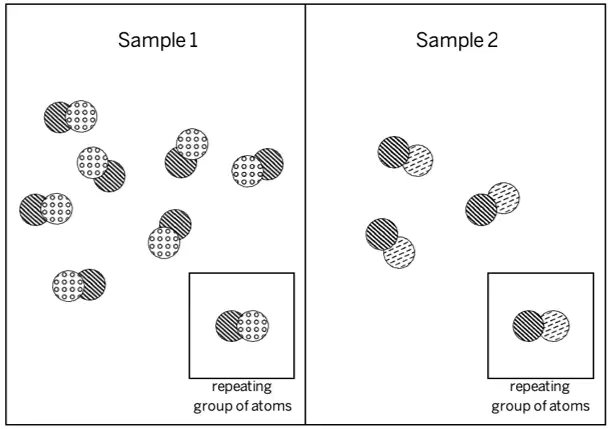
The diagram above shows the repeating groups of atoms that make up two samples.
Will the properties of the two samples likely be the same or different?
(Examples of properties are smell, color, and the temperature at which a substance melts.)
The properties will likely be different because the repeating groups of atoms that make up each sample are different.
The properties will likely be different because there are more repeating groups of atoms in Sample 1.
The properties will likely be the same because the repeating groups of atoms that make up the two samples have one of the same types of atoms.
The properties will likely be the same because the repeating groups of atoms that make up the two samples have the same number of atoms.
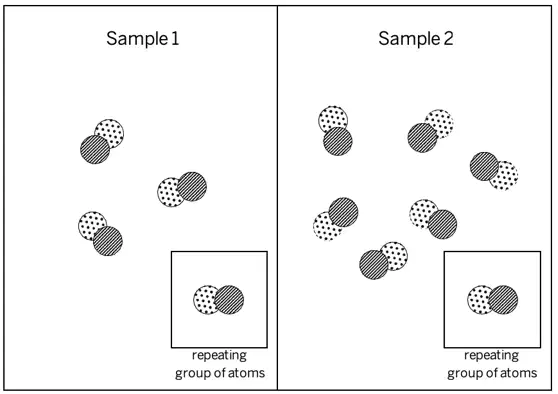
The diagram shows the repeating groups of atoms that make up two samples. Both samples are green gases at room temperature.
Will the other properties of the two samples be the same or different?
(Examples of properties are smell, color, and the temperature at which a substance melts.)
The other properties will be the same because the repeating groups of atoms that make up the two samples are the same.
The other properties will be different because there are more repeating groups of atoms in Sample 2.
The other properties will be the same because both samples are green at room temperature.
The other properties will be the same because both samples are gases at room temperature.
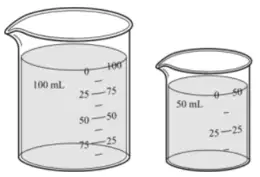
The two beakers shown contain pure water.
Which of the following properties is the same for both of these samples?
mass
weight
volume
boiling point
Which property of substance indicates whether the substance is a liquid or a solid at room temperature?
melting point
electrical conductivity
flexibility
solubility
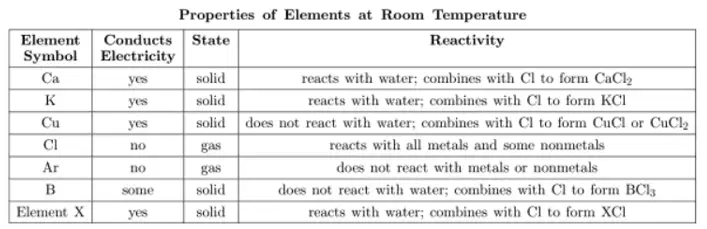
The table shows properties of several elements.
Which element would Element X most likely be grouped with on the periodic table?
calcium (Ca)
chlorine (Cl)
copper (Cu)
potassium (K)
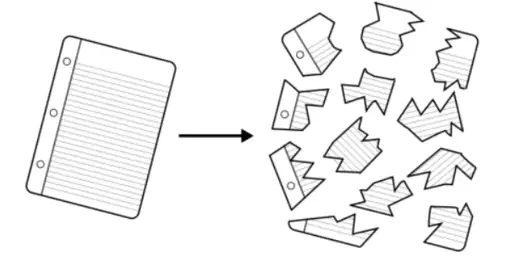
Which of these properties changes when the piece of paper is cut as shown above?
it's color
its total weight
its shape
its state of matter
Sharpening a pencil and tearing paper are examples of physical changes.
Which statement describes why these are physical changes?
There is a change in how the objects are used.
There is a change in the appearance of the objects.
There is a change in both the appearance of the objects and the materials from which they are made.
There is a change in the materials from which the objects are made.
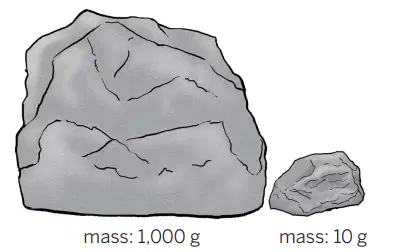
A scientist has two samples and wants to know if they are the same substance. How might the scientist test if they are the same substance?
Select two answers.
The scientist could calculate the volume of both samples. Then, they can divide the mass by the volume to calculate the density. If both samples have the same density they might be the same substance.
The scientist does not need to do any calculations. They are different masses which means they are different substances.
The scientist could cut the same volume-sized piece from each and weigh their masses. If they are the same, then they are likely the same substance.
The scientist could record t
When matter changes from solid to liquid or from liquid to gas, what kind of change takes place?
chemical change
physical change
thermal change
energy change
The smallest particle of an element that still has that element’s properties.
Ex. One oxygen atom (O) or one hydrogen atom (H).
Element
Molecule
Substance
Atom
A set of atoms that repeats over and over in a structure.
Ex.
extended structure
repeating group
model
property
A pure substance made of only one kind of atom.
element
atom
molecule
property
A group of two or more atoms bonded together.
model
element
molecule
atom
A substance made up of two or more different elements that are chemically bonded.
compound
molecule
atom
element
A type of matter that is made of one kind of particle; it has unique properties.
element
molecule
substance
atom
A representation that helps explain or show something that is difficult to observe directly.
property
model
repeating group
extended structure
A characteristic of a substance that can be observed or measured.
property
model
repeating group
extended structure
A large structure made from repeating groups of atoms or molecules bonded in a pattern.
extended structure
repeating group
compound
element

