
 Worksheets
Unit #3 Review
Total questions: 40
Worksheet time: 23mins
Which state of matter has particles that move the slowest?
Solid
Liquid
Gas
Plasma
What happens to the density of steel if it is cut in half?
The density stays the same
The density doubles
The density is halved
The density becomes zero
Which of the following is NOT an indicator of a chemical change?
Change in color
Change in shape
Formation of a gas
Production of heat or light
How are physical changes different from chemical changes?
Physical changes do not create new substances, chemical changes do
Physical changes always involve heat, chemical changes do not
Chemical changes are reversible, physical changes are not
Physical changes only occur in solids
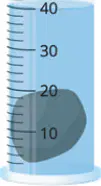
If the water level rises from 30 mL to 50 mL when a rock is added, what is the volume of the rock?
20 mL
30 mL
50 mL
80 mL
If the mass of the rock is 50 grams and its volume is 20 mL, what is the density of the rock?
2.5 g/mL
0.4 g/mL
10 g/mL
70 g/mL
Which statement best describes the Kinetic Molecular Theory?
Particles of matter are always in motion
Particles of matter are always at rest
Particles of matter only move in solids
Particles of matter do not have energy
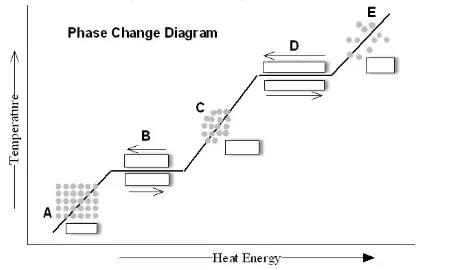
Which letters on the phase change diagram represent a phase change?
B and D
A and C
C and E
B and E
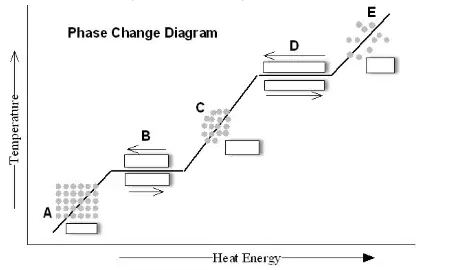
Which letter on the phase change diagram has the lowest kinetic energy?
A
B
C
E
What happens to the temperature when the substance is changing states?
The temperature stays the same.
The temperature increases rapidly.
The temperature decreases.
The temperature fluctuates randomly.
If a substance has a density of 3 g/mL and a volume of 100 mL, what is its mass?
300 g
3 g
100 g
103 g
A student has a rectangular block that is 2 cm wide, 3 cm tall, and 25 cm long, with a mass of 600 g. What is the density of the block?
4 g/cm³
2 g/cm³
5 g/cm³
6 g/cm³
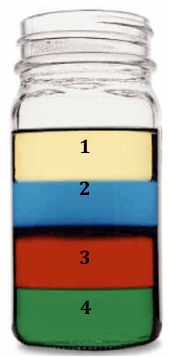
Calculate the density of the yellow liquid if its mass is 2.8 g and its volume is 2 mL.
1.4 g/mL
2.8 g/mL
0.7 g/mL
3.0 g/mL
If the mass of the red liquid is 1.8 g and the volume is 2 mL, what is its density?
0.9 g/mL
1.8 g/mL
2.0 g/mL
0.8 g/mL
If the mass of the green liquid is 6 g and the volume is 3 mL, what is its density?
2 g/mL
3 g/mL
1 g/mL
6 g/mL
Which of the following best describes a pure element?
A substance made of only one type of atom
A substance made of two types of atoms chemically combined
A mixture of two elements
A mixture of a compound and an element
Which of the following is a compound?
Krypton
Salt (NaCl)
Air
Bronze
Which of the following is a mixture?
Dry Ice (CO₂)
Sulfuric Acid (H₂SO₄)
Pizza
Baking Soda (NaHCO₃)
Label the following as a solid, liquid, gas, or plasma: The state where particles are closely packed together in a fixed arrangement.
Solid
Liquid
Gas
Plasma
How do you find the number of protons in an atom?
By looking at the atomic number
By looking at the mass number
By subtracting electrons from neutrons
By adding protons and neutrons
How do you find the number of neutrons in an atom?
Subtract the atomic number from the mass number
Add the atomic number and mass number
Subtract electrons from protons
Look at the atomic number
How do you find the number of electrons in a neutral atom?
It is equal to the number of protons
It is equal to the number of neutrons
It is equal to the mass number
It is equal to the atomic mass
Count the number of oxygen atoms on the left side of the equation: P₄O₁₀ + H₂O → H₃PO₄
10
11
12
14
Is the equation P₄O₁₀ + H₂O → H₃PO₄ balanced?
Yes
No
Only for oxygen
Only for hydrogen
Which of the following actions is an example of a physical change?
Burning
Rusting
Cutting
Exploding
Which of the following actions is an example of a chemical change?
Tearing
Squeezing
Mixing
Decomposing
What is an ionic bond?
A bond formed by sharing electrons between atoms
A bond formed by transferring electrons from one atom to another
A bond formed by mixing two substances
A bond formed by dissolving a substance in water
Which of the following is an example of a covalent bond?
Sodium chloride (NaCl)
Water (H2O)
Rust (Fe2O3)
Table sugar (C12H22O11)
What is the atomic number of Bromine?
79.904
35
17
53
How do you calculate the number of neutrons in an atom?
Atomic number minus atomic mass
Atomic mass minus atomic number
Atomic number plus atomic mass
Atomic mass divided by atomic number
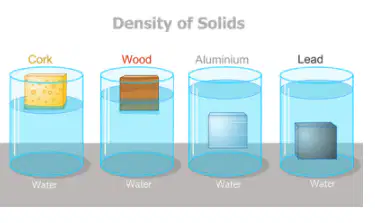
Based on the diagram, which objects are more dense than water?
Cork and wood
Aluminum and lead
Cork and aluminum
Wood and lead
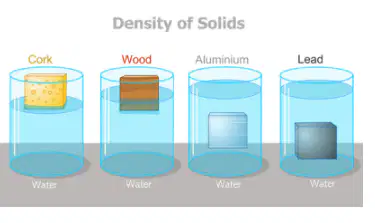
Based on the diagram, which objects are less dense than water?
Cork and wood
Aluminum and lead
Wood and lead
Cork and aluminum

Classify the Sample.
Pure Substance
Mixture of Elements
Mixture of Compounds
Mixture of Elements and Compounds

Classify the sample. Look carefully.
Pure Substance
Mixture of Elements
Mixture of Compounds
Mixture of Element and Compound
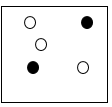

What state of matter does the picture below represent?
solid
liquid
gas
plasma

The diagram shows arrangement of particles in a
Solid
Liquid
Gas

What state is represented in the gif?
Solid
Liquid
Gas
Which is not a sign that a chemical reaction has occurred.
A change in mass
bubbling
production of an odor or smell
change in color

