
 Worksheets
APB Cellular Respiration
Total questions: 10
Worksheet time: 5hrs 0mins
In which reactions of cellular respiration and fermentation does substrate-level phosphorylation occur?
only in glycolysis
only in the citric acid cycle
only in the electron transport chain
in both glycolysis and the citric acid cycle
A cell has enough available ATP to meet its needs for about 30 seconds. What is likely to happen when an athlete exhausts his or her ATP supply?
He or she has to sit down and rest.
Catabolic processes are activated that generate more ATP.
ATP is transported into the cell from the circulatory system.
Other cells take over, and the muscle cells that have used up their ATP cease to function.
Which kind of metabolic poison would most directly interfere with glycolysis?
an agent that reacts with oxygen and depletes its concentration in the cell
an agent that binds to pyruvate and inactivates it
an agent that closely mimics the structure of glucose but is not metabolized
an agent that reacts with NADH and oxidizes it to NAD+
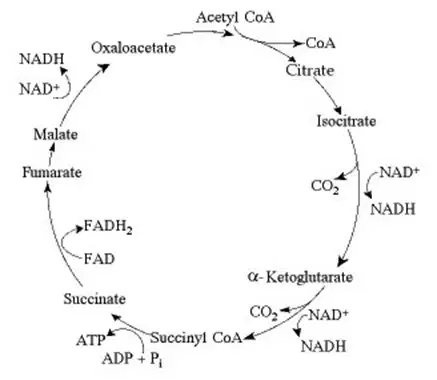
If you were to add one of the eight citric acid cycle intermediates to the culture medium of yeast growing in the laboratory, what do you think would happen to the rates of ATP and carbon dioxide production?
There would be no change in ATP production, but the rate of carbon dioxide production would increase.
The rates of ATP production and carbon dioxide production would both increase.
The rate of ATP production would increase, but the rate of carbon dioxide production would decrease.
The rates of ATP and carbon dioxide production would both decrease.
Which one of the following is formed by the removal of a carbon (as CO2) from a molecule of pyruvate?
ATP
citrate
water
acetyl CoA
Which of the following sequences describes the path by which electrons travel downhill energetically in aerobic respiration?
glucose → NADH → electron transport chain → oxygen
glucose → pyruvate → ATP → oxygen
glucose → pyruvate → electron transport chain → NADH → ATP
food → glycolysis → citric acid cycle → NADH → ATP
In liver cells, the inner mitochondrial membranes are about five times the area of the outer mitochondrial membranes. What purpose must this serve?
It allows for an increased rate of glycolysis.
It allows for an increased rate of the citric acid cycle.
It increases the surface for oxidative phosphorylation.
It increases the surface for substrate-level phosphorylation.
Which of the following metabolic processes normally occurs regardless of whether or not oxygen (O2) is present?
citric acid cycle
glycolysis
lactate fermentation
oxidative phosphorylation
An organism is discovered that thrives in both the presence and absence of oxygen. Interestingly, as oxygen is removed from the organism's environment, the rate of sugar consumption increases while the growth rate decreases. What do these observations suggest about the likely identity of this organism?
It is an unremarkable eukaryotic organism.
It is a photosynthetic organism.
It is an obligate anaerobic organism.
It is a facultative anaerobic organism.
The immediate energy source that drives ATP synthesis by ATP synthase during oxidative phosphorylation is the
oxidation of glucose and other organic compounds.
flow of electrons down the electron transport chain.
H+ concentration gradient across the membrane holding ATP synthase.
transfer of phosphate to ADP.

