
NEW
Font size
 Worksheets
Foundations of a Republic
Total questions: 15
Worksheet time: 15mins
DoK 1 — Which document established the first government of the United States but created a weak central government?
U.S. Constitution
Articles of Confederation
Bill of Rights
Great Compromise
DoK 2 — Why did the federal government under the Articles of Confederation struggle to pay off war debts?
It could not draft soldiers to collect payments.
It could not regulate westward expansion.
It could not levy taxes on the states.
It could not print any paper money.
DoK 2 — Which event exposed the weaknesses of the Articles of Confederation and increased calls for a stronger national government?
Whiskey Rebellion
Shays' Rebellion
Boston Tea Party
War of 1812
DoK 3 — Delegates met in Philadelphia in 1787 to revise the Articles but ended up creating a new constitution. Which gathering was this, and what best explains their decision?
Annapolis Convention; the states demanded more trade protections so they expanded tariffs
Constitutional Convention; the Articles were too weak to solve issues like taxation and representation
Stamp Act Congress; colonists wanted independence from Britain immediately
Second Continental Congress; they needed to manage the Revolutionary War
DoK 1 — Who was chosen to preside over the 1787 convention due to his respected leadership during the American Revolution?
Thomas Jefferson
George Washington
Benjamin Franklin
Alexander Hamilton
DoK 1 — Often called the “Father of the Constitution,” who played a central role in drafting the new framework of government?
James Madison
John Adams
Patrick Henry
John Jay
DoK 2 — Which agreement resolved the debate over representation by creating a bicameral legislature with two houses?
Great Compromise
Missouri Compromise
Three-Fifths Compromise
Northwest Ordinance
DoK 3 — Which compromise determined how enslaved people would be counted for both representation and taxation, and what was the practical effect on political power?
Three-Fifths Compromise; it increased the representation of slaveholding states without granting rights to the enslaved
Great Compromise; it equalized power between large and small states in the Senate
Missouri Compromise; it banned slavery north of the Ohio River
Treaty of Paris; it ended taxation on imported goods
Which right is specifically protected by the First Amendment as shown in the material?
Freedom of speech
Protection against self-incrimination
Right to a speedy trial
Protection from cruel and unusual punishment
According to the material, what does a police officer generally need to search a person’s home under the Fourth Amendment?
A warrant issued by a judge
Permission from a neighbor
Approval from the mayor
A verbal promise to return later
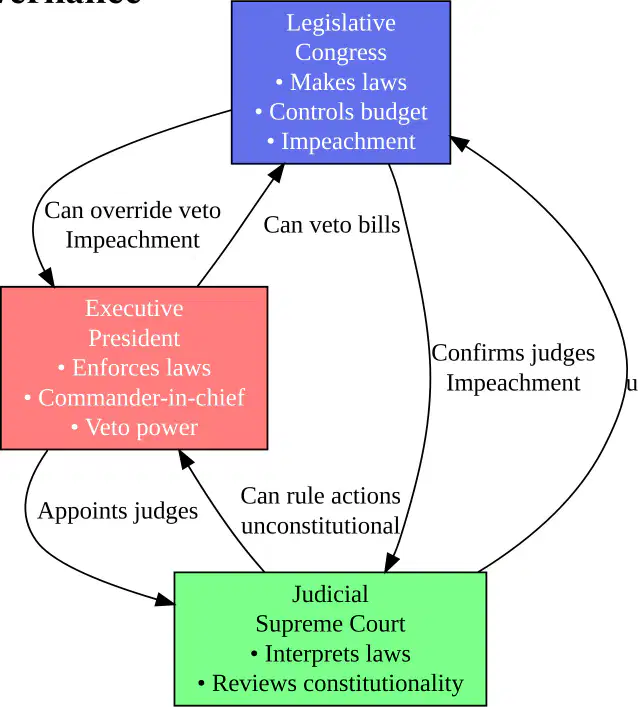
Based on the diagram of the three branches, what is the primary role of the Legislative Branch (Congress)?
Makes laws and controls the budget
Interprets laws and reviews constitutionality
Enforces laws and commands the military
Appoints judges and grants pardons
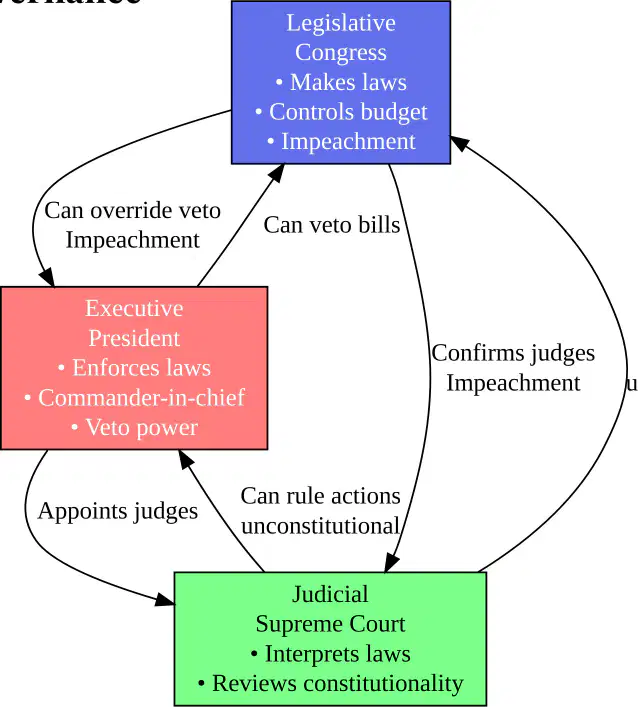
Using the checks and balances diagram, which action is an example of one branch checking another?
Congress can override a presidential veto
The President can appoint members of Congress
The Supreme Court can pass new tax laws
Congress can command the military in battle
DoK 1 — Which Enlightenment thinker is most closely associated with natural rights such as life, liberty, and property, and the idea of consent of the governed?
John Locke
Baron de Montesquieu
Jean-Jacques Rousseau
Thomas Hobbes
DoK 1 — Montesquieu’s key idea influenced the structure of the United States government. Which best describes that idea?
Direct democracy where citizens vote on every law
Separation of powers into legislative, executive, and judicial branches
Divine right of kings to rule without limits
A social contract that abolishes all government authority
DoK 2 — Which outcome best differentiates the American Revolution from the French Revolution, according to the chart?
Both ended monarchy and immediately created empires
The American Revolution formed a constitutional republic, while the French Revolution ended the monarchy and saw the rise of Napoleon
The American Revolution strengthened colonial rule, while the French Revolution created multiple independent nations
Both resulted mainly in political instability without new governments

