wayground logo

Free Printable Worksheets

Font size

S
M
L
XL
Worksheets

DNA Structure and Function, Replication, Transcription, and Tran

Total questions: 90

Worksheet time: 1hrs 23mins
Name
Class
Date
1.
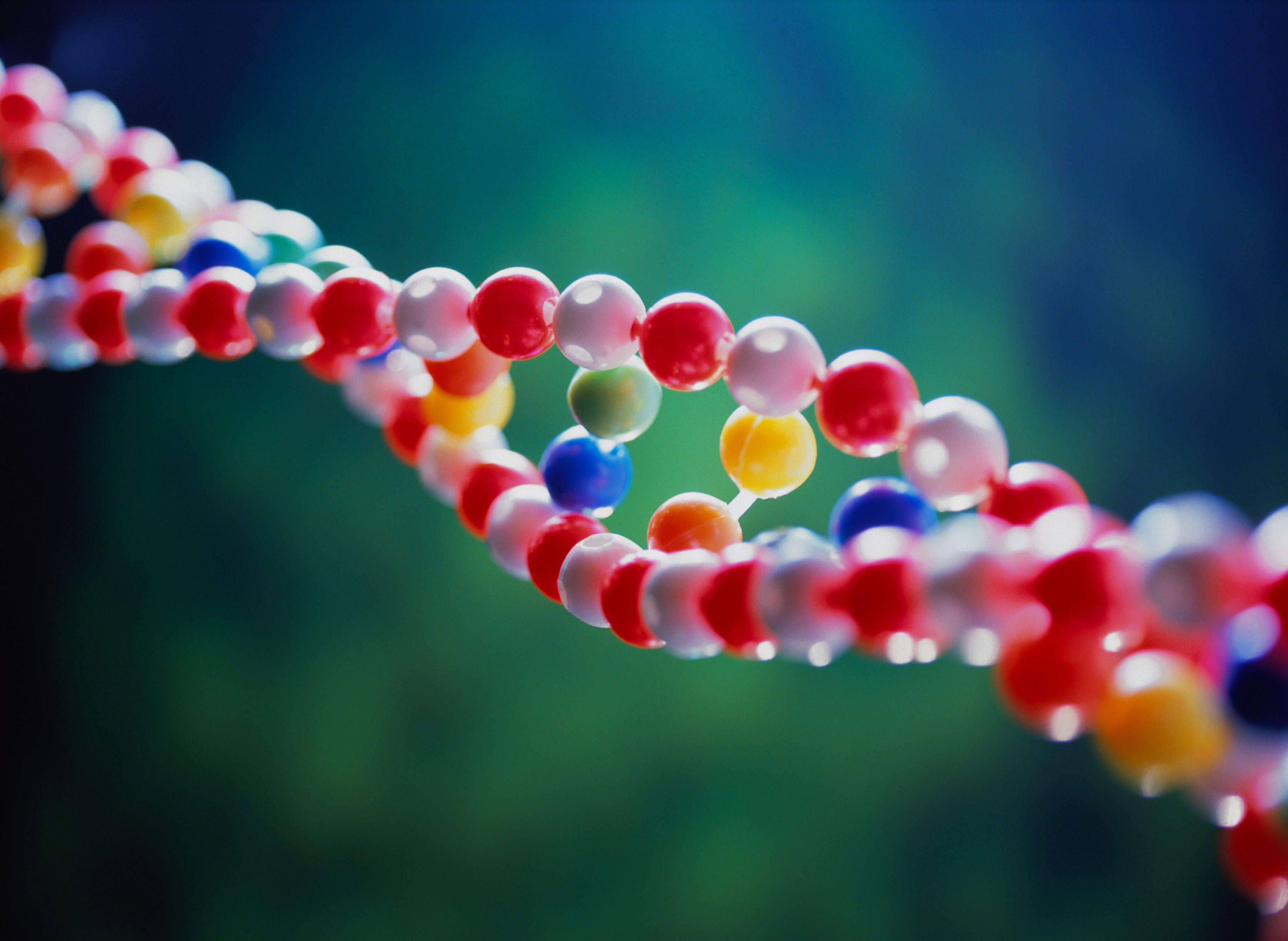
Which of the following best describes a DNA molecule?
a)
double helix
b)
contains ribose
c)
made of amino acids
d)
contains Uracil
2.
Why is DNA important?
a)
it is very small and very complicated
b)
it's in everything
c)
it serves as the blueprint for traits of all living things
d)
because we eat it every day for energy
3.
Which 2 molecules form the sides (backbone) of the DNA ladder?
a)
deoxyribose sugar and adenine
b)
deoxyribose sugar and a hydrogen bond
c)
deoxyribose sugar and the nucleus
d)
deoxyribose sugar and phosphate
4.
Nitrogenous bases are joined by which type of bond?
a)
polar bonds
b)
ionic bonds
c)
covalent bonds
d)
hydrogen bonds
5.
Which 2 molecules forms the sides (backbone) of the DNA ladder?
a)
deoxyribose and adenine
b)
deoxyribose and a hydrogen bond
c)
sugar and the nucleus
d)
deoxyribose (sugar) and phosphate
6.
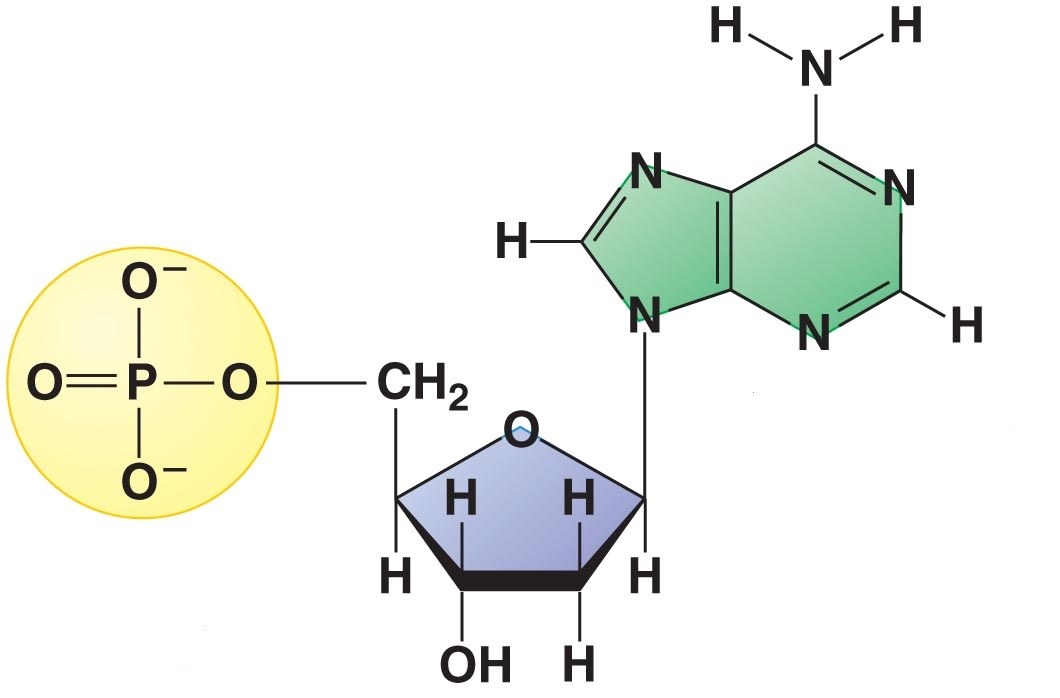
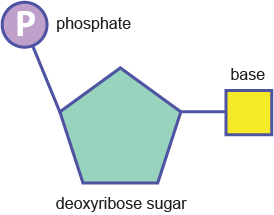
What are the three components of a nucleotide?
a)
sugar, hydrogen, nitrogen base
b)
sugar, oxygen, nitrogen base
c)
sugar, phosphate, nitrogen base
d)
sugar, phosphate, protein
7.
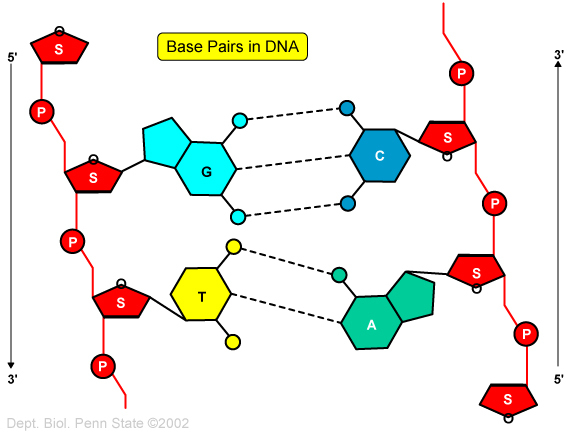
Cytosine always pairs with
a)
Adenine
b)
Thymine
c)
Uracil
d)
Guanine
8.
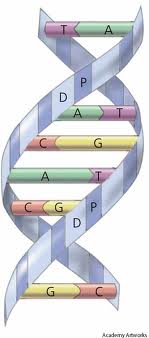
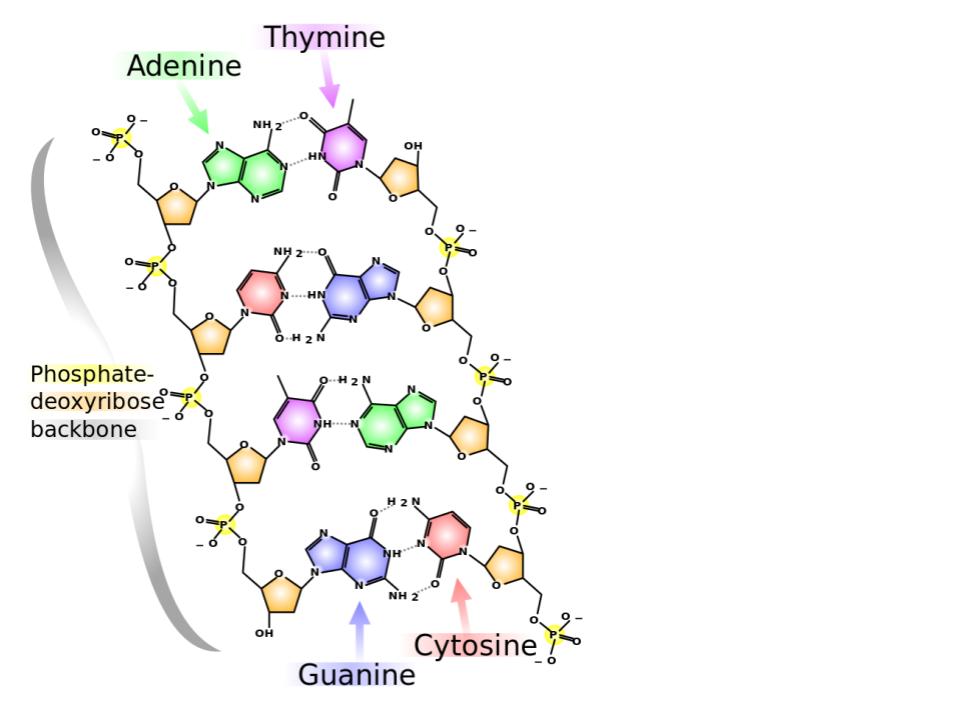
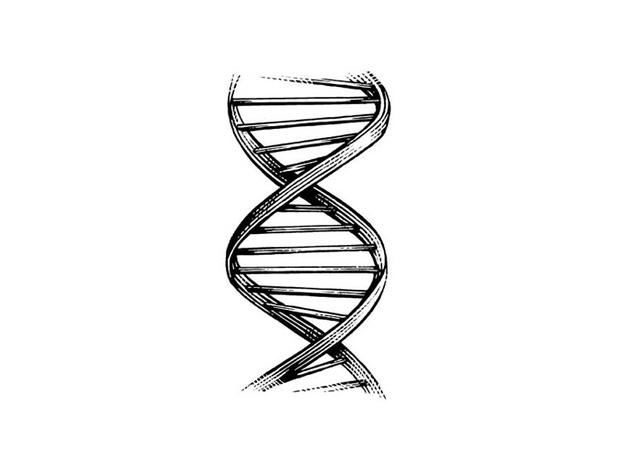
Name this structure
a)
double helix
b)
nucelotide
c)
twisted ladder
d)
hydrogen bond
9.
Which organelle is DNA usually found in?
a)
cell membrane
b)
vacuole
c)
ribosome
d)
nucleus
10.
Nucleotides are made up of a sugar, phosphate, and..?
a)
nitrogenous base
b)
nucleic acid
c)
cholesterol
d)
fatty acid
11.
Guanine bonds with ______________.
a)
Adenine
b)
Guanine
c)
Cytosine
d)
Thymine
12.
The two strands of DNA are held together by:
a)
Hydrogen Bonds
b)
Phosphodiester Bonds
c)
Glycolsyl Bonds
d)
Glycosidic Linkages
13.
What is the complement to the DNA strand below:
5'-ATGCCAT-3'
a)
5'-TACGGTA-3'
b)
3'-TACGGTA-5'
c)
3'-ATGGCAT-5'
d)
5'-ATGGCAT-3'
14.

Which of the following is a base pair?

a)

Adenine - Cytosine

b)

Cytosine - Thymine

c)

Deoxyribose - Cytosine

d)

Cytosine - Guanine

15.
Which of the following is not a component of DNA?
a)
5 Carbon Sugar
b)
Phosphate Group
c)
Carbon Base
d)
Nitrogen Base
16.
Which of the following is not a nitrogen base found in DNA?
a)
Thymine
b)
Uracil 
c)
Guanine
d)
Adenine
17.

According to Chargaff's rule, Cytosine always pair with

a)

Adenine

b)

Uracil

c)

Thymine

d)

Guanine

18.

According to Chargaff's rule, Cytosine always pair with

a)

Adenine

b)

Uracil

c)

Thymine

d)

Guanine

19.
What is the significance of the sequence (order) of the Nitrogen Bases in DNA?
a)
The order of the Nitrogen Bases determines the number of chromosomes present in an organism.
b)
The order of the Nitrogen Bases determines the traits that an organism will possess (have).
c)
The order of the Nitrogen Bases determines the gender of an organism.
d)
The order of the Nitrogen Bases determines whether an organism is abiotic biotic.
20.
Assume that you have straight hair and your sibling has curly hair. What accounts for this difference?
a)
You have DNA and your sibling does not.
b)
The your sequence of nitrogen bases is different than your sibling.
c)
Your sibling has a weave. 
d)
Your sibling has a genetic mutation. 
21.

How is the instructions for your traits carried on a DNA molecule?

a)

Sequence of the nitrogen bases

b)

In the Deoxyribose Sugar

c)

In the bond between the phosphate and the sugar

d)

In the phosphate group

22.

Label the diagram using the words provided by putting them in the correct box:

23.
Question Image

Match the codon with its amino acid

a)

ACC

1.

THR

b)

CCA

2.

PRO

c)

UAG

3.

stop

d)

AUG

4.

MET

e)

GAC

5.

ASP

24.

Label the steps in protein synthesis.

25.

Which portion of the structure of DNA is responsible for the coding of traits?

26.

Label the diagram

27.
Question Image

Match the following

a)

Transcription

1.

1st part of making proteins

b)

mRNA (messenger RNA)

2.

Occurs during transcription

c)

Translation

3.

2nd part of making proteins

d)

tRNA

4.

Helps assemble proteins by carrying specific amino acids

e)

Ribosome

5.

The site of protein creation (synthesis)

28.

Label the Following Diagram

29.

Which sequence of the genetic code would produce a polypeptide with the amino acid sequence Val-Pro-Leu? ​ (a)  

Choose from the below words
AUG AGC CCU
AGA AUG CCA
GUA CCA CUA
30.

Labeled the diagram

31.

The Universal Genetic Code Table can be used to determine the gene product of a given nucleotide sequence. The table below represents the transcription of a short peptide sequence in a human cell. Place the amino acid abbreviations that correspond to the nucleotide sequence when it is translated.

32.

Using the Codon chart attached, drag and drop the corresponding amino acid to its mRNA base

AAA : ​ (a)  

GUU : ​ (b)  

UAA : ​ (c)  

AGU : ​ (d)  

Choose from the below words
lysine
valine
stop
serine
33.

Match the following

a)

Location of transcription

1.

Inside the nucleus

b)

Location of translation

2.

In cytoplasm

(at the ribosome)

c)

Organelle that does translation

3.

Ribosome

(the organelle)

d)

Monomer of proteins

4.

Amino acids

e)

Monomer of RNA

5.

Ribo-nucleotides

(RNA nucleotides)

34.

Match the following

a)

mRNA

1.

carries the message to the ribosome

b)

rRNA

2.

part of the ribosome structure

c)

tRNA

3.

carries the amino acid to the ribosome

d)

DNA

4.

primary genetic material

35.

The monomer of nucleic acids are called ​ (a)   . The monomer of proteins are ​ (b)   .

Choose from the below words
nucleotides
amino acids
fatty acids
monosaccharides
36.

Which of the following units are repeatedly joined together to form a strand of DNA?

a)

Amino Acids

b)

Nucleotides

c)

Fatty Acids

d)

Polysaccharides

37.

In what phase of the cell cycle does DNA replication take place?

a)

G1

b)

S

c)

G2

d)

Prophase

38.

The process of DNA replication is called semi conservative because it results in

a)

none of these

b)

Two DNA molecules.  One original molecule and one with two new strands

c)

two exact copies with new strands

d)

two DNA molecules, each with 1 original strand and one new.

39.

Why does DNA replicate?

a)

To create a duplicate copy in case the original gets damaged

b)

New cells will have a copy of the DNA

c)

To create a new copy to replace the damaged original

40.

Nitrogen bases are joined by which type of bond?

a)

polar bonds

b)

hydrogen bonds

c)

phosphate bonds

d)

deoxyribose bonds

41.

What is a mutation?

a)

Adenine

b)

a change/mistake in DNA

c)

a copy of the original DNA

d)

Guanine

42.

What causes mutations?

a)

the environment

b)

random assortment

c)

chemicals

d)

independent assortment

43.

This is an example of -

THE DOG HID THE TOY (ORIGINAL)

THE DOH IDT HET OY? (NEW)

a)

addition

b)

substitution

c)

deletion

44.

This is an example of -

THE DOG HID THE TOY (ORIGINAL)

THE DOG SHI DTH ETO Y??

a)

addition

b)

deletion

c)

substitution

45.

This is an example of -

THE DOG HID THE TOY (ORIGINAL)

THE DOG HIM THE TOY (NEW)

a)

addition

b)

deletion

c)

substitution

46.
How does RNA differ from DNA?
a)
RNA contains uracil and deoxyribose
b)
RNA contains ribose and thymine
c)
RNA contains uracil and ribose
d)
RNA contains adenine and ribose
47.
How would the DNA sequence GCTATA be transcribed to mRNA?
a)
GCUAUA
b)
CGATAT
c)
CGAUAU
d)
GCUTUT
48.
The process by which the genetic code of DNA is copied into a strand of RNA is called
a)
translation
b)
transcription
c)
transformation
d)
replication
49.

What is the correct order to make a protein?

a)

Protein, DNA, RNA

b)

RNA, DNA, Protein

c)

DNA, RNA, Protein

d)

Protein, RNA, DNA

50.

RNA has what base that is instead of thymine?

a)

guanine

b)

adenine

c)

thymine

d)

uracil

51.

Which RNA carries the message?

a)

mRNA

b)

rRNA

c)

tRNA

52.
Where does transcription take place?
a)
nucleus
b)
cytoplasm
c)
ribosome
53.

Why must transcription occur where DNA can be found?

a)

because DNA can't leave

b)

because ribosomes are in the nucleus

c)

because DNA polymerase is found there

d)

because helicase unzips the DNA

54.

How many nucleotides equal 1 amino acid?

a)

1

b)

2

c)

3

d)

4

55.

TRANSCRIBE this DNA sequence: TACGTTACT

a)

AUGCAAUGA

b)

ATGCAATGA

c)

AUGGATUGA

d)

TACGTTACT

56.
In RNA, Uracil pairs with ______. 
a)
cytosine
b)
adenine
c)
guanine
d)
thymine
57.

Which organelle is the location where protein is made?

a)

Ribosome

b)

Nucleus

c)

Cytoplasm

d)

Nucleotide

58.

When these bond together, they form a protein

a)

Amino Acids

b)

Peptide Bonds

c)

Ribose

d)

Nucleotides

59.
What is the term for a three-nucleotide sequence that codes for an amino acid?
a)
base
b)
codon
c)
amine
d)
serine
60.
The process to go from DNA to mRNA is _______
a)
translation
b)
transcription
c)
replication
61.
The process to go from mRNA to a protein is called ____
a)
transcription
b)
rRNA
c)
replication
d)
translation
62.
DNA has a _____________ structure. 
a)
double helix
b)
single strand
c)
ring 
d)
chain
63.
The mRNA leaves the ________ to find the ribosome to make proteins.
a)
cell
b)
nucleotide
c)
nucleus
64.

DNA holds the code for making

a)

lipids

b)

carbohydrates

c)

proteins

d)

sugars

65.
The main function of tRNA is to...
a)
carry a message that, when translated, forms proteins
b)
form a portion of ribosomes
c)
string together complementary RNA and DNA strands
d)
bring amino acids from the cytoplasm to the ribosomes
66.
DNA travels outside of the nucleus.
a)
true
b)
false
67.
How does RNA differ from DNA?
a)
RNA contains uracil and deoxyribose
b)
RNA contains ribose and thymine
c)
RNA contains uracil and ribose
d)
RNA contains adenine and ribose
68.
How would the DNA sequence GCTATA be transcribed to mRNA?
a)
GCUAUA
b)
CGATAT
c)
CGAUAU
d)
GCUTUT
69.
The process by which the genetic code of DNA is copied into a strand of RNA is called
a)
translation
b)
transcription
c)
transformation
d)
replication
70.

What is the correct order to make a protein?

a)

Protein, DNA, RNA

b)

RNA, DNA, Protein

c)

DNA, RNA, Protein

d)

Protein, RNA, DNA

71.

RNA has what base that is instead of thymine?

a)

guanine

b)

adenine

c)

thymine

d)

uracil

72.

Which RNA carries the message?

a)

mRNA

b)

rRNA

c)

tRNA

73.
Where does transcription take place?
a)
nucleus
b)
cytoplasm
c)
ribosome
74.

Why must transcription occur where DNA can be found?

a)

because DNA can't leave

b)

because ribosomes are in the nucleus

c)

because DNA polymerase is found there

d)

because helicase unzips the DNA

75.

How many nucleotides equal 1 amino acid?

a)

1

b)

2

c)

3

d)

4

76.

TRANSCRIBE this DNA sequence: TACGTTACT

a)

AUGCAAUGA

b)

ATGCAATGA

c)

AUGGATUGA

d)

TACGTTACT

77.
A sugar, a phosphate group, and a nitrogen base form the building blocks of which organic compound?
a)
carbohydrates
b)
nucleic acids
c)
lipids
d)
proteins
78.
Which of the following is the template for the production of RNA within a cell?
a)
DNA
b)
protein
c)
ATO
d)
carbohydrate
79.
In RNA, Uracil pairs with ______. 
a)
cytosine
b)
adenine
c)
guanine
d)
thymine
80.

Which organelle is the location where protein is made?

a)

Ribosome

b)

Nucleus

c)

Cytoplasm

d)

Nucleotide

81.

When these bond together, they form a protein

a)

Amino Acids

b)

Peptide Bonds

c)

Ribose

d)

Nucleotides

82.
What is the term for a three-nucleotide sequence that codes for an amino acid?
a)
base
b)
codon
c)
amine
d)
serine
83.
The process to go from DNA to mRNA is _______
a)
translation
b)
transcription
c)
replication
84.
The process to go from mRNA to a protein is called ____
a)
transcription
b)
rRNA
c)
replication
d)
translation
85.
DNA has a _____________ structure. 
a)
double helix
b)
single strand
c)
ring 
d)
chain
86.
The mRNA leaves the ________ to find the ribosome to make proteins.
a)
cell
b)
nucleotide
c)
nucleus
87.

DNA holds the code for making

a)

lipids

b)

carbohydrates

c)

proteins

d)

sugars

88.
The main function of tRNA is to...
a)
carry a message that, when translated, forms proteins
b)
form a portion of ribosomes
c)
string together complementary RNA and DNA strands
d)
bring amino acids from the cytoplasm to the ribosomes
89.
What part of protein synthesis does this diagram represent?
a)
mRNA
b)
tRNA
c)
rRNA
d)
RNA
90.
DNA travels outside of the nucleus.
a)
true
b)
false