
Font size
 Worksheets
PCT 2
Total questions: 99
Worksheet time: 50mins
According to the text, what is one benefit of rounding on patients?
Increases call light usage
Reduces falls
Decreases patient satisfaction
Increases anxiety
Which of the following is a question you might ask a patient during rounding?
Can I assist you into a more comfortable position?
What is your favorite food?
Do you want to watch TV?
Can I call your family?
Fill in the blank: Rounding is also an opportunity to observe any changes in the patient's ______ and report them to the nurse.
condition
diet
room number
insurance
The purpose of the Hospital Consumer Assessment of Healthcare Providers and Systems (HCAHPS) Survey is:
to measure patients' perspectives on hospital care
to evaluate hospital financial performance
to assess hospital staff job satisfaction
to monitor hospital equipment usage
When removing a peripheral IV catheter, which infection-control guidelines should be followed?
Hand hygiene
Gloving
Both A and B
None of the above
When removing an IV catheter, you should apply excessive pressure over the intravenous catheter.
True
False
Fill in the blank: After removing the IV catheter, inspect the tip to be sure that it is ______.
intact
broken
missing
bent
What should you do if the site where the IV catheter was removed shows signs of infection?
Apply a sterile dressing and notify the healthcare provider.
Ignore the signs and monitor for changes.
Reinsert the IV catheter at the same site.
Cover the site with a non-sterile bandage.
'Culture and sensitivity' is defined as:
A laboratory test to identify microorganisms and determine the most effective antibiotic.
A method to measure blood pressure and heart rate.
A procedure to assess lung function and oxygen levels.
A test to evaluate kidney filtration rate.
What is the first step in changing a simple dressing?
Don gloves
Perform hand hygiene
Remove the old dressing
Dispose of the dressing in a biohazard bag
Fill in the blank: After removing gloves, you should _________
Perform hand hygiene
Put on a new pair of gloves immediately
Wipe hands with a tissue
Continue working without washing hands
Which of the following is disposed of in a biohazard bag during dressing change?
Old dressing
Gloves
Sterile gauze
Patient's clothing
Fill in the blank: To reduce the risk of infection when changing dressings, strictly follow ________ policies and procedures.
facility
personal
general
random
Removing tape from a dressing should be done quickly to minimize pain.
True
False
Fill in the blank: An ostomy is a surgically created opening from the intestines to the outside of the body and into an ________ appliance.
ostomy
urinary
digestive
respiratory
Which part of the bowel does an ileostomy drain liquid stool from?
Large bowel
Distal part of the small bowel
Rectum
Stomach
Fill in the blank: The usual consistency of stool from an ostomy can vary with the ________ of the ostomy.
location
size
color
duration
Patients with ostomies may have difficulty adjusting emotionally and in terms of caring for it.
True
False
Fill in the blank: A biohazard is a biological substance that is dangerous to ________ or the environment.
humans
plants
machines
furniture
Fill in the blank: A stoma is a surgically created opening from the inside of the body to the ________ of the skin.
surface
core
center
interior
Some ostomy pouches are designed to be rinsed and reused by the patient.
True
False
Fill in the blank: When caring for a patient with an ostomy, you are likely to perform the tasks of emptying the pouch, cleansing the ostomy and the skin around it, and ________ the appliance.
reapplying
removing
discarding
ignoring
What is the recommended temperature range for the water used to clean around the stoma during ostomy care?
35°C to 40°C
40.5°C to 43.3°C
45°C to 50°C
30°C to 35°C
Fill in the blank: After removing the ostomy belt, if the patient has the type of system that includes a belt, the next step is to _________.
Hold the skin taut and peel off the ostomy appliance from the top, while gently pushing the skin away from the skin barrier portion of the appliance.
Apply a new ostomy belt immediately.
Clean the area with alcohol wipes before removing the appliance.
Cut the ostomy appliance with scissors before removal.
When cleaning around the stoma, you should use hot water or soap.
True
False
Which of the following is NOT a step in ostomy care?
Remove the ostomy belt if the patient has one
Wipe away any feces on the stoma and around the stoma gently with toilet paper
Use hot water and soap to clean the stoma
Place gauze over the stoma in case any stool comes out while performing ostomy care
Fill in the blank: After disposing of the contents of the bedpan and your gloves, you should _________.
Perform hand hygiene.
Take a break.
Call the supervisor.
Leave the room immediately.
Clean the bedpan with bare hands.
What should you do if you notice any unusual observations, such as changes in the stool, changes in the appearance of the stoma, or signs of skin breakdown around the ostomy?
Inform the nurse immediately and document your care and all findings.
Ignore the changes and continue with routine care.
Wait until the next scheduled check to report the findings.
Try to treat the issue yourself without informing anyone.
Which of the following describes 'Non-weight-bearing' status?
The patient's affected leg cannot touch the floor.
The patient's affected leg can only touch the floor for balance.
The patient is able to bear full weight on the affected leg.
The patient is able to stand or walk on the affected leg, bearing the amount of body weight only as tolerated.
Fill in the blank: 'Touch-down weight-bearing' means the patient's affected leg can only touch the floor for ________.
balance
walking
exercise
rest
Which level of weight-bearing allows the patient to bear a portion of body weight on the affected leg?
Non-weight-bearing
Touch-down weight-bearing
Partial weight-bearing
Full weight-bearing
Fill in the blank: 'Weight-bearing as tolerated' means the patient is able to stand or walk on the affected leg, bearing the amount of body weight only as ________.
tolerated
directed
possible
comfortable
'Full weight-bearing' means the patient is able to bear full weight on the affected leg.
True
False
When ambulating a patient using assistive devices, what should you inspect prior to ambulation?
Inspect the equipment to ensure it is in good working condition and adjusted for the patient.
Check the patient's medication schedule.
Review the patient's dietary restrictions.
Verify the patient's insurance information.
Which of the following is NOT a reason to notify the nurse immediately during ambulation?
Reports shortness of breath or chest pain
Experiences a sudden headache
Feels any new pain while walking
Patient is wearing secure footwear
Fill in the blank: Assistive devices should not be ______ among patients.
shared
personalized
repaired
replaced
A gait belt is a safety device that can be used to support patients while ambulating.
True
False
Which of the following is a step in assisting a patient to stand using a gait belt?
Stand in front of the patient and place your feet at the sides of the patient's feet.
Direct the patient to place their hands on the bed alongside the thighs.
Grasp the gait belt (palms facing up) at each side and have the patient lean forward.
All of the above.
Fill in the blank: While ambulating, always remember to stand on the patient's ______ side.
weaker
stronger
right
left
Having a chair nearby is helpful when ambulating a patient who might become fatigued easily.
True
False
What should you do if a patient starts to fall?
Try to lift the patient off the floor immediately
Assist the patient to the floor and support the head
Call for assistance after lifting the patient
Ignore the situation
When transferring a weight-bearing patient from bed to wheelchair, what angle should the wheelchair be placed next to the bed?
90°
45°
30°
60°
Fill in the blank: When transferring a weight-bearing patient, you should use a _______ to help guide and support the patient during the transfer.
gait belt
wheelchair
walker
sling
Mechanical lifts are used for lifting and moving non-weight-bearing patients.
True
False
Which of the following is NOT a step in using a mechanical lift?
A) Explain the procedure to the patient
B) Place the sling under the patient
C) Engage the lifting mechanism
D) Lift patients higher than necessary
Fill in the blank: A transfer board is best performed with a ______-person assist.
three
one
two
four
When using a transfer board, both surfaces should be aligned at the same height and have their wheels in the locked position.
True
False
Raise all ______ on beds and stretchers before unlocking wheels and moving the conveyance.
side rails
pillows
blankets
wheels
When transporting a patient in a wheelchair, make sure the patient's ______ are fully supported by the footrests.
feet
hands
arms
head
If the patient has a urinary drainage bag attached to an indwelling urinary catheter, where should you attach it when moving the patient?
Above the level of the patient's bladder
Below the level of the patient's bladder
At the same level as the patient's bladder
It does not matter
When backing a wheelchair out of an elevator, what should you ensure?
The patient is securely inside the boundaries of the conveyance
The drainage bag, IV bag, and footrests will not brush against the elevator doors, walls, or other occupants
Both A and B
None of the above
Splints stabilize an extremity after injury or surgery and provide temporary support to ______ structures or operative areas.
broken bony
soft tissue
muscular
vascular
When applying a splint to the forearm, you should start at the ______ and work your way to the elbow.
wrist
shoulder
fingers
forearm
After applying a splint, you should check for circulation, movement, and sensation in the areas beyond the splint.
True
False
If the fingers are colder or look pale or blue after applying a splint, what should you do?
Ignore it
Notify the nurse immediately
Remove the splint
Massage the fingers
Elevation helps reduce ______, which helps reduce pain after applying a splint.
edema
bleeding
fracture
infection
What is a vital part of your job in preventing skin breakdown according to the passage?
Repositioning patients at least every 2 hours to minimize the risk of developing pressure ulcers.
Applying lotion to the skin every 4 hours.
Encouraging patients to wear tight clothing.
Allowing patients to remain in the same position for extended periods.
Which of the following is NOT mentioned as equipment that can relieve pressure to prevent skin breakdown?
Specialized beds
Air mattresses
Bed cradles
Oxygen tubing
What is shearing force in the context of skin care?
Shearing force is a sliding of skin layers on each other, for example, when the head of the bed is elevated but the patient slides down toward the flat part of the bed.
Shearing force is the stretching of muscles during exercise.
Shearing force is the pressure applied by tight clothing on the skin.
Shearing force is the cooling effect of air on exposed skin.
Using lift devices when moving a patient reduces friction from dragging a patient's skin across bed linens.
True
False
Why is it important to keep skin clean and dry for patients?
To prevent skin breakdown and ensure that skin does not become gritty and abraded.
To increase the risk of infection and irritation.
To make the skin more sensitive to sunlight.
To promote excessive sweating and discomfort.
Which of the following is a sign of a stage 1 pressure ulcer?
Crater full of dead tissue
Redness that doesn’t blanch
Peeling or cracking skin
Visible fat and tissue

Match the following patient positions with their corresponding diagram:
Supine
patient lying flat on back
Prone
patient lying flat on stomach
Fowler's
patient sitting up at an angle
Sims'
patient lying on side with one leg flexed
What does the term 'maceration' mean in the context of skin care?
Softening and breaking down of skin due to prolonged exposure to moisture.
Formation of calluses due to friction.
Increase in skin elasticity due to massage.
Temporary redness caused by sun exposure.
Some facilities do not allow the use of powder and cornstarch because these products can become gritty and abrade the skin.
True
False
What should you do if you observe any skin changes in a patient?
Report any skin changes to the nurse.
Ignore the skin changes and continue care.
Apply lotion without informing anyone.
Wait to see if the skin changes get worse before acting.
Match the following patient positions with their descriptions:
Lying flat on the back
Supine
Lying flat on the anterior surface of the abdomen
Prone
Lying on one side
Lateral
Lying on the back with the head of the bed elevated to various degrees (no more than 30° to prevent pressure ulcers)
Fowler's
Lying on one side with the knee on that side flexed and in front of the other leg with the knee extended
Sims'
Which patient position is best for relieving pressure off the spine and hips?
Supine
Prone
Lateral
Sims'
Sitting
Fill in the blank: The ______ position is used for resting, sleeping, taking pressure off the spine.
Lateral
Prone
Supine
Fowler's
Which position is recommended for reading, receiving care, eating, or watching television?
Supine
Prone
Fowler's
Sims'
Sitting
The Sims' position is used for relieving pressure on the hips and tailbone and for some care procedures such as enemas.
True
False
What is the main purpose of sequential compression devices (SCDs)?
To help prevent blood clots from forming in the lower legs by promoting blood flow.
To monitor heart rate during surgery.
To deliver medication intravenously.
To measure blood pressure continuously.
Which of the following is NOT a step in applying SCD sleeves?
A. Place the sleeve under the patient's leg
B. Wrap the sleeve securely around the leg
C. Plug the connector on the sleeve into the device
D. Leave the sleeve loose for comfort
Fill in the blank: Remove the SCD sleeves once during an ______ shift to check the patient's skin and circulation.
8-hour
12-hour
6-hour
4-hour
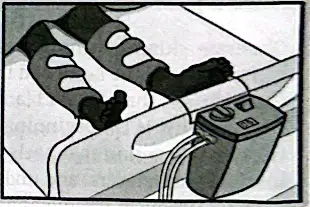
What part of the device is plugged into the connector that goes to the device?
The connector on the sleeve is plugged into the connector that goes to the device.
The battery is plugged into the connector that goes to the device.
The display screen is plugged into the connector that goes to the device.
The power button is plugged into the connector that goes to the device.
After wrapping a sequential compression device sleeve around a patient's leg, how many fingers should fit between the sleeve and the patient's skin?
One
Two
Three
Four
What is the purpose of antiembolism stockings/compression hose?
To prevent blood clots from forming in the deep veins of the legs and help prevent fluid buildup in the legs.
To increase the temperature of the legs for comfort.
To reduce muscle cramps during exercise.
To provide support for broken bones in the legs.
List the first step when applying antiembolism stockings.
Have the patient lie supine.
Measure the patient's ankle circumference.
Check the patient's blood pressure.
Apply lotion to the patient's legs.
When applying antiembolism stockings, what should you do after turning the stocking inside-out down to the heel?
Place your hand inside the stocking and grasp the tip where the patient's toes will go.
Begin rolling the stocking up from the heel to the knee.
Stretch the stocking to its full length before applying.
Fold the stocking at the ankle before sliding it onto the foot.
Why should you not roll the stocking down at the top when applying antiembolism stockings?
Because that could interfere with blood circulation in the leg and foot.
Because it makes the stockings more comfortable.
Because it helps the stockings stay up.
Because it improves the appearance of the stockings.
What is the recommended frequency for patients to cough and take deep breaths after surgery to prevent respiratory complications?
At least every 1 to 2 hours while awake.
Once every 6 hours.
Only before meals.
Every 30 minutes while asleep.
What is the purpose of using an incentive spirometer?
To help prevent respiratory complications after surgery by encouraging deep breathing.
To monitor blood pressure levels.
To measure blood glucose levels.
To administer medication.
Which of the following is NOT a step for using an incentive spirometer?
Assist patients into a comfortable position
Have patients breathe out in the usual way
Tell patients to put their lips around the mouthpiece
Instruct patients to breathe out through the device
After inhaling with an incentive spirometer, patients should hold their breath for at least ____ seconds before exhaling.
3
1
5
10
How often should patients be encouraged to repeat the use of the spirometer while awake?
Every 1 to 2 hours
Every 4 to 6 hours
Once a day
Every 30 minutes
Basic first aid for bleeding involves applying pressure to the site with a gauze pad for several _____
minutes
hours
seconds
days
To stop a nosebleed, which of the following steps should be taken?
Have the patient lie down
Apply pressure to the nostril by pinching the nose
Maintain pressure for 1 to 2 minutes
Insert gauze immediately
If the nose is still bleeding after applying pressure, what should be done next?
Insert gauze and notify the nurse.
Apply ice directly to the nose.
Tilt the head backward and wait.
Ignore the bleeding and continue normal activities.
What is the universal sign for choking?
Grabbing the front of the neck.
Raising both hands above the head.
Clapping hands together rapidly.
Pointing to the mouth.
Which of the following is NOT a step in administering abdominal thrusts (Heimlich maneuver) to an adult?
A) Stand or kneel behind the patient
B) Make a fist and place it against the patient's abdomen
C) Press your fist into the patient's abdomen with a gentle, slow thrust
D) Repeat thrusts until the patient expels the foreign body or becomes unresponsive
When a patient is having a seizure, you should:
Restrain the patient
Put something in the patient's mouth
Turn the patient's head to one side if no neck or spine injury is evident
Leave the patient alone
Common symptoms of shock include rapid pulse, increased shallow breathing, blank stare, and _________
cold, clammy, pale skin
warm, dry, flushed skin
slow, deep breathing
bright, alert eyes
If you suspect a patient is in shock, what should you do first?
Call for help and ensure the patient has an open airway.
Give the patient something to eat or drink.
Move the patient to a sitting position.
Ignore the symptoms and wait for improvement.
When a patient feels dizzy or about to faint, you should:
Have them stand up quickly
Elevate their lower legs or sit and place their head between their knees
Give them water immediately
Leave them alone
What does CPR stand for?
Cardiopulmonary Resuscitation
Cardiac Pressure Response
Circulatory Pulse Recovery
Critical Patient Rescue
What is the purpose of electrodes in patient care?
To deliver medication
To detect and record the heart's electrical activity
To measure blood pressure
To provide oxygen
Which of the following situations require activating the facility’s emergency response team?
Cyanosis
No pulse
Shortness of breath
Difficulty breathing
Which of the following is NOT a situation that requires immediate notification of the nurse?
Uncontrollable bleeding
Choking
No breathing
Falls
Fill in the blank: If you find a patient unresponsive, you should shake the patient’s shoulders and ask, 'Are you ____?'
okay
awake
alive
here

