
 Worksheets
Chapter 5 - Enabling Tool Use and Planning in Agents
Total questions: 74
Worksheet time: 37mins
Which concept empowers intelligent agents to reason about their own cognitive processes and dynamically modify their behaviors?
Reflection and introspection
Planning algorithms
Tool integration
Hierarchical task networks
What is a significant step forward in AI agents?
Increasing memory capacity
Combining how agents plan and use tools
Improving hardware speed
Reducing energy consumption
Which of the following is NOT mentioned as a type of tool that agents can utilize?
APIs
Databases
Software functions
Physical sensors
Which planning algorithms are mentioned as essential for agents?
State-space search, reinforcement learning, hierarchical task network planning
Genetic algorithms, neural networks, clustering
Sorting algorithms, searching algorithms, hashing
Linear regression, decision trees, support vector machines
Integrating tool use and planning is important for intelligent agents because it (a) .
Imagine an agent needs to choose between several APIs to complete a task. What process, as described in the chapter, should the agent follow?
Assess the suitability of each API based on goals and select the most appropriate one
Randomly select an API
Use the API with the shortest name
Choose the API that is most expensive
If you were to implement a new tool for an agent, which aspect would you need to consider to ensure efficient action sequences?
How the tool integrates with planning algorithms
The color of the tool's interface
The popularity of the tool among users
The tool's price
What is the primary purpose of tool usage by intelligent agents?
To augment the agent’s inherent functionality and decision-making processes by leveraging external resources
To reduce the agent’s reliance on external data sources
To limit the agent’s ability to perform complex tasks
To replace the agent’s internal algorithms with external ones
What is a limitation of an agent operating in isolation?
It can only use real-time data
It relies solely on its internal knowledge and algorithms
It can access specialized tasks
It can manage complex workflows
Which of the following best describes the difference between an agent in isolation and an agent with tool access when asked about the weather?
The isolated agent can provide real-time weather data, while the tool-access agent cannot
The tool-access agent can provide accurate, real-time weather information, while the isolated agent cannot
Both agents provide the same level of information
The isolated agent can execute specialized tasks, while the tool-access agent cannot
Why is tool usage important for agents?
It allows agents to transcend their intrinsic limitations by harnessing external tools and systems
It makes agents less efficient in decision-making
It restricts agents to only using training data
It prevents agents from managing complex workflows
Suppose you want an agent to answer a question about current weather conditions. What would be the most effective way to ensure an accurate response?
Give the agent access to a real-time weather lookup tool
Rely solely on the agent’s training data
Ask the agent to make up an answer
Limit the agent’s access to external resources
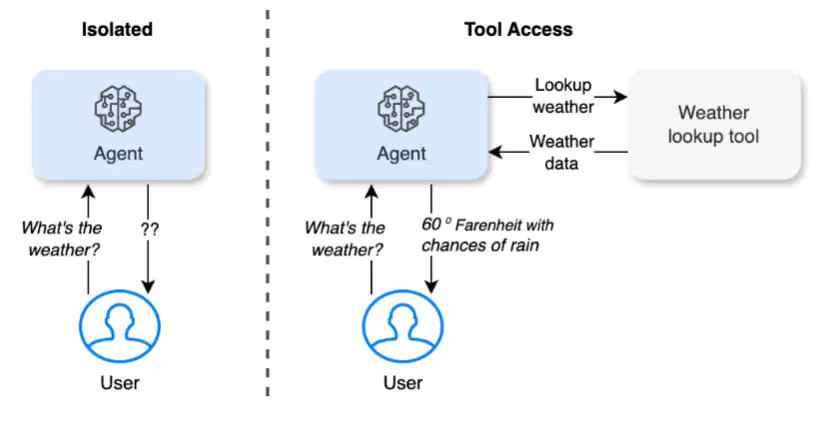
Based on Figure, what is the main difference in agent behavior when it has tool access versus when it is isolated?
The agent with tool access can provide specific weather data, while the isolated agent cannot
The isolated agent can access external tools, while the tool-access agent cannot
Both agents provide the same answer to the user
The isolated agent can manage complex workflows, while the tool-access agent cannot
Which of the following best describes the main significance of tool use in agents powered by LLMs?
To broaden the agent’s competencies and enable it to tackle complex, real-world challenges beyond its native problem-solving abilities.
To reduce the computational power required by the agent.
To limit the agent’s scope to only predefined tasks.
To replace the need for any external data sources.
What is the primary difference between function calling and tool calling in the context of LLMs?
Function calling is for internal tasks, while tool calling is for interacting with external systems.
Function calling is slower than tool calling.
Tool calling is only used for database lookups.
Function calling requires no parameters.
When an LLM invokes a tool or function, what does it actually do?
It generates a structured response indicating the tool/function, parameters, and their format.
It executes the code for the tool or function directly.
It ignores the request and continues processing.
It randomly selects a tool or function to use.
Why is understanding the distinction between tool calling and function calling important for designing AI agents?
It helps in integrating internal and external systems to enhance agent functionality.
It allows agents to avoid using any external APIs.
It ensures agents only perform database lookups.
It prevents agents from accessing real-time data.
Suppose an LLM is asked about the weather in a specific city. Describe the process it follows to provide an answer using tool calling.
The LLM generates a structured call specifying the weather lookup function and relevant parameters, which is then handled by an external system to retrieve the answer.
The LLM directly accesses the weather database and returns the answer.
The LLM ignores the request if it cannot answer directly.
The LLM asks the user to look up the weather themselves.
Match each item below with whether it is included or NOT included in the structured response generated by an LLM when invoking a tool or function.
The expected output format of the tool/function.
NOT included in the structured response.
Which tool/function it wants to use.
Included in the structured response.
What parameters should be passed to the tool/function.
Included in the structured response.
How those parameters should be formatted.
Included in the structured response.
Which of the following models is explicitly trained for tool calling behavior?
OpenAI's GPT-4
BERT
ResNet
VGGNet
What is the main purpose of using docstrings when defining tools in frameworks like CrewAI or LangGraph?
To provide descriptive text about the tool's function
To increase the speed of code execution
To encrypt the tool's logic
To reduce memory usage
Which of the following is NOT typically included in a tool's docstring?
The tool's purpose
Required and optional arguments
Expected return values
The tool's graphical user interface
Why might some models achieve similar tool calling functionality with aggressive prompt engineering, even if not explicitly trained for it?
Because prompt engineering can guide the model's behavior
Because all models have built-in tool calling capabilities
Because prompt engineering increases model size
Because prompt engineering disables tool calling
In Python, how are docstrings typically enclosed when defining tools?
Triple quotes (""")
Single quotes (')
Double quotes (")
Curly braces ({})
When defining a tool for an agent using a framework approach, the docstring should include (a) to ensure clarity for users.
A developer wants to create a tool for looking up weather data using a framework like CrewAI. What is the strategic advantage of using docstrings for this purpose?
It makes tool creation intuitive and follows standard programming practices
It makes the tool run faster
It hides the tool from users
It prevents errors in the code
Tools must be defined in (a) format when working directly with LLM APIs without a framework.
When defining multiple tools for LLM APIs, how are they typically organized?
As a single string
As a list (or array) of JSON schema objects
As a binary file
As a spreadsheet
Why is there an increase in affinity toward using libraries or frameworks such as CrewAI, LangGraph, and AutoGen for tool definitions in LLM agents?
They provide more complex APIs
They offer simplified ways of defining tools regardless of the LLM being used
They require manual tool management
They only work with OpenAI's GPT
Suppose you are working on a project that uses multiple LLM models, each with different ways of defining tools. What challenge might you encounter, and how could you address it?
Difficulty in training the models; use more data
Cumbersome tool definition and management; use libraries or frameworks to simplify the process
Slow response times; upgrade your hardware
Inconsistent output formatting; use a different programming language
Which type of tool serves as the primary gateway for agents to access external services and data in real time?
Application programming interfaces (APIs)
Database tools
Utility functions
Hardware interface tools
What is the main function of database tools in LLM agents?
Connecting different systems and services
Storing, retrieving, and managing structured data
Handling specialized tasks that run locally
Interacting with physical devices
Utility functions in agent toolkits are particularly valuable for which type of tasks?
Tasks that require integration between platforms
Tasks that require consistent, repeatable operations
Tasks that involve physical device control
Tasks that require real-time data access
Integration tools are essential for (a) agent capabilities.
How do hardware interface tools extend the influence of agents beyond digital interactions?
By enabling agents to process natural language
By allowing agents to access web services
By enabling agents to affect real-world changes and monitor physical environments
By supporting both reading and writing operations in databases
An agent needs to maintain persistent information across sessions and access domain-specific knowledge bases. It should primarily use (a) .
If an agent must handle calendar synchronization and file management across multiple platforms, which tool category is most appropriate?
Utility functions
Hardware interface tools
Integration tools
Application programming interfaces (APIs)
Match each toolkit category to the scenario where it is most essential for agents working with robotics systems and sensor data.
Database tools
Storing and retrieving large amounts of sensor data efficiently
Hardware interface tools
Directly controlling motors, sensors, and other physical components
Utility functions
Performing common calculations or data transformations on sensor readings
Integration tools
Connecting different software systems used in robotics workflows
Explain how utility functions contribute to the efficiency of agent operations. Provide an example of a task they might handle.
Utility functions enable agents to connect different systems, such as calendar and file management.
Utility functions handle specialized tasks locally, such as data processing or mathematical calculations, making operations consistent and repeatable.
Utility functions allow agents to interact with physical devices and monitor environments.
Utility functions provide standardized methods for accessing external web services.
Strategically, why might an agent combine multiple tool types to perform a complex task? Illustrate with an example.
To reduce the number of operations required for simple tasks
To ensure all tasks are performed in real time
To create powerful capabilities by leveraging the strengths of each tool type, such as integrating APIs for data access, databases for storage, and utility functions for processing
To avoid interacting with physical environments
Which of the following best describes "tool composition and chaining" in the context of agent systems?
Combining multiple tools to accomplish complex tasks
Selecting the most secure tool for a task
Updating tools to the latest version
Handling errors when a tool fails
What is a primary consideration for agents when performing tool selection and decision-making?
Choosing the tool with the most features regardless of cost
Selecting the most suitable tool or combination of tools based on context and requirements
Always using the newest tool available
Ignoring performance and reliability factors
Which strategy is most appropriate for agents to handle failures when working with tools?
Implementing fallback mechanisms to switch to alternative tools or approaches
Ignoring the failure and continuing the process
Always restarting the entire workflow
Only using tools that never fail
Tool state management is important for agents because (a) .
What is a key reason for agents to handle tool updates and versioning?
To maintain compatibility with multiple versions and adapt to new tool interfaces
To avoid using deprecated features entirely
To only use the oldest version of a tool
To ignore changes in tool capabilities
Which of the following is a critical aspect of tool security and access control for agents?
Managing authentication credentials and respecting rate limits
Always sharing credentials with all users
Ignoring communication channel security
Using tools without any access restrictions
Given a scenario where a user requests flight and hotel options for a trip within a specific budget, which agent capabilities are most likely to be involved? (Select the best answer.)
Tool composition and chaining, tool selection, and error handling
Only tool updates and versioning
Only tool state management
Only tool security and access control
A key reason for the paradigm shift toward tool use in agentic systems is (a) .
How can agents in healthcare benefit from using external tools?
By providing personalized recommendations using medical databases and decision support systems
By ignoring external resources and relying only on internal reasoning
By limiting their advice to general health tips
By using only basic diagnostic algorithms
Which of the following is NOT mentioned as a domain where intelligent agents can use tools?
Robotics and automation
Manufacturing plants
Physical realm
Space exploration
Match each statement about intelligent agents with the correct reason why utilizing external tools and resources is important.
It allows agents to adapt and thrive in dynamic, complex environments
Agents can respond to changing situations and solve new problems by leveraging various resources.
It restricts agents to a single tool
Agents are limited in their capabilities and flexibility.
It makes agents less efficient
Agents are unable to optimize their performance and may waste resources.
It prevents agents from achieving ambitious objectives
Agents are unable to reach challenging goals due to lack of support from external tools.
A virtual travel agent can leverage APIs from which of the following sources to plan and book complete travel itineraries?
Airlines, hotels, rental car companies, and travel review sites
Only airlines
Only hotels
Only travel review sites
How does the integration of various tools and databases enhance the capabilities of an AI travel agent?
It allows the agent to provide personalized recommendations and coordinate all aspects of a trip
It limits the agent to searching flights only
It makes the agent slower in planning trips
It prevents the agent from accessing real-time data
Imagine you are designing an agent for a manufacturing plant. How would you strategically use external tools to improve the agent’s performance in handling assembly tasks?
By leveraging various tools and machinery to perform intricate assembly tasks, quality inspections, or material handling operations
By restricting the agent to software-based tools only
By ignoring the use of physical tools and machinery
By focusing only on the agent’s internal reasoning capabilities
What reasoning process would an AI travel agent use to make intelligent trade-offs when booking a trip for a user?
Integrating and reasoning over data from various sources to provide recommendations tailored to the user's preferences and constraints
Randomly selecting travel options without considering user preferences
Ignoring customer ratings and travel document requirements
Focusing only on flight schedules without considering other factors
Which of the following is a fundamental capability of intelligent agents that enables them to reason about their actions and devise strategies to achieve their objectives?
Planning
Memorization
Visualization
Networking
What is the main challenge of using traditional planning algorithms like STRIPS and A* planning for LLM agents?
They are too slow for real-time applications
They struggle with handling natural language and nuanced states
They require expensive hardware
They cannot process binary conditions
Which planning algorithms are considered most practical for LLM agents due to their alignment with language model processing?
STRIPS and MCTS
LLM-based planning and HTN
GraphPlan and Fast Forward
A* planning and Monte Carlo Tree Search
STRIPS planning algorithm is most effective for which type of conditions?
Nuanced language states
Clear, binary conditions
Probabilistic outcomes
Continuous variables
STRIPS is considered too rigid for language-based planning in LLM agents because it struggles with (a) .
Suppose you are designing a planning system for an LLM agent that must handle a wide variety of conversation states and knowledge contexts. Which type of planning algorithm would be most suitable?
STRIPS
LLM-based planning
Monte Carlo Tree Search
GraphPlan
Given the limitations of STRIPS in handling nuanced language states, what adaptation might be necessary to make it more suitable for LLM agents?
Reducing all states to binary true/false conditions
Incorporating probabilistic reasoning and flexible state representations
Increasing the speed of computation
Limiting the number of possible actions
Which fundamental challenge does the A* planning algorithm face when applied to LLM agents?
Difficulty in quantifying the “distance” between conversation states
Lack of computational power
Inability to generate any actions
Over-reliance on random sampling
Why is GraphPlan considered computationally intractable for language-based planning in LLM agents?
It cannot represent possible actions
Language interactions do not fit into discrete layers with clear cause-and-effect relationships
It requires too much memory for simple tasks
It only works for numeric data
What is one reason MCTS becomes impractical for LLM agents?
It does not use simulations
It requires actual LLM calls for each simulation, making it expensive
It cannot handle numeric data
It is only suitable for image processing
(a) is considered moderately practical for use with LLM agents.
How does FF planning’s goal-oriented approach benefit LLM agents in handling language tasks?
It ignores the context of the conversation
It aligns with how LLMs handle task completion and provides useful approximations for complex tasks
It eliminates the need for heuristic search
It only works for numeric planning problems
What modification is necessary for FF planning to work effectively with LLM agents?
Removal of heuristic search
Adaptation to handle natural language and partial state descriptions
Conversion to a random sampling algorithm
Restriction to numeric data only
Considering the limitations of A*, GraphPlan, and MCTS, why might FF planning still be considered for LLM agents despite its own challenges?
FF planning is the only algorithm available
FF planning offers goal-oriented search and flexibility for partial state descriptions, which are valuable in language contexts
FF planning does not require any modifications
FF planning is computationally intractable
Match the following planning approaches with their corresponding descriptions.
LLM-based planning and HTN planning
These two approaches are mentioned as most practical for LLM agents.
Genetic algorithms and A* search
These two approaches are commonly used in optimization and pathfinding problems.
Breadth-first search and depth-first search
These two approaches are classic uninformed search strategies in computer science.
Monte Carlo tree search and Q-learning
These two approaches are popular in reinforcement learning and game tree exploration.
Which principle does LLM-based planning operate on?
Language models can only recall facts
Language models can understand complex goals and adapt steps based on context
Language models require explicit state representations
Language models cannot handle real-world scenarios
What is one advantage of LLM-based planning over traditional planning algorithms?
It ignores context
It uses only numerical data
It handles complex, real-world scenarios more flexibly
It requires explicit state representations
Which of the following is NOT a component integrated during the context integration phase of LLM-based planning?
Domain knowledge
Current state
Constraints
Execution planning
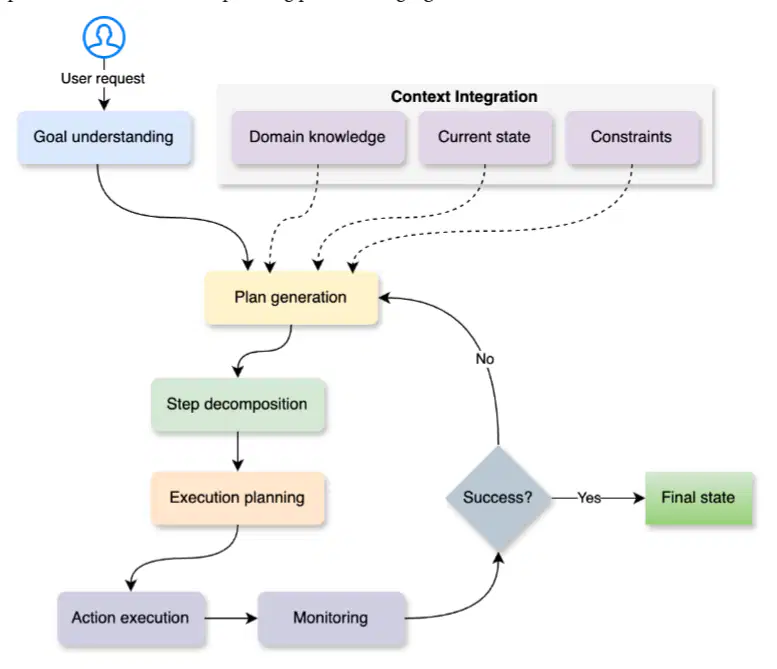
In the LLM-based planning algorithm flow, what happens if the monitoring step determines that the plan was not successful?
The process ends
The plan is regenerated
The final state is reached
The constraints are removed

