
 Worksheets
CNA Exam Practice Questions (#3)
Total questions: 20
Worksheet time: 10mins
What type of diets do patients with congestive heart failure need?
High-sodium diet with unrestricted fluids
Low-sodium diet with fluid restriction
High-fat, high-cholesterol diet
No restrictions on diet or fluids
What is incontinence?
Voluntary control of bowel and bladder
Inability to control bowel or bladder function
Excessive sweating due to heat
Reduced urine output from dehydration
What is flaccid?
Muscles that are tight and rigid
Muscles with normal tone and strength
Muscles that are weak with little or no tone
Muscles that are spasming intermittently
What is the normal respiration rate? Abnormal?
8 – 12 breaths per minute is normal
12 – 20 breaths per minute is normal
20 – 28 breaths per minute is normal
28 – 36 breaths per minute is normal
Explain ROM
Restricting movement to prevent injury
Moving a joint through its full range to maintain mobility and prevent contractures
Strength training with weights to increase muscle mass
Walking long distances to improve endurance
What color is erythema?
Blue
Yellow
Red
Pale white
Are patients allowed to decorate their room?
No, decorations are never permitted
Yes, with personal items as long as it is safe and follows facility policy
Only during holidays
Yes, but only with staff-selected items
How do you deal with a deceased patient?
Leave the body untouched until family arrives
Provide respectful postmortem care and follow facility policy and cultural practices
Immediately remove all medical devices without documentation
Move the body to a chair for ventilation
What is contracture?
Temporary muscle soreness after exercise
Permanent shortening of muscle or joint leading to limited movement
A sprain that heals in two weeks
A voluntary muscle spasm
Where should a wheelchair be placed for a patient who is paralyzed?
On the patient’s weak side, far from the bed
On the patient’s strong side, close to the bed
Directly in front of the patient with brakes off
Behind the patient to encourage turning
How should you enter a blind patient’s room?
Walk in silently and begin care
Knock, identify yourself, and speak before touching the patient
Turn on bright lights without warning
Move furniture to clear space without notice
When do you apply elastic stockings?
At bedtime after the patient has been up all day
In the morning before the patient gets out of bed, when legs are least swollen
Only after a bath when the skin is moist
Only if the patient complains of leg pain
How do you transfer a patient who has a paralyzed left side to the toilet?
Assist from the left (weak) side and pivot toward the weak leg
Place the wheelchair and assist from the right (strong) side, pivoting toward the strong leg
Stand the patient without support and walk to the toilet
Pull the patient by the arms to the toilet
How are you supposed to perform log rolling on a patient?
Turn the head first, then the shoulders, then the hips
Move the patient as one unit with the spine aligned, using a draw sheet and assistance
Twist the torso while keeping the legs straight
Lift the patient under the arms and rotate quickly
Are you allowed to trim a diabetic patient’s toenails?
Yes, it is routine nursing care
No, toenail care should be performed by a podiatrist or per facility policy
Only if the patient requests it
Yes, but only with electric clippers
What is another name for bedsores?
Cellulitis
Pressure ulcers
Eczema
Dermatitis
How would you massage a decubitus ulcer?
Massage directly on the reddened or ulcerated area
Do not massage the ulcer; protect the area and relieve pressure
Apply deep tissue massage for circulation
Massage only with ice
What is the purpose of padding on a side rail?
To decorate the bed
To prevent injury and skin breakdown from contact with the rail
To keep the patient from seeing outside the bed
To make the rail heavier
Which type of hepatitis spreads through stool?
Hepatitis A
Hepatitis B
Hepatitis C
Hepatitis D
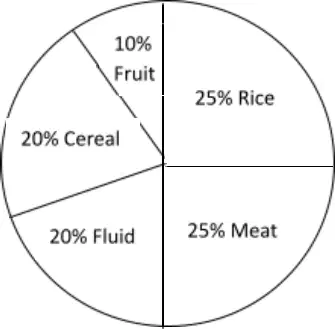
A patient ate all of the following except cereal; based on the pie chart of the meal, what is the total amount he ate?
55%
75%
80%
90%

