
 Worksheets
Semester 1 Review Honors
Total questions: 90
Worksheet time: 59mins
A student combines 20 g of substance A and 30 g of substance B in an open container. After the reaction, the product has a mass of 48 g.
What most likely explains the difference in mass?
Atoms were destroyed during the reaction.
Atoms were rearranged, and some gas escaped.
The scale was inaccurate.
Matter was converted into energy.
The balanced equation is:
2Na+Cl2→NaCl
What does this equation show about the law of conservation of mass?
The number of atoms is greater after the reaction.
Sodium disappears and chlorine increases.
The total number of atoms remains the same.
The mass of the product is less than the reactants.
A student burns a piece of magnesium in a closed system. The mass before the reaction is 5.4 g, and the mass after the reaction is also 5.4g.
What does this prove?
Some atoms turned into energy.
The container added extra mass.
No new substance is formed.
Mass is conserved when the system is closed.
The total mass of the products in a chemical reaction is 72 g. The mass of one reactant is 25 g.
What is the mass of the remaining reactants?
47 g
97 g
67 g
57 g
In the photosynthesis reaction:
6CO2+6H2O → C6+H12+O6+6O2
Which evidence from the equation supports the law of conservation of mass?
Glucose contains more atoms than reactants
The number of atoms on both sides is equal
Oxygen is not conserved
The reactants lose mass during the reaction
What happens to atoms during a chemical reaction?
Atoms are created or destroyed.
Atoms combine into elements.
Atoms rearrange to form new substances.
Atoms turn into energy and disappear.
A student mixes 80 g of reactant A and 20 g of reactant B.
What is the expected mass of the product if mass is conserved?
60 g
100 g
90 g
67 g
Which elements are found in the chemical formula Na2CO3 ?
Sodium, Oxygen, and Nitrogen
Sodium, Calcium, and Oxygen
Sodium, Carbon, and Oxygen
Sodium and Calcium
How many total atoms in H2SO4 ?
6
7
67
8
How many oxygen atoms are in Al2(SO4)3 ?
2
3
67
12
How does the number of oxygen atoms compare in 2H2O versus 2CO2 ?
Same number of oxygen
2H2O has more
2CO2 has more
Cannot be determined
A student observed that a candle melts when heated, but releases black smoke when burned.
What conclusion can be made?
Melting and burning are both chemical changes
Melting is a physical change; burning is a chemical change
Both changes are physical because no gas is formed
Both changes are chemical because heat is added
Sort these as chemical of physical changes:
Formation of a precipitate
A student applies a net force of 60 N to a box with a mass of 10 kg. What is the acceleration of the box?
6 meters per second2
67 meters per second2
0.17 meters per second2
600 meters per second2
If the net force on a 12 kg object is doubled, what happens to the acceleration?
It is halved
It is doubled
It remains the same
It becomes zero
A ball with a mass of 2 kg accelerates at 4 meters per second2 .
What is the net force acting on it?
6 N
67 N
8 N
4 N
Which situation correctly demonstrates Newton's Second Law?
A balloon rising because the air pushes it up.
A car accelerating faster when pushed harder.
A book resting on a table.
Two objects repelling due to magnetism
A 15 kg cart is pushed with a force of 75 N. What is its acceleration?
67 meters per second2
5 meters per second2
3 meters per second2
1 meters per second2
If the same net force is applied to two objects, which will accelerate more?
The one with more mass
The one with less mass
They will accelerate the same
The one with friction
If an object's mass is reduced by half while keeping the same force, what happens to its acceleration?
It doubles
It halves
It stays the same
It becomes zero
Two identical forces are applied to a 2 kg ball and a 4 kg ball. Which has a higher acceleration?
2 kg ball
4 kg ball
Both accelerate equally
Neither moves
What must happen to acceleration if mass increases and force stays the same?
It increases
It decreases
It stays the same
It becomes negative
If you triple the net force on an object while keeping mass constant, how does the acceleration change?
It becomes 1/3
It triples
It doubles
It stays the same
If you apply a force of 100 N to a 20 kg cart. What is the acceleration?
67 meters per second2
5 meters per second2
10 meters per second2
200 meters per second2
What best explains the relationship between force an acceleration?
Inverse - more force equals less accerlation
Direct - more force equals more acceleration
They are unrelated
Force only affects speed, not acceleration
How does Newton's First Law apply to the need for seatbelts in a car crash?
Objects at rest stay at rest unless a force is applied
Seatbelts cause accerlation
Passengers will stay in motion unless acted on by the seatbelt
The car moves forward because of friction
During a car crash, the passenger's head moves forward while the torso is restrained by the seatbelt. Which law best explains the head's continued motion.
Newton's First Law
Newton's Second Law
Newton's Third Law
Law of Conservation of Mass
A football player collides with another player and is knocked backward. Which law best explains the opposing forces they exert on each other?
Newton's First Law
Newton's Second Law
Newton's Third Law
Law of Gravity
Why does a rocket require more fuel to accelerate a heavier payload?
Newton's First Law
Newton's Second Law
Newton's Third Law
Newton's Zero Law
Two tectonic plates push against each other until one slips, releasing energy in an earthquake. Which law best describes the buildup and sudden release of force?
Newton's First Law
Newton's Second Law
Newton's Third Law
Law of Momentum
Why does a more massive tectonic plate require more energy to move during tectonic shifts?
Newton's First Law
Newton's Second Law
Newton's Third Law
Law of Inertia
A gymnast pushes off the vault an flips in the air. Which law explains the gymnast's forward motion after leaving the vault?
Newton's First Law
Newton's Second Law
Law of 67s
In which system do Newton's First, Second, and Third Laws act simultaneously?
A parked car
A person sitting in a chair
A roller coaster in motion with passengers inside
A still glass of water
A baseball is hit, flies through the air, and lands in a glove. Which law is represented when the glove applies force to stop it?
Newton's First Law
Newton's Second Law
Newton's Third Law
All three laws
A student increases the amplitude of a wave. What effect does this have on the wave's energy?
The energy decreases
The energy stays the same
The energy increases
The frequency increases
Two waves travel through the same medium. One has a longer wavelength and the same speed. What can be said about its frequency?
It has a higher frequency
It has the same frequency
It has a lower frequency
It has more energy
A wave with a high frequency has which of the following characteristics?
Long wavelength and low energy
Short wavelength and high energy
High amplitude and low speed
High speed and long wavelength
A student compares two waves and notices one wave has higher peaks and deeper troughs. What wave property is being compared?
Wavelength
Frequency
Amplitude
Speed
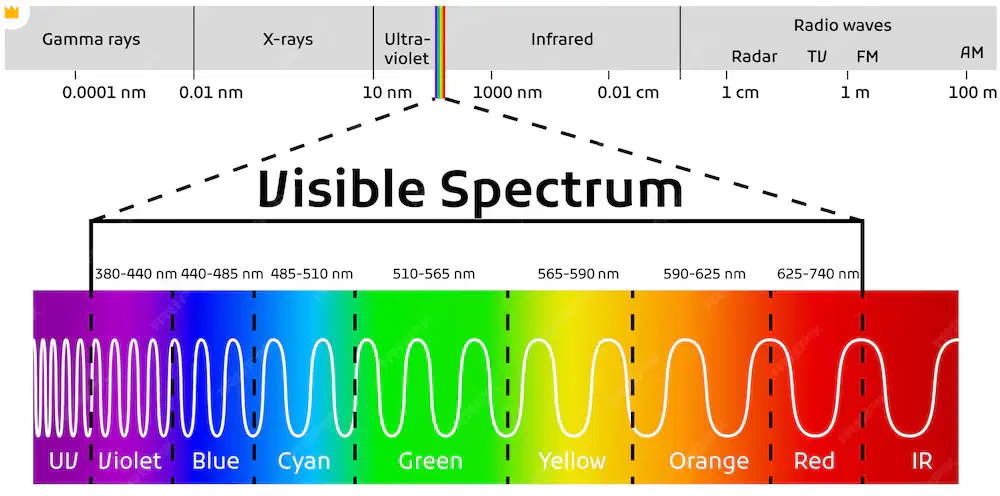
Which of the following electromagnetic waves has the shortest wavelength and highest frequency?
Radio Waves
Infrared Waves
Ultraviolet Waves
Gamma Rays
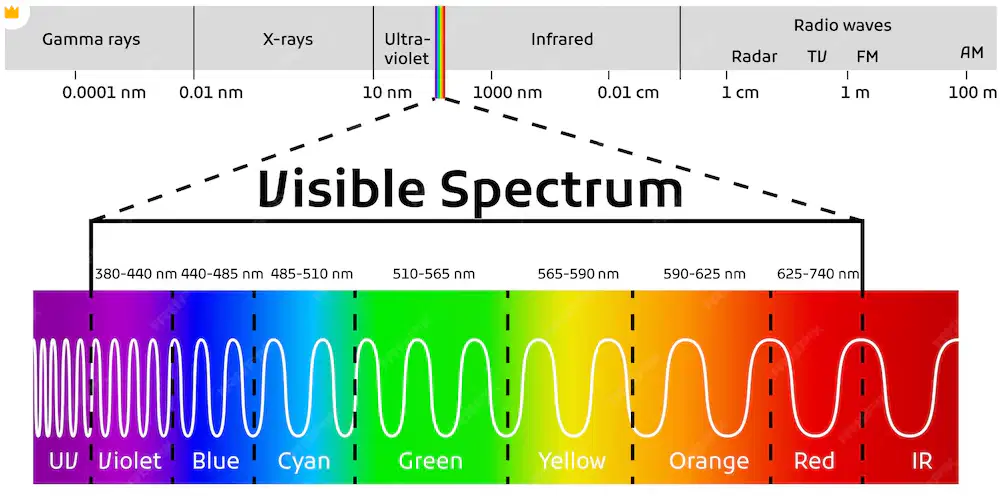
A microwave and a radio wave are compared. Which statement is correct?
Microwaves have lower frequency and longer wavelength
Microwaves have higher frequency and shorter wavelength
Radio waves have more energy
Radio waves travel faster
A toy car travels 10 meters in 2 seconds. What is its average speed?
20 m/s
5 m/s
2 m/s
67 m/s
A student investigates how different surfaces affect speed. The same cart travels 6 meters in 3 seconds on Surface A and 6 meters in 2 seconds on Surface B. Which statement is correct?
The cart moved faster on Surface A
The speed was the same on both surfaces
The cart moved faster on Surface B
There is not enough information
Which of the following would cause an object's velocity to change but not its speed?
Increasing distance
Changing direction while maintaining constant speed
Increasing time
Stopping completely
An object moves 10 meters in 2 seconds, then 10 more meters in the next 2 seconds. Which distance time graph best represents this motion?
A curved line that increases steeply
A straight diagonal line
A horizontal line
A line that curves downward
A student describes a graph where the line slopes upward and then becomes horizontal. What happened during the second part of the graph?
The object moved faster
The object remained still
The object moved backward
The object decreased in speed
A distance- time graph shows two lines: Line A is steeper than Line B. What does this mean?
Line B has a greater speed
Line A is slower
Line A has a greater speed
Both are moving at the same speed
Why do convection currents occur in Earth's mantle and atmosphere?
Because gases and liquids transfer heat through radiation
Because cold matter rises and warm matter sinks
Because energy moves in a vacuum
Because warm matter rises and cool matter sinks
How does thermal energy transfer from the Sun to Earth through space?
Convection
Conduction
Radiation
Reflection
A metal spoon becomes hot after sitting in a pot of boiling soup. What method of thermal energy transfer is responsible?
Convection
Conduction
Radiation
Insulation
A student slides a book across a table. The book slows down and stops. Which two forces are most responsible for this?
Applied force and gravity
Friction and gravity
Friction and magnetism
Normal force and gravity
A skateboarder moves down a ramp. Which force causes the motion and which one resists it?
Gravity causes motion; friction resists
Normal force causes motion; gravity resists
Friction causes motion; magnetism resists
Gravity causes motion; magnetism resists
A box is pushed with a 10 N to the right and 6 N to the left. What is the net force on the box, and is it balanced or unbalanced?
4 N to the right; unbalanced
4 N to the left; balanced
16 N to the right; unbalanced
0 N; balanced
Why does photosynthesis demonstrate conservation of energy in a system?
Because energy is destroyed by sunlight
Because energy is created during the process
Because light energy is transformed into chemical energy stored in glucose
Because light energy is converted into thermal energy only
A student compresses and releases a spring, creating a wave. What type of wave is demonstrated, and how is energy transferred?
Longitudinal; energy travels in the same direction as the compressions
Transverse; energy travels perpendicular to the compressions
Longitudinal; energy traves in circlesl
Transverse; energy travels in the opposite direction
Sort these crustal features based on boundary
Mountains
Volcanic Mountains - Convergent
Oceanic Trenches
Rift Valleys
Mid Ocean Ridges
Volcanic Mountain - Divergent
Fault Lines
Earthquakes
Tsunami
Rock Slides


The cold front is moving
east and southeast
west and northwest
north
south

A cold front is approaching Minneapolis. What will happen to the air temperature?
stay the same
increase
decrease




Why do you see precipitation near the L? (select 2 answers)
because that is low pressure and that is where air rises, forming clouds
because that is where air is falling and it brings rain with it
because southern Ohio is always rainy this time of year
because the cold front is meeting the warm front which forces warm air to rise rapidly forming clouds

The Jet Stream is a global pattern of atmospheric movement that influences patterns in local weather. Based on the information provided in the weather map, which city shown will most likely experience a drop in pressure over the next few days?
Baltimore
Portland
Rapid City

Near which two cities are the low pressure systems located?
Seattle & San Francisco
Chicago & Seattle
Dallas & Houston
Chicago & Nashville

Near which city is the high pressure system located?
Seattle
Minneapolis
Dallas
Chicago

Which two cities are most likely to experience clear, dry weather?
Seattle & San Francisco
Chicago & Minneapolis
Chicago & Nashville
Dallas & Houston
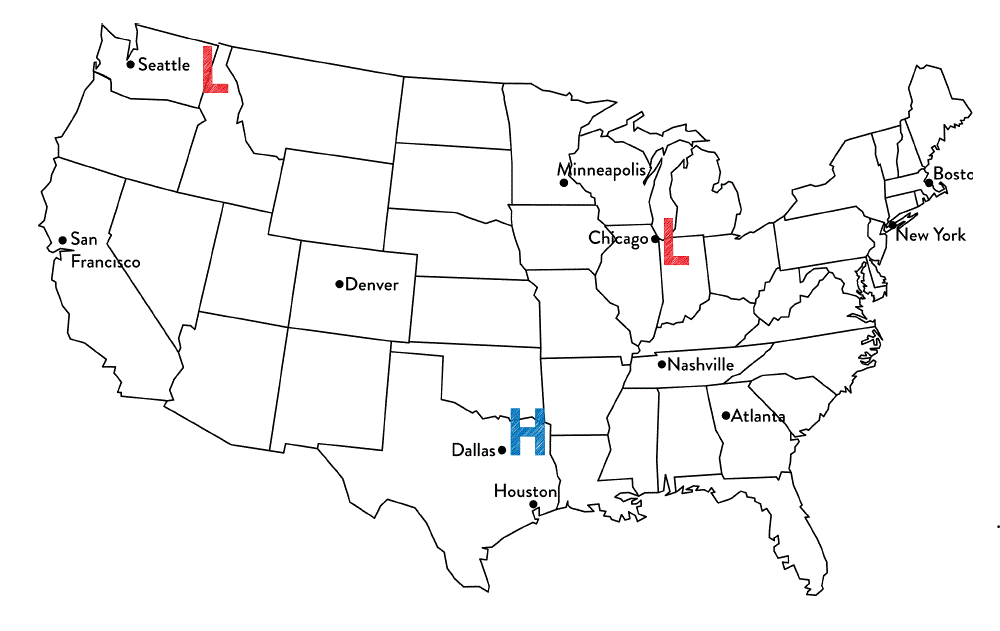
Tim said that Chicago is most likely to experience rainy weather. Jennifer thinks that Dallas is most likely to experience rainy weather.
Which student is correct?
Tim because Chicago is the closest to a low pressure system and they produce precipitation.
Jennifer because high pressure systems produce precipitation
Both students are correct because all systems produce precipitation
Neither of the students are correct because the cities are not close enough to the system.

Why does city "B" have clear skies?
It is in North America
There is not a front moving through city "B"
Clouds do not form in the West
It is located near a high pressure system

Where on Earth would cold currents originate?
Near the equator
Near the poles
Near the coast
Near the center of the largest oceans

Why is water warmer near the equator?
Because the equator receives less direct sunlight
Because of the deserts located there
Because the equator receives more direct sunlight
Because the equator has warmer wind currents

Coastal regions near warm currents tend to have cooler climates.
True
False
The sun provides the energy necessary to drive convection within Earth's oceans.
True
False
Ocean currents have an effect on:
climate and weather
temperature and weather
weather and density
salinity and climate
On the H-R diagram, it compares a star's brightness to its
Temperature
Composition
Age
What are 90% of stars classified as on the H-R diagram?
Supergiants
White Dwarfs
Main Sequence
Giants

How does star E compare to star B in the diagram?
Star E is hotter and brighter than star B.
Star E is hotter and dimmer than star B.
Star E is cooler and brighter than star B.
Star E is cooler and dimmer than star B.

Select any statement that is true about Star F on the diagram.
Star F is a main sequence star.
Star F is a blue star.
Star F is a Spectral Type K star.
Star F is a dim star.
Star F has a low temperature.
Which of these galaxies would be considered an elliptical galaxy?


The attractive force between objects is called....
force
Gravity
inertia
motion

Match the correct part of the chemical equation with its descriptor.
A
Reactants
B
Yields
C
Products
D
Subscript
E
Coefficient

