
 Worksheets
November 7, 2025
Total questions: 21
Worksheet time: 11mins
Name
Class
Date
1.
Name:
4 lines
2.
Big Business and Inventions
By the late 1800s, the United States experienced rapid industrial growth. Key inventions such as the telephone, light bulb, typewriter, and assembly line transformed production and communication. Entrepreneurs like Andrew Carnegie and John D. Rockefeller used strategies such as vertical and horizontal integration to expand their businesses and dominate industries.
During this time, the government practiced laissez-faire economics, meaning minimal intervention in business. While this encouraged growth and wealth, it also allowed some business owners to exploit workers, including children, who often worked long hours for low pay. Public criticism and reform movements eventually led to labor regulations and better working conditions.
Question 1. Which invention was NOT mentioned as transforming production?
a)
A. Assembly line
b)
B. Light bulb
c)
C. Steam locomotive
d)
D. Telephone
3.
2. How did Andrew Carnegie gain control of the steel industry?
a)
A. By inventing steel production methods
b)
B. Using vertical and horizontal integration
c)
C. By government subsidies
d)
D. Hiring only adult workers
4.
3. Which of the following was a positive effect of laissez-faire economics?
a)
A. Exploitation of child labor
b)
B. Rapid economic growth
c)
C. Poor working conditions
d)
D. Monopolies
5.
4. What was a negative consequence of laissez-faire policies?
a)
A. Increased government control
b)
B. Unethical business practices
c)
C. Growth of small businesses
d)
D. Lower profits
6.
5. Horizontal integration means:
a)
A. Controlling multiple stages of production
b)
B. Merging with or buying competitors in the same industry
c)
C. Expanding internationally
d)
D. Outsourcing labor
7.
Farmers in the Midwest and South faced falling crop prices, rising debt, and monopolistic railroads. Letters from farmers often described working “from sunup to sundown” yet barely making enough to pay shipping costs. This led to the formation of the Populist Party, which demanded government regulation of railroads, a more flexible currency, and policies to help farmers. While the party never won the presidency, it influenced later reforms in the early 20th century.
Question 6. How did farmers respond to these challenges?
a)
A. Moving to cities
b)
B. Forming political organizations like the Populist Party
c)
C. Starting factories
d)
D. Protesting in Europe
8.
Imagine you are a U.S. citizen in 1898. News arrives that the USS Maine exploded in Havana Harbor. Newspapers blame Spain and demand retaliation. Public pressure forces the government to act, resulting in war. Following the conflict, the United States gained overseas territories such as Puerto Rico, Guam, and the Philippines, marking the country’s rise as a world power.
Question 7: What was the immediate cause of the Spanish-American War?
a)
A. Industrialization
b)
B. Explosion of the USS Maine
c)
C. Annexation of Hawaii
d)
D. Panama Canal construction
9.
8. By 1914, two major alliance systems had formed in Europe: the Triple Entente (Britain, France, Russia) and the Triple Alliance (Germany, Austria-Hungary, Italy). These alliances, intended to deter aggression, instead created a domino effect when conflict broke out. What began as a dispute between Austria-Hungary and Serbia quickly escalated into a world war due to these binding agreements.
Question:
How did the alliance system contribute to the scale of World War I?
a)
It delayed declarations of war by months.
b)
It encouraged neutrality in minor disputes.
c)
It expanded a regional conflict into a global war.
d)
It prevented nations from intervening in support of allies.
10.
9. World War I was characterized by trench warfare, especially on the Western Front. Soldiers lived for months in muddy, disease-ridden trenches, facing constant artillery fire. Advances were measured in yards, not miles, and high casualty rates were the norm. Technological innovations like machine guns and barbed wire made frontal assaults deadly and ineffective.
Question:
What was one major consequence of trench warfare in World War I?
a)
Rapid and decisive military victories
b)
A prolonged stalemate with minimal territorial gains
c)
Increased mobility and use of cavalry
d)
Elimination of traditional battlefield tactics
11.
10. Millions of soldiers from European colonies in Africa, Asia, and the Caribbean were recruited or conscripted to fight in World War I. While these troops served bravely, they often faced racial discrimination and were typically given the most dangerous or labor-intensive tasks. Their service would later fuel anti-colonial movements and demands for equality.
Question:
What does the use of colonial troops during World War I suggest about the relationship between imperial powers and their colonies?
a)
Colonies were fully integrated into European society.
b)
Colonized people were viewed as equal partners in war.
c)
Colonies were exploited for manpower without equal rights or recognition.
d)
Colonial soldiers refused to fight in European wars.
12.
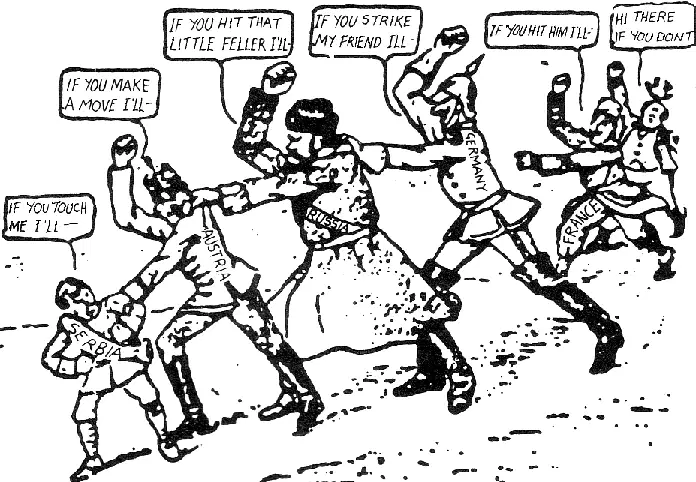
11. Which historical period is most accurately depicted by the "Chain of Friendship" image, reflecting the complex network of alliances that played a significant role in the onset of a major global conflict?
a)
A) The Age of Exploration
b)
B) The Cold War
c)
C) The years leading up to World War I
d)
D) The American Revolution
13.
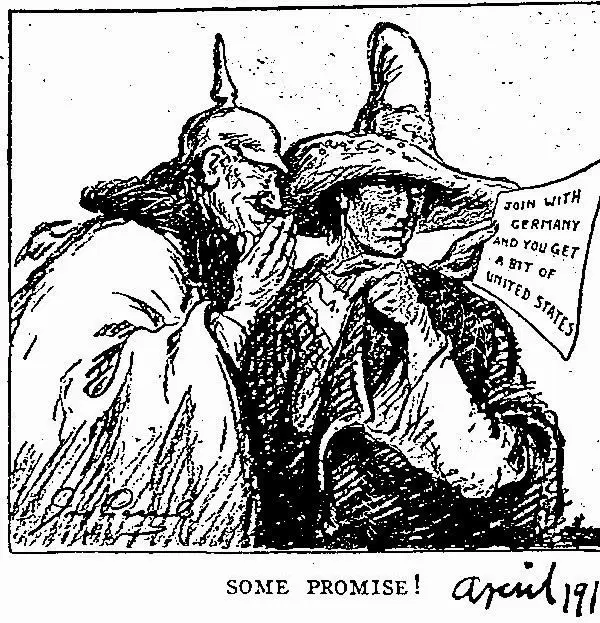
12.The political cartoon refers to which cause of the US entering the war?
a)
Zimmerman telegram
b)
sinking of the Lusitania
c)
unrestricted submarine warfare
d)
the Roosevelt Corollary
14.
13. Which of the following best defines 'The belief that a country should maintain a strong military capability and be prepared to use it aggressively to defend or promote national interests.'?
a)
Militarism
b)
Alliances
c)
Imperialism
d)
Nationalism
15.
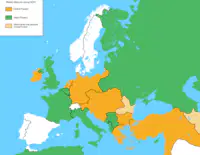
14. What countries made up the Central Powers?
a)
Britain, France, Russia, Italy and the United States
b)
Mexico
c)
Australia
d)
Austria-Hungary, Germany, Ottoman Empire
16.
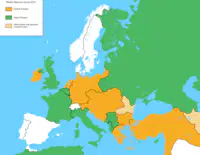
15. What countries were known as the Allied Powers during WWI?
a)
Britain, France, Russia, and the United States
b)
Mexico, Japan
c)
Australia, Germany, Italy
d)
Austria-Hungary, Germany, Ottoman Empire
17.

16. What is the purpose of this poster?
a)
A. Promote neutrality
b)
B. Warn against allies
c)
C. Encourage military enlistment
d)
D. Reduce taxes
18.
17. How does propaganda influence citizens?
a)
A. Shapes public opinion and encourages action
b)
B. Decreases patriotism.
c)
C. Eliminates war
d)
D. Reduces recruitment
19.
18. When did the U.S. enter WWI?
a)
1914
b)
1917
c)
1918
d)
1920
20.
19. What does the acronym M.A.I.N. stand for in relation to the causes of World War I?
a)
A) Militarism, Alliances, Imperialism, Nationalism
b)
B) Monarchy, Agriculture, Industry, Neutrality
c)
C) Militarism, Autocracy, Independence, Negotiation
d)
D) Monarchy, Alliances, Imperialism, Nationalism
21.
20. Russia left the war due to the:
a)
A) Bolshevik Revolution
b)
B) Russian Revolution
c)
C) World War Two
d)
D) American Revolution
100 %

