
 Worksheets
Kuiz -topic 3
Total questions: 10
Worksheet time: 5mins
Read the description: A normally-open contact keeps the circuit open in its initial (not actuated) position. Pressing the push button closes the circuit so current flows to the load. When the plunger is released, a spring returns the switch to its initial position, interrupting the circuit. Which statement best explains why current stops after releasing the push button?
The load disconnects itself when powered
The spring forces the contact back to open, breaking the circuit
The push button locks the contact closed permanently
The circuit becomes shorted and trips a fuse
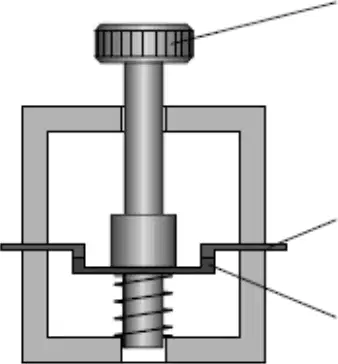
Which statement correctly describes a normally-closed contact as shown in the figure? The contact is closed in its initial position and changes state when the pushbutton is pressed.
It remains open until the pushbutton is pressed, then closes.
It is closed in its initial position and opens when the pushbutton is pressed.
It toggles between two outputs without interrupting either circuit.
It closes both circuits simultaneously when actuated.
Recall: According to the description, what happens when voltage is applied to a relay’s solenoid coil?
The coil heats up and mechanically pushes the contacts closed without magnetism
An electromagnetic field is produced that attracts the armature toward the coil core
The return spring compresses and forces the armature away from the contacts
The contacts instantly open because the coil blocks current
Skill/Concept: In a relay, which component directly moves to actuate the contacts, and what returns it when coil current is interrupted?
The coil core moves the contacts, and the insulation returns it
The armature moves the contacts, and a return spring brings it back
The relay coil moves the contacts, and the coil core resets them
The contacts move the armature, and the return spring pushes the coil
Strategic Thinking: Use the construction diagram to identify a fault. If the return spring is missing but the relay coil still energizes, which behavior is most likely when power is removed? (Refer to the labeled diagram showing armature, coil core, relay coil, insulation, contact, and return spring.)
The armature will remain in its actuated position, leaving contacts in the last state
The coil core will physically push the armature back to its initial position
The contacts will automatically open due to insulation expanding
The relay will immediately cycle open and closed until power is restored
Which application best describes a common purpose of a relay in electropneumatic circuit design?
Amplifying mechanical motion without changing signals
Signal multiplication to drive multiple outputs from one control
Generating power for the main circuit from the control circuit
Continuous analog modulation of voltage in the same circuit
A limit switch is a mechanical sensor used to detect the position of a machine part. Based on the description and diagram showing changeover, normally open, and normally closed contacts, which statement best describes a limit switch’s typical contact arrangement and how it can be connected?
It is normally a changeover contact and can be wired as normally open, normally closed, or left unused.
It is normally a normally open contact and can only be wired as normally open.
It is normally a normally closed contact and must always be wired as normally closed.
It has fixed contacts that cannot be configured and requires electronic actuation.
A reed switch used as a magnetic proximity sensor operates contactlessly and is actuated by a magnetic field. Which statement best describes its construction and operation?
It uses a mechanical lever to close metal contacts inside an air-filled plastic tube
It contains two contact reeds in a glass tube filled with inert gas; a nearby magnet’s field closes the reeds to allow current to flow
It relies on optical detection to trigger a semiconductor switch housed in a vacuum-sealed chamber
It has a single spring contact that is compressed by external force to complete the circuit
Inductive proximity sensors include three main internal blocks. Which sequence correctly matches their roles from sensing to output?
Amplifier generates the magnetic field, oscilllator detects metal, flip-flop stabilizes power
Oscillator generates an alternating magnetic field; flip-flop evaluates the oscillator state; amplifier actuates the output
Flip-flop creates the field; amplifier senses attenuation; oscillator switches the output
Amplifier produces a DC field; oscillator amplifies signals; flip-flop outputs analog voltage
A capacitive proximity sensor changes its output when an object enters the stray field at the front of the sensor. Which principle best explains this behavior?
The sensor measures a change in capacitance that attenuates the RC oscillator
The sensor detects a change in magnetic flux that strengthens an LC resonator
The sensor senses heat transfer that increases thermistor resistance
The sensor relies on light reflection that triggers a photodiode

