
 Worksheets
A level chapter 19-24 review
Total questions: 159
Worksheet time: 2hrs 24mins
Which is an example of an ionic crystal?
Quartz
NaCl
Ammonia
Iron
This type of solid forms a regular repeating
three-dimensional structure called a crystal lattice. What type of solid is this?
amorphous
crystalline
glass
diamond
What is Lattice Energy?
one mole of an ionic compound is formed from its gaseous ions under standard conditions
one mole of electrons is added to one mole of gaseous atoms to form one mole of gaseous 1- ions under standard conditions
one mole of an ionic compound is formed from its atoms under standard conditions
one mole of gaseous atoms is formed from its element under standard conditions
Bond breaking is
exothermic
endothermic
bond making is
exothermic
endothermic
Factors affecting the value of lattice energy
the size of the ions only
the charges of the ions only
BOTH the size of the ions AND the charges of the ions
When comparing different ionic compounds, the one with the greater charges will have a _______ magnitude of lattice energy.
greater
less
same
When comparing different ionic compounds, the one with the ions of greater size or radius will have a _______ magnitude of lattice energy.
greater
smaller
same
Choose the ionic compound with the greater magnitude of lattice energy.
NaCl
KCl
Choose the ionic compound with the greater magnitude of lattice energy.
CaCl2
KCl
Choose the ionic compound with the greater magnitude of lattice energy.
CaCl2
CaS
Choose the ionic compound with the greater magnitude of lattice energy.
NaCl
NaBr
Choose the ionic compound with the greater magnitude of lattice energy.
NaCl
CsI
The equation below represents .........
Mg2+ (g) + 2Cl- (g) --> MgCl (g)
lattice energy
enthalpy of formation
enthalpy of atomisation
electron affinity
Lattice energy becomes more exothermic when .......
size of ions are small
charge of ions are small
Lattice energy is always ...........
endothermic
exothermic
can be both endothermic or exothermic
Enthalpy of atomisation is always ...........
endothermic
exothermic
can be both endothermic or exothermic
Ionisation energy is always ...........
endothermic
exothermic
can be both endothermic or exothermic
Second and third electron affinities are always exothermic.
true
false
What is the general trend of first electron affinity going down the group 16 (ignore the first period)?
more negative
less negative
no change
enthalpy of formation is always exothermic
true
false
What is the first electron affinity?
one mole of electrons is added to one mole of gaseous 1- ions to form one mole of gaseous 2- ions under standard conditions
one mole of gaseous atoms is formed from its element under standard conditions
one mole of electrons is added to one mole of gaseous atoms to form one mole of gaseous 1- ions under standard conditions
If we want to calculate lattice energy we use
Hess's law
Born-Haber cycle
Enthalpy change of formation
Electron Affinity
Factors affecting anion polarisation
Charge density of the cation
The polarisability of the anion
The solubility of the group 2 hydroxides ........... down the group
increases
decreases
The solubility of the group 2 sulfates ...... down the group
decreases
increases
Hess’s law can be used to calculate (a) for reactions that do not occur directly or cannot be found by experiment
When an ionic solid dissolves in water, bonds are formed between water molecules and the ions. These bonds are called ion–dipole bonds
dipole –dipole bonds
ion–ion bonds
ion–dipole bonds
According to Hess's law, we can calculate lattice energy with the formula
ΔHlatt = ΔHf – ΔH1
ΔHf = ΔHlatt – ΔH1
ΔHlatt = ΔH1 - ΔHf
Rank the compounds below from highest to lowest lattice energy: NaBr, AlN, BeO, Li2S
AlN > BeO > Li2S > NaBr
NaBr > Li2S > BeO > AlN
BeO > Li2S > AlN > NaBr
AlN > Li2S > BeO > NaBr
Using the bank of lettered choices below, choose the correct sequence of choices necessary to complete this descriptions below:
A. Lattice Energy
B. Ionization Energy
C. Binding Energy
_______________ is the energy required to remove any particle from a system of particles, in this case, an electron from any atomic orbital, while _______________ is the energy required to remove the most loosely bound electron from an atom.
On a separate note, _______________ is the energy required to separate an ionic compound into its constituent ions.
A, B, C
C, B, A
B, C, A
C, A, B
Given the following ionic compounds, place them in order of decreasing lattice energy:
Al2S3, BaI2, KBr, NaF, MgO
Al2S3, BaI2, MgO, KBr, NaF
KBr, NaF, BaI2, MgO, Al2S3
Al2S3, MgO, BaI2, NaF, KBr
MgO, NaF, KBr, BaI2, Al2S3
Given the list of ions below without their radii, use what you know about trends in atomic size to rank the ions in order of increasing strength of interactions (i.e. - most exothermic):
N3-, O2-, F-, Na+, Mg2+, Al3+
Na+ < F- < Mg2+ < O2- < N3- < Al3+
F- < O2- < N3- < Na+ < Mg2+ < Al3+
Al3+ < N3- < O2- < Mg2+ < F- < Na+
F- < Na+ < O2- < Mg2+ < N3- < Al3+
Which of the equation below refers to the standard enthalpy of formation, ΔHfo?
Na(g) ---> Na+(g) + e- ΔH = -364 kJmol-1
C2H5OH (l) + 3O2 (g) ---> 2 CO2(g) + 3H2O (l) ΔH = - 1286 kJmol-1
2C (s) + 2H2 (g) ---> C2H4 (g) ΔH = - 52.3 kJmol-1
Na+(g) ---> Na+(aq) ΔH = - 364 kJmol-1
Heat released when 1 mole of aqueous ions is formed from gaseous ions.
Enthalpy of Formation
Enthalpy of Combustion
Enthalpy of Hydration
Enthalpy of Lattice Dissociation
Which equation represents the process that occurs when the standard enthalpy of atomisation of iodine is measured?
½ I2 (s) → I (g)
I2 (s) → 2I (g)
½ I2 (g) → I (g)
I2 (g) → 2I (g)
Lowest lattice enthalpy (∆LEH)?
NaBr
LiCl
KI
First electron affinity of an element is usually ________ and second electron affinity is ____________.
exothermic, endothermic.
exothermic, exothermic.
endothermic, endothermic.
endothermic, exothermic.

Given the Born-Haber cycle below, which of the following enthalpy change is not represented by steps a-g
Enthalpy of formation
Enthalpy of atomization of calcium
1st electron affinity of bromine
2nd electron affinity of bromine

Identify the enthalpy change represented by letter g.
Enthalpy of formation
Enthalpy lattice of formation
Electron affinity of bromine
Enthalpy of atomisation of zinc

What enthalpy change does the number 4 represent?
Formation
1st ionisation energy of Na
1st electron affinity of Na
Atomisation of Na
Enthalpy change is represented by step y ?
Enthalpy of formation calcium bromide
Enthalpy of atomisation of calcium
1st electron affinity of bromine
Enthalpy of atomisation of bromine

What is value of the enthalpy of lattice energy for NaCl (s)?
+766
+230
-230
-766

Calculate value x.
-1970 kJ
-266 kJ
+266 kJ
+1970 kJ

What is the value of enthalpy of formation of NaF (s)?
-928 kJ mol-1
-574 kJ mol-1
+107 + 496
+107 + 496 - 928
What is the definition of lattice enthalpy?
Heat released when one mole of solid ionic compound is formed from its gaseous ions.
Heat released when an ionic lattice is formed from one mole of its gaseous ions.
Heat released when one mole of an ionic lattice is formed from ions in their standard states.
Heat released when an ionic lattice is formed from one mole of gaseous atoms.
Which of the equation below refers to the standard enthalpy of formation, ΔHfo?
Na(g) ---> Na+(g) + e- ΔH = -364 kJmol-1
C2H5OH (l) + 3O2 (g) ---> 2 CO2(g) + 3H2O (l) ΔH = - 1286 kJmol-1
2C (s) + 2H2 (g) ---> C2H4 (g) ΔH = - 52.3 kJmol-1
Na+(g) ---> Na+(aq) ΔH = - 364 kJmol-1
The enthalpy change when 1 mole of a compound is formed from its elements in their standard states under standard conditions. This is the enthalpy of.....
Combustion
Formation
Lattice breaking
Ionisation
Heat released when 1 mole of aqueous ions is formed from gaseous ions.
Enthalpy of Formation
Enthalpy of Combustion
Enthalpy of Hydration
Enthalpy of Lattice Dissociation
Which equation represents the process that occurs when the standard enthalpy of atomisation of iodine is measured?
½ I2 (s) → I (g)
I2 (s) → 2I (g)
½ I2 (g) → I (g)
I2 (g) → 2I (g)
Lowest lattice enthalpy (∆LEH)?
NaBr
LiCl
KI
First electron affinity of an element is usually ________ and second electron affinity is ____________.
exothermic, endothermic.
exothermic, exothermic.
endothermic, endothermic.
endothermic, exothermic.
Which one of the following statements is not correct?
The first ionisation energy of iron is greater than its second ionisation energy.
The magnitude of the lattice enthalpy of magnesium oxide is greater than that of barium oxide.
The oxidation state of iron in [Fe(CN)6]3− is greater than the oxidation state of copper in [CuCl2]−
The boiling point of C3H8 is lower than that of CH3CH2OH
Given the Born-Haber cycle below, which of the following enthalpy change is not represented by steps a-g
Enthalpy of formation
Enthalpy of atomization of calcium
1st electron affinity of bromine
2nd electron affinity of bromine
Identify the enthalpy change represented by letter g.
Enthalpy of formation
Enthalpy lattice of formation
Electron affinity of bromine
Enthalpy of atomisation of zinc
What enthalpy change does the number 4 represent?
Formation
1st ionisation energy of Na
1st electron affinity of Na
Atomisation of Na
Enthalpy change is represented by step y ?
Enthalpy of formation calcium bromide
Enthalpy of atomisation of calcium
1st electron affinity of bromine
Enthalpy of atomisation of bromine
What is value of the enthalpy of lattice energy for NaCl (s)?
+766
+230
-230
-766
Calculate value x.
-1970 kJ
-266 kJ
+266 kJ
+1970 kJ
What is the value of enthalpy of formation of NaF (s)?
-928 kJ mol-1
-574 kJ mol-1
+107 + 496
+107 + 496 - 928
In the chemical reaction, the successful formation of products depends on the following factors EXCEPT:
The collisions between reacting molecules must be effective
The colliding molecules must approach each other in the right orientation
The energy of colliding molecules must be equal to or more than activation energy
A collision between molecules must produce sufficient energy to overcome the activation energy
The catalyst alters the rate of a chemical reaction by,
providing an alternative pathway with a lower Ea
changing the products formed in the direction of the reaction
providing a surface on which the molecules react
increasing the frequencies of collisions between molecules
The ____________ states that atoms, ions, or molecules must collide in order to react.
transition state
activation energy
rate law
collision theory
Liz observes 2 reactions, A and B.
Reaction A is performed in a beaker placed on top of a hotplate.
Reaction B is is performed in a beaker placed within a container of ice.
Which of the following statements is true?
Reaction A will react slower because the higher temperature will cause more collisions because the heat makes the molecules tired.
Reaction A will react slower because the higher temperature will cause give the reactants higher speed and kinetic energy.
Reaction B will react faster because the lower temperature causes the particles to move slower, allowing them to have more time to attach to one another.
Reaction B will react slower because the lower temperature makes the particles move slower, resulting in less collisions.
Which of the following best describes why increasing temperature increase reaction rate?
Activation energy is reduced.
Collisions become more frequent.
Collisions become more energetic.
Collisions become more frequent and more energetic.
To measure rate of reaction, we can monitor the concentration change in which of the following?
Reactants only
Products only
Reactants or products
What is the best definition of rate of reaction?
The time it takes to use up all the reactants
The rate at which all the reactants are used up
The change in concentration of a reactant/product per unit time
The time it takes for one of the reactants to be used up

The question below is about the Maxwell–Boltzmann distribution shown for a sample of a gas, X, at two different temperatures.
Which statement is correct for the higher temperature?
The area under the curve to the left of Ea decreases.
The total area under the curve increases.
The activation energy decreases.
More molecules have the mean energy.

This question is about the Maxwell–Boltzmann distribution of molecular energies in a sample of a gas shown in the figure below.
What does the area under the curve represent?
The total energy of the particles.
The total number of particles.
The number of particles that can react with each other.
The total number of particles that have activation energy.

The graph below shows a typical energy distribution for particles of an ideal gas in a sealed container at a fixed temperature.
Which of the following statements is true?
Position A represents the mean energy of a molecule in the container.
Addition of a catalyst moves the position of EA to the right.
The area under the curve to the right of EA represents the number of molecules with enough energy to react.
The position of the peak of the curve at a higher temperature is further away from both axes.

The graph shows the Maxwell−Boltzmann distribution of molecular energies in a sample of gas at a fixed temperature.
The horizontal axis label is
energy
J mol−1
E
mean energy
If the reactant particles collide with less than the activation energy, the particles will be rebound, and no reaction will occur. (BONUS)
True
False

The diagram represents the Maxwell‒Boltzmann energy distribution curve of the reactants for a chemical reaction with different activation energies, Ea1 and Ea2.
What is the reason why the rate of the reaction with activation energy Ea2 is greater?
More frequent collisions between the particles occur.
More energetic collisions between the particles occur.
A catalyst has been added.
The temperature is higher.


SO2 + O2 <=> SO3
If the concentration of SO2 is increased, the equilibrium position of the reaction will shift ___________.
SO2 + O2 <=> SO3
If the equilibrium position shifts to the right, the concentration of O2 will ___________.
N2 (g) + 3 H2 (g) <=> 2 NH3 (g)
If the pressure in the system is increased, which substance(s) will increase in concentration?
N2 + O2 <=> 2NO: Δ H = +182 kJ mol-1.
If the temperature is increased the equilibrium position will shift _______.
2 NO(g) + O2(g) ⇌ 2 NO2(g)
If a (dynamic) equilibrium is disturbed by changing the conditions, the position of equilibrium................
Raising the pressure, by decreasing the volume of the container, will...

Fe3O4(s) + 4H2(g) <=> 3Fe(s) + 4H2O(g)
Kc =
Identify the incorrect statement about achieving equilibrium.
achieved when product and reactant concentrations are equal
achieved when forward and reverse reaction rates are same
achieved when concentration of reactants is stable/constant
achieved when concentration ratio of reactants to products becomes stable, thus fixing the equilibrium constant (equilibrium position)
PCl3 (g) + Cl2 (g) ↔ PCl5 (g) + energy
Which of the following causes an increase in the moles of PCl5 present at equilibrium shown?
decreasing the volume of the container
raising the temperature
adding a mole of He gas at constant volume
adding a mole of He gas at constant pressure
What kind of equilibrium does the reaction below show?
H2(g) +I2(g) ↔ 2HI(g)
Heterogeneous equilibrium, all the reactants and products are in the same physical state.
Homogeneous equilibrium, all the reactants and products are in the same physical state.
Heterogeneous equilibrium, the reactants and products are present in more than one physical state
Homogeneous equilibrium, the reactants and products are present in more than one physical state
Given: A + B --> 2C K = 1.2 x 10⁻³
What is the K for the reaction 2C --> A + B?
1.2 x 10⁻³
1.2 x10³
833
83333


Which of these ions is violet in colour?
V2+
V3+
VO2+
VO2+

An element where the last electron added was into a d subshell is the definition of...
Transition Metal
d-block element
catalytic ion
complex ion
What is a ligand
An atom, molecule or ion that forms a dative covalent bond to a central metal ion in a complex.
An atom, molecule or ion that accepts a pair of electron from a central metal ion in a complex.
A central metal ion with one or more covalent bonds to it
A d-block element that has a partially filled d subshell

Tetraaquadihydroxocopper (II) is
dark blue
a pale blue ppt
a blue solution
yellow (but looks green)
Which Hydroxide Precipitate is "Amphoteric"
[Cu(H2O)4(OH)2]
[Fe(H2O)4(OH)2]
[Cr(H2O)3(OH)3]
[Fe(H2O)3(OH)3]

VO2+ --> VO2+ --> V3+ --> V2+
Yellow --> (Green) --> Blue ---> Violet --> Green
Yellow --> Orange --> Green ---> Blue
Yellow --> (Green) --> Blue ---> Green --> Violet
Violet --> Green --> Blue ---> (green)--> Yellow
The coordination number of [Cu(en)3]2+ is
3
6
2
12
The number of en ligands dative covalently bonded to Cu in [Cu(en)3]2+ is
3
6
2
[Cu(H2O)6]2+ + edta4- <−−>[Cu(edta)]2- + 6H2O
The entropy decreases from left to right
The entropy increases from right to left
The entropy increases from left to right
Which is not an example of a ligand substitution reaction?
[Cu(H2O)6]2+ + 2OH- --> [Cu(H2O)4(OH)2] + 2H2O
[Cu(H2O)6]2+ + 4Cl- --> [Cu(Cl)4]2- + 6H2O
[Cu(H2O)4(OH)2] + 4NH3 --> [Cu(H2O)2(NH3)4]2+ + 2H2O + 2OH-
[Cu(H2O)6]2+ + 3en --> [Cu(en)3]2+ + 6H2O
What is entropy?
The measure of randomness or disorder in a system
The measure of energy dispersal in a system
The measure of temperature change in a system
The measure of pressure change in a system
Which of the following is a spontaneous change? (Select all that apply)
Sugar dissolving in water
Water turning to ice at 10°C
Ethanol vaporizing at 20°C
Limestone decomposing at room temperature
What happens to the entropy when a solid melts?
Entropy increases
Entropy decreases
Entropy remains the same
Entropy cannot be determined
Which substance has the highest entropy?
Diamond
Graphite
Calcium
Lead
What is the standard molar entropy of water?
48.0 J/K mol
69.9 J/K mol
188.7 J/K mol
213.6 J/K mol
Which type of substances have low entropy?
Gases
Solids
Liquids
Aqueous solutions
In the reaction 2N2O5(g) → 4NO2(g) + O2(g), what is the entropy change of the system?
Positive
Negative
Zero
Cannot be determined
What is the entropy change of the system for the reaction 2Ca(s) + O2(g) → 2CaO(s)?
Increases
Decreases
Remains Same
Information missing for correct evaluation
Which of the following reactions has a positive total entropy change?
S(s) + H2(g) → H2S(g)
2C(graphite) + N2(g) → C2N2(g)
4P(s) + 5O2(g) → P4O10(s)
C3H8(g) + 5O2(g) → 3CO2(g) + 4H2O(l)
How does increasing the temperature affect the ability of zinc carbonate to undergo thermal decomposition?
Increases the entropy change of the system
Decreases the entropy change of the system
Has no effect on the entropy change of the system
Cannot be determined

Calculate the entropy change of the system for the reaction:
2Ca(s) + O2(g) -----> 2CaO(s)
ΔSθ (system) =
−208.4 J.K-1.mol-1
ΔSθ (system) =
−200.4 J.K-1.mol-1
ΔSθ (system) =
−208.4 J.K.mol-1
ΔSθ (system) =
−200.4 J.K.mol-1

Calculate the entropy change of the system for the reaction:
CH4(g) + 2O2(g) --------> CO2 + 2H2O
ΔSθ (system) =
−5.2 J.K-1.mol-1
ΔSθ (system) =
−52.2 J.K-1.mol-1
ΔSθ (system) =
5.2 J.K-1.mol-1
ΔSθ (system) =
52.2 J.K-1.mol-1

Calculate the entropy change of the surroundings for the reaction
ΔSθ (surroundings) =
+4.262 J.K-1.mol-1
ΔSθ (surroundings) =
-4.262 J.K-1.mol-1
ΔSθ (surroundings) =
+4.262 kJ.K-1.mol-1
ΔSθ (surroundings) =
-4.262 kJ.K-1.mol-1

Calculate the entropy change of the surroundings for the reaction
ΔSθ (surroundings) =
+2.987 J.K-1.mol-1
ΔSθ (surroundings) =
-2.987 J.K-1.mol-1
ΔSθ (surroundings) =
+2.987 kJ.K-1.mol-1
ΔSθ (surroundings) =
-2.987 kJ.K-1.mol-1

If we look at Table 22.3, we can find some trends about absolute entropies. What can you infer about Sθ values? (Pick one correct answer)
increase as Ar increases
increase from solids to liquids to gases
decrease if the element is soft
All options are correct options

What is ΔSθ for the reaction 2Na(s) + Cl2(g) → 2NaCl(s)?
Remember: At 0 K, ΔS = 0 as ΔS for all the substances = 0
ΔSθ = –123.2 J.K–1.mol–1
ΔSθ = 411.6 J.K–1.mol–1
ΔSθ = 123.2 J.K–1.mol–1
ΔSθ = –411.6 J.K–1.mol–1

Calculate ΔGθ for the reaction:
C2H6(g) + 4O2(g) → 2CO2(g) + 3H2O(l)
ΔGθ = -1467.5 kJ.mol-1
ΔGθ = -1533.3 kJ.mol-1
ΔGθ = 1467.5 kJ.mol-1
ΔGθ = 1533.3 kJ.mol-1

Calculate the value of ΔGθ at 1000 K.
Remember: ΔGθ = ΔHθ - TΔSθ
ΔGθ = +141 kJ.mol-1
ΔGθ = +336 kJ.mol-1
ΔGθ = -141 kJ.mol-1
ΔGθ = -336 kJ.mol-1

For the following processes 'a' & 'b', choose the correct reason why ΔHθ and ΔSθ have the signs (positive or negative) shown.
(a) ΔHθ is negative because relatively weak bonds in magnesium and oxygen are converted into strong ionic bonds in magnesium oxide. ΔSθ is negative because of the difference between no. of moles of reactants and products is decreasing from left to right of the reaction.
(b) ΔHθ is positive because a relatively weak π bond is being formed. ΔSθ is positive because of the difference between no. of moles of reactants and products is increasing from left to right of the reaction.
(a) ΔHθ is negative because relatively strong metallic bonds in magnesium and weak bonds in oxygen are converted into strong ionic bonds in magnesium oxide. ΔSθ is negative because of the difference between no. of moles of reactants and products is decreasing from left to right of the reaction.
(b) ΔHθ is positive because a relatively weak π bond is being formed. ΔSθ is positive because of the difference between no. of moles of reactants and products is increasing from left to right of the reaction.
(a) ΔHθ is negative because relatively strong metallic bonds in magnesium and strong double covalent bonds in oxygen are converted into strong ionic bonds in magnesium oxide. ΔSθ is negative because of the difference between no. of moles of reactants and products is decreasing from left to right of the reaction.
(b) ΔHθ is positive because a relatively strong double covalent bond is being formed. ΔSθ is positive because of the difference between no. of moles of reactants and products is increasing from left to right of the reaction.
(a) ΔHθ is negative because relatively strong metallic bonds in magnesium and a weak π bond in oxygen are converted into strong ionic bonds in magnesium oxide. ΔSθ is negative because of the difference between no. of moles of reactants and products is decreasing from left to right of the reaction.
(b) ΔHθ is positive because a relatively weak π bond is being formed. ΔSθ is positive because of the difference between no. of moles of reactants and products is increasing from left to right of the reaction.
What is a redox reaction?
A reaction where both reactants get reduced.
A reaction where both reactants get oxidized.
A reaction that involves a transfer of electrons between reactants.
A reaction that involves the combustion of at least one reactant.
What is reduction?
It is the gain of electrons.
It is the loss of electrons.
It is the creation of electrons.
It is the destruction of electrons.
What is oxidation?
It is the gain of electrons.
It is the loss of electrons.
It is the creation of electrons.
It is the destruction of electrons.
What is a reducing agent?
It is the species that gets reduced -- gains electrons.
It is the species that gets oxidized -- loses electrons.
It is the species that creates electrons.
It is the species that destroys electrons.
What is an oxidizing agent?
It is the species that gets reduced -- gains electrons.
It is the species that gets oxidized -- loses electrons.
It is the species that creates electrons.
It is the species that loses electrons.
What is a galvanic (voltaic) cell?
It is a cell that destroys electrons on one side and creates electrons on the other side.
It is a cell that contains only one metal bar and one aqueous ion solution.
It is a type of battery that drives a redox reaction when electricity is applied.
It is a type of battery that generates an electrical current from redox reactions.
What is a standard half-cell?
It is one cell that comprises half of a whole battery.
It is a cell containing only a metal bar with no aqueous ion solution.
It is a cell containing only an aqueous ion solution and no metal bar.
It is a cell that generates half of a volt of electricity.
What is a half-reaction?
It is a reaction at equilibrium where half of the substances are reactants and half of the substances are products.
It is the reaction that occurs when the switch of a galvanic cell is open.
It shows EITHER the reduction component or the oxidation component of a redox reaction.
It shows BOTH the reduction and oxidation components of a redox reaction.
What is an anode?
It is the electrode where oxidation takes place.
It is the electrode where reduction takes place.
It is an aqueous solution containing an electrode.
It is the salt bridge that connects half-cells.
What is a cathode?
It is the electrode where oxidation takes place.
It is the electrode where reduction takes place.
It is an aqueous solution containing an electrode.
It is the salt bridge that connects half-cells.
Electrons always flow from
cathode to anode
anode to cathode
Oxidation occurs at the
anode
cathode
Electrons are gained at the
anode
cathode

Given their standard reduction potentials, which of the species is going to be oxidized?
Cu2+/Cu = 0.34V
Zn2+/Zn = -0.76V
Cu
Zn
CuSO4
ZnSO4
What occurs to the mass of copper electrode in the following reaction?
Zn/Zn2+ // Cu2+/Cu
increases
decreases
remains the same
Which metal is the negative electrode?
Zn/Zn2+ // Cu2+/Cu
zinc
copper
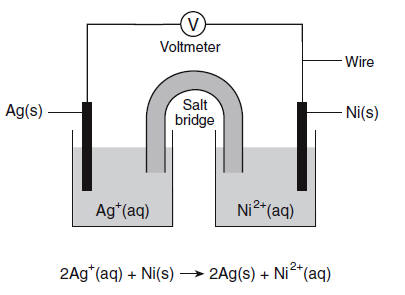
What reaction occurs at the anode?
Ag+/Ag = 0.80V
Ni2+/Ni = -0.25V
Ag+ + e- →Ag
Ag → Ag+ + e-
Ni2+ + 2e- → Ni
Ni → Ni2+ + 2e-
What would be the theoretical cell potential of the previous electrochemical cell?
Ag+/Ag = 0.80V
Ni2+/Ni = -0.25V
1.05V
-1.05V
0.55V
-0.55V