
NEW
Font size
 Worksheets
Nucleic Acids and Inheritance — Worksheet Questions (Grade 11)
Total questions: 59
Worksheet time: 30mins
Which of the following statements describes the process of transformation in bacteria.
A strand of DNA is created from an RNA molecule.
A strand of RNA is created from a DNA molecule.
Bacterial cells are infected by a phage DNA molecule.
External DNA is taken into a cell, becoming part of the cell's genome.
Which of the following characteristics allowed Hershey and Chase to determine whether the genetic material was made of DNA or protein.
DNA contains sulfur, whereas protein does not.
DNA contains phosphorus, whereas protein does not.
DNA contains nitrogen, whereas protein does not.
DNA contains purines, whereas protein includes pyrimidines.
Which of the following investigators was (were) responsible for determining that DNA contains equal amounts of adenine and thymine, and equal amounts of guanine and cytosine.
Alfred Hershey and Martha Chase
Oswald Avery, Maclyn McCarty, and Colin MacLeod
Erwin Chargaff
Matthew Meselson and Franklin Stahl
A sample of double-stranded DNA contains 42% cytosine. Approximately what percent of the nucleotides in this sample will be thymine.
8%
16%
42%
58%
A sample of double-stranded DNA contains 28% thymine. Approximately what percent of the nucleotides in this sample will be guanine.
8%
16%
22%
72%
Which of the following characteristics of DNA allows it to carry a vast amount of hereditary information.
sequence of bases
phosphate-sugar backbones
complementary pairing of bases
antiparallel orientation
Which of the following combinations of base pairs will be found in a molecule of DNA.
A = C
A = G and C = T
A + C = G + T
G + C = T + A
In DNA polymerization, a phosphodiester bond is formed between a phosphate group of the nucleotide being added and which of the following atoms or molecules of the last nucleotide in the polymer.
the 5' phosphate
C6
the 3' OH
a nitrogen from the nitrogen-containing base
Which of the following statements accurately describes differences between DNA replication in prokaryotes and DNA replication in eukaryotes?
Prokaryotic chromosomes have histones, whereas eukaryotic chromosomes do not.
Prokaryotic chromosomes have a single origin of replication, whereas eukaryotic chromosomes have many.
The rate of elongation during DNA replication is slower in prokaryotes than in eukaryotes.
Prokaryotes produce Okazaki fragments during DNA replication, but eukaryotes do not.
DNA strands are antiparallel. Which of the following statements defines "antiparallel"?
The double helix structure of DNA creates nonparallel strands.
A 5' to 3' DNA strand is paired with the 3' to 5' DNA strand.
Hydrogen bonds between base pairs cause DNA strands to cross.
One DNA strand contains bases that complement the bases in the opposite strand.
Radioactive thymine is added to media containing one actively dividing E. coli bacterium. Which of the following outcomes would be seen after a single cell division?
One of the daughter cells, but not the other, would have radioactive DNA.
Neither of the two daughter cells would be radioactive.
All four bases of the DNA would be radioactive.
DNA in both daughter cells would be radioactive.
In E. coli, a mutation in a gene called dnaB prevents the helicase from binding at the origin of replication. Which of the following events would you expect to occur as a result of this mutation?
Additional proofreading will occur.
No replication fork will be formed.
Replication will occur via RNA polymerase alone.
Replication will require a DNA template from another source.
In E. coli, which enzyme catalyzes the elongation of a new DNA strand in the 5' → 3' direction?
primase
DNA ligase
DNA polymerase III
helicase
In bacteria, which of the following proteins is responsible for removing nucleotides from the RNA primer that is used for initiation DNA synthesis?
Primase
DNA pol I
DNA pol III
DNA ligase
Which answer best describes the role of telomerase in replicating the ends of linear chromosomes?
It adds a 5' cap structure to the chromosome ends that resists degradation by nucleases.
It causes specific double-strand DNA breaks that result in blunt ends on both strands.
It catalyzes the lengthening of telomeres, compensating for the shortening that could occur during replication without telomerase activity.
It adds numerous GC pairs, which resist hydrolysis and maintain chromosome integrity.
The sequence of nucleotides below is present at a DNA location where the chain opens to form a replication fork: 3' C C T A G G C T G C A A T C C 5' An RNA primer is formed starting at the underlined T (T) of the template. Which of the following represents the primer sequence?
5' A G C C U A G G 3'
5' A C C T T A G G 3'
5' A C G U U A G G 3'
5' A G C C T A G G 3'
Which list provides the correct enzyme order required for nucleotide excision repair of a thymine dimer?
nuclease, DNA polymerase, RNA primase
helicase, DNA polymerase, DNA ligase
DNA ligase, nuclease, helicase
nuclease, DNA polymerase, DNA ligase
Which of the following is a reason that the low error rate of DNA replication is important to evolution?
Replication with a high error rate is likely to kill the cell.
Fixing replication errors provides a cellular role for mismatch repair enzymes.
Rare errors are the source of variation.
Most mutations have no effect on phenotype.
In bacteria, what is the function of DNA polymerase III?
to unwind the DNA helix during replication
to seal together the broken ends of DNA strands
to add nucleotides to the 3' end of a growing DNA strand
to degrade damaged DNA molecules
Which of the following statements correctly describes the difference between ATP used in metabolism and the nucleotides used as a building block during DNA synthesis?
The nucleotides have the sugar deoxyribose; ATP has the sugar ribose.
The nucleotides have two phosphate groups; ATP has three phosphate groups.
ATP contains three high-energy bonds; the nucleotides have two.
ATP is found only in human cells; the nucleotides are found in all animal and plant cells.
Which of the following statements correctly describes the difference between the leading and the lagging strands of DNA in DNA replication?
The leading strand is synthesized in the same direction as the movement of the replication fork, and the lagging strand is synthesized in the opposite direction.
The leading strand is synthesized by adding nucleotides to the 3' end of the growing strand, and the lagging strand is synthesized by adding nucleotides to the 5' end.
The lagging strand is synthesized continuously, whereas the leading strand is synthesized in short fragments that are ultimately stitched together.
The leading strand is synthesized at twice the rate of the lagging strand.
Which of the following is a reason that a new DNA strand elongates only in the 5' to 3' direction during DNA replication?
DNA polymerase begins adding nucleotides at the 3' end of the template.
Single stranded binding protein stabilizes DNA by blocking access to the 5' end.
Replication must progress toward the replication fork.
Dehydration reactions require a free -OH group.
What is the function of the enzyme topoisomerase in DNA replication?
relieving strain in the DNA ahead of the replication fork caused by the untwisting of the double helix
detecting the shape of the template base's surface to help recruit the appropriate nucleotide to pair
reattaching the hydrogen bonds between the base pairs in the double helix
joining DNA primers using the parental DNA strand as a template
What is the role of DNA ligase in the elongation of the lagging strand during DNA replication?
It synthesizes RNA nucleotides to make a primer.
It joins Okazaki fragments together.
It unwinds the parental double helix.
It stabilizes the unwound parental DNA.
Which of the following types of molecules help to hold the DNA strands apart while they are being replicated?
primase
ligase
DNA polymerase
single-strand DNA binding proteins
Exposure to UV radiation in sunlight causes DNA changes in skin cells. Why are these changes more harmful when they occur in an individual with xeroderma pigmentosum (XP) than in an individual who does not have this disorder?
XP individual's DNA replication machinery incorporates more incorrect nucleotides in new DNA strands than occur in non-XP individuals.
Compared to XP individuals, non-XP individuals produce more UV protecting pigments.
XP individuals have significantly more thymine's in their DNA than non-XP individuals do.
Compared to XP individuals, non-XP individuals have more effective nucleotide excision repair enzymes.
A replication error results in a zygote that has inactive telomerase, which of the following characteristics would you expect to see in the organism that develops?
a high probability of somatic cells becoming cancerous
an inability to produce Okazaki fragments
an inability to repair thymine dimers
a reduction in chromosome length in gametes
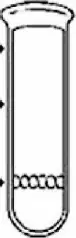
Use the figure to answer the following question. In the late 1950s, Meselson and Stahl grew bacteria in a medium containing "heavy" (radioactive) nitrogen (15N) and then transferred them to a medium containing 14N (non-radioactive). Which of the results in the figure would be expected after one round of DNA replication in the presence of 14N?
A
B
C
D
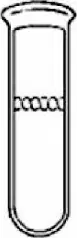
Use the figure to answer the following question. A space probe returns with a culture of a microorganism found on a distant planet. Analysis shows that it is a carbon-based life-form that has DNA. You grow the cells in "heavy" (radioactive) nitrogen (15N) for several generations and then transfer them to 14N medium. Which pattern in the figure would you expect if the DNA was replicated in a conservative manner?
A
B
C
D
DNA is isolated from bacteria undergoing DNA replication. After heat treatment to disrupt hydrogen bonds the DNA is centrifuged and it separates into two classes. One class of DNA includes very large molecules (thousands or even millions of nucleotides long), and the other includes short stretches of DNA (several hundred to a few thousand nucleotides in length). Which types of DNA do the two classes most likely represent?
leading strands and Okazaki fragments
lagging strands and Okazaki fragments
Okazaki fragments and Origin of replication
leading strands and fragments generated due to replication errors
Within a double-stranded DNA molecule, if adenine forms hydrogen bonds with thymine, and cytosine forms hydrogen bonds with guanine what consequence in the structure of the DNA?
It allows variable width of the double helix.
It permits complementary base pairing.
It determines the tertiary structure of a DNA molecule.
It determines the type of protein produced.
Semiconservative replication involves a template. Which of the following best describes the template molecule?
single-stranded binding proteins
DNA polymerase
one strand of the DNA molecule
an RNA molecule
After DNA replication, the resulting daughter DNA double helix contains one strand of the original parental DNA and one new strand. What is the explanation for this phenomenon?
DNA replication is semiconservative.
DNA replication is conservative.
DNA replication is not conservative.
RNA synthesis is conservative.
Who performed classic experiments that supported the semiconservative model of DNA replication?
Watson and Crick
Meselson and Stahl
Hershey and Chase
Franklin and Wilkins
What catalyzes the formation of phosphodiester bonds between a DNA strand and a new nucleotide being added during DNA replication?
Primase
DNA polymerase
ATP
Helicase
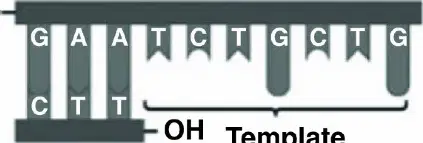
Use the figure to answer the following question. Referring to the figure, what bases will be added as DNA replication proceeds on the bottom strand?
5' C, A, G, C, A, G, A 3'
3' T, C, T, G, C, T, G 5'
5' A, G, A, C, G, A, C 3'
3' G, T, C, G, T, C, T 5'
Which of the following statements correctly describes the difference between the leading strand and the lagging strand in DNA replication?
The leading strand is synthesized in the 3'→ 5' direction in a discontinuous fashion, while the lagging strand is synthesized in the 5'→ 3' direction in a continuous fashion.
The leading strand is synthesized continuously in the 5'→ 3' direction, while the lagging strand is synthesized discontinuously in the 5'→ 3' direction.
The leading strand requires an RNA primer, whereas the lagging strand does not.
There are different DNA polymerases involved in elongation of the leading strand and the lagging strand.
What are telomeres?
the structures that hold two sister chromatids together
enzymes that elongate the DNA strand during replication
the sites of origin of DNA replication
the ends of linear chromosomes
Telomere shortening puts a limit on the number of times a cell can divide. Research has shown that telomerase can extend the life span of cultured human cells. Which of the following best explains the effect of telomerase on cellular aging?
Telomerase will speed up the rate of cell proliferation.
Telomerase can eliminate telomere shortening and slows aging.
Telomerase shortens telomeres, which delays cellular aging.
Telomerase would have no effect on cellular aging.
Which of the following types of cells are affected most by telomere shortening?
only prokaryotic cells
only eukaryotic cells
only plant cells
only animal cells
Which of the following is most likely to result from reduced or very little active telomerase activity?
Cells may become cancerous.
Telomere lengthens in germ cells.
Cells age and begin to lose function.
Cells maintain normal functioning.
Researchers found a strain of bacteria that had mutation rates one hundred times higher than normal. Which of the following statements correctly describes the most likely cause of these results?
The single-strand binding proteins were malfunctioning during DNA replication.
There were one or more base pair mismatches in the RNA primer.
The proofreading mechanism of DNA polymerase was not working properly.
The DNA polymerase was unable to add bases to the growing nucleic acid chain.
In a healthy eukaryotic cell, the rate of DNA repair is typically equal to the rate of DNA mutation. Which of the following is most likely to result if the rate of repair lags behind the rate of mutation?
the cell can be transformed into a cancerous cell
RNA may be used instead of DNA as inheritance material
DNA replication will proceed more quickly
DNA replication will continue by a new mechanism
In DNA replication in E. coli, the enzyme primase is used to attach a 5 to 10 base ribonucleotide strand complementary to the parental DNA strand. The RNA strand serves as a starting point for the DNA polymerase that replicates the DNA. If a mutation occurred in the primase gene, which of the following results would you expect?
Replication would only occur on the leading strand.
Replication would only occur on the lagging strand.
Replication would not occur on either the leading or lagging strand.
Replication would not be affected as the enzyme primase in involved with RNA synthesis.
The lagging strand is characterized by a series of short segments of DNA (Okazaki fragments) that are joined together to form a finished lagging strand. The experiments that led to the discovery of Okazaki fragments gave evidence for which of the following ideas?
DNA polymerase synthesizes leading and lagging strands during replication only in one direction.
DNA is a polymer consisting of four monomers: adenine, thymine, guanine, and cytosine.
DNA is the genetic material that requires removal of short RNA segments to be functional.
Bacterial replication is fundamentally different from eukaryotic replication.
Which of the following statements accurately describes the structure of a eukaryotic chromosome?
It is composed of a single strand of DNA.
It is constructed as a series of nucleosomes wrapped around two DNA molecules.
It has different numbers of genes in different cell types of an organism.
It is a single linear molecule of double-stranded DNA plus proteins.
Which of the following is most likely to result if a cell is unable to produce histone proteins?
there would be an increase in the amount of DNA produced during replication
the cell's DNA could not be packed into its nucleus
the 30-nm fiber pack more tightly and become thinner than 30 nm
topoisomerases in the 300-nm fiber scaffolding would not need to be as active
Histone proteins contain internal cores that are hydrophobic and surface amino acids that are positively charged. Which of the following characteristics of DNA would best support tight binding between DNA and histones?
the ring structures in DNA bases that disperse charge promote hydrophobic interactions with histone cores
DNA 5' and 3' ends have negative charge responsible for stabilizing interactions with histone surfaces
the DNA backbone has a net negative charge that forms ionic bonds with histones
the 3.4 nm per helical turn in DNA fits around the spherical shape of the histones
Which of the following lists represents the order of increasingly higher levels of organization of chromatin?
nucleosome, 30-nm chromatin fiber, looped domain
looped domain, 30-nm chromatin fiber, nucleosome
nucleosome, looped domain, 30-nm chromatin fiber
30-nm chromatin fiber, nucleosome, looped domain
Which of the following statements correctly describes the structure of chromatin?
Heterochromatin is composed of DNA, whereas euchromatin is made of DNA and RNA.
Both heterochromatin and euchromatin are found in the cytoplasm.
Heterochromatin is highly condensed, whereas euchromatin is less compact.
Euchromatin is not transcribed, whereas heterochromatin is transcribed.
Which of the following structural characteristics is most critical for the association between histones and DNA?
Histones are small proteins.
Histones are highly conserved (that is, histones are very similar in every eukaryote).
There are at least five different histone proteins in every eukaryote.
Histones are positively charged.
In his work with pneumonia-causing bacteria and mice, Griffith found that ________.
the protein coat from pathogenic cells was able to transform nonpathogenic cells
heat-killed pathogenic cells caused pneumonia
some substance from pathogenic cells was transferred to nonpathogenic cells, making them pathogenic
the polysaccharide coat of bacteria caused pneumonia
What is the basis for the difference in how the leading and lagging strands of DNA molecules are synthesized?
The origins of replication occur only at the 5′ end.
Helicases and single-strand binding proteins work at the 5′ end.
DNA polymerase can join new nucleotides only to the 3′ end of a pre-existing strand, and the strands are antiparallel.
DNA ligase works only in the 3′ → 5′ direction.
In analyzing the number of different bases in a DNA sample, which result would be consistent with the base-pairing rules?
A = G
A + G = C + T
A + T = G + C
A = C
The elongation of the leading strand during DNA synthesis ________.
progresses away from the replication fork
occurs in the 3′ 5′ direction
produces Okazaki fragments
depends on the action of DNA polymerase
In a nucleosome, the DNA is wrapped around ________.
histones
ribosomes
polymerase molecules
a thymine dimer
E. coli cells grown on 15N medium are transferred to 14N medium and allowed to grow for two more generations (two rounds of DNA replication). DNA extracted from these cells is centrifuged. What density distribution of DNA would you expect in this experiment?
one high-density and one low-density band
one intermediate-density band
one high-density and one intermediate-density band
one low-density and one intermediate-density band
A student isolates, purifies, and combines in a test tube a variety of molecules needed for DNA replication. When she adds some DNA to the mixture, replication occurs, but each DNA molecule consists of a normal strand paired with numerous segments of DNA a few hundred nucleotides long. What has she probably left out of the mixture?
DNA polymerase
DNA ligase
Okazaki fragments
primase
The spontaneous loss of amino groups from adenine in DNA results in hypoxanthine, an uncommon base, opposite thymine. What combination of proteins could repair such damage?
nuclease, DNA polymerase, DNA ligase
telomerase, primase, DNA polymerase
telomerase, helicase, single-strand binding protein
DNA ligase, replication fork proteins, adenylyl cyclase

