
NEW
Font size
 Worksheets
Properties of Matter and Chemical Bonds
Total questions: 10
Worksheet time: 10mins
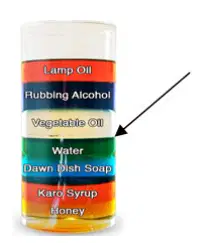
If an object were dropped in the density column below, and it settled between the water & vegetable oil, what can be determined about the object's density?
The object's density is greater than water's and less than vegetable oil's.
The object's density is greater than vegetable oil's and less than water's.
The object's density is 1.0 g/cm3.
Nothing can be determined about the object's density.
Which of the following are physical properties of substances with strong intermolecular forces?
High boiling point and high viscosity
High boiling point and low viscosity
Low boiling point and low viscosity
Low boiling point and high viscosity
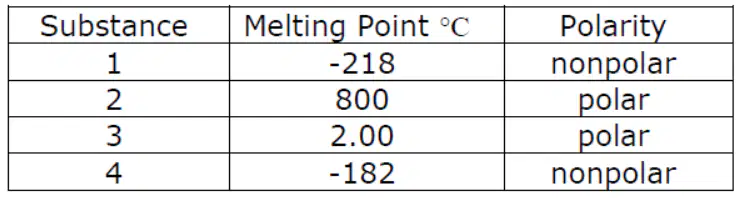
Use the data table to answer the following question. Which substance has the stronger intermolecular forces?
Substance 1
Substance 2
Substance 3
Substance 4

A piece of stone has a mass of 24.595 grams and a volume of 5.34 cm3. What is the density of the stone?
0.217 g/cm3
0.222 g/cm3
4.61 g/cm3
131 g/cm3
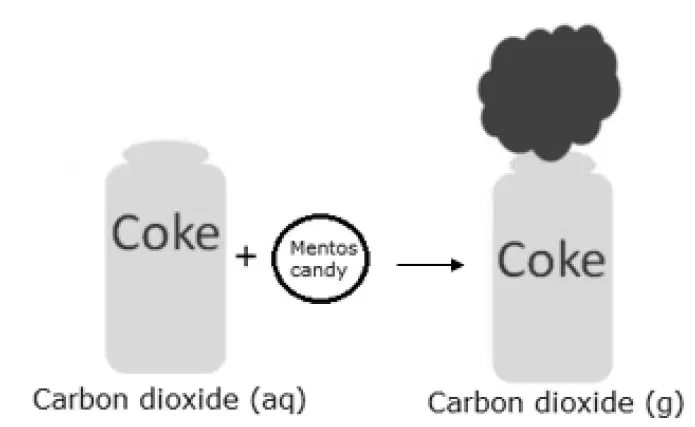
Use the information and picture to answer the following question.
In the science lab, students were asked to make a statement as to whether adding Mentos (candy) to Coke (soda/pop) is a chemical or physical change. When Mentos are placed in Coke, carbon dioxide that is dissolved in the liquid Coke is released as gas.
Physical change, because matter is not lost in the reaction of Coke and Mentos.
Chemical change, because whenever a gas is given off a chemical change has occurred.
Physical change, because no new product is produced, aqueous carbon dioxide is changed to gaseous carbon dioxide.
Chemical change, because the Mentos candy dissolves in the Coke producing a new product.
Which of the following substances would you expect to have the lowest boiling point based on their intermolecular forces?
Substance with ionic bonds
Substance with Van der Waals forces
Substance with dipole-dipole forces
Substance with hydrogen bonding
A liquid has a mass of 50.0 grams and occupies a volume of 62.5 cm3. What is the density of the liquid?
12.5 g/cm3
3.13 g/cm3
1.25 g/cm3
0.80 g/cm3
When salt is dissolved in water, the salt seems to disappear. What type of change has occurred?
Physical change, because the water changes color
Chemical change, because a new substance is formed
Physical change, because the salt can be recovered by evaporation
Chemical change, because the salt reacts with water
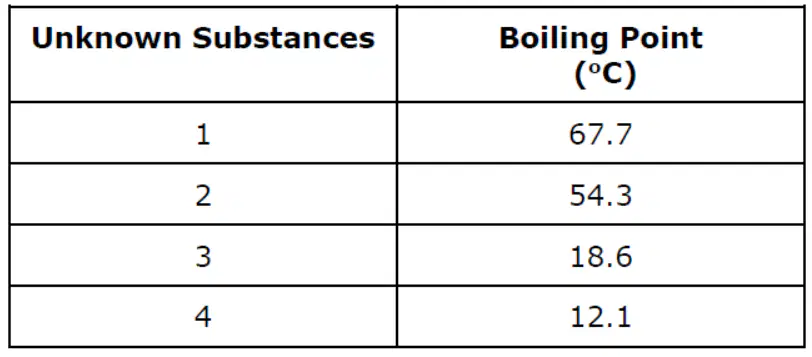
Use the table to answer the following question. Which substances are gases at room temperature (25°C)?
1 & 2 because they have weaker intermolecular forces.
1 & 2 because they have stronger intermolecular forces.
3 & 4 because they have weaker intermolecular forces.
3 & 4 because they have stronger intermolecular forces.


