
 Worksheets
ENDOCRINE SYSTEM
Total questions: 35
Worksheet time: 18mins
Which of the following is used in the treatment of hyperprolactinemia?
Acetyl choline
Dopamine
Dopamine antagonist
Neostigmine
Which of the following is not a characteristic of Pendred syndrome?
Defective organification of iodine
Goiter
Conduction deafness
Sensorineural deafness
Attention deficit hyperactive disorder in children is associated with which hormone resistance?
Growth hormone
Thyroid hormone
Hypothalamic hormones
Cortisol
A 36-year old man came to the OPD for high BP, headache, palpitation. He also has shortness of breath sometimes and heavy sweating. On examination, he has tremors, looks agitated and pale. What is your provisional diagnosis?
Panhypopituitarism
Thyrotoxicosis
Pheochromocytoma
Cushing’s syndrome
Normally the I/G ratio following a balanced diet is approximately (a)
Type-1 DM: Ketoacidic coma :: Type-2 DM: (a)
Deficiency of 21beta-hydroxylase accounts for 90% of the cases of (a)
Regarding the calorigenic effect of thyroid hormone, which of the following statements is true?
One milligram of T3 will produce an excess of 1000 kcal.
One microgram of T4 will produce an excess of 1000 kcal.
One milligram of thyroxine will produce an excess of 1000 kcal.
One milligram of tetraiodothyronine will produce an excess of 1000 cal.
Read the following statements and choose the correct option. Statement A: Certain breast cancers, especially in perimenopausal women are estrogen-dependent. Statement B: Approximately 15–20% of cervical cancers have an amplification of the HER2/neu gene or overexpression of its protein product, leading to increased disease recurrence and worse prognosis. Note: HER2/neu = Human Epidermal growth factor Receptor 2.**
Both are False.
Only A is True.
Only B is True.
Both are True.
A 22-year-old woman and her twin sister both complain of increasing diplopia. She has noted increasing fatigue and a 7-kg weight loss without dieting over the past 3 months. Physical examination shows exophthalmos and weak movement of extraocular muscles. In both, the thyroid gland is diffusely enlarged but painless and has no lymphadenopathy. A fine tremor is observed in her outstretched hands. A radionuclide scan of the thyroid shows a diffuse increase in uptake. The serum is most likely to show the following features on laboratory examination:
Decreased free thyroxine level
Increased triiodothyronine level
Antibodies against TSH receptor
Increased TRH level
A 24-year-old G2, P1 woman is in the early second trimester. She complains of a small amount of vaginal bleeding for the past week and has had marked nausea and vomiting for 3 weeks. On examination, the uterus measures large for dates. An ultrasound examination shows intrauterine contents with a “snowstorm appearance”, without a fetus. The gross appearance of tissue obtained by dilation and curettage shows numerous grape-like vesicles. The substance that is most likely to be greatly increased in the serum of this patient is:
Estradiol
Alpha fetoprotein
Human placental lactogen
Human chorionic gonadotropin
Open (a) is an important indicator of congenital hypothyroidism.
A 10-day-old male neonate presents with vomiting, poor feeding, weight loss, and dehydration. On examination, he has hypotension and hyperpigmentation. Lab reports show hyponatremia, hyperkalemia, and hypoglycemia. External genitalia appear normal.
Blood levels of which steroid precursor is to be checked and what is the probable diagnosis?
17 hydroxypregnenolone congenital adrenal hyperplasia
17 hydroxyprogesterone congenital adrenal hyperplasia
Progesterone Pseudohypoaldosteronism
dehydroepiandrosterone, Pseudohypoaldosteronism
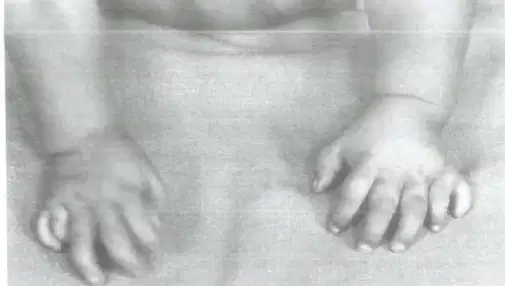
A 12-year-old boy is brought to the pediatric clinic for evaluation of progressive visual impairment. His parents report that he has difficulty seeing at night and has been bumping into objects. On examination, he is obese, has postaxial polydactyly, and mild intellectual disability. Fundoscopy reveals pigmentary retinopathy. Renal ultrasound shows hyperechogenic kidneys with poor corticomedullary differentiation. His younger sibling has similar features.**
Sensorineural hearing loss
Hypogonadism
Café-au-lait spots
Macrocephaly
Which of the following national programmes has no relation to disorders or diseases of the endocrine system?**
IDD
NPPMTBI
NPCDCS
An 18 year old boy is brought to casualty with minor burns following a house fire. He tells that he did not even smell the smoke. There is H/O B/L orchidopexy at age 7. O/E no secondary sexual characters are developed, microphallus, Eunuchoid habitus. Which of the following best explains the underlying defect?
Pituitary gonadotroph cell destruction
Primary testicular failure due to seminiferous tubule dysgenesis
Failure of migration of GnRH-secreting neurons from olfactory placode
Mutation causing androgen receptor insensitivity
Which of the following is not involved in characteristic triad of Wermer's Syndrome?
Parathyroids
Pancreatic islets
Posterior Pituitary
Anterior Pituitary
Which of the following is not used to diagnose diabetic ketoacidosis?
Serum glucose >250 mg/dl
Serum potassium <3.5 mEq/l
Serum by carbonate <15 mEq/l
pH <7.3
Which of the following will not be measured to diagnose metabolic syndrome?
HDL levels
Hip circumference
Blood glucose
Blood pressure
Pioglitazone decreases blood glucose primarily by:
Increasing insulin release from β-cells
Decreasing hepatic gluconeogenesis
Increasing GLUT-4 translocation via PPAR-γ activation
Increasing incretin effect
GLP-1 analogues produce weight loss mainly due to:
Increased insulin release
Delayed gastric emptying & satiety
Increased renal glucose excretion
Direct lipolysis
Which drug causes downregulation of GnRH receptors when given continuously?
Leuprolide
Human chorionic gonadotropin
Gonadorelin
Danazol
A drug used to induce ovulation in infertility by blocking estrogen receptors:
Letrozole
Clomiphene
Bromocriptine
Leuprolide
Select the false statement
Mumps can cause suppurative bilateral parotitis.
Mumps causes epididymo orchitis in postpubertal males.
Mumps may present without parotitis is 10% cases.
Mumps can also cause oophoritis and pancreatitis.
Patient presents with a typhoid-like undulating fever along with epididymo-orchitis and prostatitis. He is a farmer and closely works with cows and goats. Name the most likely causative agent.**
Brucella melitensis
Brucella suis
Rickettsia rickettsi
Borrelia recurrentis
Which of the following structures is most commonly found extending upward from the isthmus of the thyroid gland?
Pyramidal lobe
Zuckerkandl’s tubercle
Inferior thyroid artery
Levator glandulae thyroideae
A 38-year-old man with acute pancreatitis develops transient hyperglycemia. Which anatomical region of the pancreas is most likely affected to cause early endocrine dysfunction?
Head
Neck
Body
Tail
The anterior pituitary (adenohypophysis) develops from which embryological structure?
Diencephalon
Neural crest
Rathke’s pouch
Neuroectoderm
Which of the following schedules of THE DRUGS AND COSMETIC RULES 1945 do hormone preparations come under?
Schedule G
Schedule H
Schedule J
Schedule L
All of the following statements about physiological changes during pregnancy are true, except:
Doubling time of maternal plasma hCG is 1.4-2 days in early pregnancy
There is rise in BMR, and fall in maternal serum Iodine
Progesterone levels are abnormally high during ectopic pregnancy
In pregnancy, there is hyperinsulinemia, particularly during third trimester
Read the following statements about hCG and pick the correct option:
a) Stimulates Leydig cells of male foetus to produce testosterone
b) Has immunosuppressive activity
c) Inhibits both adrenal and placental steroidogenesis
d) Promotes secretion of relaxin and progesterone from corpus luteum
e) hCG levels in blood disappear within 2 days following pregnancy**
a, b, c are correct, and d, e are false
b, d, e are correct, and c, d are false
a, e, are correct, and b, c, d are false
a, b, d are correct and c, e are false
A baby weighing 5.3kg is born to a diabetic mother, with plumpy face, buried eyes and excessive buccal fat. Such a condition of the infant is called (a)
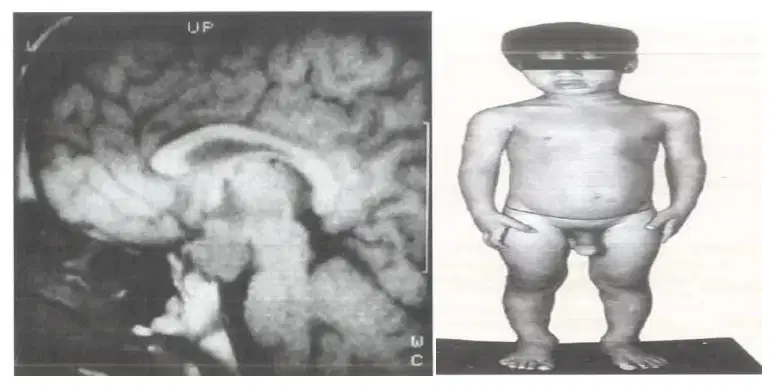
Based on the images given below identify the etiology of the condition
hypothalamic hamartoma
hydrocephalus
tubercular meningitis
head trauma
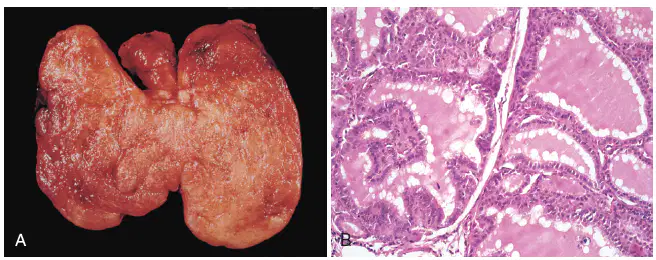
Identify the condition from the given picture
Hashimoto's thyroiditis
graves disease
multinodular goitre
papillary carcinoma of thyroid
Select the drugs that act as tocolytics (uterine relaxants)
a) ritodrine b)halothane c)nifedipine d) quinine
a,b,c
a,b,d
only a
all of the above

