
Font size
 Worksheets
Mitosis Test Review
Total questions: 40
Worksheet time: 42mins
Why do the cells lining the stomach divide more quickly than those in the liver?
They are much smaller cells.
They have fewer chromosomes.
They need much more surface area.
They undergo more wear and tear.
Mitosis is a process by which
DNA is replicated.
a cell’s cytoplasm divides.
cells grow in size.
a cell’s nucleus divides.
A cell that undergoes repeated mitosis without cytokinesis would have
many daughter cells.
fewer chromosomes.
many nuclei.
cancerous properties.
Which of the following statements are typical for cancer cells? Select the three best answers.
They tend to be unspecialized.
They undergo apoptosis.
They may form tumors that metastasize.
They have defective genes.
They use none of the body’s nutrients.
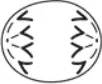
Identify the stage shown in the diagram and select the statement that correctly describes what happens during this stage.
Anaphase — chromosomes line up at the equator of the cell and attach to spindle fibers.
Prophase — the nuclear envelope re-forms and chromosomes decondense.
Anaphase — sister chromatids are pulled apart toward opposite poles.
Telophase — sister chromatids are pulled apart toward opposite poles.
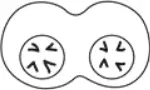
Identify the stage shown in the diagram and select the statement that correctly describes what happens during this stage.
Metaphase — chromosomes line up at the equator of the cell and attach to spindle fibers.
Prophase — the nuclear envelope re-forms and chromosomes decondense.
Anaphase — sister chromatids are separated and pulled to opposite poles.
Telophase — the cell membrane pinches in and two nuclei are present.
There are three checkpoints in the cell cycle. At each checkpoint, the cell determines whether conditions are favorable for division to continue. If conditions are not favorable, the cell cycle stops and causes the cell to die. Which statement describes what would happen if the checkpoints could not function correctly?
The cell would divide without control and lead to the formation of cancer.
The cell would regain control of the cell cycle by using a type of lipid instead of protein.
The cell would divide without control and produce new cells that have functioning checkpoints.
The cell would regain control of the cell cycle by adding an additional checkpoint at cytokinesis.
The cell cycle includes the phases interphase, mitosis, and cytokinesis. Match each cell process to the phase in which the process occurs.
A cell develops and grows.
Interphase
Chromosomes of a cell separate.
Mitosis
Cell membranes form to divide a cell into two cells.
Cytokinesis
What is the end result of the cell cycle?
two identical cells
one identical cell
two different cells
one cell that is unchanged
What phase in the cell cycle does DNA replication happen?
G1
G2
M
S
For what life processes does the body use cells produced by mitosis?
growth of the body
healing and repair of tissues
replacing worn-out cells
producing eggs and sperm
Describe how the body would be affected if mitosis occurred at a slower rate.
growth and tissue repair would slow because new cells are made less often
the body would grow faster because more cells are made
the body would immediately develop cancer from uncontrolled cell division
genetic variation would increase because chromosomes mix more often
What is the end result of the cell cycle and mitosis?
two identical cells
one identical cell
two different cells
one cell that is unchanged
Which three of the following best describe what would happen if mitosis did not take place?
Organisms would be single-celled.
Chromosomes would not duplicate.
Asexual reproduction would not occur.
Body tissues would not repair themselves.
The production of gametes would not occur.
During which phase of mitosis do chromosomes become visible and the nuclear envelope begins to break down?
Prophase
Metaphase
Telophase
Anaphase
Which of the following best describes cytokinesis in animal cells?
Chromosomes condense and become visible
Spindle fibers attach to centromeres
The cytoplasm divides by pinching inwards
The cell wall forms between two nuclei
What would most likely happen if a cell skipped the S phase of the cell cycle?
The cell would divide into four daughter cells
The cell would not replicate its DNA
The cell would not grow in size
The cell would immediately enter mitosis
Which phase of mitosis is characterized by the complete separation of sister chromatids to opposite ends of the cell?
Prophase
Anaphase
Metaphase
Telophase
What is the primary purpose of the G2 phase in the cell cycle?
DNA replication
Cytokinesis
Preparation for mitosis
Cell growth
During which stage of the cell cycle does the cytoplasm divide to form two separate cells?
S phase
Metaphase
Prophase
Cytokinesis
During which phase of the cell cycle does the cell grow and carry out normal functions before DNA replication?
G2 phase
S phase
M phase
G1 phase
What would happen if a cell failed to complete cytokinesis after mitosis?
The cell would become smaller
The cell would skip the next cell cycle
The cell would immediately die
The cell would have two nuclei in one cytoplasm
Which checkpoint in the cell cycle ensures that DNA has been accurately replicated before mitosis begins?
S checkpoint
G1 checkpoint
G2 checkpoint
M checkpoint
_________ _________ are a special type of body cell that can develop into different types of cells.
(a)
Why are your muscle cells different from your nerve cells?
muscle and nerve cells have different DNA, different genes
muscle and nerve cells have the same DNA (same genes) but different genes are turned on
muscle and nerve cells began with the same DNA (same genes) but some different genes were destroyed by each cell type
muscle cells are not different from nerve cells, they are the same
There are about 200 cells in the human body. All these cells have the same DNA. True or False?
True
False
maybe
it depends upon the type
When gene expression occurs
A gene is mutated with either an insertion or deletion
The gene is removed from the genotype in that cell
The gene is passed on to the daughter cells during mitosis
The gene is activated and used in protein synthesis
As a fertilized egg divides, the cells differentiate because they
have different sets of DNA passed on to the daughter cells
have different sets of genes activated in the daughter cells
have mutations that cause different genes to appear in the daughter cells
randomly assort the chromosomes into different daughter cells

What phase of mitosis is depicted in the image?
Prophase
Metaphase
Anaphase
Telophase
Mitosis occurs in eukaryotic cells. Because of mitosis, the daughter cells created are –
less likely to experience mutations
genetically identical to parent cells
genetically unique from each other
more likely to adapt to the environment
DNA replication occurs during the S phase. Before DNA replication can occur, DNA must separate –
behind the deoxyribose sugars
between the nitrogen bases
underneath the phosphate groups
between the carbon atoms
If there are 20 chromosomes in the nucleus before mitosis how many will there be in each new daughter cell after cytokinesis?
20
10
40
200
How many chromosomes to do most human cells have?
2
46
92
Identical to your age
What happens in G1 of Interphase?
The cell is growing
The cell is dividing
The cell is duplicating its' DNA or creating (synthesizing) more DNA

In general, the purpose of a checkpoint in the cell cycle is:
To allow the cell to rest
To check for any errors
To signal cell replication
To signal DNA replication
What happens during cytokinesis?
The nucleus disappears
The cell membrane divides
The DNA divides
Two new nuclei form
Uncontrolled cell division which usually leads to tumors and disease is called:
Metaphase
Cytokinesis
Cancer
Diabetes
Select all stages of interphase?
G1
S
G2
Mitosis

