Worksheets
Electron Configuration and Electronegativity Concepts
Total questions: 28
Worksheet time: 27mins
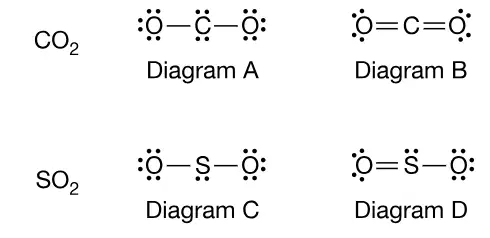
Possible Lewis diagrams for CO₂ and SO₂ are shown. Which of the following statements best describes the accuracy of the diagrams?
Diagrams A and C are correct because all atoms are shown with a complete octet of electrons.
Diagrams B and C are correct because both show the molecules with the correct total number of valence electrons.
Diagrams A and D are correct because both have the correct total number of valence electrons and all atoms are shown with a complete octet of electrons.
Diagrams B and D are correct because both have the correct total number of valence electrons and all atoms are shown with a complete octet of electrons.

A Lewis diagram of ammonia is shown. Which of the following claims about the polarity of the ammonia molecule is correct?
The molecule is polar because there is a concentration of electrons near the nitrogen atom.
The molecule is polar because it contains more hydrogen atoms than nitrogen atoms.
The molecule is nonpolar because there is a lone pair of electrons on the nitrogen atom.
The molecule is nonpolar because the electrons on the nitrogen atom are pulled toward the hydrogen atoms in the molecule.
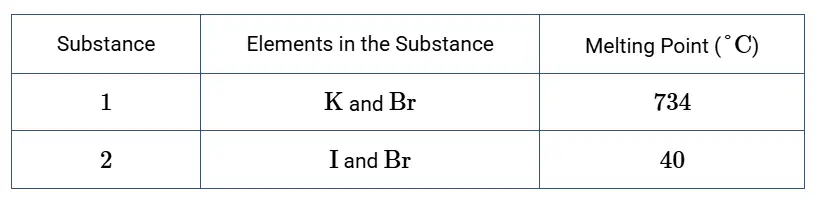
The data in the table show properties of two substances. Which of the following statements identifies the type of bonding in one of the substances and provides correct reasoning?
Substance 1 has covalent bonding between K atoms and the Br atoms because it has a much higher melting point than substance 2 has.
Substance 1 has ionic bonding between the K ions and the Br ions because the elements are in the same period on the periodic table.
Substance 2 has covalent bonding between the I atoms and the Br atoms because it has a much lower melting point than substance 1 has.
Substance 2 has ionic bonding between the I ions and the Br ions because both elements are nonmetals.

A Lewis dot diagram for the amino acid glycine is shown. Four of the atoms are labeled w, x, y, and z. Which atom is in the center of a trigonal planar molecular geometry?
Nw
Cx
Cy
Oz

Answer the following question using the C.E.R. format. Which has a lower ionization energy: lithium or potassium?

Which of the following has a larger radius than zinc?
Gallium
Strontium
Magnesium
Aluminum
As atoms in Group 15 are considered in order from top to bottom, the electronegativity of each successive element...
increases
remains the same
decreases
none of the above

Compare and contrast the movement of atoms going across the periodic table and down the periodic table.

An element has similar chemical properties to oxygen and selenium. It has an atomic number greater than krypton but less than iodine. Use the periodic table to identify the element
selenium
tellurium
polonium
sulfur
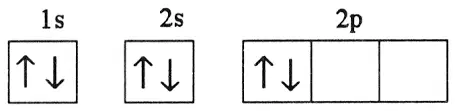
What is incorrect about this orbital diagram?
Both arrows in the 2p box should be pointing up
There is nothing incorrect with this diagram
There should only be 1 arrow in the first 2p box and one in the 2nd 2p box.
All the arrows should be pointing up
Electrons occupy orbitals of lowest energy first. This is part of what electron configuration rule?
Aufbau principle
Hund's rule
Pauli Exclusion principle
Quantum rule
How many electrons does O2- have? Give your claim and reasoning.
Which of the following is the orbital notation for oxygen?
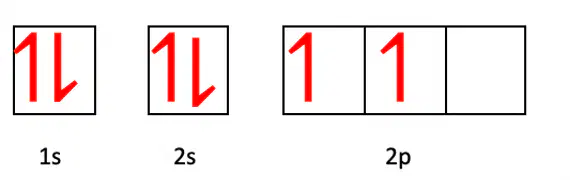
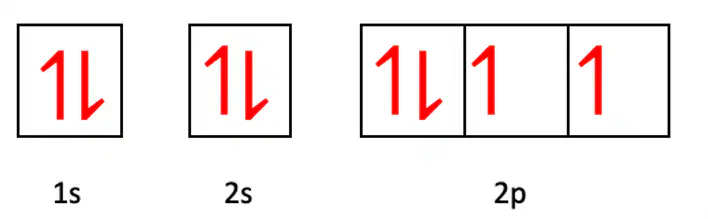
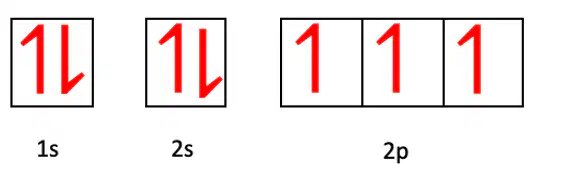
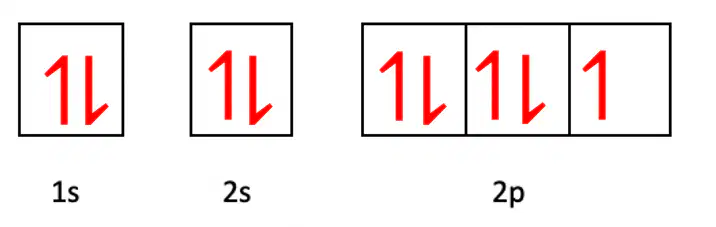
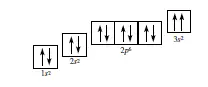
Which guideline, Hund’s rule or the Pauli exclusion principle, is violated in the following orbital diagrams?
pauli's exclusion
hund's rule
aufbau
none of these; the diagram is correct
The electron configuration of an atom is 1s²2s²2p⁶.. How many electrons does this atom have?
3
8
6
10
What is the Noble gas configuration for Si?
[Ar] 2s²2p²
[Ne] 2s² 2p²
[Ne] 3s²3p²
[Ar]3s²3p²
Write the electron configuration for Iodine; (a) the ground state configuration; (b) the Noble gas configuration; (c) valence electron configuration
The s sublevel has_orbitals, while the p sublevel has_orbitals.
1, 3
5, 7
3, 7
1, 5
What atom matches this electron configuration? 1s²2s²2p⁶3s²3p⁶4s²3d¹⁰
(a)
How many lone pairs are on S in H₂S? What shape is the molecule?
none/linear
one/trigonal planar
two/bent
two/tetrahedral
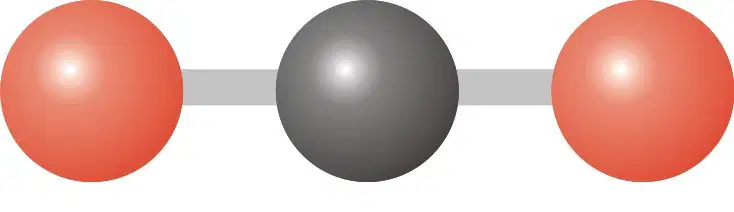
Which molecule would have this molecular geometry?
BF3
PCl₅
CH4
CO2
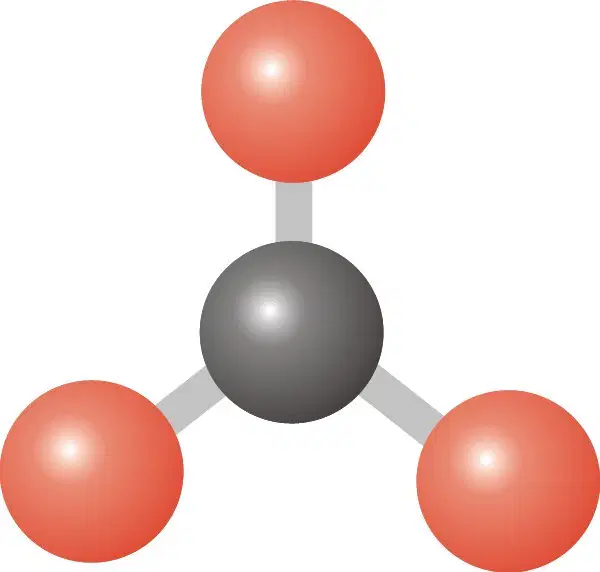
What molecule could this be?
BF3
H2O
CH4
CO2

Provide a written response for your answer to the following question, including molecular geometry and degree angle: What molecular shape is in the structure shown here?
Which of the following is a cation?
Si⁴+
Co
Titanium-48
Ag-
You have an element with an atomic number of 15 and an atomic mass of 32. What isotope is it?
Phosphorus-32
Germanium-15
Phosphorus-15
Germanium-32
Isotopes are atoms of the same element with different numbers of _____ & therefore different _____.
n0; atomic numbers
e-; atomic masses
p+; atomic numbers
n0; atomic masses
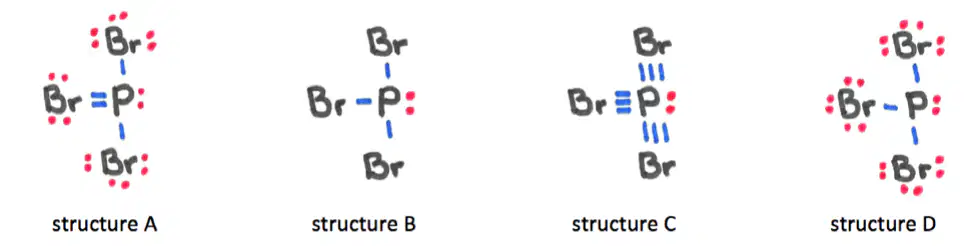
Which of the following is the correct Lewis structure for the compound PBr₃?
A
B
C
D
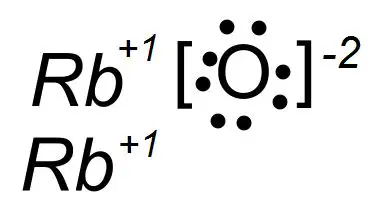
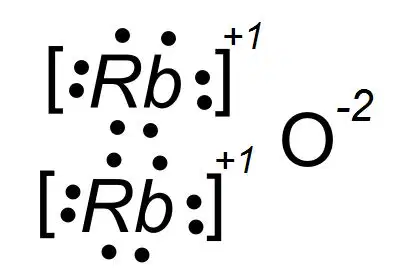
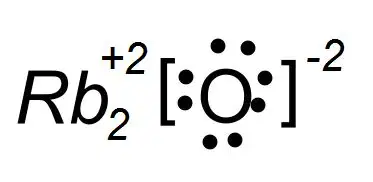
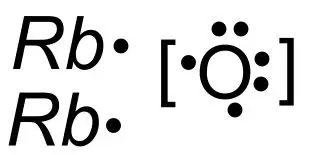
Which of the following is the correct Lewis dot between Rb and O?