
NEW
Font size
 Worksheets
P4_MATTER
Total questions: 12
Worksheet time: 6mins
Which of the following is not Matter?
Bottle
Sand
Light
Air
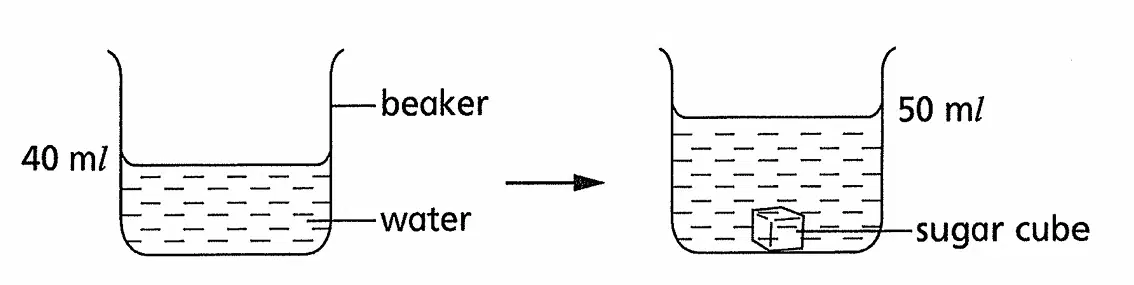
Cavern prepared a beaker containing 40 ml of water. He added a sugar cube into the beaker of water and the water level rose from the 40-ml mark to the 50-ml mark.
Which of the following is the new water level if two more similar sugar cubes were added into the beaker of water?
40 ml
50 ml
60 ml
70 ml
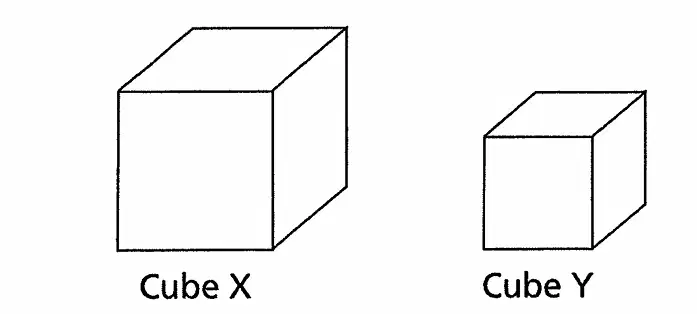
The diagrams below show two cubes.
What can be concluded based on the diagrams?
(1) Cube X has a bigger mass than cube Y.
(2) Cube Y has a bigger mass than cube X.
(3) Cube X has a bigger volume than cube Y.
(4) Cube X occupies a smaller space than cube Y.
Which statements about matter are correct?
A All matter can be seen.
B Matter has mass and volume.
C There are three states of matter.
D The different states of matter have the same properties.
A and D only
B and C only
A, B and C only
A, B, C and D
Which statement about a solid is correct?
A solid can flow.
A solid can be compressed.
A solid has a definite shape.
A solid does not have a definite volume.
Which is/are the property/properties of a liquid?
A Can flow
B Can be compressed
C Has a definite shape
D Has a definite volume
(1) D only
(2) A and D only
(3) B and C only
(4) B and D only
Which statement about matter in the gaseous state is correct?
(1) It can be compressed.
(2) It does not have volume.
(3) It has a definite shape but no definite volume.
(4) It does not have a definite shape but has a definite volume.
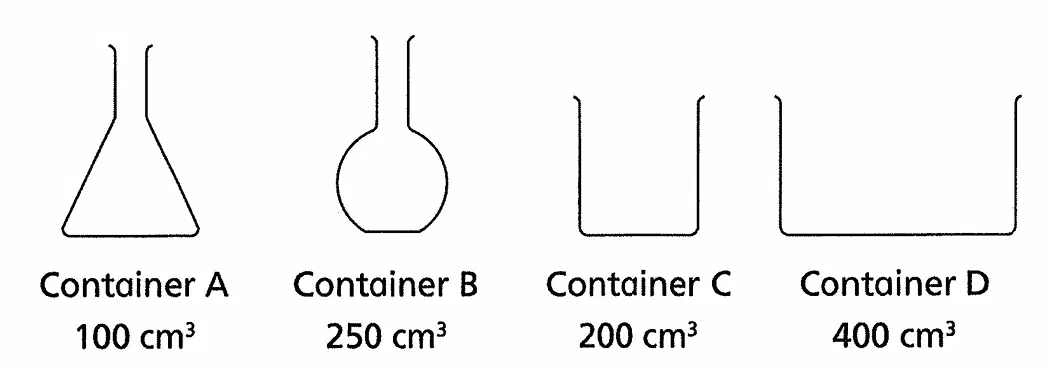
The following diagrams show four different containers and their capacities.
Which container(s) can contain 300 cm³ of water?
D only
A, B and C only
B, C and D only
A, B, C and D
Which is the unit for mass?
(1) Litre
(2) Gram
(3) Metre
(4) Second
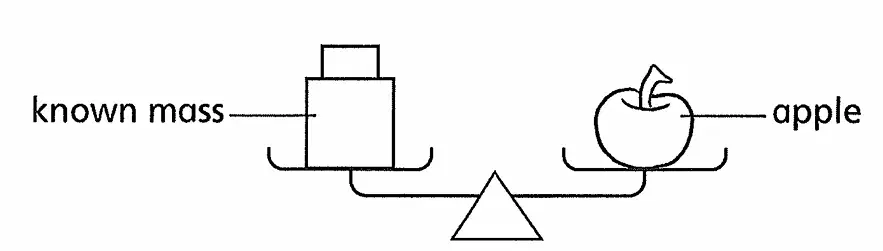
Weiping conducted the experiment as shown below.
What was the aim of his experiment?
To determine the mass of the apple.
To determine the volume of the apple.
To determine the surface area of the apple.
To determine whether the apple can be compressed.
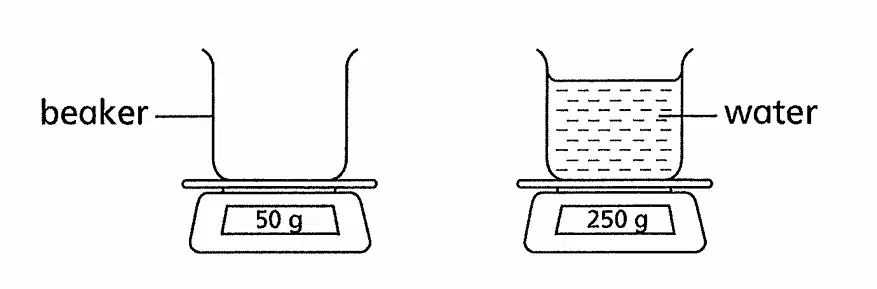
Kumar measured the mass of the beaker and the mass of the same beaker containing water.
What is the mass of the water in the beaker?
50 g
100 g
200 g
250 g
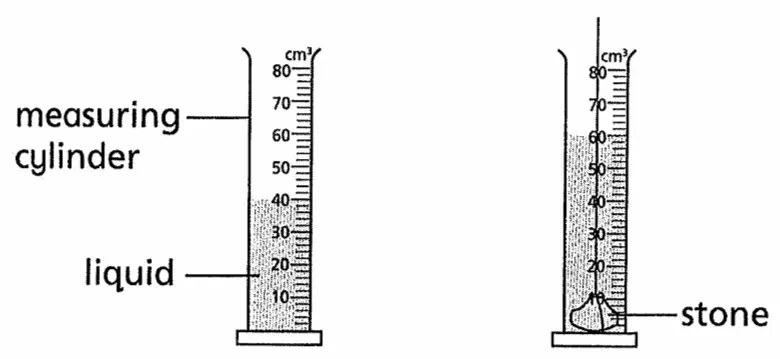
Mandy lowered a stone into a measuring cylinder containing water as shown below. What is the volume of the stone?
20 cm³
30 cm³
40 cm³
60 cm³

