
 Worksheets
9.3: Asian Classical Civilizations Introduction
Total questions: 150
Worksheet time: 1hrs 15mins
Which pair of regions is the focus of Asian Classical Civilizations in this organizer?
India and China
Japan and Korea
Mesopotamia and Egypt
Greece and Rome
According to the organizer, which two categories are used to examine civilizations’ geography?
Human and Physical
Urban and Rural
Coastal and Inland
Polar and Tropical
Which empire leadership is specifically highlighted with a named leader in the organizer?
Maurya Empire
Gupta Empire
Qin Dynasty
Han Dynasty
Which topic is listed for both Indian and Chinese sections in the organizer?
Contributions
Silk Road
Buddhism
Feudalism
In the Chinese section of the organizer, what impact is examined for Han China?
Impact of Confucianism in Han China
Impact of Buddhism in Han China
Impact of Legalism in Han China
Impact of Daoism in Han China
Which two Indian empires are implied as paired in the organizer’s first big idea?
Maurya and Gupta Empires
Mughal and British Empires
Chola and Vijayanagara Empires
Hindu and Buddhist Empires
What is the purpose of the 'Contribution' columns alongside the images in the organizer?
To list key achievements of the featured civilizations or dynasties
To record students’ attendance
To show trade route distances
To calculate population growth
Which dynasty pairing is a big idea in the Chinese section?
Qin and Han Dynasty
Song and Tang Dynasty
Yuan and Ming Dynasty
Zhou and Shang Dynasty
Which leader is associated with the Qin Dynasty as suggested by the organizer’s prompt 'Qin Leader:'?
Ashoka
Shi Huangdi
Kublai Khan
Emperor Wu
Which study component is common to both Indian and Chinese parts of the organizer regarding geography?
Human and Physical geography analysis
Maritime exploration logs
Desertification case studies
Glaciation mapping
The organizer suggests examining factors leading to the growth of which paired empires in India?
Maurya and Gupta
Qin and Han
Mughal and British
Tang and Song
What overarching theme connects the 'Big Ideas' lists in both sections of the organizer?
Understanding civilizations’ contributions and development
Practicing mathematical computations
Learning modern political parties
Studying European colonization
Which civilization’s contributions might include advancements like centralized bureaucracy and standardization, based on typical Qin topics?
Qin China
Gupta India
Han China
Maurya India
Which civilization’s contributions might include achievements such as classical art, literature, and mathematics, consistent with Gupta topics?
Gupta India
Qin China
Han China
Maurya India
Which investigation area is specified for India under geography in the organizer?
Human and Physical features
Only climate zones
Only river systems
Only urban centers
Which investigation area is specified for China under geography in the organizer?
Human and Physical features
Only military forts
Only mountain ranges
Only coastal ports
Which kind of assessment date is referenced at the bottom of the organizer?
India & China Quest Date
European History Exam Date
World War II Test Date
Geography Field Trip Date
Based on the organizer’s structure, what is a likely comparative task students will perform?
Compare contributions of Indian and Chinese classical civilizations
Calculate modern GDP of India and China
Debate current political leaders
Map airline routes between capitals
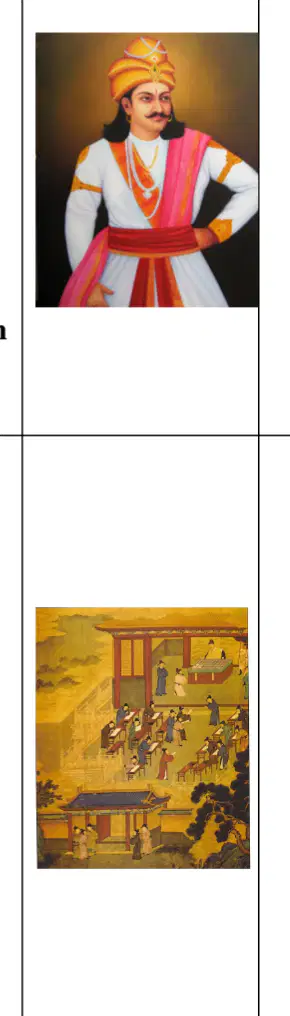
Which image section is aligned with the Indian content in the organizer?
Portrait of an Indian figure in traditional attire
Landscape of the Great Wall
Map of Mediterranean Sea
Greek temple frieze
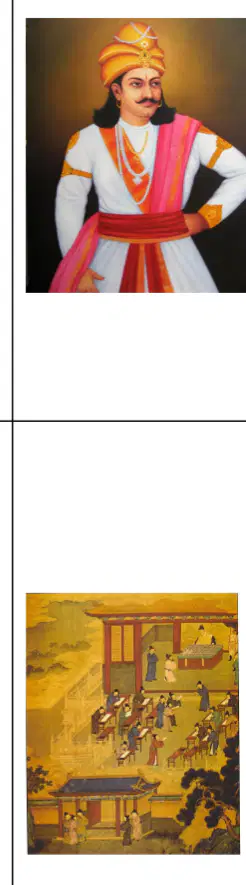
Which image section is aligned with the Chinese content in the organizer?
A court scene painting with figures in a traditional Chinese setting
A Roman legion marching
An African savanna with wildlife
A Viking longship at sea
Which term refers to seasonal wind patterns that bring heavy rains to South Asia, shaping agriculture and trade?
Caste System
Monsoons
Civil service
TerraCotta Army
In ancient India, which structure organized society into hereditary groups with specific roles and rules?
Bureaucracy
Caste System
Confucianism
Taoism
Which empire in India was founded by Chandragupta and later ruled by Ashoka, known for unifying much of the subcontinent?
Gupta Empire
Mauryan Empire
Han Dynasty
Qin Dynasty
Which Indian empire is often associated with a golden age of learning, mathematics, and arts?
Mauryan Empire
Gupta Empire
Qin Dynasty
Han Dynasty
Which belief system from India emphasizes dharma, karma, and the cycle of reincarnation with many deities?
Buddhism
Confucianism
Hinduism
Taoism
Which belief system founded by Siddhartha Gautama teaches the Four Noble Truths and the path to end suffering?
Hinduism
Buddhism
Confucianism
Taoism
Which overland trade network connected China with the Mediterranean, spreading goods like silk and ideas across Eurasia?
Indian Ocean Trade Complex
Silk Roads
Great Wall of China
Civil service
Which Chinese dynasty built the first unified empire, standardized laws and measures, and began the Great Wall project?
Han Dynasty
Gupta Empire
Qin Dynasty
Mauryan Empire
Which Chinese dynasty expanded bureaucracy and promoted Confucian ideals through civil service examinations?
Qin Dynasty
Han Dynasty
Mauryan Empire
Gupta Empire
Which philosophy emphasizes order, filial piety, and moral behavior to maintain social harmony in China?
Confucianism
Taoism
Buddhism
Hinduism
Which term describes an administrative system with appointed officials managing government tasks?
Untouchables
Bureaucracy
Monsoons
TerraCotta Army
In the Indian social hierarchy, which group was considered outside the caste system and faced severe discrimination?
Brahmins
Kshatriyas
Untouchables
Vaishyas
Which trading system relied on monsoon wind patterns to connect East Africa, Arabia, India, and Southeast Asia by sea?
Silk Roads
Indian Ocean Trade Complex
Great Wall of China
Civil service
Which term refers to government jobs obtained through examinations that tested knowledge of Confucian texts in imperial China?
Civil service
Bureaucracy
Caste System
TerraCotta Army
Which massive fortification was expanded to protect northern borders of China from nomadic invasions?
Silk Roads
Great Wall of China
Indian Ocean Trade Complex
TerraCotta Army
Which archaeological discovery includes thousands of life-sized clay soldiers buried with the first emperor of China?
Civil service
TerraCotta Army
Untouchables
Monsoons
Which Chinese philosophy values living in harmony with the natural way (Dao) and minimal interference?
Confucianism
Taoism
Buddhism
Hinduism
Which government model concentrates authority in a central body rather than local or regional power centers?
Centralized Government
Bureaucracy
Civil service
Caste System
Which time span best defines the Classical Era based on the timeline of human history?
10,000 BCE–630 CE
600 BCE–900 CE
476–1500 CE
1400–1800 CE
According to the section’s definition, what major political characteristic distinguished many Classical Era civilizations?
Decentralized tribal leadership
City-states without rulers
A strong, centralized government
Direct democracy in all regions
Which statement describes why Classical Era civilizations were more interconnected than earlier ones?
They avoided contact to preserve traditions
They expanded land empires and relied more on trade networks
They moved populations to isolated rural areas
They banned long-distance travel across seas
Which feature is commonly linked to a civilization’s golden age during the Classical Era?
Widespread famine and population decline
Major contributions to collective learning and lasting ideas
Elimination of trade routes to focus on local production
Permanent military occupation by foreign powers
Based on the timeline, which era follows the Classical Era in sequence?
Ancient History
Post-Classical Era
Early Modern Period
Late Modern Period
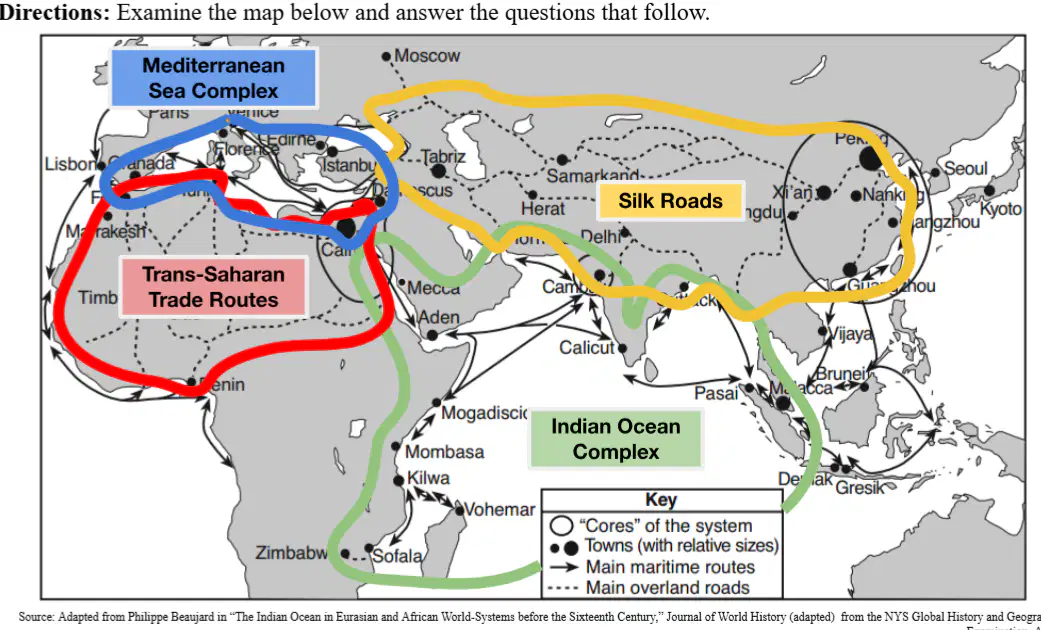
Which trade system is highlighted as a major maritime network connecting regions during the Classical Era?
Trans-Saharan Trade Routes
Silk Roads
Mediterranean Sea Complex
Indian Ocean Complex
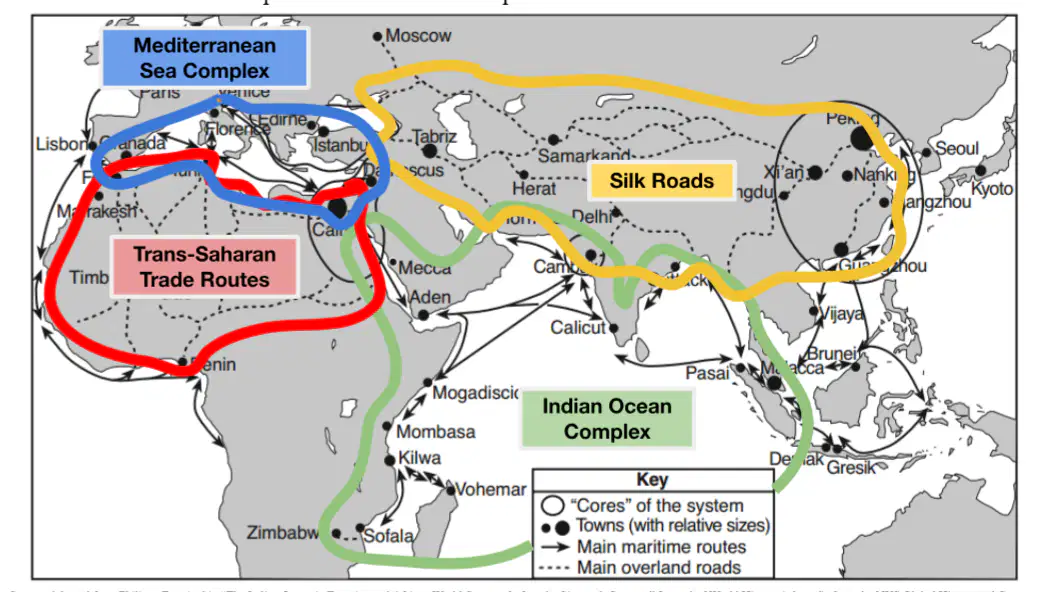
Using the map, which pair of regions is directly connected by the Indian Ocean Complex’s main maritime routes?
East Africa and Southeast Asia
Western Europe and the Andes
Central Asia and Siberia
North America and the Mediterranean
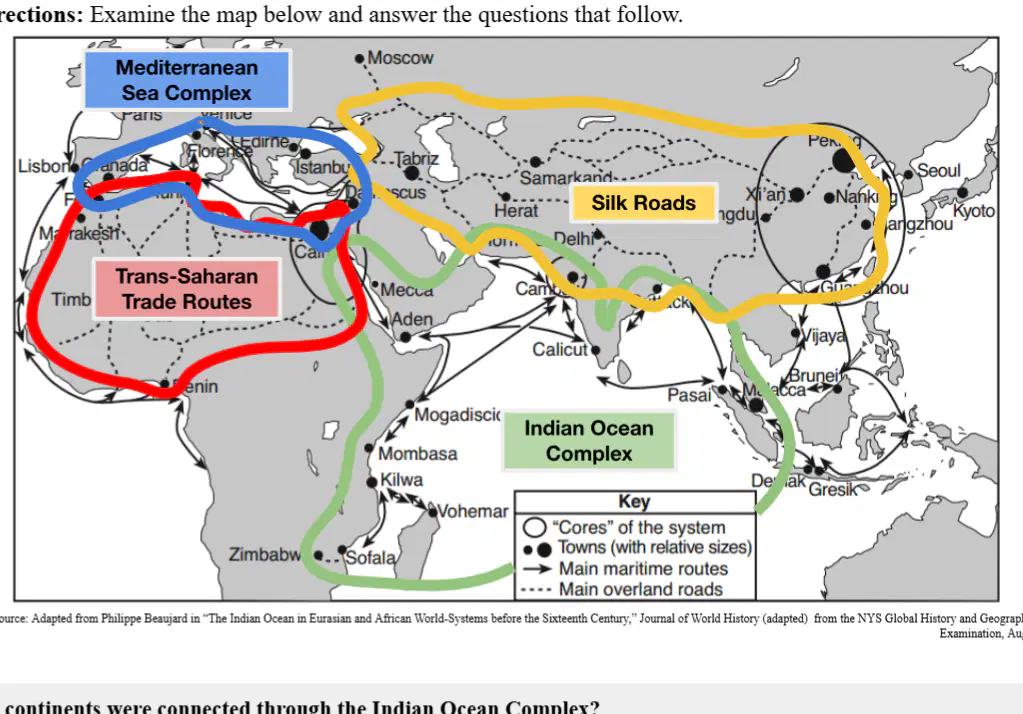
Which statement best distinguishes the Trans-Saharan Trade Routes from the Indian Ocean Complex on the map?
Trans-Saharan routes are sea lanes linking islands
Trans-Saharan routes are overland paths across North Africa, while the Indian Ocean Complex is a maritime network
Both are exclusively river routes crossing the Eurasian steppe
Both operate only within the Mediterranean basin
Which classical civilization is noted for developing ideas and technologies that became important contributions to later civilizations?
India
Rome
Mesopotamia
Mesoamerica
The classical civilizations of India developed __________ networks that enriched their economies and allowed them to exchange goods and technology. Choose the best term to complete the statement.
religious
trade
military
transport
Under __________ rule, the people of India experienced peace and prosperity under a strong government influenced by Hindu ideas.
Maurya
Qin
Han
Zhou
Which pair of empires is credited with producing many advancements in the arts and sciences?
Maurya and Qin
Gupta and Han
Maurya and Gupta
Qin and Zhou
Seasonal winds known as __________ impacted the growing seasons of the Indian subcontinent.
typhoons
trade winds
monsoons
chinooks
Due to its strong roots in __________, Buddhism started in India but spread outside of the subcontinent.
Confucianism
Hinduism
Legalism
Daoism
Which Chinese ruler is associated with major achievements of the Qin Dynasty, including beginning construction of the Great Wall?
Liu Bang
Shi Huangdi
Wudi
Zhou Wenwang
The Qin Dynasty took power from the failing __________ Dynasty and was ruled by Shi Huangdi.
Han
Zhou
Tang
Song
The greatest achievement of the Qin was beginning the construction of the __________.
Grand Canal
Great Wall
Silk Road
Forbidden City
Han China had a strong __________ government that used the civil service as a means of social control.
military
central
feudal
local
The Han Empire grew through __________ expansion and through an extensive trade network, but fell as a result of internal weakness and external invasions.
naval
colonial
military
religious
One lasting impact of the Han was the creation of an effective __________ system for government employment.
law code
taxation
civil service
census
Before the Gupta Dynasty, which ruling family unified India for the first time in 250 BCE and created a strong government in Pataliputra?
Zhou
Mauryan
Han
Gupta
After a brutal war of expansion, which Mauryan emperor converted to Buddhism and created a law code based on Buddhist principles?
Wudi
Shi Huangdi
Ashoka
Chandragupta Maurya
Around 300 CE, which dynasty took control and unified India, reinstating Hinduism as the official religion and creating new caste-based laws?
Maurya
Gupta
Qin
Han
Which philosophy or belief system had a major impact on Han China by promoting respect for hierarchy and the civil service?
Hinduism
Confucianism
Buddhism
Legalism
In Han China, the civil service system primarily aimed to select officials based on __________.
hereditary status
military rank
merit and examinations
wealth
Which geographic factor most directly influenced agriculture in India by determining wet and dry seasons?
Mountain rain shadows
Monsoon winds
River floods from the Nile
Ocean currents of the Atlantic
According to the passage, which period marks the first confirmed permanent settlements of humans in India and the emergence of the Indus River Valley Civilization?
Vedic Period (1500–320 BCE)
Maurya Empire (321–185 BCE)
Indus River Valley Civilization (3300–1700 BCE)
Gupta Empire (320–550 CE)
Which pair of cities is identified in the passage as examples of Indus River Valley urban centers noted for grid street patterns and drainage systems?
Pataliputra and Taxila
Harappa and Mohenjo-Daro
Varanasi and Ayodhya
Ujjain and Mathura
What factor led to the abandonment of Indus sites around the middle of the second millennium BCE, according to the passage?
Frequent invasions from the northwest
A severe drought that dried up the Indus River basin
A major earthquake that destroyed most cities
Religious migration to the Ganges plain
Which development is linked in the passage to the Vedic period in India after the fall of the Indus River Valley civilization?
Rise of Buddhism and rejection of Hindu texts
Formation of city-states under the Gupta
Emergence of Hinduism and the composition of texts like the Vedas and the Mahabharata (including the Bhagavad Gita)
Unification of India under the Maurya Empire
Which statement best describes the Maurya Empire as presented in the passage?
It existed mainly as small, independent tribes along the Ganges River.
It unified much of India in 320 BCE and later embraced Buddhism.
It was confined to the Indus basin and ended with the drying of the river.
It was founded by Siddhartha Gautama and centered on religious reform.
According to the passage, what distinguishes Buddhism’s origin and its relationship to Hinduism?
It originated in the Indus Valley and fully accepts all Hindu beliefs.
It was founded by Siddhartha Gautama in 537 BCE and rejects many of Hinduism’s most important beliefs.
It was composed during the Vedic period and includes the Bhagavad Gita.
It began under the Gupta Empire and emphasizes the Vedas.
According to the introduction, where did Hinduism originate and how did it develop over time?
In Mesopotamia, created by a single founder in a short period
In the Indus River Valley of India, growing through contributions of many people over thousands of years
In the Himalayan mountains, formed by a royal decree during one century
In Southeast Asia, spread from one author’s teachings collected in a single year
Which sacred texts are identified as central to Hinduism?
The Torah
The Tripitaka
The Vedas
The Analects
In Hindu thought, what is Brahman described as in relation to the many gods?
A separate god competing with others
The universal reality of which many gods are different forms
A minor deity of fortune
A title given only to priests
Which pair correctly matches each deity with the role stated in the material?
Vishnu — Destroyer; Shiva — Preserver
Shiva — God of Good Fortune; Ganesha — Destroyer
Ganesha — Preserver; Vishnu — God of Good Fortune
Vishnu — Preserver; Shiva — Destroyer
Which statement about Hinduism’s deities is supported by the material?
Hinduism recognizes only three deities
Hinduism includes more than 33,000 deities, each with stories and responsibilities
Hinduism forbids worshiping any images of gods
All deities are considered identical with no distinct personalities
Based on the key concepts listed, which idea explains moral duty in Hindu life?
Karma
Dharma
Reincarnation
Caste System
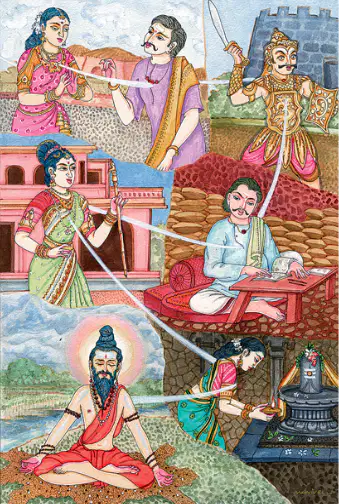
Which concept is most directly linked to the cycle of birth, death, and rebirth shown in the images and text?
Vedas
Reincarnation
Caste System
Ganesha
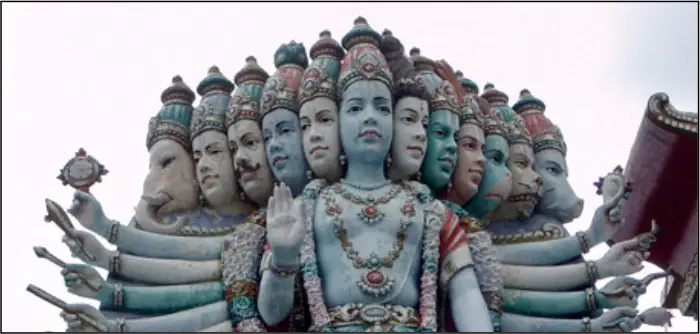
Consider the caption noting Vishnu’s “universal form” in the Bhagavad Gita. What inference best aligns with the text’s explanation of Hindu gods?
The image argues that gods are unrelated to each other
It supports the belief that diverse deities can be manifestations of one ultimate reality
It rejects the idea of Brahman entirely
It shows Vishnu as a historical king rather than a deity
Which statement best defines the Hindu Caste System as described in the material?
A flexible class structure that allows people to change status through education
A rigid social hierarchy that people are born into with no social mobility
A temporary grouping method used only during religious festivals
A democratic ranking system where citizens vote on their caste
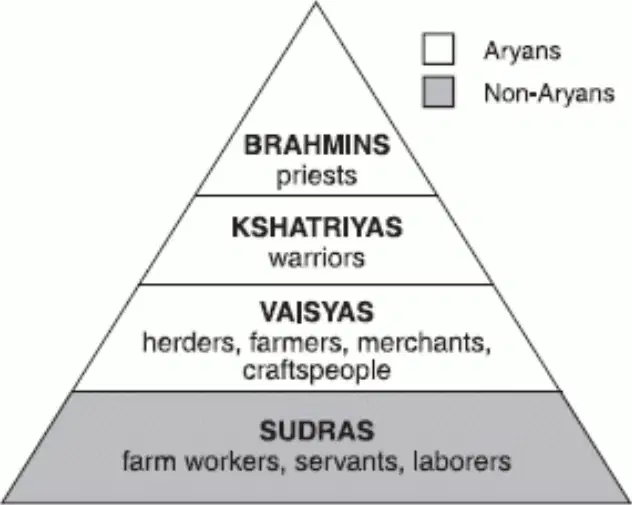
According to the caste pyramid diagram, which group occupies the top level of the hierarchy?
Kshatriyas
Vaisyas
Sudras
Brahmins
Which caste is associated primarily with warriors?
Kshatriyas
Vaisyas
Sudras
Brahmins
Which caste includes herders, farmers, merchants, and craftspeople?
Brahmins
Kshatriyas
Vaisyas
Sudras
Which caste is described as farm workers, servants, and laborers?
Sudras
Brahmins
Kshatriyas
Vaisyas
In Hindu belief, what term describes the cycle of birth, death, and rebirth?
Dharma
Karma
Reincarnation
Moksha
What is the Hindu concept of a person’s duty and responsibilities determined by their caste?
Karma
Dharma
Moksha
Dalit
In the fill‑in passage’s word bank context, what is the ultimate goal of life described as “union with Brahman”?
Karma
Dharma
Moksha
Reincarnation
According to the passage, if a person follows the duties of their caste, what do they gain?
Bad karma
Social mobility
Good karma
Immediate moksha
Based on the word bank and paragraph, what term refers to those considered outside the caste system and responsible for “unclean” work?
Vaisyas
Sudras
Untouchables (Dalit)
Kshatriyas
Which statement aligns with the text’s explanation of karma?
Karma is a set of rituals performed by priests
Karma is the belief that actions affect one’s future rebirths
Karma means the same as dharma in all contexts
Karma guarantees immediate social mobility in this life
According to the social order description, why is the caste system called “rigid”?
Because castes change every decade
Because you cannot leave the caste you are born into
Because people vote annually to determine castes
Because occupations are random
Which factor does the caste system determine according to the diagram text?
Only religious practices
Your job, where you live, and who you can associate with
Only military service
Only eligibility for education
Which group is explicitly identified as priests at the top of the caste pyramid?
Sudras
Brahmins
Vaisyas
Untouchables
According to the paragraph, what happens if someone dies with good karma?
They achieve moksha immediately regardless of dharma
They are reborn into a higher caste
They return as the same caste automatically
They become a priest in their next life
Which pair correctly matches caste and typical role as presented?
Kshatriyas—priests
Vaisyas—warriors
Sudras—farm workers, servants, laborers
Brahmins—merchants
Which belief could be used as a form of social control according to the activity prompt on reincarnation?
The idea that reincarnation rewards or punishes behavior through future births
The concept that social mobility is guaranteed through schooling
The belief that caste is determined by voting each year
The notion that dharma has no relation to caste duties
Which statement about Aryans in relation to Hinduism is supported by the material?
Aryans introduced a strict social order that contributed to the caste system
Aryans were a lower caste within India known as Sudras
Aryans rejected the idea of reincarnation
Aryans arrived after Hinduism had disappeared from India
Which statement best describes a common challenge that hindered the territorial expansion of both the Maurya and Gupta empires?
Frequent invasions and strong mountain barriers limited sustained control over distant regions
A lack of cavalry prevented movement across India’s plains
Widespread desertification made agriculture impossible beyond the Ganges
Monsoon rains permanently flooded key trade corridors
Under Maurya rule, which policy most directly transformed society across India?
Centralized administration with standard taxes and law enforcement
Decentralized city-states governed by local merchants
Open borders without taxation to promote migration
Nomadic governance rotating capital every season
Which development is most closely associated with Gupta rule’s impact on Indian society?
A flourishing of arts, science, and literature supported by stable governance
Complete abolition of regional languages to standardize Sanskrit
Isolation from long-distance trade to preserve tradition
Military rule that suppressed urban growth and scholarship
Which idea captures a key impact of Hinduism on Indian society?
Guiding social roles and rituals through dharma and practice
Replacing local customs with a single uniform legal code
Mandating monastic life for all citizens
Eliminating temple traditions in favor of state festivals
Which statement best explains a major impact of Buddhism in India?
Promoting nonviolence and monastic communities that influenced ethics and kingship
Establishing caste-based hereditary priesthood across all regions
Prohibiting trade and travel along major caravan routes
Requiring worship exclusively in household shrines
Indian mathematicians are credited with which contribution that had global impact?
Development of the concept of zero and place-value notation
Invention of Roman numerals for imperial records
Creation of abacus-based tally sticks
First use of lunar calendars in Europe
Which feature best represents a hallmark of Indian architecture during classical periods?
Stone stupas and temple complexes with intricate carvings
Wooden pyramids modeled on Mesopotamian ziggurats
Underground cities used exclusively for storage
Massive brick domes without decorative reliefs
Which literary achievement is commonly linked to India’s cultural impact?
Epic narratives such as the Ramayana and Mahabharata shaping values and identity
Mandatory royal diaries written only in Latin
Travelogues focused on Mediterranean sea routes
Short laws codes replacing oral storytelling
What was the Silk Road in relation to India’s historical context?
A network of overland and maritime trade routes connecting India to Central Asia and beyond
A single paved highway running only within the Ganges plain
An exclusive royal road used solely for military campaigns
A canal system that linked Indian coastal cities internally
How did participation in the Silk Road network benefit India?
Facilitated exchange of goods like textiles and ideas such as religions and mathematics
Limited contact with other regions to maintain isolation
Reduced urban markets by banning foreign merchants
Stopped the spread of technologies by restricting caravans
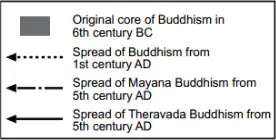
Based on the map titled "The Spread of Buddhism Through the Silk Roads and Indian Ocean Complex," which region is identified as the original core of Buddhism in the 6th century BC?
Lumbini and the surrounding area of northern India/Nepal
The Gobi Desert region of northern China and Mongolia
The islands of Java and Sumatra in Southeast Asia
The Korean Peninsula in East Asia
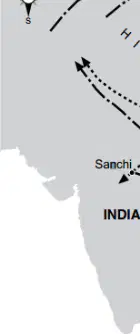
Which trade networks shown in the map most directly facilitated the spread of Buddhism from India to East Asia?
Overland Silk Roads crossing Central Asia
Trans-Saharan caravan routes across North Africa
Atlantic Ocean sea lanes linking Europe and the Americas
Arctic coastal routes along Siberia
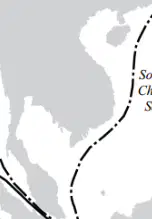
According to the map’s arrows and legend, which branch of Buddhism is shown spreading from the 6th century AD primarily to Southeast Asian islands like Java and Sumatra?
Theravada Buddhism
Mahayana Buddhism
Zen Buddhism
Tibetan Vajrayana Buddhism
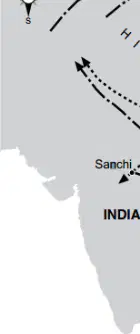
Use evidence from the map to determine the most likely route by which Buddhism reached Sri Lanka.
Maritime routes across the Bay of Bengal within the Indian Ocean Complex
Overland passage through the Himalayas and the Gobi Desert
River transport along the Yangtze to the East China Sea
Overland migration through Korea into Japan
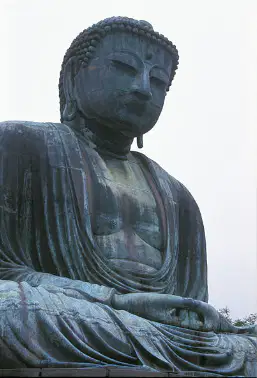
Considering the images of modern-day Buddhist monks and the Great Buddha statue at Kōtoku Temple, which inference best explains Buddhism’s cultural impact across Asia?
Buddhism developed localized practices and monumental art as it spread beyond its Indian origins
Buddhism remained confined to northern India with minimal artistic expression
Buddhism spread only through government edicts and avoided trade networks
Buddhism discouraged monastic communities and public statues
Which statement best identifies Siddhartha Gautama in the development of Buddhism?
He compiled the Tripitaka after centuries of Buddhist practice
He founded Buddhism and became known as the Buddha, the Enlightened One
He served as a Hindu priest who introduced the caste system to Buddhists
He was a Chinese philosopher who taught ancestor worship
According to the instructional text, what is the sacred text of Buddhism?
Vedas
Tripitaka (Three Baskets of Wisdom)
Analects
Quran
Which concept describes the ultimate spiritual goal in Buddhism achieved through enlightenment?
Moksha
Nirvana
Karma
Dharma
Which belief is explicitly rejected by Buddhists according to the material?
Reincarnation
Meditation
The caste system
The Eightfold Path
Which pairing correctly matches a Buddhist symbol with what it represents as described in the material?
Lotus flower—Four Noble Truths
Wheel of Life—cycle of reincarnation and eight spokes for the Eightfold Path
Stupa—Tripitaka scriptures
Fire—Buddha’s birth
Which statement reflects the reason some consider Buddhism a philosophy rather than a religion, according to the text?
It has no sacred writings
It worships thousands of gods
It involves no worship of gods and emphasizes personal determination and meditation
It requires participation in a caste system
Which of the following is one of the Four Noble Truths implied by the teachings of Siddhartha Gautama?
All suffering should be ignored as illusion
Suffering exists and can be reduced by following a path of right actions and thoughts
Only rulers suffer from desire
Suffering ends only through ritual sacrifices
Select the practice most directly connected to Buddhist spiritual progress as highlighted in the material.
Public worship of a creator god
Meditation to control thoughts and seek truth
Animal sacrifice to cleanse karma
Strict obedience to hereditary caste duties
Which statement best compares Buddhism and Hinduism according to the provided summary?
They share no concepts and originate from different regions
They share some concepts due to Buddhism’s origin in a Hindu-dominated area, but Buddhists reject the caste system
Buddhism is older and taught polytheism while Hinduism rejects all gods
Both require worship of thousands of gods
Which item correctly matches an element to the Eightfold Path as depicted in the teaching diagram?
Respect life, say nothing to hurt others, work for the good of others
Perform sacrifices, obey caste rules, worship gods
Accumulate wealth, conquer enemies, expand territory
Recite hymns, build temples, honor ancestors
Which description of reincarnation aligns with the Buddhist context presented?
A single lifetime ending with heaven or hell only
A repeated cycle of rebirth symbolized by the Wheel of Life
A temporary sleep before awakening as the same person
A punishment reserved for those who reject meditation
Why might following the Eightfold Path be described as a staircase for those seeking enlightenment, based on the worksheet framing?
Each step must be learned gradually to progress toward Nirvana
It requires climbing a literal staircase in temples
It emphasizes social rank at each step
It is a random path without order
Which geographic barrier lies to the southwest of China and historically limited interaction with South Asia?
Yellow Sea
Pacific Ocean
Himalayas
Gobi Desert
Which river flows across central China and is historically associated with fertile plains and early settlements?
Yangtze River
Yellow River
Mekong River
Indus River
Which neighboring region to the north of China is historically linked to nomadic groups that the Great Wall sought to deter?
Korea
Japan
Mongolia
Thailand
Based on the map, which body of water borders China to the east?
Atlantic Ocean
Pacific Ocean
Yellow Sea
Arabian Sea
What was the primary purpose for building the Great Wall of China?
To separate trade routes within China
To protect against northern invasions
To control river flooding
To mark provincial boundaries
Which ruler is credited with initiating large sections of the Great Wall during the unification of China?
Emperor Wu of Han
Shi Huang Di of Qin
Emperor Taizong of Tang
Kublai Khan of Yuan
Why was the Great Wall primarily constructed along China’s northern frontier?
The terrain in the south was too mountainous to build
Threats largely came from nomadic groups in the north
Southern rivers provided natural defense
Northern climate preserved the bricks better
In Chinese history, what is a dynasty?
A religious school
A trade network between cities
A ruling family that governs over a period of time
A council of merchants
What term describes the historical pattern in which a dynasty rises, prospers, declines due to problems, and is replaced by a new dynasty?
Mandate of Heaven
Feudal system
Dynastic cycle
Cultural diffusion
Under which dynasty was China unified for the first time in 221 BCE and a centralized government created?
Zhou Dynasty
Qin Dynasty
Han Dynasty
Tang Dynasty
Who was the emperor of the Qin Dynasty known for harsh policies and monumental building projects?
Liu Bang
Shi Huang Di
Wudi
Sun Yat-sen
Which philosophy emphasized strict laws and punishments, contributing to discontent under the Qin?
Confucianism
Daoism
Legalism
Buddhism
After the fall of the Qin, which dynasty organized a bureaucracy to manage government tasks?
Shang Dynasty
Han Dynasty
Song Dynasty
Yuan Dynasty
Which concept best matches Confucianism’s societal influence during the Han?
Harmony with nature and minimal government
Strict enforcement of laws with severe punishments
Filial piety, social order, and moral duty
Expansion of maritime trade only
What was the Silk Road named for?
The stone paving used on the route
The prominence of silk as a highly valued trade good
A river that flowed along the road
The smoothness of travel
How did the Silk Road network benefit China?
It isolated China from foreign ideas
It provided a path only for military campaigns
It facilitated trade and cultural exchange with distant regions
It replaced all internal roads with sea routes
What government practice did the Han develop to select officials based on merit and learning?
Hereditary nobility appointments
Civil service examinations
Guild elections
Military draft tests
Which geographic feature listed is a desert that affected northern China’s development?
Himalayas
Gobi Desert
Yellow Sea
Yangtze River
Which statement best describes Daoism’s influence on society compared to Legalism and Confucianism?
Daoism promoted alignment with the natural way and reduced government interference
Daoism demanded strict punishments for minor crimes
Daoism focused solely on filial piety and hierarchical relationships
Daoism required standardized laws across all provinces
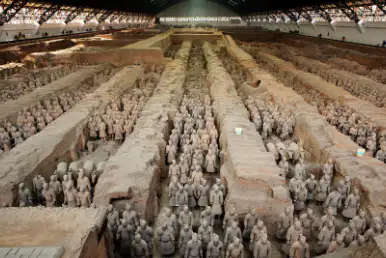
Which image most likely depicts the legacy of the Qin emperor’s burial project?
A network of mountain passes
Terracotta soldiers lined in pits
A fleet of river barges
Silk weaving looms
Which statement best identifies the founder and sacred text of Daoism as presented in the lesson?
Founder: Confucius; Text: Analects
Founder: Lao Tzu (Laozi); Text: Tao-Te Ching (Dao-De-Jing)
Founder: Siddhartha Gautama; Text: Tripitaka
Founder: Han Feizi; Text: Legalist Canon
According to Daoist belief, peace and harmony are achieved primarily through which approach listed in the lesson?
Strict legal codes and centralized authority
Virtue, self-development, meditation, feng shui, and chanting scriptures
Military strength and expansion
Accumulation of wealth and trade monopolies
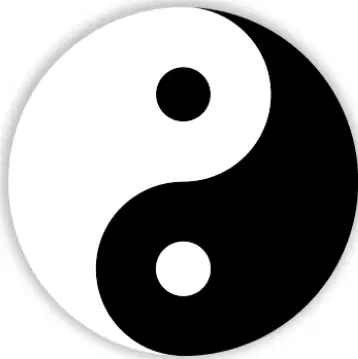
In the Yin and Yang symbol described in the lesson, what do the two halves represent?
Competing political factions in ancient China
Opposing forces such as light and dark, good and evil, that balance each other
Different social classes ranked from most to least respected
The Five Relationships within Confucianism
Which statement reflects a core Daoist idea about human life from the lesson text?
Humans should live simply and in harmony with nature
Humans must follow rigid legal codes to ensure order
Humans should pursue wealth to achieve status
Humans must reject meditation as a distraction
What do Confucians believe will bring peace and harmony in society, according to the lesson?
Withdrawal from society and contemplation of nature
Proper behavior in families guided by the Five Constants, Filial Piety, and the Five Relationships
Economic reforms and market deregulation
Military conquest of neighboring states
Which text contains the teachings of Confucius as identified in the lesson?
Tao-Te Ching
Analects
Book of Changes (I Ching)
Bhagavad Gita
Which option best describes Filial Piety in the context provided?
The rule of law over moral duty
Respect and dutiful behavior toward parents and elders
A trade agreement among city-states
A military alliance between clans

