
 Worksheets
Winter PM2 Civil War-WW1
Total questions: 79
Worksheet time: 1hrs 1mins
1 of 721 of 72 Items
00:25
Question
“But the wickedness which I now begin to expose is immeasurably aggravated by the motive which prompted it. Not in any common lust for power did this uncommon tragedy have its origin. It is the rape of a virgin Territory, compelling it to the hateful embrace of Slavery; and it may be clearly traced to a depraved longing for a new slave State, the hideous offspring of such a crime, in the hope of adding to the power of slavery in the National Government. Yes, sir, when the whole world, alike Christian and Turk, is rising up to condemn this wrong, and to make it a hissing to the nations, here in our Republic, force -- aye, Sir, FORCE, -- has been openly employed in compelling Kansas to this pollution, and all for the sake of political power. There is the simple fact, which you will vainly attempt to deny, but which in itself presents an essential wickedness that makes other public crimes seem like public virtues.”
- Senator Charles Sumner, 1856
The argument presented in the excerpt from the Sumner’s speech has the most in common with which of these situations?
the passage of the Fugitive Slave act of 1850
the motives behind South Carolina’s secession from the Union in 1860
the platform of the southern secessionists known as the “Fire eaters”
the argument against the expansion of slavery in the Wilmot Proviso of 1848
Bleeding Kansas illustrated
that the North and the South were preparing to battle.
that giving the states a choice caused division.
that people can get along and ignore differences.
that the slave rebellion was about to start.
This group wanted equal rights for the freed slaves.
Democrats
Southern Republicans
Northern Democrats
Radical Republicans
This famous court case ruling said that segregation was legal if it was separate but equal.
Brown vs Board of Education
Plessy vs Ferguson
Marbury vs. Madison
State vs Federal
What was the decision in the Supreme Court case Dred Scott v. Sandford?
Dred Scott was given his freedom
Slavery was outlawed
African Americans are not citizens
African Americans had the right to vote

In exchange for allowing California statehood, what did the North agree to do?
expand slavery into Ohio
share the gold from California
capture & return escaped slaves
surrender Fort Sumter
Northerner who moved to the South after the Civil War for economic reasons
Scalawag
Carpet Bagger
Southern White who supported the Republican Party.
Scalawag
Carpet Bagger
What was the Compromise of 1877?
An agreement that it Samuel J. Tilden won, he would maintain federal troops in the south.
An agreement that if Rutherford B. Hayes won, he would remove federal troops from the south.
An economic agreement that would return American economy right and end the panic of 1873.
An agreement between two parties that mutually benefits both.
The 14th Amendment made African Americans...
free slaves
citizens of the U.S.
the right to vote
A law that required blacks to work or face being arrested or forced to work as a servant
Freedmen Bureau
Sharecropping
Black Codes
Compromise of 1877
A terrorist group that prevented blacks from voting
Ku Klux Klan
Freedmen Bureau
Jim Crow Laws
Civil Rights Act of 1866
a farming system that keep blacks poor and uneducated
poll tax
sharecropping
black code
14th Amendment
A government agency that help freedmen during Reconstruction
Black Codes
Freedmen Bureau
New State Constitution
Enforcement Act
The Pawnee tribe is found in the ______.
Southeast Region
Eastern Woodlands
Northwest Coast
Great Plains
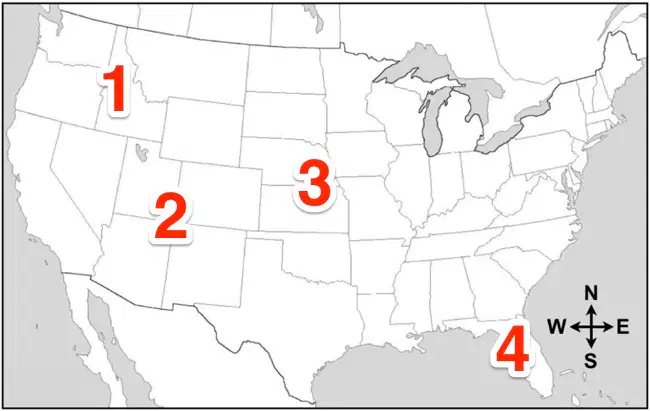
The Pawnee were Native Americans who were classified as Plains Indians. Which number on the map represents the area in which the Pawnee people were originally found?
1
2
3
4
Which word means the growth of an economy based on factories and production?
urbanization
industrialization
immunization
articulation
What is the name of this era, where the wealthy were very, very wealthy, and the poor were very, very poor?
The Gliding Age
The Gelding Age
Westward Expansion
The Gilded Age
Which word means the growth of cities?
Moving
colonization
inflation
urbanization
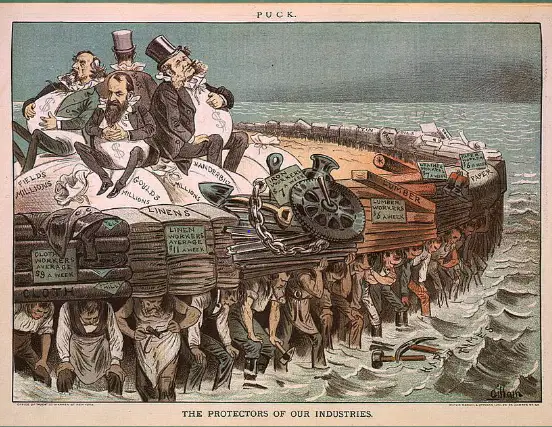
In this cartoon, who does the cartoonist think is the "protector of industry"?
Bosses
Workers
Labor Unions
The Ocean
Skyscrapers were only possible because Andrew Carnegie was able to mass produce (a) and Elisha Otis invented the (b) which made it faster to climb tall buildings.
Which of the following best describes a Labor Union?
A group of women giving birth
A group that works for the rights of workers
A group of working states
A marriage between workers
Laissez-Faire
Capitalism that allows companies to conduct business without government intervention
Theory that taught only the strong survived
Group of businesses owned by competing companies that is controlled by a single group of trustees
Complete control over an industry’s production, wages, and prices
Vertical Integration
Complete control over an industry’s production, wages, and prices
Group of businesses owned by competing companies that is controlled by a single group of trustees
Process in which companies producing similar products merge
Process in which a company buys out its suppliers or owns each step of production & distribution process

Horizontal Integration
Process in which companies producing similar products merge
Process in which a company buys out its suppliers
Group of businesses owned by competing companies that is controlled by a single group of trustees
Complete control over an industry’s production, wages, and prices
Trust
Complete control over an industry’s production, wages, and prices
Group of businesses owned by competing companies that is controlled by a single group of trustees
Capitalism that allows companies to conduct business without government intervention
Theory that taught only the strong survived
Large labor union (700,000) members. Included both skilled and unskilled workers
AFL
CIO
Knights of Labor
Nation Labor union

What was the first major industry of the Industrial Revolution?
textiles (clothing)
food
electronics
shipbuilding
In the economy of the south after the civil war, what set the price/established the price of cotton?
Labor unions and consumers/factories
Decree of government agencies
The interaction of supply that sharecroppers picked and demand from people making clothes or factories
Businesses which bought and sold cotton only


One of the benefits of the transcontinental railroad was that -
farmers were able to sell their goods to distant markets
the business relationship between Mexico and America improved
the cost of traveling across the country increased by fifty percent
businessmen were able to ship goods across the Atlantic Ocean to Europe for cheaper prices
How did they blast holes into the mountains to create tunnels for the trains to pass through?
Carrying dirt in wheelbarrows
Using bombs and gunpowder
Using dynamite and nitroglycerin
Using water pressure
Immigration officers asked immigrants why they had come, where they planned to live, and what they planned do on ____________________.
Ellis Island
Angel Island
both islands
Many Asian immigrants came to ___________________.
Ellis Island
Angel Island
both islands
Many European immigrants came to ____________________.
Ellis Island
Angel Island
both islands
What did most immigrants come to the United States hoping for? (Choose 3)
better opportunities
religious freedom
modern technology
government jobs
fair government

What compartment of the ship did most people travel in?
First Class
Second Class
Third Class
Steerage
What did the Temperance Movement primarily affect?
Slavery laws
Consumption of alcohol
Womens rights
What did the Temperance Movement believe was contributing to the moral decline of the United States?
Drugs
Alcohol
Relgion
All of the above
Which state was the first to create a law surrounding the work of the Temperance Movement?
Massachusetts
Missouri
New York
Maine
A Jewish immigrant and established the American Federation of Labor
Samuel Gompers
Isaac Meyers
Edwin Drake
Thomas Edison
Teddy Roosevelt and the Rough Riders had an important victory in Cuba at-
Pebble Beech
San Juan Hill
Normandy
Havana Harbor

Leading advocate for imperial expansion.
To achieve world power, a country needed a powerful navy.
Wrote The Influence of Sea Power upon History (1890).
Woodrow Wilson
Alfred Thayer Mahan
Teddy Roosevelt
Franklin D. Roosevelt
The Monroe Doctrine wanted European Countries to stay out of the _____.
Western Hemisphere
Eastern Hemisphere
In simple terms, what does the Monroe Doctrine give as a warning to the European countries?
don't try to re-colonize the Americas
stop raiding on our ships
don't try to upset the leaders who are in place in the Americas
if you attack our trading partners, England and France, we will attack you.
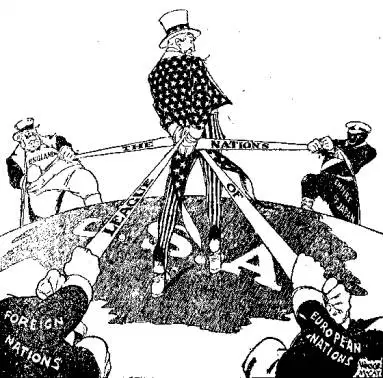
This cartoon is suggesting that the League of Nations would
lead to the defeat of the Central Powers in World War I.
cause the United States to lose World War I.
limit the United States' sovereign powers.
drag the United States into foreign wars.
Which foreign policy allowed for multiple nations to trade with China?
Open Door Policy
Dollar Diplomacy
Moral Diplomacy
Big Stick Policy
Where did the US encourage a revolt in Central America and why?
Colombia; to take control of oil fields
Panama; to build a canal connecting the Atlantic and Pacific Oceans
Bolivia; to elminate the rebel Simon Bolivar
Mexico; to catch "Pancho" Villa
The purchase of which territory was viewed as a folly?
Hawaii
Guam
Alaska
Cuba
Hawaii was taken over by business men lead by...
Sandford B. Dole
Theodore Roosevelt
Grover Cleveland
the Queen of Hawaii

Which exiled Cuban leader raised money in Ybor City and other cities in Florida to organize a new revolt against Spanish rule in Cuba?
Enrique Dupuy de Lome
Vicente Martinez Ybor
Emilio Aguinaldo
Jose Marti
What was the intended purpose of the Open Door Policy?
Develop American-style democratic institutions and practices in China
Prevent Japan and powerful European nations from locking the United States out of trade monopolies in China
Establish a strong American military presence on the Chinese mainland
Support Japanese efforts to industrialize farming and mass production techniques
Who was the leader of Hawaii when the American businesses over threw the government?
Queen Liliokahlani
Sanford Dole
Jose Marti
Emilio Zapata
What 19th-century publisher is famous for the phrase "You furnish the pictures and I'll furnish the war" in 1898?
Joseph Pulitzer
William R. Hearst
Frederick Douglass
James Fenimore Cooper
This was a British Cruise ship (that had American passengers on it) that was torpedoed and sunk by a German submarine.
Titanic
Mississippi
Lusitania
Arkansas

What type of warfare contributed to the stalemate on the Western Front?
guerilla
conventional
trench
submarine
Which country was responsible for the assassination of Archduke Franz Ferdinand, one of the triggers of World War 1?
Germany
France
Russia
The country responsible for the assassination of Archduke Franz Ferdinand was Serbia.
What were the conditions like in the trenches during World War 1?
The conditions in the trenches during World War 1 were extremely harsh, with soldiers facing constant exposure to the elements, unsanitary living conditions, and the constant threat of enemy attacks.
The conditions in the trenches during World War 1 were comfortable and well-maintained
Soldiers in the trenches during World War 1 enjoyed luxurious accommodations
The conditions in the trenches during World War 1 were similar to a vacation resort
Select all that apply: Which of the following are causes of World War I?
Militarism
Alliances
Nationalism
Imperialism
Religion
What is an early name for Post-Traumatic Stress Disorder?
Shocking Disorder
War Trauma
Shell Shock

Laws passed by Congress that made it illegal to criticize the war. Those who participated in anti-war activities faced fines and prison.
War Bonds
Propaganda
Mobilize
Espionage and Sedition Acts
a policy of remaining apart from the affairs or interests of other groups, especially the political affairs of other countries
Isolationism
Intervention
Reparations
Disillusionment

