
 Worksheets
Rehab Unit 2 Fall 25 (musculoskeletal + fractures)
Total questions: 46
Worksheet time: 23mins
Name
Class
Date
1.
1. Which type of muscle is uninucleate and contains no striations?
a)
Skeletal
b)
Smooth
c)
Cardiac
2.
2. Which type of muscle contains intercalated discs?
a)
Skeletal
b)
Smooth
c)
Cardiac
3.
What type of blood would you expect to find in the Left Atrium of the heart?
a)
Oxygenated
b)
Deoxygenated
c)
Option 2
4.
The vessels that carry blood from the heart to the lungs are the
a)
Pulmonary arteries
b)
Pulmonary veins
5.
5. Transfer the force of contraction from cell to cell in cardiac muscle cells.
a)
Desmosomes
b)
Gap Junctions
c)
Intercalated Discs
d)
Pacemaker cells
6.
6. Disorder that affects the heart muscle causing the heart to lose its ability to pump blood efficiently.
a)
Myocardial Infarction
b)
Coronary Artery Disease
c)
Chronic Hypertension
d)
All of the above are correct because they are all cardiomyopathies
7.
7. Which type of muscle can sustain contraction longer?
a)
Skeletal
b)
Smooth
c)
Cardiac
8.
8. Wave-like rhythmic muscle contraction that propels substances along a tubular tract. Name the term and correct type of muscle this happens in.
a)
Peristalsis; skeletal
b)
Peristalsis; smooth
c)
A-fib; cardiac
d)
V-fib; cardiac
9.
10. White skeletal muscle fibers have __________oxygen supply and ___________ quickly.
a)
rich; endure
b)
rich; tire
c)
poor; tire
d)
poor; endure
10.
15. Which of the following is not a function of joints?
a)
Holds bones together
b)
Bears weight
c)
Stores minerals
d)
Movement
11.
19. Injury caused by overstretching or tearing of connective tissue.
a)
Strain
b)
Sprain
c)
Tendonitis
d)
Bursitis
12.
Mature cartilage cells
a)
Osteocytes
b)
Myocytes
c)
Chrondrocytes
d)
Osteoblasts
13.
20. Injury to a tendon
a)
Strain
b)
Sprain
c)
Tendonitis
d)
Bursitis
14.
23. Which of the following is NOT a function of the skeletal system?
a)
Mineral and adipose storage
b)
Hematopoiesis
c)
Immune support
d)
Protection of viseral organs
15.
24. Subdivision of the skeletal system that contains the skull and thoracic cage.
a)
Axial skeleton
b)
Appendicular skeleton
16.
26. Bone is composed of what type of tissue
a)
Epithelial
b)
Nervous
c)
Connective
d)
Muscular
17.
28. Which type of bone is found to have red bone marrow?
a)
Compact
b)
Spongy
18.
29. Lining of the medullary cavity of a long bone.
a)
Periosteum
b)
Endosteum
c)
Epiphysis
d)
Nutrient foramen
19.
30. The correct term for growth plate is
a)
Proximal epiphysis
b)
Epiphyseal line
c)
Epiphyseal plate
d)
Distal epiphysis
20.
In an adult the growth plate has fused and is now known as the
a)
Proximal epiphysis
b)
Epiphyseal line
c)
Epiphyseal plate
d)
Distal epiphysis
21.
33. The endosteum is composed of
a)
Fibrocartilage
b)
Articular cartilage
c)
Connective tissue
d)
Yellow marrow
22.
34. A hole though which blood vessels, nerves, and ligaments pass
a)
Fossa
b)
Foramen
c)
Tuberosity
d)
Tubercle
23.
35. Mature bone cells
a)
Osteoblasts
b)
Osteoclasts
c)
Osteocytes
d)
Lacunae
24.
36. Bone dissolving cells
a)
Osteocytes
b)
Osteoblasts
c)
Osteoclasts
d)
Lacunae
25.
37. Bone building cells
a)
Osteocytes
b)
Osteoblasts
c)
Osteoclasts
d)
Lacunae
26.
Another name for brittle bone disease is
a)
Ricketts
b)
Osteogensis Imperfecta
c)
Osteoporosis
d)
Osteomyelitis
27.
What is crepitus?
a)
An audible crackling, popping or grinding sensation.
b)
A soft tissue swelling caused by fluid buildup in the joints.
c)
A medical term for muscle spasms that occur after an injury.
d)
A condition characterized by the loss of cartilage between bones, leading to joint stiffness.
28.
38. The broken ends of a bone line up and have not moved out of place.
a)
Displaced
b)
Non-displaced
29.
39. FOOSH is an example of this type of fracture.
a)
Transverse
b)
Oblique
c)
Impacted
d)
Segmental
30.
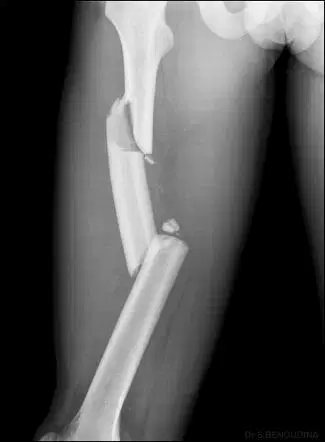
40. Identify
a)
Oblique
b)
Spiral
c)
Impacted
d)
Segmental
31.
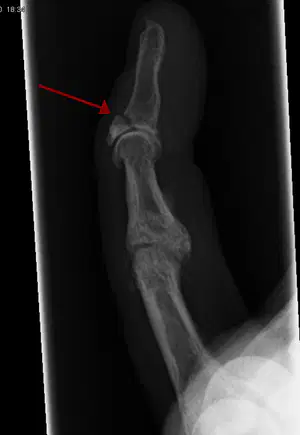
42. Identify
a)
Stress
b)
Oblique
c)
Avulsion
d)
Greenstick
32.
43. Occurs secondarily to cancer
a)
Osteoporosis
b)
Pathological fracture
c)
Nutritional deficiency
d)
Bone infection
33.
Which type of force would result in a FOOSH fracture?
a)
Bending
b)
Compression
c)
Tension
d)
Twisting
34.
Which type of force would result in an avulsion fracture?
a)
Shear
b)
Twisting
c)
Tension
d)
Compression
35.

44. What type of diagnosic imaging is pictured below?
a)
X-ray
b)
CT scan
c)
DEXA
d)
MRI
36.
47. Immobilization is a good treatment option for a comminuted fracture.
a)
True
b)
False
37.
48. A greenstick fracture is considered a __________ fracture.
a)
Complete
b)
Partial
38.
49. One issue with bracing following a compression fracture is the muscles surrounding the fracture could _____________.
a)
Hypertrophy
b)
Atrophy
39.
50. Closed Reduction requires surgery.
a)
True
b)
False
40.
51. This type of open reduction leaves hardware through the skin.
a)
Open reduction internal fixation
b)
Open reduction external fixation
41.
52. An avulsion fracture can occur due to this type of force
a)
Shearing
b)
Axial Loading
c)
Tension
d)
Traumatic
42.
55. After a person is casted for 8 weeks the fractured bone is completely healed.
a)
True
b)
False
43.
56. Why is it important to wear gloves when applying a cast?
a)
PPE-santitation
b)
So you don't mess up your manicure
c)
The casting tape is made of very sticky adhesive
d)
To look like a real provider.
44.
57. What promotes a long bone growing in width?
a)
Epiphyseal Plate
b)
Osteocytes
c)
Osteoblasts/Osteoclasts
d)
Lacunae
45.
58. what is responsible for lengthwise growth of a long bone?
a)
Epiphyseal Plate
b)
Osteocytes
c)
Osteoblasts/Osteoclasts
d)
Lacunae
46.
60. Structure that connects muscle to bone
a)
Ligament
b)
Joint
c)
Tendon
d)
Bursa
100 %

