
 Worksheets
Batch System Stoichiometric Table: Introduction
Total questions: 10
Worksheet time: 5mins
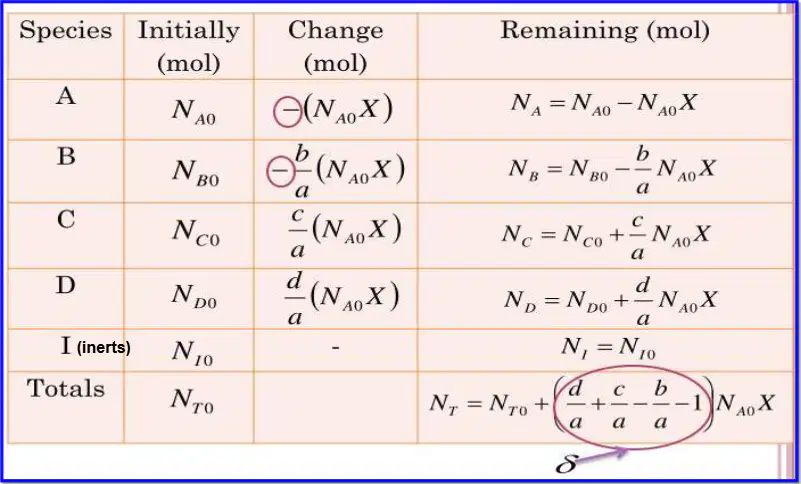
The totals row in the batch stoichiometric table gives N_T = N_T0 + (d/a + c/a − b/a − 1) N_A0 X. Which part represents the delta (δ) parameter that changes total moles?
δ = d/a + c/a − b/a − 1
δ = N_A0 X
δ = N_T0
δ = b/a
In a liquid-phase reaction, the volume stays the same. Which symbol shows the constant volume used here?
V = V0
V = 3V
V = B
V = C
The equation A + (1/3)B → C + (1/3)D is another way to write the reaction. What fraction is with B and D?
1/2
1/3
1/4
3/1
Recall: In the liquid-phase batch system, which symbol represents the initial volume that remains constant?
V0
Z
R
T
Skill/Concept: If CD = CA0[ΘD + (d/a)X] for species D in a liquid batch system, what is the qualitative trend of CD as X increases when ΘD and (d/a) are positive?
CD increases with X
CD decreases with X
CD is independent of X
CD oscillates with X
What does the word "effluent" mean in this lesson?
The leaving flow from the reactor
The entering flow to the reactor
The heat inside the reactor
The color of a liquid
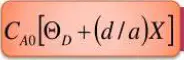
Recall: For species D in the liquid-phase flow system, which expression is presented?
CD = CA0[θD + (d/a)X]
CD = CA0[θD − (d/a)X]
CD = CA0[θC + (d/a)X]
Skill/Concept: The total molar concentration CT for variable volumetric flow reactors is given as FT/ν. Which equation of state links CT to pressure P, gas constant R, temperature T, and compressibility factor Z?
CT = P/(ZRT)
CT = ZR/(PT)
CT = RT/(ZP)
The total molar flow rate F_T is related to conversion X. Which expression connects them as shown?
F_T = F_{T0} + F_{A0} δ X
F_T = F_{T0} − F_{A0} δ X
F_T = F_{T0} × F_{A0} δ X
F_T = F_{A0} + F_{T0} δ X
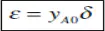
Skill check: If ε = y_{A0} δ and y_{A0} doubles while δ stays the same, what happens to ε?
ε doubles
ε halves
ε stays zero
ε becomes negative