
 Worksheets
Unit 6: International Trade
Total questions: 63
Worksheet time: 32mins
What happens when a nation’s currency depreciates?
Its imports increases.
Its products become more expensive to other nations.
Its products become cheaper to other nations.
Its trade decreases.
A nation has a deficit in its international balance of trade when______________.
government expenditures exceed tax revenues
it buys goods of greater value from other nations that it sells to them
it sells goods of greater value to other nations than it buys from them
it invests more in other countries that it receives from them
Assume that all nations have low tariffs. Each country freely buys and sells to other countries. However, as a result of a rise in nationalism, each country imposes high tariffs. Which of the following would likely occur?
Interdependence between nations will stay the same.
Interdependence between nations will decrease.
Standard of living in both nations will increase.
Interdependence between nations will increase.
What does the process of specialization do for an economy?
It makes it easier to control.
It fosters competition.
It eliminates unemployment.
It makes the economy more efficient.
The United States placed a limit on the number of goods that can be brought into the country for sale. This is an example of ____________________.
an import quota
a tariff
a customs duty
a voluntary restraint
Which of the following is a treaty which eliminated all trade barriers between Canada, Mexico, and the United States?
EU
APEC
OPEC
NAFTA
According to the law of comparative advantage, a nation should ____________________.
specialize and export goods with the lowest average cost
specialize and export goods with the lowest production cost
specialize and export goods with the highest opportunity cost
specialize and export goods with the lowest opportunity cost
Japan now produces over half of the wrist watches available for sale in the United States. Suppose the United States government places a quota on foreign watches. Which of the following would result from change in quota on wrist watches.
The prices of watches will be eliminated.
The price of watches will decrease.
The price of watches will be unchanged.
The price of watches will increase.
What is a tax on imported products called?
A tariff
A quota
A value added tax
An embargo
Which one of the following is an embargo?
A way of raising revenue for the government.
When a prohibition of trade is enacted.
When a tax is placed on an imported good to offset an illegal practice.
When a number limit is placed on an imported good.
Suppose the exchange rate between the United States and Mexico changes from $1 = 10 Peso to $1 = 11 Peso. What most likely would happen to the price of American goods in Mexico?
The will increase.
They will remain the same.
They will decrease.
They could either increase or decrease.
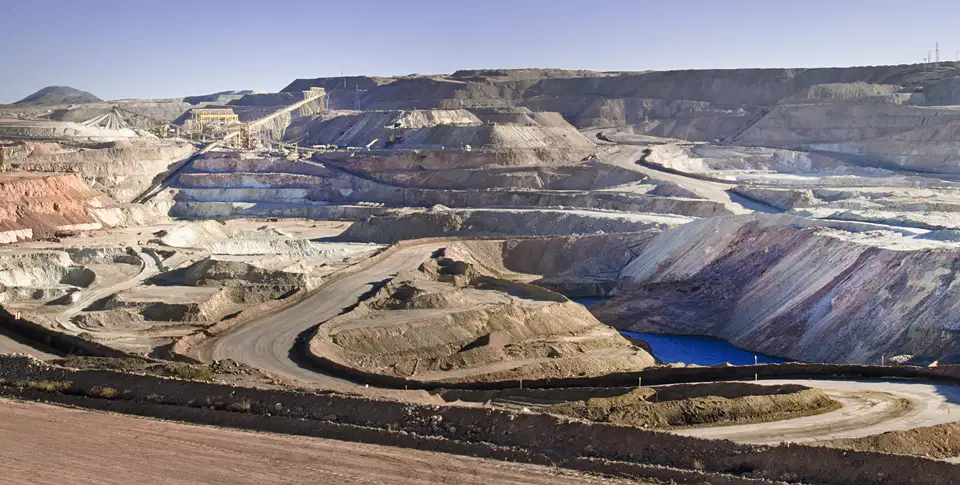
Which factors of production are visible in this photo of a Chilean copper mine?
land and physical capital
land and human capital
labor and physical capital
labor and human capital
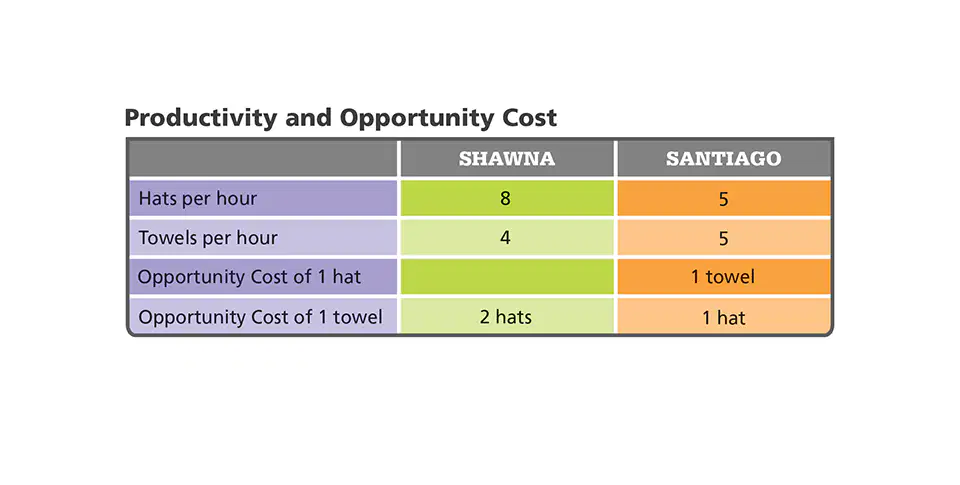
What is Shawna's opportunity cost when she produces 1 hat?
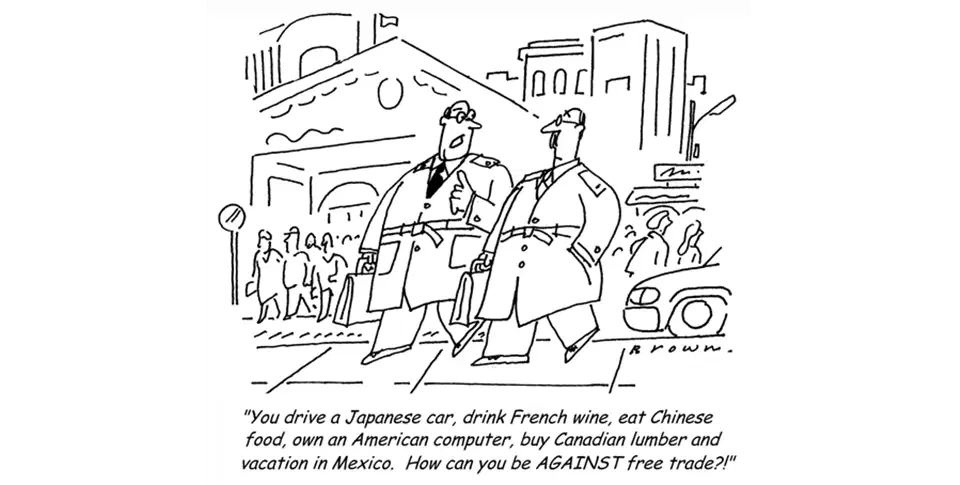
What is this political cartoon pointing out?
People who support free trade are usually businessmen.
People who are against free trade buy expensive imported products.
People who buy imported products generally benefit from free trade.
People who make trips to Mexico are also likely to buy Canadian lumber and drive a Japanese car.
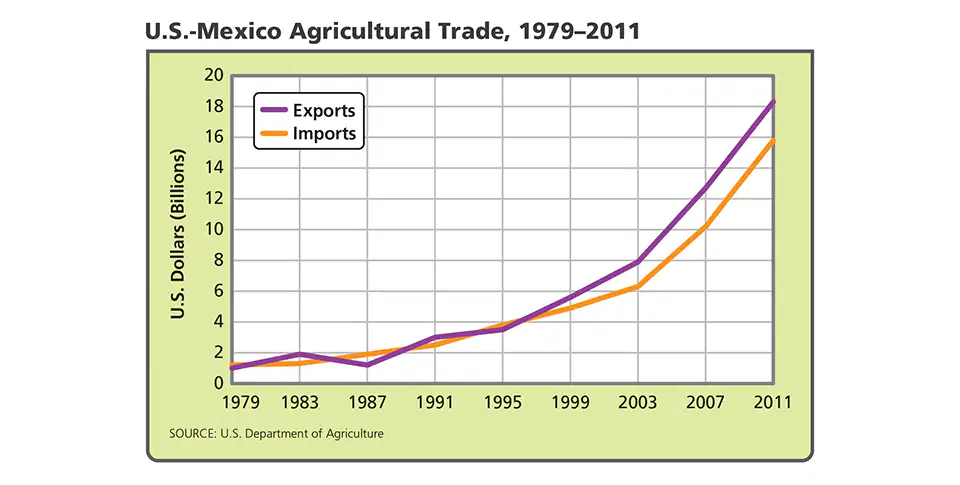
The graph shows U.S. agricultural exports to Mexico and U.S. agricultural imports from Mexico. Which of the following statements does the graph support?
U.S.–Mexican trade has grown, and the U.S. has a positive balance of trade with Mexico.
U.S.–Mexican trade has grown, and the U.S. has a negative balance of trade with Mexico.
U.S. imports have outpaced exports, and the U.S. has a positive balance of trade with Mexico.
U.S. exports have outpaced imports, and the U.S. has a negative balance of trade with Mexico.
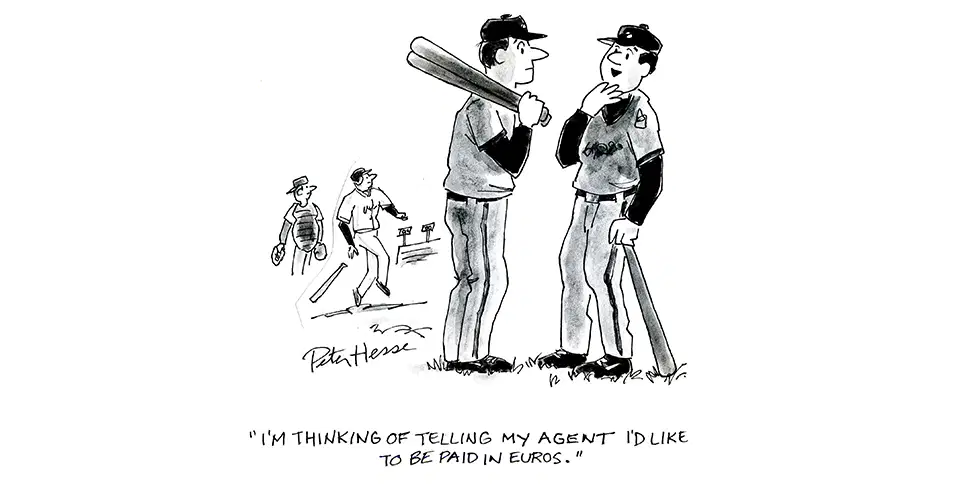
Which of the following conditions would BEST explain the statement of the speaker in this cartoon?
There is a fixed exchange rate for dollars to euros.
There is a flexible exchange rate for dollars to euros.
The dollar is appreciating, and the euro is depreciating.
The euro is appreciating, and the dollar is depreciating.
Why have members of the European Union adopted the euro?
It makes depreciating the currency easier.
It simplifies trade and makes the purchasing of goods in a neighboring country easier.
It limits the use of fixed-rate currencies.
It reduces the likelihood of economic downturns and their effects on countries in the Eurozone.
Which of the following is an indicator that the United States is a developed nation?
It has many natural resources.
It is a representative democracy.
Its population is more than 300 million.
It has a high GDP per capita.
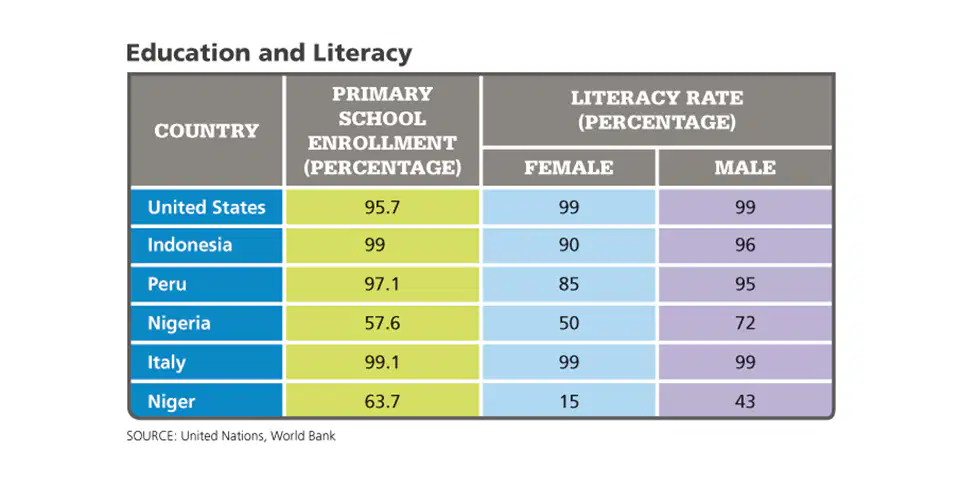
According to data in the table, in which two countries would you expect to find women in highly productive roles in the workforce?
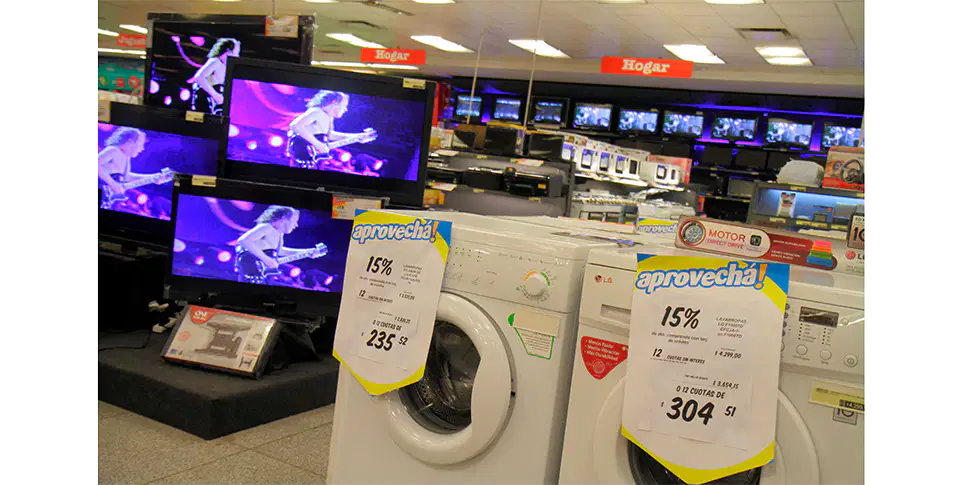
What do you see in this photo of an appliance store in Argentina that indicates the country's level of development?
The store has a clean showroom.
The store sells a variety of consumer goods.
The country has a local television station.
The country has an appreciation for culture such as music.

This flower farm in Ecuador illustrates which key characteristic of globalization?
Global export systems are fast enough to transport highly perishable goods.
Ecuador's currency, the U.S. dollar, is traded on foreign exchange markets.
More than one color of rose is available on international markets.
Women are employed in an international export business.
he decision to build production facilities in a foreign country benefits both the multinational and the host nation.
Which of the following statements BEST explains the above claim?
A multinational benefits from gaining political power, and the host nation benefits from increased tariffs
A multinational benefits from cheaper labor, and the host nation benefits from gaining jobs and tax revenue
multinational benefits from avoiding some shipping fees, and the host nation benefits from driving out weak domestic industries.
A multinational benefits from avoiding some tariffs, and the host nation benefits from low wages for its workers.
Marta can either produce four backpacks or two lamps in an hour. Robin can either produce six backpacks or two lamps in an hour.
In the above scenario, who has an absolute advantage in making backpacks, and what is that person’s opportunity cost for producing one lamp?
Marta has an absolute advantage in making backpacks; opportunity cost is one backpack
Marta has an absolute advantage in making backpacks; opportunity cost is two backpacks.
Robin has an absolute advantage in making backpacks; opportunity cost is three backpacks
Robin has an absolute advantage in making backpacks; opportunity cost is four backpacks
Computerization has allowed investors around the world to watch the values of stocks in many different markets. They move quickly to buy the stock of promising companies in whatever country they find them—and sell just as quickly at any sign of trouble.
The text above is a description of the effect of
the FOREX
globalization
comparative advantage
foreign direct investment

What key aspect of U.S. exports to China and other foreign countries does this poster illustrate?
The U.S. has a growing trade deficit with China.
One of the strongest U.S. exports is technologically sophisticated goods.
The U.S. exports pop culture through music, television shows, and movies.
Some U.S. exports provide goods that an importing country couldn't produce alone.

A United Auto Workers labor union member puts this bumper sticker on his car. This bumper sticker reflects a protectionist view because it shows that
he believes the American military is weakened when imports increase.
he believes that American cars are of higher quality than foreign cars.
he doesn't want foreign companies to invest in the United States.
he wants to support American companies and protect jobs in the United States.
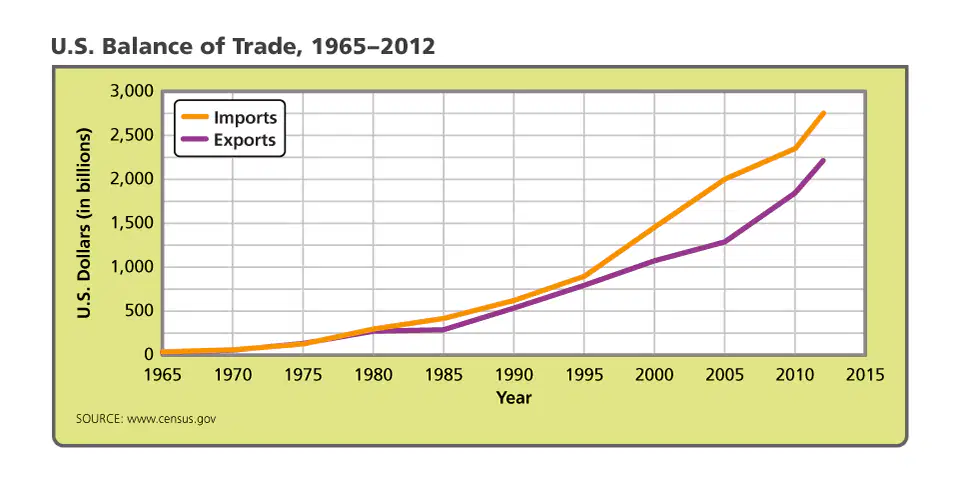
According to this graph, in what year was the U.S. trade deficit largest?
2000
In the global economy, companies may move parts of their operations to other countries. This practice is known as
offshoring
franchising
telemarketing
foreign portfolio investment
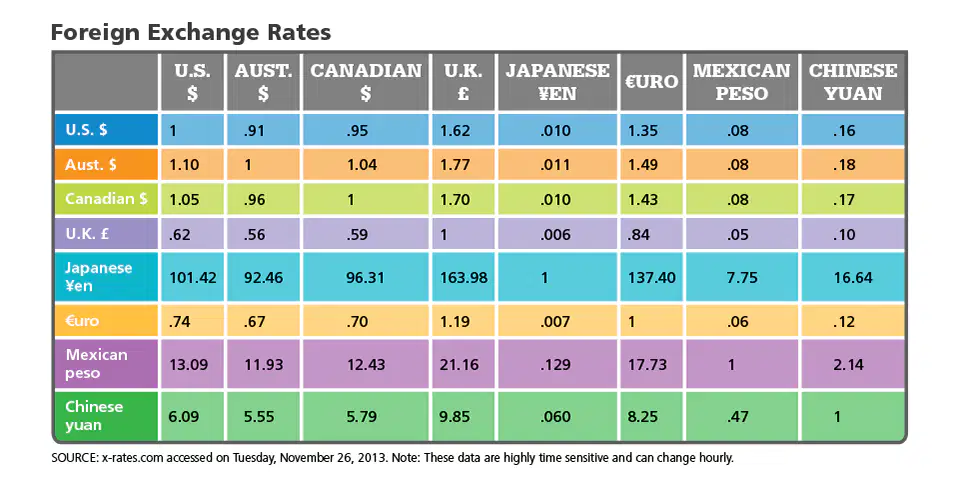
In which place would a Mexican tourist need the most pesos to buy the local currency?
a country in the EU
United Kingdom
United States
Canada
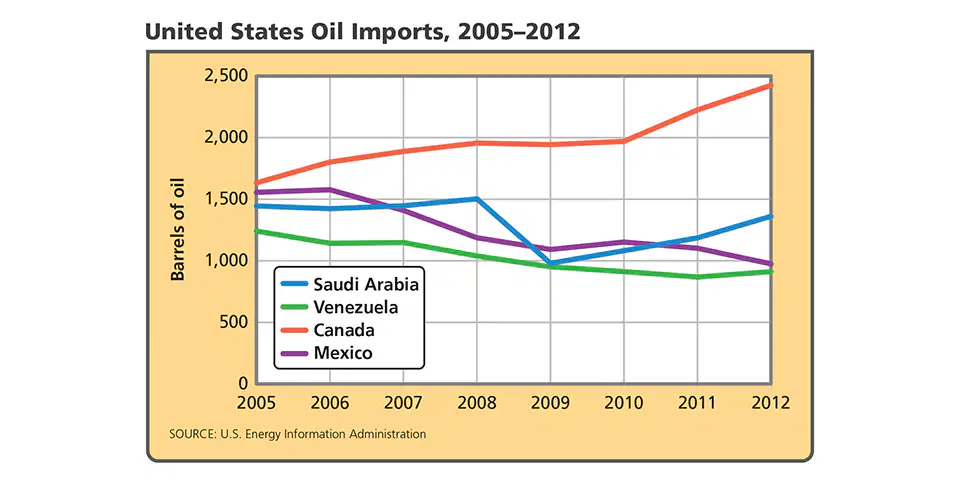
According to this graph, which country has seen its exports of oil to the United States grow the most over the time period shown?
The United States limits the annual amount of raw cotton coming into the country from other nations. This is an example of
a licensing fee
an embargo
a VER
an import quota

Which criticism of multinationals located in LDCs does this photo BEST illustrate?
Multinational profits go to foreign owners.
Multinationals drive traditional craft workers out of business.
Multinationals create few jobs because many industries are highly mechanized.
Multinationals can gain political influence in an LDC because they are so large and wealthy.
A nation may impose trade barriers and other economic sanctions for political reasons. Sanctions are actions a nation or group of nations takes in order to punish or put pressure on another nation.
According to the definition above, which of the following is an example of a sanction?
The United States bans imported fruit treated with certain pesticides.
The United States prohibits investment in Iran.
The United States will not import cars without catalytic converters.
Citizens in Thailand protest passage of a free trade agreement with the European Union.
Tariffs on all farm products and on some 10,000 other goods were eliminated over 15 years.
Some auto tariffs were eliminated immediately while others were phased out in periods of five to ten years.
Trucks were to have free access across borders and throughout the three member countries.
These developments were the result of which trade agreement?
ASEAN
CAFTA
MERCOSUR
NAFTA
What must workers in the United States do to remain competitive in a global economy?
start their own companies
continually advance their skills and education
earn as much money as possible
reduce their carbon emissions
Country A can produce 10 cars or 20 computers. Country B can produce 6 cars or 9 computers. Which country has a comparative advantage in cars, and which has a comparative advantage in computers?
The concept of comparative advantage explains why
only the most productive countries gain from trade
even less efficient producers can benefit from trade.
trade always harms workers
countries should produce everything they need
A country that can produce a good with the lowest opportunity cost should
What happens when a country imposes high tariffs on imported goods?
Consumers benefit from lower prices
Domestic producers face more competition
Consumers pay higher prices and have fewer choices
The quality of goods automatically improves
Who benefits the most from a protective tariff in the short run?
domestic producers
domestic consumers
foreign exporters
the World Trade Organization
How can an embargo affect consumers in the country imposing it?
They gain access to more goods
Prices decrease as imports increase
They may face shortages or higher prices on restricted goods
It has no effect on consumers
What is a potential long-term downside of subsidies?
They make producers too dependent on government support
They reduce domestic production
They eliminate consumer choice
They decreased producer profits
How might trade standards act as a non-tariff barrier?
They restrict imports that don’t meet certain requirements
They encourage imports
They increase production efficiency
They reduce regulations on trade
What is the primary goal of ASEAN?
To eliminate all trade barriers worldwide
To restrict trade with the United States
To compete with the European Union militarily
To promote regional economic cooperation among Southeast Asian countries
What countries are part of the USMCA trade agreement?
United States, Mexico, and Argentina
United States, Mexico, and Canada
United States, Canada, and Brazil
United States, Chile, and Mexico
What is the main role of the World Trade Organization (WTO)?
To enforce military sanctions
To manage oil production among members
To create tariffs for developing countries
To monitor and promote free trade among member countries
How can subsidies help domestic producers in the short run?
They increase competition from foreign firms
They raise the costs of production
They make domestic goods cheaper and more competitive
They discourage exports
Over time, trade barriers may hurt producers because:
They protect domestic competition
They reduce incentives to innovate
They make foreign products cheaper
They eliminate market power
An embargo is
a tax on imports
a total ban on trade with another country
a limit on exports
a safety requirement
Which of the following is a benefit Georgia receives from international trade?
increased dependence on agriculture only
reduced demand for port services
job creation through shipping, logistics, and multinational corporations
decreased state revenue
Which Georgia port is one of the fastest-growing container ports in the U.S.?
Charleston
Miami
Savannah
Atlanta
The Port of Brunswick specializes in:
containerized cargo
automobiles and heavy machinery
agricultural exports
oil and gas
The Northeast Inland Port (Appalachian Regional Port) helps Georgia by
Reducing truck traffic and improving freight efficiency
Eliminating the need for rail service
Reducing the number of multinational corporations
Increasing trade barriers
Which is an example of a multinational corporation with a strong presence in Georgia?
Nike
Coca-Cola
Toyota
IKEA
All of the following corporations are headquarted in Georgia EXCEPT
UPS
Delta
Chick-fil-A
New Balance
An exchange rate is best defined as:
the amount of money the government prints
the tax charged on imports
the value of one nation's currency in terms of another
the price of a country's exports
Which of the following can cause a currency to appreciate?
lower interest rates
decreased foreign demand for that country's goods
Increased demand for that country’s currency
High inflation
If the U.S. dollar appreciates, what happens to American exports?
They become cheaper for foreigners
They become more expensive for foreigners.
Export levels rise
Trade deficits shrink.
f the U.S. dollar depreciates, American consumers are likely to experience:
cheaper imports
more expensive imports
lower export demand
stronger currency buying power
A weak (depreciated) U.S. dollar generally benefits:
A strong (appreciated) U.S. dollar generally benefits:
If Japanese yen depreciates relative to the U.S. dollar, what happens to U.S. imports from Japan?
If the British pound appreciates relative to the U.S. dollar, who benefits?
Americans traveling to London
British consumers buying U.S. goods
British importers of U.S. products
American exporters selling to Britain

