
 Worksheets
Biology Genetics Assessment
Total questions: 12
Worksheet time: 6mins
How many chromosomes will each daughter cell have after the final step of meiosis? Enter your numerical answer in the box.
15
23
30
46
Cystic fibrosis is an autosomal recessive disorder in humans. What is the probability that an offspring will have cystic fibrosis if both parents are carriers of the disorder?
25%
50%
75%
100%
How is it possible that offspring from the same parents express different traits?
The chromosomes from the parents are inherited together before they express specific characteristics.
The chromosomes that are inherited by the offspring mutate after they arrive in the cells.
Each potential offspring generates its own genes as it goes through development.
Independent assortment varies which alleles are inherited each time fertilization takes place.

What is the probability of albinism in the offspring of a cross between two mice with AaBb alleles?
1/16
3/16
4/16
9/16
Offspring look different from their parents because they have different genes. These genes are assigned randomly during the process of meiosis. A student wrote the sentences shown here to explain this phenomenon but was unclear on how the process worked. Some sentences are correct, and others are incorrect. Which TWO sentences are incorrect?
Crossing-over produces new combinations of alleles on each chromosome.
In anaphase I of meiosis, each replicated chromosome pairs with its corresponding homologous chromosome.
This pairing forms a structure called a tetrad, which contains six chromatids.
In this way, crossing-over works to increase genetic diversity in populations of sexually reproducing organisms.
Crossing over occurs during prophase I of meiosis and leads to genetic variation.
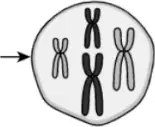
Which process occurs between Step 2 and Step 3 and creates more genetic diversity in the resulting cells?
Chromosome nondisjunction
Genome replication
Crossing over
Chromosomal deletion
Classical albinism is the result of a recessive allele in humans. A population shows that approximately half of the members do not express albinism and the other half expresses albinism. What would the genotypes of the parents have to be to produce these results?
Heterozygous; homozygous dominant
Homozygous recessive; homozygous dominant
Heterozygous; homozygous recessive
Heterozygous; heterozygous
Two traits are inherited independently. If both parents are heterozygous for both traits, resulting in a total of 2,560 offspring, how many of these offspring would be heterozygous for at least one of the genes?
160
480
1,440
1,920
Gametes produced by an organism contain a combination of genes from that organism. In every gamete, this combination is -
the same because it is created from the same DNA
the same because chromosomes are copied prior to meiosis
different due to DNA replication prior to mitosis
different due to independent assortment during meiosis
In tomatoes, red fruit (R) is dominant to yellow fruit (r), and tall plants (T) are dominant to short plants (t). Which of the following statements are true if the parents are heterozygous for both traits?
The parental genotypes are RRTT.
The parental genotypes are RrTt.
The parents are both red and short.
All the offspring will be red and short.
The phenotypic ratios of the offspring will be 9:3:3:1.
If a person who is homozygous dominant has children with a person who is homozygous recessive, what percentage of their children will likely have achondroplasia?
100
0
25
50
Fill in the blank: The genotype for a Silver angelfish is _____.
LL
Ll
ll
lL

