
 Worksheets
6th Test in Bio
Total questions: 23
Worksheet time: 12mins
Zoe is studying how certain organisms reproduce. She learns about a type of cell division that leads to the production of reproductive cells. Which of the following describes a common outcome of this process?
Replacing liver cells after surgery
Production of spores in fungi
Prevention of mutations in somatic cells
Formation of diploid cells
Evelyn is studying how cells divide to form eggs and sperm in animals. She wants to know which process is most important for producing haploid cells during this division. Which process should Evelyn focus on?
Mitosis
Reduction division
Independent assortment
Crossing over
Grace has a garden where she grows different types of flowers from seeds collected from the same parent plants. The flowers that bloom are different in color and pattern, even though they come from the same parents. Which of the following statements explains how the process of meiosis contributes to the flowers' differences?
Genetic material is mixed in the final phase
Gametes have the same genetic material as a parent cell
Diploid cells produced have a copy of all the parents' genetic material
Genetic traits are separated during the formation of haploid cells
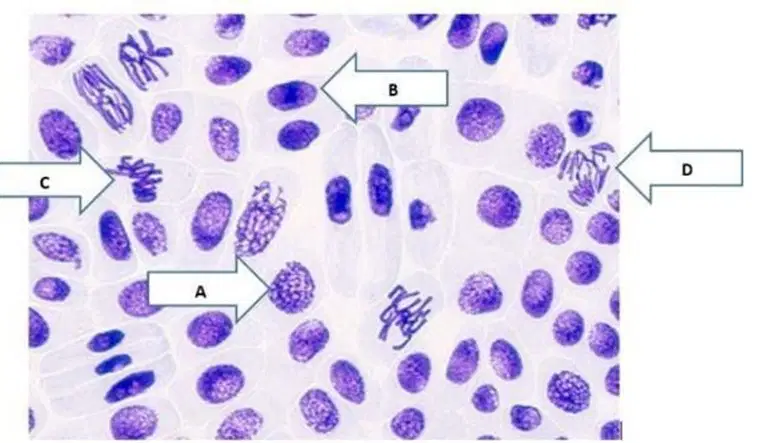
Grace is working in a biology lab and observes a microscopic image of plant cells going through different phases of mitosis. She labels the cells as A, B, C, and D. Which phase is correctly identified and justified?
The condensed chromatin indicates that A is prophase
The presence of a nucleus indicates that B is anaphase
The missing nuclear envelope indicates that C is metaphase
The separation of sister chromatids indicates that D is telophase
During interphase, Mason's muscle cell is determined to contain damaged mitochondria. What will most likely happen to this cell?
The defective cell will proceed through GAP1 and GAP2 but be destroyed during mitosis
The problem will be corrected during the synthesis phase, then the cell will continue to divide through mitosis
The problem cell will be detected during the S-phase of the cell cycle and the cell destroyed
The defective cell will most likely be detected during GAP1 and removed from the cell cycle
Olivia is studying how bacteria and mice reproduce. She learns that bacteria reproduce asexually, while mice reproduce sexually. Which statement correctly states why one type of reproduction is beneficial over the other?
Asexual reproduction creates offspring that have a variety of traits
Sexual reproduction produces organisms that are genetically diverse
Asexual reproduction produces offspring genetically different from the parents
Sexual reproduction can produce many offspring very quickly
Charlotte is a scientist working in a laboratory. She wants to increase the chance of pregnancy in mice by using hormone shots to increase gamete production. Which of the following statements justifies the process the mouse cells went through after the hormone was administered?
Mitosis, because daughter cells genetically identical to the parent cell are needed for reproduction
Meiosis, because the cells produced need to be diploid rather than haploid
Meiosis, because haploid cells are needed for reproduction
Mitosis, because the cells will be produced faster
Charlotte is studying how cancer develops in cells. She learns that cancer is the uncontrolled growth of cells. Which of the following would be most likely to cause cancer?
Transcription of mRNA
Mutations in proteins that regulate the cell cycle
Crossing over during synthesis
Normal cells touching cancerous cells
Ava visits her doctor and learns that she has a mutation in her p53 gene. This mutation prevents her damaged cells from being destroyed during the cell cycle. This mutation would increase the likelihood of which condition?
crossing over
replication
mitosis
cancer
Abigail is studying how pancreatic cancer affects cell survival rates. She learns that patients with pancreatic cancer have a 12% chance of surviving for 5 years after diagnosis, but this can change depending on how early the disease is detected. Abigail wonders: where in the cell cycle would these cancerous cells have been removed if things were functioning properly?
Cytokinesis
GAPs 1 and 2
Mitotic division
Synthesis
A group of 4 students wants to design an experiment in an effort to support the hypothesis, "Sunlight is needed for the normal healthy growth of plants." Each student presents a possible experimental procedure as shown below.
Student #1: Purchase 20 plants. Select 10 plants. Place each in a cup containing 350 grams of soil. Place all the cups in the sun. Take the other 10 plants and place each in a cup containing 250 grams of soil. Place this group under a box. Observe and document changes.
Student #2: Plant 20 plants in pots. Place 10 of the plants outside in the sunlight. Place the other 10 plants outside under a box. The same amount of soil and water must be used. Document your observations.
Student #3: Place 20 plants in a container in front of a window. Give all the plants the same amount of water and the same type of soil. Observe plants for any changes.
Student #4: Obtain two seeds. Place one seed outside and one on an inside windowsill. Both seeds should be exposed to sunlight. Observe and document which seed sprouts the fastest.
Which student provides the best reason for choosing his or her experiment to test the hypothesis?
Student #1: "The plants will react differently in different amounts of soil"
Student #2: "Also included are 10 plants that are placed under a box"
Student #3: "All plants are placed in the sun"
Student #4: "Seeds grow into plants, so if the seeds are healthy, then the plants will also be healthy"
A group of 4 students wants to design an experiment in an effort to support the hypothesis, "Sunlight is needed for the normal healthy growth of plants." Each student presents a possible experimental procedure as shown below.
Student #1: Purchase 20 plants. Select 10 plants. Place each in a cup containing 350 grams of soil. Place all the cups in the sun. Take the other 10 plants and place each in a cup containing 250 grams of soil. Place this group under a box. Observe and document changes.
Student #2: Plant 20 plants in pots. Place 10 of the plants outside in the sunlight. Place the other 10 plants outside under a box. The same amount of soil and water must be used. Document your observations.
Student #3: Place 20 plants in a container in front of a window. Give all the plants the same amount of water and the same type of soil. Observe plants for any changes.
Student #4: Obtain two seeds. Place one seed outside and one on an inside windowsill. Both seeds should be exposed to sunlight. Observe and document which seed sprouts the fastest.
What should the students include that will increase the credibility of their experiment?
Information about solar energy
Different amounts of water
Criteria for what is normal healthy plant growth
Inclusion of seeds in all experiments

The work of Karl Von Frisch reveals some interesting information about honeybees. Some of the bees leave the hive to search for food. When these bees return to the hive, they are observed performing turns or dancing on the surface of the honeycomb. The graph below shows the relationship between the number of turns the scout honeybees make and the distance from the hive to a food source. What can be inferred from the results of this experiment?
Bees have nerves
Bees can dance
Bees eat honey after dancing
Bees communicate with each other
Emma is observing cell division under a microscope in her biology class. She notices that certain structures are responsible for separating the genetic material during mitosis. What is the role of microtubules during mitosis?
They pair up during metaphase
They pull apart sister chromatids
They form homologous chromosomes
They develop into a cell membrane
Ava is observing cells under a microscope in her biology class. She notices that after mitosis, two cells, each with a nucleus, are formed. Many cell structures are involved in this process. Which of the following best describes the role of a cell structure involved in mitosis?
The cytoplasm pulls the nucleus apart
The cytoskeleton builds the cell membrane
The nuclear envelope breaks down to release chromosomes
The cell membrane aligns the chromatids in the middle of the cell
Anika is studying how cells function in the human body. She learns that cells go through different stages during their life, which are illustrated by the cell cycle model. Which of the following accurately describes a stage of the cell cycle?
Crossing over happens during mitosis
Normal functions occur during interphase
Damaged cells are removed from the cycle during synthesis
Cells produced during Gap 1 have chromosomal variations
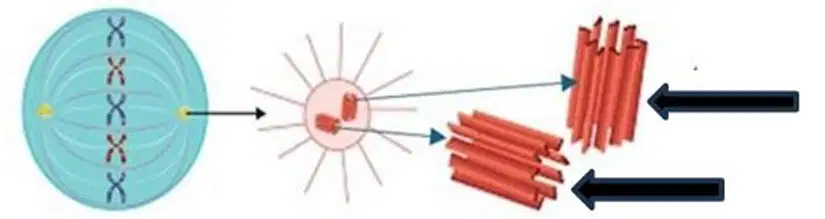
Luis was helping his teacher prepare onion root tip slides for a school science fair. While observing the slides under a light compound microscope, he noticed dividing cells and drew the following image in his science notebook. Luis included arrows pointing to specific cell structures. What are these structures?
Chromosomes
Centrioles
Chromatin
Emma is studying cell division in her biology class. She learns that meiosis and mitosis have different stages with some similarities and differences. What distinguishes Prophase I during meiosis from Prophase during mitosis?
During meiosis Prophase I, chromatin moves to the central plane of the cell.
During meiosis Prophase I, chromatin condenses and shortens.
During meiosis Prophase I, crossing over occurs.
During meiosis Prophase I, spindle fibers separate the cells formed.
Lucas is learning about cell division in his biology class. He discovers that errors in the cell cycle can lead to diseases. Which of the following best describes what happens if a cell bypasses the checkpoints in the cell cycle?
The cell may divide uncontrollably and form a tumor
The cell will always become a stem cell
The cell will stop functioning and die immediately
The cell will produce more mitochondria
Sophia is studying the differences between mitosis and meiosis. She wants to know which process is responsible for maintaining genetic stability in somatic cells. Which process should she focus on?
Independent assortment
Mitosis
Crossing over
Meiosis
Henry observes that some plants in his garden have unusual growths. He learns that these growths are caused by cells dividing without control. Which of the following is most likely responsible for this uncontrolled cell division?
Proper functioning of cell cycle checkpoints
Mutations in genes that regulate cell division
Normal DNA replication
Balanced hormone levels
Jacob wants to test the hypothesis that water is essential for plant growth. He sets up two groups of plants: one receives water daily, and the other does not receive any water. What should Jacob do to ensure his experiment is reliable?
Keep all other conditions the same except for water
Measure only the height of the plants
Use different types of plants in each group
Change the amount of sunlight for each group
When studying honeybee behavior, researchers notice that bees use specific movements to share information about food sources. What does this suggest about honeybee communication?
Bees do not interact with each other
Bees rely only on scent to find food
Bees communicate only through sound
Bees use physical signals to convey messages

